
Advanced Tactics for Winning on Customer Satisfaction in GovTech
In GovTech, customer satisfaction hinges on how well technology solves real-world problems. Here’s how to align modernization with user needs.
1. Audit Pain Points First
Conduct structured interviews with end-users (e.g., government clerks, citizens). Create a “pain matrix” ranking issues by frequency and severity. Common pain points: slow load times (>3s), complex workflows, data entry errors. Use this to prioritize which features to rebuild or retire.
2. Choose Scalable Frameworks
Select frameworks that support incremental adoption. Next.js is a strong choice for GovTech because it offers server-side rendering (improving perceived speed) and static site generation (for compliance-heavy pages). Tip: Start with a single high-friction module (e.g., a permit application flow) as a pilot before full migration.
3. Plan Data Migration Carefully
Downtime in government services erodes trust. Follow these steps:
- Map all data dependencies and create a rollback plan.
- Use phased migration (e.g., move read-only data first, then write operations).
- Run parallel systems for at least one billing cycle to catch discrepancies.
- Automate validation checks (e.g., record counts, hash comparisons) post-migration.
Quick Checklist:
- [ ] Pain points documented and prioritized
- [ ] Pilot module chosen
- [ ] Data migration timeline with rollback
- [ ] Parallel run scheduled
By tackling technology upgrades with user needs as the compass, you not only improve satisfaction but build a defensible competitive moat.
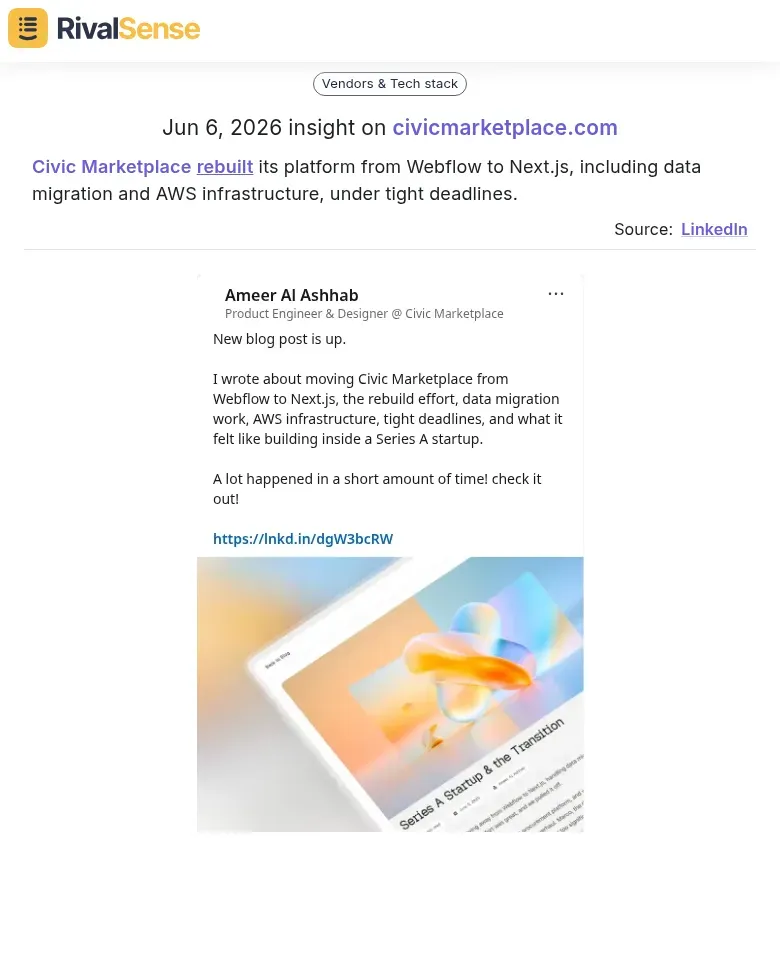
RivalSense Insight: Civic Marketplace rebuilt its platform from Webflow to Next.js, including data migration and AWS infrastructure, under tight deadlines.
Why this matters for your strategy: Monitoring a competitor’s tech overhauls reveals their commitment to performance, scalability, and modern user experiences. This early signal lets you benchmark your own roadmap, anticipate feature leaps, and spot potential vulnerabilities during their transition.
Strategic Event Participation to Gather Customer Insights
Industry conferences are goldmines for understanding competitor customer satisfaction in GovTech. Attend key events (e.g., NASCIO, Gartner IT Symposium) and network with decision-makers. Use structured conversations: ask about their top challenges and what solutions they wish existed.
Host exclusive events—like invitation-only breakfasts or roundtables—where candid feedback flows freely. Create a safe space by promising anonymity and focusing on industry pain points, not specific vendors. Listen for recurring themes about competitor strengths and weaknesses.
Pro Tip: Prepare a checklist before each event:
- Define target personas (e.g., CIOs, procurement leads).
- Draft 5 non-obvious questions (e.g., "What feature would make you switch vendors?")
- Assign a note-taker to capture verbatim quotes and sentiment.
Use these interactions to map satisfaction drivers (e.g., reliability, ease of integration) and barriers (e.g., poor support, long procurement cycles). Post-event, synthesize insights into a competitive intelligence brief.
Action Step: Within 48 hours, categorize feedback into "drivers" and "barriers" and share with your product team to inform roadmap priorities.
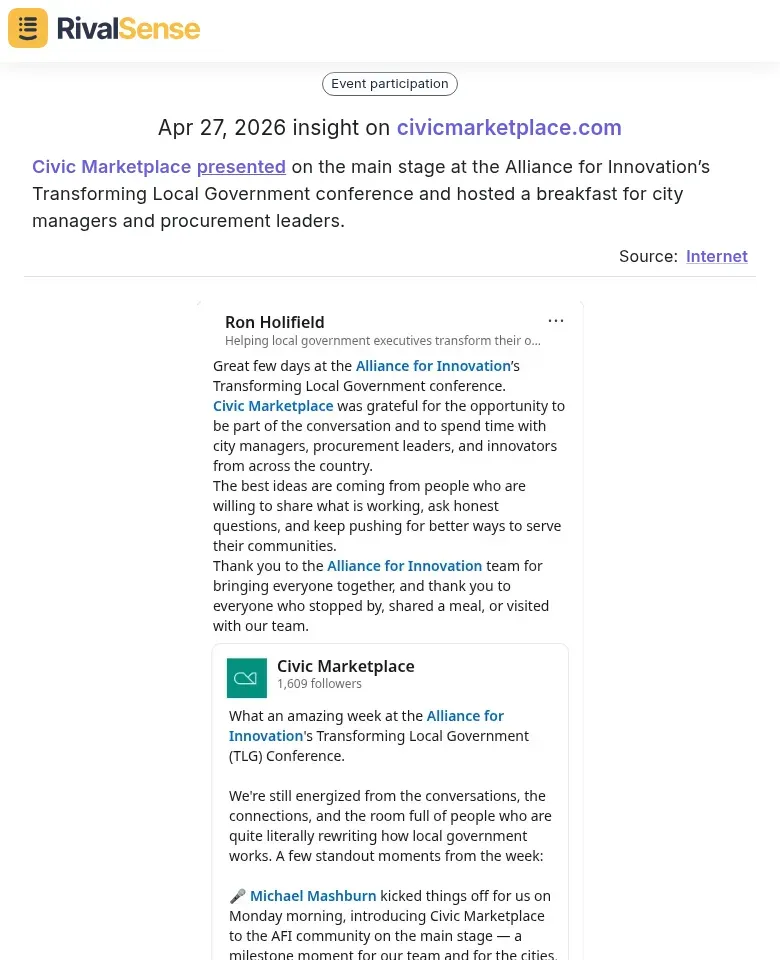
RivalSense Insight: Civic Marketplace presented on the main stage at the Alliance for Innovation’s Transforming Local Government conference and hosted a breakfast for city managers and procurement leaders.
Why this matters for your strategy: A competitor’s event footprint uncovers their go-to-market priorities and the audiences they’re cultivating. Tracking these appearances helps you identify which relationships they’re building, what thought leadership angles they’re pushing, and where you might need to strengthen your own presence.
Investing in Customer-Facing Roles for Enhanced Satisfaction
To truly outpace competitors in GovTech, invest in specialized customer-facing roles that bridge the gap between your product and the unique needs of public sector clients. A prime example is a Supplier Enablement Manager—a role dedicated to helping government buyers navigate procurement, onboarding, and compliance.
Practical Steps to Implement:
- Define the Role Scope: Map customer lifecycle stages (e.g., procurement, implementation, renewal) and assign ownership to specific roles. For GovTech, this might include a Procurement Liaison for RFP responses, an Implementation Specialist for deployment, and an Account Executive for renewals.
- Empower with Real-Time Feedback Loops: Equip these roles with tools (e.g., CRM integrations, Slack channels) to escalate and act on customer feedback within 24 hours. Example: If a city IT manager reports a compliance hurdle, the Supplier Enablement team can immediately update documentation or adjust workflows.
- Hire for Adaptability & Government Acumen: Look for candidates with experience in public sector workflows or regulatory environments. Prioritize soft skills like empathy and problem-solving over pure technical expertise.
Checklist for Success:
- [ ] Role descriptions tied to specific lifecycle stages
- [ ] Feedback-to-action SLA ≤ 24 hours
- [ ] Monthly cross-functional syncs to share customer insights
By aligning hires with customer journeys, you turn every touchpoint into a satisfaction driver—and a competitive moat.
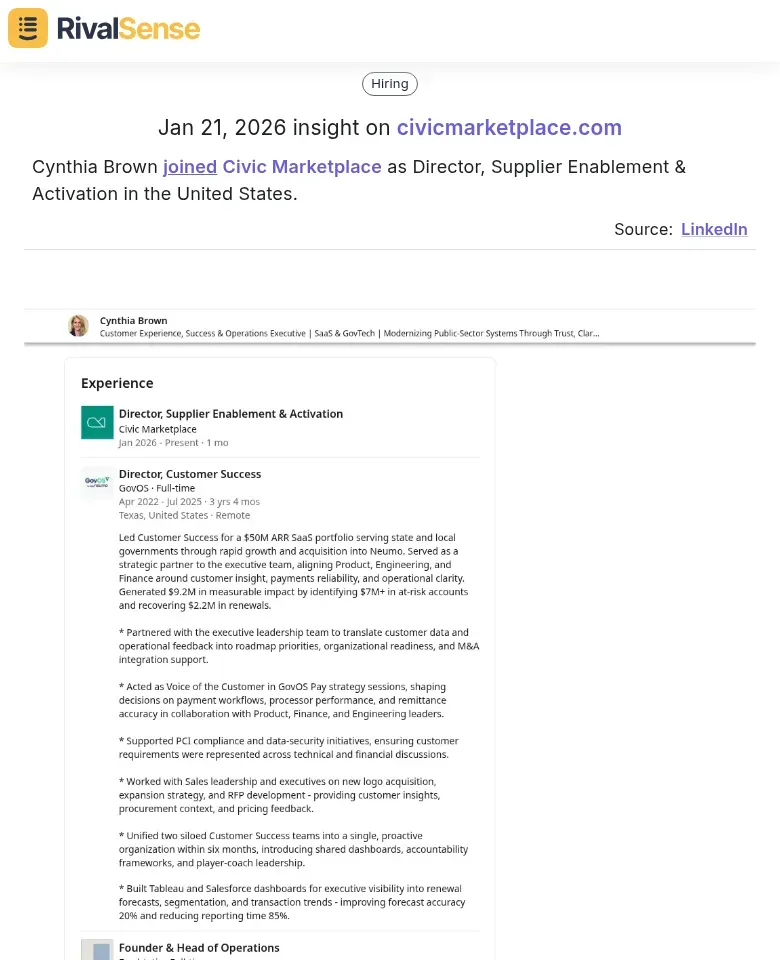
RivalSense Insight: Cynthia Brown joined Civic Marketplace as Director, Supplier Enablement & Activation in the United States.
Why this matters for your strategy: New customer-facing hires signal where a competitor is doubling down on experience, onboarding, or retention—often well before product changes appear. Tracking these moves helps you anticipate shifts in service quality and adjust your own talent strategy accordingly.
Ensuring Seamless Customer Experience During Platform Migrations
For GovTech leaders, platform migrations are high-stakes transitions that can make or break customer trust. Here’s how to ensure a seamless experience:
1. Communicate Transparently
- Share a clear migration timeline at least 60 days in advance, detailing each phase (e.g., data migration, testing, go-live).
- Use a simple visual roadmap with milestone dates and expected downtime windows. Send weekly email updates and host optional Q&A webinars.
- Be upfront about potential service impacts: “During the 48-hour migration window, reporting features will be unavailable; core compliance functions remain online.”
2. Provide Hands-On Training
- Create role-specific training paths (admin, end-user, IT). For example, deliver short video tutorials (<3 minutes) for common tasks.
- Offer a sandbox environment where customers can practice before go-live. Include a “Day 1 Quick Start” checklist: login, explore dashboard, run first report, test key workflow.
- Provide downloadable cheat sheets and a searchable knowledge base with FAQs.
3. Offer Dedicated Transition Support
- Assign a dedicated migration coordinator for each customer segment. Set up a hotline and a Slack/digital channel for real-time issue resolution.
- Establish a severity-based escalation matrix: critical (system down) → <1 hour response; high (feature blocked) → <4 hours; medium (question) → <24 hours.
- After migration, follow up at 7-, 30-, and 90-day marks with a satisfaction survey and a checklist of follow-up actions.
By treating migrations as a partnership, you turn a potentially disruptive event into a loyalty-building experience.
Building Trust Through Thought Leadership and Engagement
To build trust in GovTech, move beyond product demos and establish your organization as a thought leader. Here’s how:
1. Own the Main Stage
Submit session proposals to key events like NIST’s Cybersecurity Summit or NASCIO conferences. Focus on topics such as ‘Modernizing Legacy Systems Without Disruption’ or ‘Integrating Zero Trust in State Agencies.’ Include a case study showcasing measurable outcomes (e.g., ‘30% faster procurement processing’).
2. Share Actionable Insights
Publish quarterly reports on emerging trends (e.g., AI in public safety, digital equity). Use a three-part structure: (a) Trend analysis with data, (b) Implications for agencies, (c) Practical steps to adopt. Distribute via GovTech-focused newslists and LinkedIn groups.
3. Foster Ongoing Dialogue
Create a private community (e.g., Slack group or invite-only webinars) for agency leaders. Host monthly ‘Office Hours’ where your experts answer operational questions. Send a Friday briefing with curated news and a ‘Tip of the Week’ (e.g., ‘How to draft an RFP for interoperable cloud solutions’).
Checklist for Success:
- ☐ Map key events 6 months ahead and submit proposals
- ☐ Prepare 1-page insight briefs for each trend report
- ☐ Assign a team member to moderate the community daily
- ☐ Gather feedback via quarterly satisfaction surveys to refine content
This approach positions you as a partner invested in their mission, not just a vendor—turning trust into long-term contracts.
Creating a Feedback Loop for Continuous Improvement
To build a feedback loop that drives continuous improvement in GovTech, start by scheduling monthly check-ins with key customer stakeholders. Use a standardized satisfaction survey (e.g., CSAT or NPS) to track trends over time. Pro tip: Pair quantitative data with 15-minute qualitative calls to uncover ‘why’ behind scores.
Next, mine insights from industry events, webinars, and user groups. Assign a team member to log recurring themes and pain points from these interactions. Create a shared repository (e.g., a CRM or Airtable) where every customer touchpoint is recorded and tagged by topic.
Finally, close the loop by prioritizing feedback into your product roadmap. Use a structured triage process:
- Categorize feedback (bug, feature request, usability).
- Score by impact and effort.
- Assign to sprint cycles.
Checklist for your feedback loop:
- [ ] Monthly CSAT/NPS survey sent
- [ ] Quarterly customer advisory board meeting
- [ ] Post-event feedback summary shared with product team
- [ ] Feedback repository updated weekly
- [ ] Top 3 customer requests baked into next release
Iterate not only on features but also on the feedback process itself—review its effectiveness every quarter. This systematic approach ensures you continuously refine your GovTech solution based on real user needs, not assumptions.
Keeping tabs on competitor moves like platform migrations, event strategies, and key hires is essential to staying ahead. With RivalSense, you get those insights delivered in a single weekly report, freeing you to act rather than search. Try RivalSense for free and get your first competitor report today.
📚 Read more
👉 Advanced Tactics: Turning Regulatory Intel into Customer Service Wins
👉 How to Decode Competitor Funding Events Like Civinity’s €13.54M Bond Issuance
👉 Competitor Financial Analysis: How to Decode Your Rivals' Financial Health
👉 Key Account Manager Responsibilities: Actionable Telecom Strategies
👉 How One Competitor Used RivalSense to Respond to Nextiva's Pricing Shift