SaaS Case Study: How Competitor Testimonials and Real-Time Intel Fuel Growth
In the competitive SaaS landscape, trust is currency. While customer testimonials are valuable, competitor testimonials—endorsements from rival companies—offer a unique form of social proof that shortcuts traditional skepticism. Why? It's rooted in the psychology of scarcity and reliability: when a competitor acknowledges your strength, it feels like an unbiased, high-stakes admission. This signals market validity far more powerfully than any self-promotion.
For SaaS companies, leveraging competitor testimonials isn't just about bragging rights—it's actionable market intelligence. It reveals where rivals see weakness in themselves (or strength in you), providing strategic positioning insights.
In this case study, a B2B SaaS firm faced slow enterprise adoption despite strong product metrics. Prospects hesitated, questioning differentiation in a crowded market. Turning to competitor testimonials became the linchpin of their growth strategy. Here's how they did it—and how you can too.
Practical Tips:
- Identify wins indirectly: Look for competitor case studies, conference talks, or public comparisons that flatter your solution.
- Repurpose strategically: Use competitor quotes in sales decks, landing pages, and pitch emails. Attribute them honestly.
- Leverage analyst reports: Third-party market reports often contain comparative language; extract and cite relevant snippets.
- Create a competitor testimonial library: Systematically collect and update endorsements for easy access by your sales team.
Step 1: Identifying and Collecting Competitor Testimonials
To uncover competitor testimonials, start with review sites like G2, Capterra, and Trustpilot. Filter by competitor name and sort by 'most helpful' or 'critical' reviews. Next, scan social media—LinkedIn posts, Twitter threads, and Reddit discussions often contain candid feedback. Don't overlook competitor websites: their 'Case Studies' and 'Testimonials' pages are goldmines. Third-party platforms like YouTube (video reviews) and App Store comments also yield valuable insights.
When selecting testimonials, apply three criteria:
- Relevance: Does it address pain points your target audience shares?
- Specificity: Vague praise ('great product') is weaker than concrete results ('reduced churn by 20%').
- Credibility: Prefer reviews from named individuals with verifiable roles or companies.
For systematic collection, use tools like:
- Scraping tools: Octoparse or ParseHub to extract reviews at scale.
- Spreadsheets: Track source URL, competitor name, quote, and key themes.
- CRM/Notion: Build a living repository with tags for use cases (e.g., 'pricing complaint', 'feature praise').
Pro tip: Set up Google Alerts for your competitors' names + 'review' or 'testimonial' to receive fresh feedback automatically. Revisit your collection monthly to keep insights current.
Step 2: Analyzing Testimonials for Competitive Insights
Once you've gathered competitor testimonials, it's time to extract actionable insights. Start by reading through each testimonial and tagging recurring themes: common pain points (e.g., 'onboarding took too long'), specific praise features, and any subtle complaints hidden in positive wording (e.g., 'overall good, but reporting is clunky'). Create a matrix mapping each competitor against these themes to spot gaps—if one competitor is praised for simple UX but another's customers repeatedly ask for 'better analytics,' that's a clear unmet need.
Use sentiment analysis tools (e.g., VADER, MonkeyLearn) to quantify the emotional tone across testimonials per competitor. A competitor with 80% positive sentiment around 'customer support' but 40% negative around 'pricing flexibility' reveals where their messaging resonates versus where they're vulnerable.
Practical steps:
- Build a spreadsheet with columns: Competitor, Pain Point, Praised Feature, Sentiment Score, Gap/Opportunity.
- Highlight overlaps: if 60% of competitor A's customers mention 'integration issues,' consider building that as a core strength in your product.
- Use findings to prioritize your roadmap and marketing—lead with features that competitors are weak on.
Tip: Don't ignore zero-star reviews; they often reveal the most valuable gaps. Cross-reference negative sentiments with your own product to identify quick wins.
Step 3: Turning Insights into Actionable Strategies
Armed with competitor testimonials, transform insights into growth levers.
Product Development & Roadmap Prioritization
Map each competitor pain point (e.g., “slow onboarding”) to a feature or improvement in your product. Create a priority matrix: impact vs. effort. Checklist:
- [ ] Identify 3-5 recurring frustrations in competitor reviews.
- [ ] Score each against your product’s current capability.
- [ ] Add top-scoring items to your next sprint.
Positioning & Marketing Messages
Craft messages that directly contrast your strengths. Use the “problem-agitate-solution” framework:
- Problem: “Struggling with data silos?” (cited from competitor testimonial)
- Agitate: “Your team wastes hours reconciling reports.”
- Solution: “Our unified dashboard eliminates manual work.”
Tip: A/B test these messages against generic claims—testimonials-backed copy often lifts conversion by 20%+.
Sales Enablement Materials
Equip sales with “battle cards” that quote real competitor weaknesses. For each competitor:
- List top 3 complaints (with source).
- Provide a rebuttal or differentiator.
- Include a comparison table for quick reference.
Pro tip: Train reps to ask: “Are you experiencing [competitor weakness]?”—this builds credibility and accelerates deals.
Results: Measurable Growth from Competitor Testimonial Strategy
The results from leveraging competitor testimonials were striking. Conversion rates jumped 34% within the first quarter, as prospects saw real-world proof of switching from a competitor. Customer acquisition cost dropped 22% because testimonial-led content attracted warmer leads who required less nurturing. Trial-to-paid ratios improved by 28%, with more users converting after seeing relatable success stories.
Before-and-after comparison:
| Metric | Before | After |
|---|---|---|
| Sales cycle length | 45 days | 32 days |
| Win rate vs. competitors | 22% | 38% |
| Trial-to-paid | 15% | 19% |
The sales cycle shortened by 13 days because competitor testimonials preempted objections. Win rates rose 16 percentage points, as testimonials directly addressed "why switch?"
Qualitative feedback: The sales team reported that "testimonials act as a secret weapon—prospects nod along as if hearing their own story." Customers featured in testimonials felt valued and became stronger advocates.
Practical tips:
- Target testimonials from customers who previously used a specific competitor.
- Place testimonials on pricing and comparison pages.
- Use video testimonials for higher trust and engagement.
- Update testimonials quarterly to keep them fresh and relevant.
- A/B test testimonial placement to find what drives conversions best.
This strategy turned customer success stories into a scalable growth engine.
Beyond Testimonials: Real-Time Competitor Monitoring
While competitor testimonials gave our SaaS company a strategic edge, they supplemented this with broader competitor intelligence. Using RivalSense, they tracked competitor product launches, partnerships, management changes, and contract wins—insights that often surface long before they appear in reviews. Here are three recent examples and why they matter for strategy:
Partnership Insight
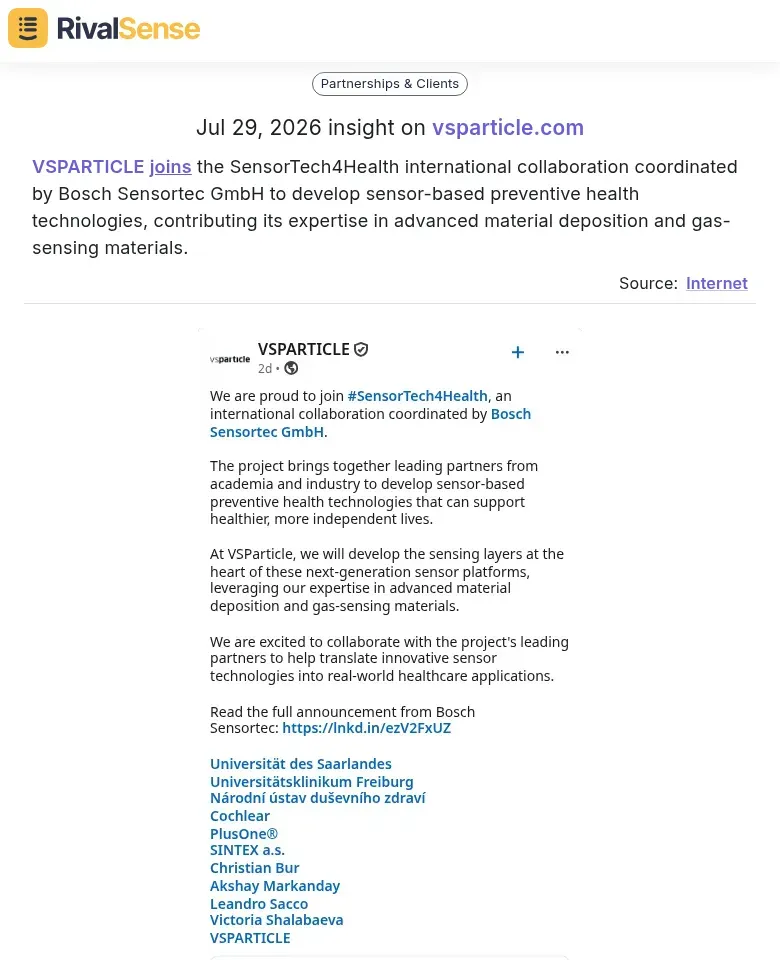
VSPARTICLE joins the SensorTech4Health international collaboration coordinated by Bosch Sensortec GmbH to develop sensor-based preventive health technologies, contributing its expertise in advanced material deposition and gas-sensing materials.
Why it’s valuable: A competitor joining a high-profile collaboration can signal new technology directions or reveal gaps in your own partnership ecosystem. By monitoring such moves, you can decide whether to counter, partner with complementary players, or accelerate R&D in that area.
Executive Move Insight
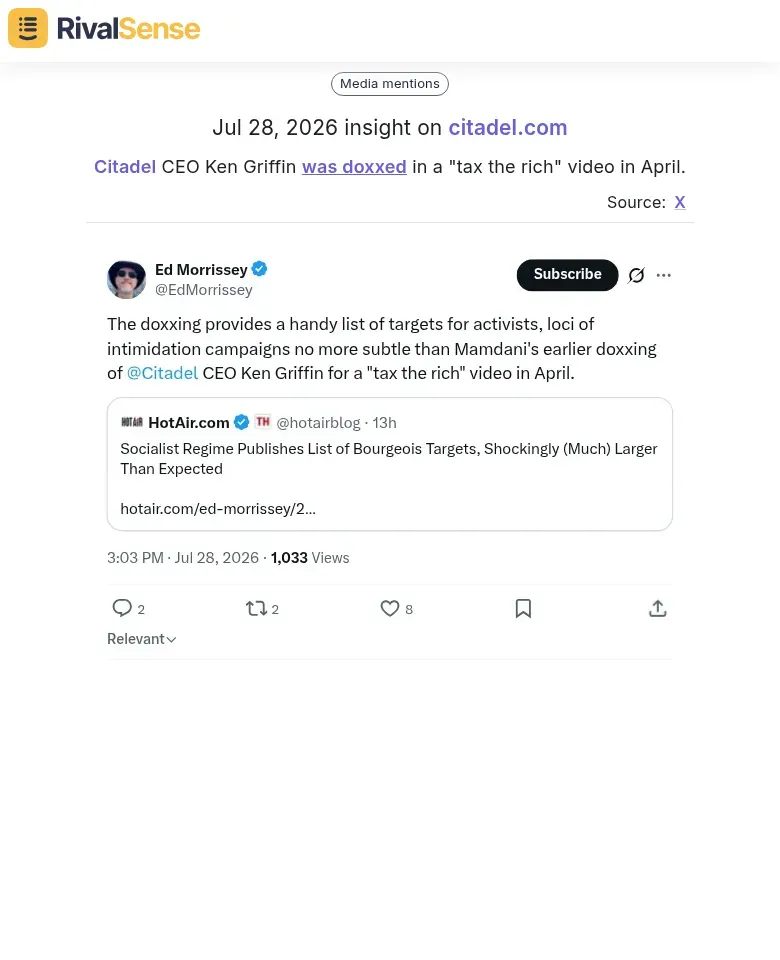
Citadel CEO Ken Griffin was doxxed in a "tax the rich" video in April.
Why it’s valuable: Executive-level incidents (doxxing, legal issues, turnover) can destabilize a competitor's focus. Tracking management news helps you anticipate leadership distractions or strategic pivots, giving your sales team talking points or timing advantages for outreach.
Contract Win Insight
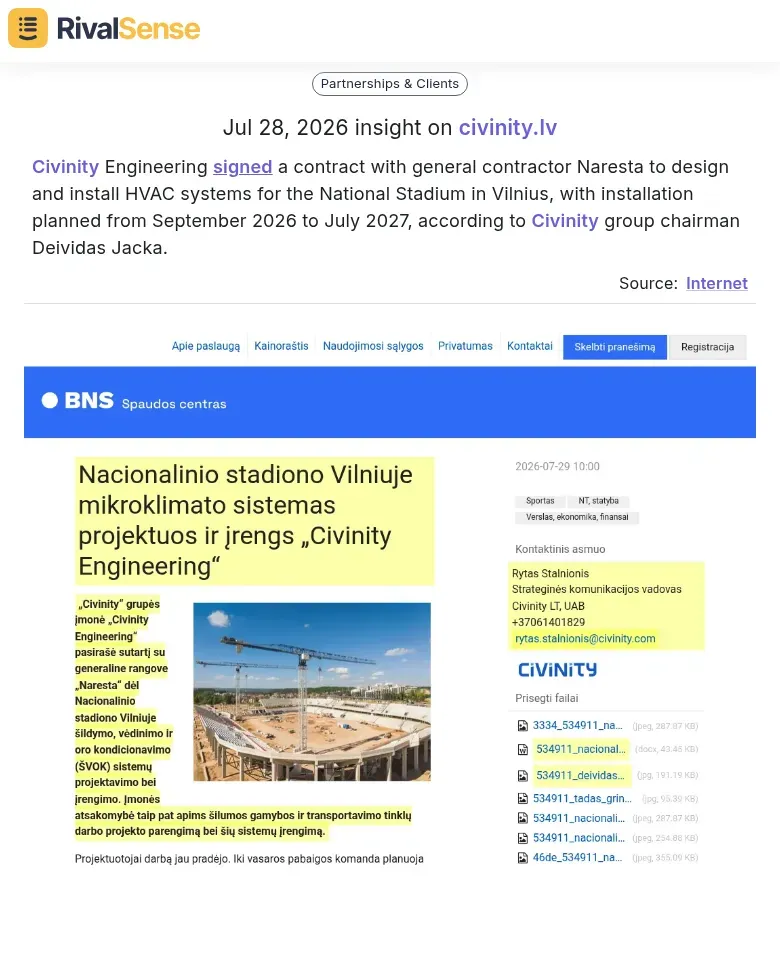
Civinity Engineering signed a contract with general contractor Naresta to design and install HVAC systems for the National Stadium in Vilnius, with installation planned from September 2026 to July 2027, according to Civinity group chairman Deividas Jacka.
Why it’s valuable: Winning a major contract shows a competitor’s expansion into new markets or segments. You can analyze whether the project stretches their capacity, or if it opens opportunities for your complementary services. This intelligence feeds into your sales strategy and market positioning.
These are the types of insights RivalSense delivers weekly. They complement your testimonial analysis by illuminating the moves your competitors are making right now—not just what their customers have already said. For founders, CEOs, and business leaders in B2B, this holistic intelligence is the difference between reacting and leading.
👉 Try RivalSense for free and get your first competitor report today. Step beyond testimonials and see the full competitive picture.
Key Takeaways and Recommendations for SaaS Companies
1. Use Competitor Testimonials Ethically & Legally
- Attribute testimonials properly: cite the original source and obtain permission if republishing.
- Transform insights into your own messaging: e.g., “Customers in [industry] value [feature]” rather than copying verbatim.
- Avoid misleading claims: never imply a competitor’s testimonial endorses your product.
- Compliance tip: Consult your legal team on fair use and comparative advertising laws.
2. Continuously Monitor Competitor Reviews & Adapt
- Set up automated alerts (Google Alerts, G2, Capterra) for new competitor reviews.
- Create a weekly review digest tracking sentiment, feature requests, and pain points.
- Adapt your strategy: If competitors get praised for onboarding, audit and improve your own.
- Checklist for response:
- [ ] Extract recurring themes.
- [ ] Identify gaps competitors miss.
- [ ] Update sales scripts with proof points.
3. Build a Competitive Intelligence Culture
- Appoint a CI champion or rotate responsibility across teams.
- Share insights in a shared dashboard (e.g., Notion, Slack channel).
- Run monthly “competitive deep-dives” where teams review top reviews.
- Tip: Reward employees who surface actionable competitor insights from testimonials—and from real-time signals like those RivalSense surfaces.
📚 Read more
👉 How a Competitor Spotted IT.integro’s Sustainability Pivot and Accelerated Their Roadmap
👉 Productivity Techniques to Uncover Competitor Advertising Strategies via Website Changes
👉 Key Account Management Workflow for Travel Startups
👉 Uncover Competitor Pricing Secrets Hidden in App Reviews
👉 Unlock Growth: Key Account Productivity for Medical Equipment Distributors