
How to Track Competitor Podcast Appearances (2026 Guide)
Podcasts are a goldmine for thought leadership, brand building, and direct access to niche audiences. Your competitors know this — they’re appearing on shows weekly, building authority and relationships. Tracking those appearances gives you a window into their messaging, partnerships, and strategic priorities. Here’s how to systematically monitor competitor podcast activity, and what to do with the intel.
🎯 Why Bother Tracking Competitor Podcasts?
- Messaging intelligence: Hear how they position themselves, what stories they tell, and how they handle objections.
- Partnership leads: Show hosts are often connectors. A competitor’s appearance can lead to partnerships, guests, or customers.
- Content repurposing opportunities: Their podcast clips can inspire your own content or reveal topics your audience cares about.
- SEO visibility: Podcasts rank in Google for branded searches. Tracking helps you monitor their third-party credibility growth.
- Competitive benchmarking: Are they appearing on shows with 1,000 listeners or 100,000? That signals reach and authority.
Step 1: Manual Search Methods (Zero Cost)
Start with simple searches to see what’s out there.
- Google Search:
"[Competitor Name]" podcastor"[Competitor Name]" interview - Apple Podcasts & Spotify: Search the competitor’s name or their key employees’ names. Check the “Podcasts” tab.
- YouTube: Many podcasts publish video. Search the same queries on YouTube.
- LinkedIn: Competitors often share their appearances. Search “episode” or “podcast” on their company page and personal profiles.
Tip: Set up a Google Alert for "[Competitor Name]" podcast to get email notifications when new episodes appear.
Step 2: Use Podcast Databases and Search Tools
These platforms index millions of episodes and let you search by guest name, topic, or show.
- Listen Notes: The go-to podcast search engine. Search any name or keyword and filter by date, language, or country. See episode-level details, ratings, and audience estimates.
- Podchaser: Like IMDb for podcasts. Search for a person or company to see all episodes they’ve appeared on. You can create lists to track multiple competitors.
- Chartable / Podtrac: Industry rankings and analytics. While not directly searchable, they can reveal which shows are popular in your niche.
Pro tip: Listen Notes has an API if you want to automate searches. But for most teams, manual checks once a week are enough.
Step 3: Automated Monitoring with Tools
Manual tracking breaks down as you scale to more competitors or want real-time alerts. That’s where specialized competitor tracking tools come in.
RivalSense monitors your competitors across 80+ sources — including company websites, social media, news, registries, and media mentions (which covers podcast appearances). Instead of checking multiple platforms, you get a weekly email report that surfaces any time your competitor appears on a podcast, mentions a new partnership, or shifts messaging. Set it up once and let the tool do the scanning. And because RivalSense tracks product updates, pricing changes, and leadership moves, you get a complete picture — not just podcast alerts.
Other options:
- Ahrefs / SEMrush: Set up a “brand mention” alert for your competitor’s name. It will catch some podcast mentions if the show’s website mentions the guest.
- Mention.com / Brand24: Social listening tools that scan the web for keywords. Can pickup podcast show notes and social shares.
🔍 Beyond Podcasts: The Moves You Can’t Afford to Miss
Podcast appearances are just one signal. A competitor might launch a new product, announce a game‑changing integration, or quietly roll out a feature that reshapes the customer experience. Catching these moves early can inform your own roadmap and positioning. Here are real insights RivalSense has surfaced — each carrying strategic weight.
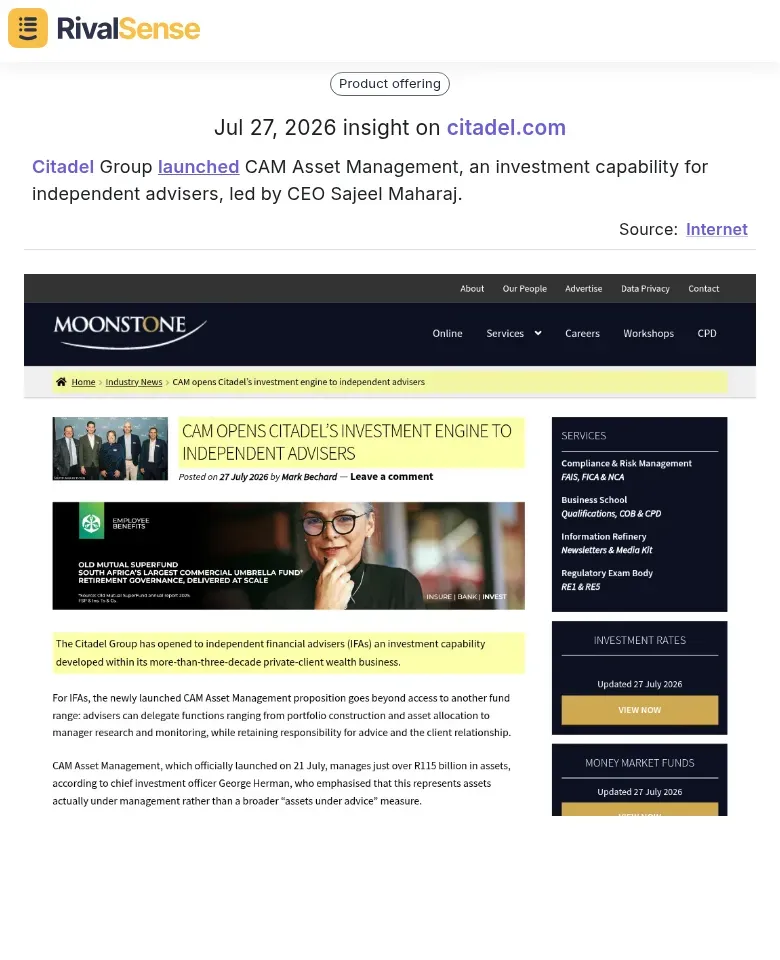
Product Launch: Citadel Group launched CAM Asset Management, an investment capability for independent advisers, led by CEO Sajeel Maharaj. Why it matters: A new product targeted at a specific advisor segment signals market expansion. You can assess whether this niche is worth pursuing or if it exposes gaps in your own offering.
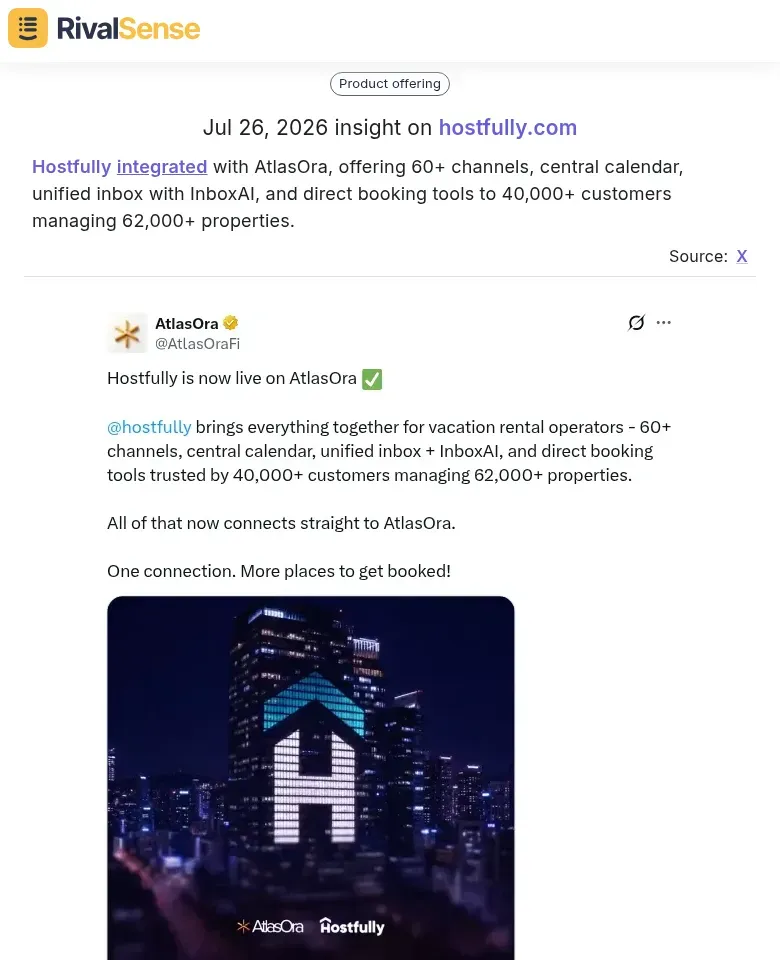
Partnership / Integration: Hostfully integrated with AtlasOra, offering 60+ channels, central calendar, unified inbox with InboxAI, and direct booking tools to 40,000+ customers managing 62,000+ properties. Why it matters: A broad channel integration reveals ecosystem consolidation. It shows which partners are critical, and you can identify similar collaboration opportunities before your competitor locks them in.
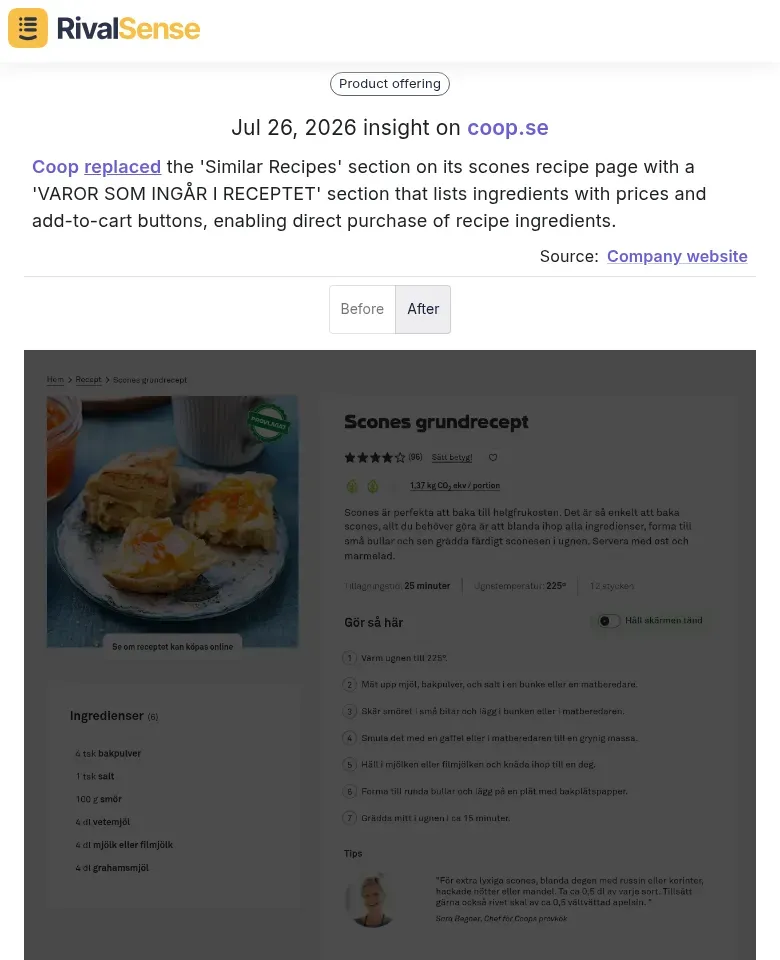
Feature Update: Coop replaced the ‘Similar Recipes’ section on its scones recipe page with a ‘VAROR SOM INGÅR I RECEPTET’ section that lists ingredients with prices and add-to-cart buttons, enabling direct purchase of recipe ingredients. Why it matters: This is a creative UX play that shortens the path to purchase. Spotting such moves early helps you benchmark innovation and adapt your own digital experience.
These insights — alongside podcast appearances — land in a single weekly email. That makes it easier to connect the dots between messaging, product, and market moves.
Step 4: Checklist for Tracking Competitor Podcast Appearances
Use this recurring checklist to stay on top of competitor podcast activity.
Weekly Tasks:
- [ ] Search “Competitor Name” + “podcast” on Google (sort by past week)
- [ ] Check Apple Podcasts / Spotify search for new episodes featuring competitors
- [ ] Review LinkedIn for any “new episode” posts from competitor employees
- [ ] Scan your automated monitoring tool’s report (e.g., RivalSense weekly email)
- [ ] Listen to one episode (at 1.5x speed) to capture messaging and tone
Monthly Tasks:
- [ ] Search Listen Notes or Podchaser for all appearances in the past month
- [ ] Update a spreadsheet with competitor name, podcast name, date, topic, and host
- [ ] Note any recurring shows (signals a relationship worth watching)
- [ ] Review competitor’s YouTube channel for podcast clips
Step 5: Analyze What You Find
Once you have a list, go deeper on each appearance.
| Element | What to Look For |
|---|---|
| Show theme | Is it a general business show or niche-specific? That tells you their target audience. |
| Episode title | What angle did they pitch? e.g., “How We Grew 300% in 6 Months”. That’s their value proposition. |
| Host tone | Aggressive? Friendly? How does the competitor handle different styles? |
| Key stories | What case studies or anecdotes do they repeat? Those are core to their narrative. |
| Calls to action | Do they plug a lead magnet, demo, or free consultation? Note the offer. |
| Partnership mentions | Any co-marketing, integrations, or guests they recommend. |
| Audience size | Use Listen Notes or similar to estimate reach. Compare to your own podcast appearances. |
Tip: Create a “Competitor Podcast Intelligence” board in Notion or a spreadsheet and update it each month.
Step 6: Use the Intelligence
Tracking is useless without action. Here’s how to leverage competitor podcast appearances.
- Refine your own podcast strategy: Notice they’re on X types of shows? Consider targeting similar shows with a different angle.
- Pitch the same hosts: If a host interviewed a competitor, they likely want more guests in that space. Reach out with a fresh perspective.
- Identify gaps: Your competitor talks about pricing but never about customer success? That’s your opening.
- Repurpose their insights: Not copy — but if they reveal a common customer pain, use that to create a blog post or LinkedIn thread addressing it.
- Monitor for partnership signals: If they appear on a podcast hosted by a potential partner, you might reach out to that partner first.
Step 7: Build Your Own Pipeline
Don’t just track — get on podcasts yourself. The same tools and tactics work in reverse. Use PodMatch or MatchMaker.fm to find shows that invite your competitor’s type of guest. When you appear, share it and track your own appearances just as diligently.
📌 Final Tips
- Set a cadence: Weekly scans are enough for most businesses. Increase frequency if a competitor launches a big campaign.
- Involve your team: Share a monthly summary with marketing, sales, and product teams.
- Don’t obsess: Track to learn, not to copy. Your unique voice is your advantage.
- Use automation wisely: Manual tracking for high-value competitors, automated tools (like RivalSense) for the long tail and for the full picture — product launches, partnerships, and pricing shifts that podcasts alone won’t reveal.
Ready to stop juggling alerts and spreadsheets? Try RivalSense for free and get your first competitor report today — podcast mentions, product moves, and all.
📚 Read more
👉 SaaS Case Study: How Competitor Testimonials and Real-Time Intel Fuel Growth
👉 How a Competitor Spotted IT.integro’s Sustainability Pivot and Accelerated Their Roadmap
👉 Productivity Techniques to Uncover Competitor Advertising Strategies via Website Changes