
Uncover Key Account Opportunities Through Competitor Event Analysis
Competitor events are a goldmine of strategic intelligence. The themes they choose and the speakers they feature reveal their current priorities and target markets. For instance, a competitor hosting a summit on "AI-Powered Supply Chains" signals a push into logistics. But the real opportunity lies in the attendee list and partner collaborations. Who's on the list? Which accounts are they wooing? Partnerships with complementary vendors (e.g., a CRM provider co-hosting with a data enrichment tool) hint at ecosystem plays. By tracking these events, you gain early signals of account penetration and expansion moves.
Practical steps:
- Set up alerts for competitor event announcements.
- Scrape public attendee lists (e.g., from event apps or LinkedIn).
- Cross-reference attendees with your target account list.
- Note partner co-marketing—these relationships often precede joint product integrations.
- Use tools like RivalSense to automate monitoring.
This intelligence lets you proactively engage accounts before your competitor deepens their foothold.
Decoding Event Themes and Speaker Lineups
Decoding the themes and speaker lineups of competitor events reveals strategic priorities and key account targets. Start by analyzing the event theme (e.g., 'Enterprise AI Impact')—it signals where the competitor is positioning thought leadership and product messaging. If they emphasize a specific technology or use case, expect their sales and marketing to follow suit.
Next, examine the speaker roster. Look for recognizable customer logos like Canva or Xero. These companies are likely strategic references or active targets. Create a list of such accounts and cross-reference with your own pipeline—they may be ripe for competitive displacement.
For example, RivalSense recently spotted that Glean is hosting a Sydney event on May 4 with leaders from Canva, Optus, Xero, AWS, Mantel, and Snowflake to discuss enterprise AI impact. 🚀
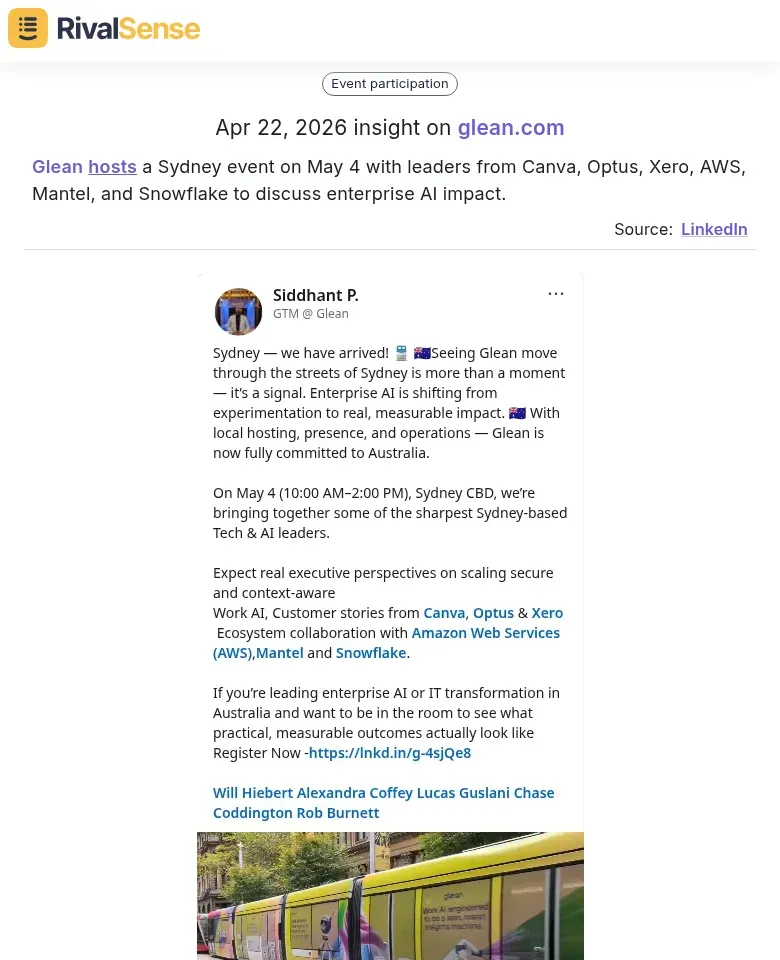
Tracking such speaker lineups is valuable because it reveals which accounts your competitor considers as strategic references or target partners. These accounts are actively engaged and likely to be receptive to alternative value propositions. By adding them to your watchlist, you can time your outreach before the competitor deepens their relationship.
Finally, note cross-industry speaker diversity. A fintech-focused competitor featuring healthcare speakers signals ambition to expand beyond core verticals. Map these industries to your own strengths and prepare tailored outreach.
Practical steps:
- Collect event agendas and speaker bios from competitor websites or LinkedIn.
- Tag themes by technology, use case, and industry.
- Identify customer speakers and research their relationship with the competitor (case study, press release, joint webinar).
- Build a watchlist of accounts appearing at multiple competitor events.
- Share insights with sales teams to prioritize outreach and craft competitive talking points.
This analysis turns event data into actionable account intelligence.
Analyzing Event Formats: Hackathons, Conferences, and Exclusive Gatherings
The format of a competitor's event reveals their account strategy. Here’s how to decode three common types:
1. Customer Hackathons – Deep Engagement Signals
These signal deep engagement. If a competitor runs a hackathon for existing customers, they’re co-creating use cases and strengthening loyalty. Action: Identify which accounts participate—these are high-risk for churn. Reach out with complementary solutions or case studies that address the same pain points.
Real insight: RivalSense identified that Dust is hosting its second Customer Hackathon on May 29 in Paris for Enterprise customers to build and deploy use cases with team support. 🛠️
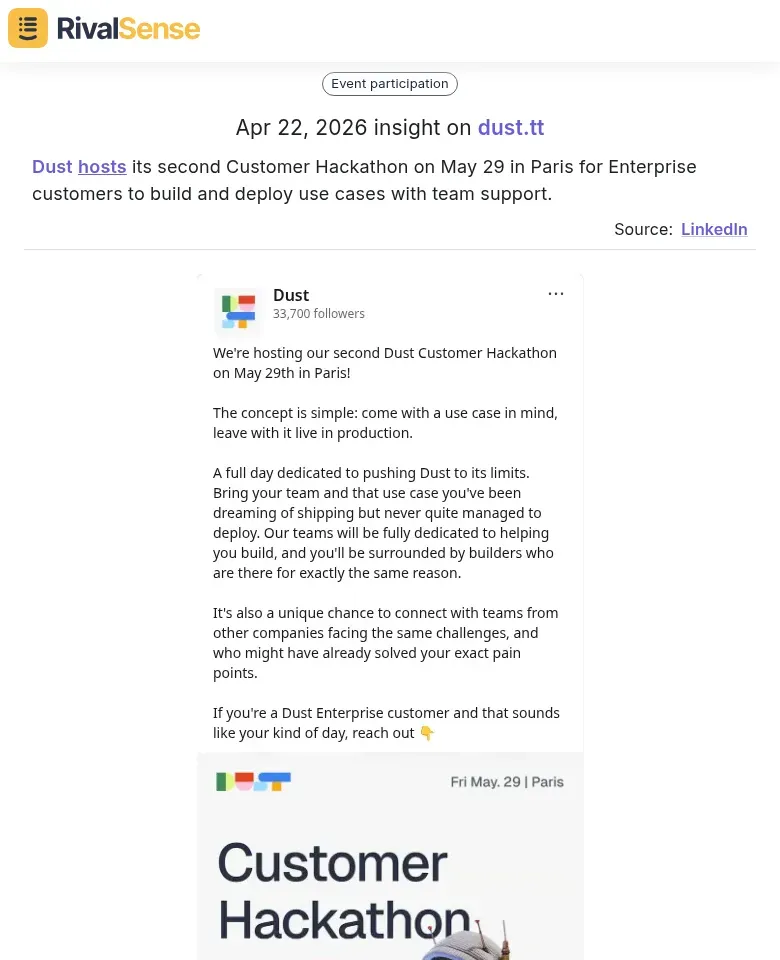
Why this matters: Hackathons indicate the competitor is investing heavily in customer retention and product stickiness. Accounts that attend are highly engaged and may be less likely to churn—unless you can demonstrate superior value. Use this intelligence to craft retention plays for your own customers who might be tempted, and to poach dissatisfied participants.
2. Conference Booths – Awareness Goals
A broad presence at industry conferences indicates awareness goals. They’re casting a wide net for leads. Tip: Scan their booth materials for new product angles. If they’re demoing a feature you lack, prioritize development. Also, note which sessions they sponsor—those topics are their strategic focus.
3. Exclusive Gatherings – High-Value Prospect Plays
Invite-only dinners or roundtables target high-value prospects. This signals an acquisition play for top-tier accounts. Checklist:
- Who attended? Cross-reference with your pipeline.
- If a prospect was there, prepare a competitive battle card and schedule a check-in.
Format Nuance: Hands-on workshops (hackathons) nurture existing accounts; thought leadership panels (conferences) attract new ones. Match your response: for nurturing events, reinforce relationships; for acquisition events, accelerate your sales cycle.
Pro tip: Track event formats over time. A shift from conferences to exclusive events may signal a pivot to enterprise sales.
Identifying Account Opportunities from Event Participation
Competitor events are goldmines for identifying warm leads. Any account that attends, sponsors, or speaks at a rival’s conference is already engaged with their narrative—making them primed for your outreach. Start by scraping attendee lists or session speakers from competitor event pages. Cross-reference these with your CRM to flag accounts that are not yet in your pipeline. For high-value targets, monitor if they are featured as customer speakers or case studies; this signals a strong relationship you need to intercept before the deal closes.
Next, look for partner co-hosting patterns. If a competitor co-hosts with AWS, Snowflake, or another ecosystem player, they are likely building joint solutions or go-to-market plays. Identify accounts that are also customers of those partners—they may be the next target for a bundled offer. Counter by pitching your own alliance with an alternative partner (e.g., Azure or Databricks) to provide a comparable or superior value proposition.
Real example from RivalSense: NAVEX Senior Solutions Engineer Joshua Pifer invites attendees to visit the NAVEX team at booth 10 during the Compliance Week National Conference. 📢
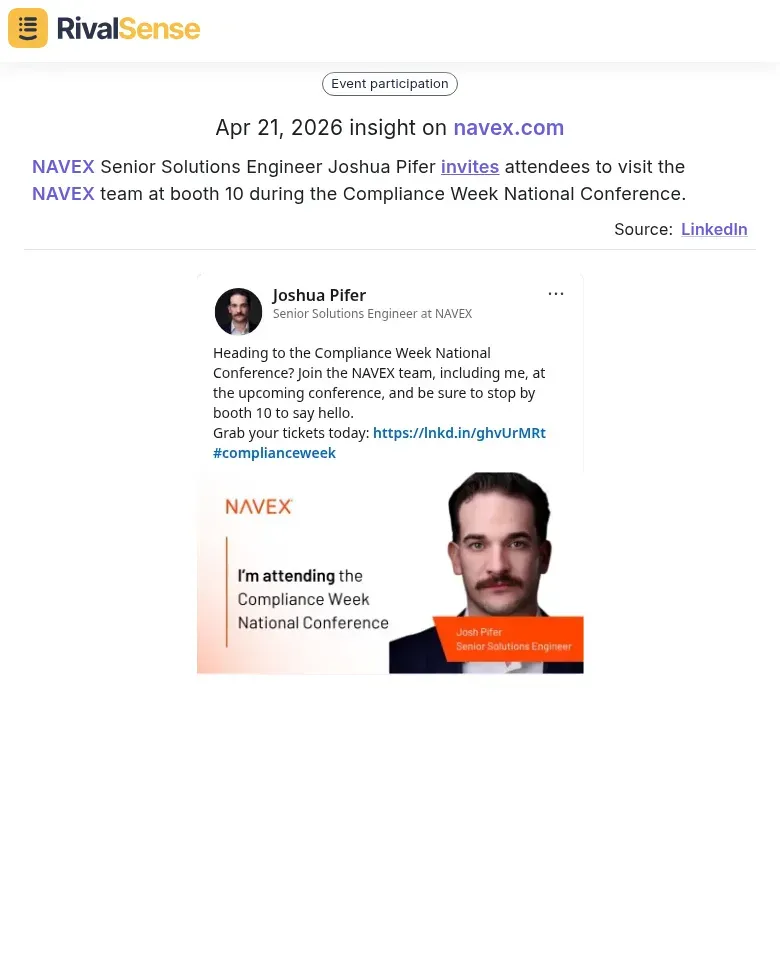
Why this type of insight is valuable: A specific invite to a booth signals that the competitor is actively generating leads at that event. The person named (Joshua Pifer) might be your entry point for competitive intelligence. By scanning such mentions, you can identify which accounts are being targeted and which sales reps are engaging them. This lets you preempt outreach with counter-messaging before the competitor builds rapport.
Quick checklist:
- [ ] Scrape competitor event pages for attendee/speaker lists.
- [ ] Cross-match with CRM to find uncontacted accounts.
- [ ] Flag accounts featured in competitor case studies.
- [ ] Identify partner co-hosts and their customer base.
- [ ] Prepare differentiated messaging for each warm lead.
Actionable Steps: Building a Competitor Event Monitoring System
To build a competitor event monitoring system, start by setting up automated alerts. Use tools like Google Alerts, Mention, or RivalSense to track competitor event announcements, speaker lists, and post-event recaps. Create saved searches for each competitor plus keywords like “webinar,” “conference,” or “summit.” Next, map event participants to your Ideal Customer Profile (ICP) and CRM. After each event, scrape attendee lists (if public) or use LinkedIn to identify who attended. Cross-reference with your CRM to prioritize high-value accounts. Tailor your outreach: reference a specific session they attended or a question they asked. Finally, feed event insights into your content and sales strategies. For example, if a competitor launched a new feature at a conference, create a comparison guide or a counter-positioning sales play. Use account-based tactics: send personalized follow-ups to attendees from target accounts, offering exclusive insights or demos.
Pro tip: assign a team member to monitor event hashtags and social chatter in real time—this uncovers pain points and objections you can address immediately.
Conclusion: Turning Event Intelligence into Revenue
Competitor events aren't just noise—they're a goldmine of account-level intelligence. By systematically tracking who attends, speaks, or sponsors, you can identify high-intent buyers, map decision-maker networks, and time your outreach when prospects are most engaged.
Turn intelligence into revenue with this 3-step workflow:
-
Capture event signals – Use tools like RivalSense to log event participation per account (e.g., "VP of Sales attended CompetitorX webinar"). Tag accounts as "warm" or "in-market."
-
Trigger targeted plays – For each signal, define a sales play: send a comparison guide after a competitor webinar, offer a free trial after a trade show booth visit, or share a case study that counters competitor messaging.
-
Measure & refine – Track conversion rates from event-triggered sequences vs. cold outreach. Double down on event types (e.g., user conferences vs. analyst briefings) that yield highest win rates.
Pro tip: Create a shared "Competitor Event Calendar" with your sales and marketing teams. Assign owners to monitor specific events and debrief weekly on new account insights.
Regular analysis of competitor event activity sharpens your positioning and keeps you ahead of market shifts. Start small—track one competitor's events for a month—and scale from there. The accounts you win through event intelligence will be your most defensible revenue.
Ready to automate this? Try RivalSense for free today and get your first competitor report delivered—start uncovering account opportunities immediately. No strings attached, just actionable insights in your inbox every week.
📚 Read more
👉 Sendible's Strategic Pivot: From Small Business to Software Integrators – What It Means for You
👉 How to Track Key Account Risks Before They Sink Your Business
👉 Strategic Key Account Tracking for Media Buying Agencies: Best Practices and App Strategies
👉 Strategic Tech Partnerships: How Oticon and Google Revolutionized Pediatric Hearing Aids
👉 How to Use RivalSense to Grow and Retain Your Strategic Accounts