
Competitor Customer Testimonials Analysis Template for Social Media Agencies
For social media agencies, competitor customer testimonials are a goldmine of strategic intelligence. Beyond surface-level praise, they reveal subtle shifts in target audience and positioning—like a competitor suddenly featuring testimonials from enterprise clients, signaling an upmarket pivot. By analyzing who competitors serve, you can spot underserved segments: if rivals focus on e-commerce brands, perhaps local service businesses are ripe for your agency.
Practical steps to extract insights:
- Collect testimonials from competitor websites, LinkedIn, and review platforms (e.g., G2, Clutch).
- Tag each testimonial by industry, company size, pain point, and desired outcome.
- Look for patterns—e.g., a surge in testimonials from SaaS startups may indicate a new specialization.
- Identify gaps—segments or pain points your competitors rarely address.
Checklist for your analysis:
- [ ] 10+ competitor testimonials collected
- [ ] Tagged by industry, size, and pain point
- [ ] Common themes documented
- [ ] Untapped segments listed
This groundwork turns testimonials from social proof into a roadmap for your agency’s differentiation and growth.
Spotting Pivots in Target Audience from Testimonials
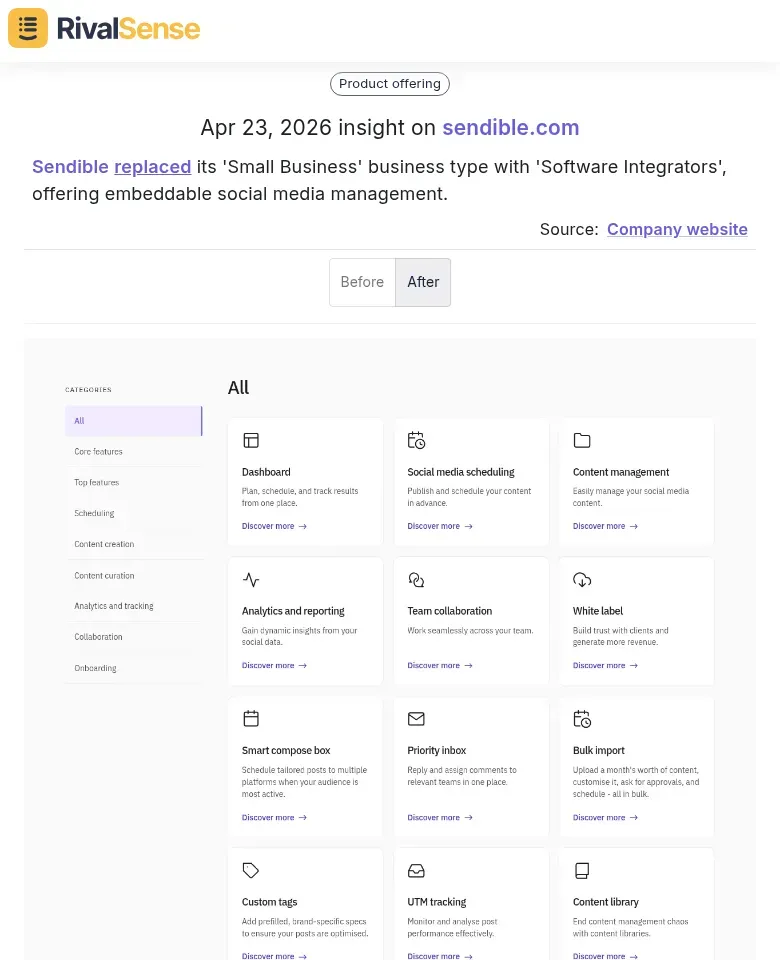
Competitor testimonials can reveal subtle but critical shifts in their target audience. For instance, Sendible’s early testimonials emphasized “small business owners” and “solo entrepreneurs,” but over time, language shifted to “software integrators,” “multi-location brands,” and “enterprise teams.” This signals a pivot from serving SMBs to targeting agencies and larger organizations that need complex integrations.
Such shifts in business type offer a clear window into a competitor’s strategic direction. By tracking these changes, you can adjust your own positioning to capture the segments they leave behind or double down on areas where they are moving away.
How to spot audience pivots:
- Collect testimonials over time – Pull 10–15 testimonials from each competitor, noting the date and customer job titles.
- Categorize language – Look for repeated phrases like “growing team,” “multiple clients,” “custom integrations,” or “white-label.”
- Identify new personas – If you see a surge in terms like “developer,” “API,” or “custom workflow,” the competitor is targeting technical buyers.
- Check use cases – Are testimonials about “saving time” (small biz) or “scaling operations” (enterprise)?
Actionable steps for your agency:
- Create a simple spreadsheet with columns: Competitor, Customer Title, Key Phrases, Implied Persona.
- Update your own ICP by adding new segments you hadn’t considered, like “tech-forward marketing teams.”
- Test messaging for these new personas in your outreach.
Pro tip: Use a tool like RivalSense to automate testimonial collection and track language shifts over time.
Uncovering Product and Feature Direction Through Customer Stories
Customer testimonials aren't just social proof—they're a goldmine for product intelligence. By systematically analyzing competitor customer stories, you can spot feature investments before they hit the roadmap.
Detect feature investments. Look for repeated mentions of specific capabilities. For example, if multiple testimonials praise "seamless Instagram Reels scheduling" or "built-in Canva integration," that signals a deliberate product bet. Use a simple spreadsheet to tag each mention by feature category (e.g., scheduling, analytics, collaboration).
Correlate praise with upcoming roadmaps. Cross-reference testimonial themes with job postings, press releases, or changelogs. If customers rave about a "new in-app video editor," check if the competitor recently hired video engineers or launched a beta. This triangulation reveals where they're doubling down.
Prioritize your own development. Validated market demand from competitor customers reduces your risk. If 70% of their testimonials highlight "embeddable social media management," that's a clear signal. Build a weighted priority matrix: score each feature by mention frequency, customer sentiment, and strategic fit. Ship what the market already wants.
Quick checklist:
- [ ] Collect 20+ competitor testimonials
- [ ] Tag each by feature category
- [ ] Cross-reference with job postings
- [ ] Score features by demand signal
- [ ] Add top 3 to your roadmap
Learning Content and Engagement Strategies from Testimonials
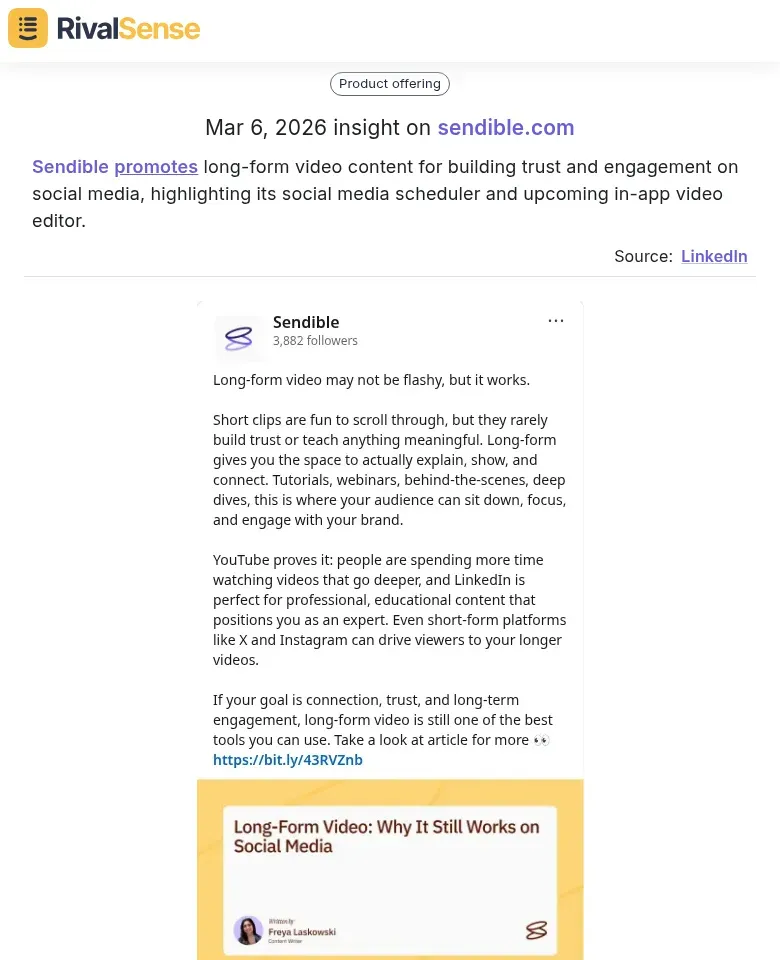
To extract actionable insights from competitor testimonials, focus on how they promote content formats that build trust and engagement. For instance, Sendible emphasizes long-form video content as a trust-building tool while highlighting its social media scheduler and an upcoming in-app video editor. This type of insight reveals not only product direction but also the content strategy that resonates with their audience—valuable for refining your own thought leadership and engagement tactics.
Step 1: Catalog Content Types
Create a table listing each testimonial’s format (video, text, audio) and the specific product features praised. For example, if multiple clients rave about a “social media scheduler,” that’s a high-value feature to emphasize in your own messaging.
Step 2: Identify Emotional Triggers
Highlight phrases like “saved us hours” or “finally organized.” These reveal pain points you can address in your thought leadership pieces.
Step 3: Adapt Themes
If competitors’ testimonials often mention “scaling content production,” write a LinkedIn article titled “How We Helped a Client 10x Output Without Burning Out.” Use similar language and structure, but add your unique perspective.
Pro Tip: Repurpose top-performing testimonial themes into a blog series or social media carousel. Track which formats drive the most engagement to refine your strategy.
Building a Competitor Testimonial Analysis Template
To build a robust competitor testimonial analysis template, start by creating a structured document (spreadsheet or database) with these core fields:
1. Customer Profile
- Industry, company size, role of the testimonial giver
- Pain points mentioned (e.g., “wasted time on manual reporting”)
2. Feature Mentions
- Specific features praised (e.g., “real-time analytics dashboard”)
- Emotional language (e.g., “love,” “game-changer”) – this signals high value
3. Content Themes
- Recurring topics (e.g., “ease of use,” “ROI,” “support”)
- Quotes that reveal competitor positioning
4. Audience Shifts
- Track if certain industries or roles appear more over time
Pro tip: Use a color-coding system to highlight trends (e.g., green for growing segments, red for declining).
Cadence: Review your template bi-weekly. Set a recurring calendar reminder to scan competitor websites, G2, Capterra, and social media for new testimonials. Update the sheet within 48 hours of spotting a new one. Every month, summarize top 3 shifts in audience or messaging – then share with your strategy team. This turns raw data into actionable intelligence for your social media campaigns.
Turning Insights into Actionable Strategy
Turning Insights into Actionable Strategy
Once you've analyzed competitor testimonials, it's time to act. Here's how to translate findings into a winning strategy:
1. Refine Your Positioning & Services
- Map recurring pain points (e.g., "slow reporting") to your unique strengths. If competitors are praised for "real-time dashboards," ensure yours is front and center.
- Identify service gaps: If clients rave about a competitor's dedicated account manager, consider adding a similar tier.
- Checklist: ☐ List top 3 competitor strengths ☐ List top 3 weaknesses ☐ Adjust your UVP accordingly.
2. Craft Content & Sales Messaging
- Use exact phrases from testimonials in your copy (e.g., "Our clients say we deliver '30% faster turnaround' just like [Competitor], but with deeper analytics.")
- Create comparison content: "How We Stack Up Against [Competitor]" addressing validated needs.
- Tip: A/B test landing pages with competitor-inspired messaging vs. your original copy.
3. Set Up Continuous Monitoring
- Use tools like RivalSense to track new competitor testimonials weekly.
- Create a shared dashboard with alerts for emerging themes (e.g., "AI-powered insights").
- Hint: Review testimonials quarterly to spot shifts in customer priorities before they become mainstream.
By systematically turning insights into action, you'll stay ahead of market trends and consistently refine your agency's value proposition.
Ready to automate competitor testimonial tracking and get weekly updates on product launches, pricing changes, and more? Try RivalSense for free and get your first competitor report today: https://rivalsense.co/
📚 Read more
👉 Uncover Key Account Opportunities Through Competitor Event Analysis
👉 Sendible's Strategic Pivot: From Small Business to Software Integrators – What It Means for You
👉 How to Track Key Account Risks Before They Sink Your Business
👉 Strategic Key Account Tracking for Media Buying Agencies: Best Practices and App Strategies
👉 Strategic Tech Partnerships: How Oticon and Google Revolutionized Pediatric Hearing Aids