
How to Track Key Account Risks Before They Sink Your Business
Every B2B leader knows the sinking feeling: a key account that represented 20% of your revenue suddenly starts behaving differently. Orders slow down. Emails go unanswered. Your champion leaves the company. Before you know it, they've churned — or worse, they've switched to a competitor.
The problem? Most companies only spot account risks when it's too late. They rely on gut feelings, sporadic check-ins, or post-mortems after the damage is done.
But what if you could systematically track key account risks — the same way financial institutions track customer risk in AML compliance? The same frameworks that banks use to prevent money laundering can be adapted to help you detect early warning signs in your most valuable B2B relationships.
Here's how to build a practical account risk tracking system — and why competitive intelligence tools like RivalSense can be your secret weapon.
Why Account Risk Tracking Matters (Beyond Revenue)
Your largest accounts aren't just revenue sources — they're strategic assets. Losing one can crater your quarterly numbers, trigger layoffs, and send your team into crisis mode. Yet most companies treat account health as a binary thing: either everything's fine, or it's a fire drill.
A systematic risk-tracking approach flips that. It helps you:
- Allocate resources proactively — focus your best people where risk is highest
- Calibrate engagement — low-risk accounts get standard nurturing; high-risk accounts get executive intervention
- Spot competitive threats early — before your rival sends a proposal
- Build defensible retention strategies — with data, not hunches
The Four Dimensions of Account Risk
Banks assess customer risk across four dimensions: customer profile, geography, product/service, and delivery channel. For B2B account risk, we can adapt these into:
1. Account Health Risk — How healthy is the relationship itself?
- Declining engagement (support tickets down, meeting frequency drops)
- Leadership changes at the client (your champion leaves)
- Negative feedback or NPS scores
- Payment delays or contract renegotiations
2. Competitive Risk — Is a competitor circling?
- Your competitor just launched a feature your account has been requesting
- The client is running an RFP or evaluating alternatives
- Your competitor hired someone from the client's team
- The client's procurement team is asking about contract terms
3. Market/Industry Risk — Is the client's own business under pressure?
- Layoffs or restructuring at the client
- Regulatory changes affecting their industry
- Their stock price is dropping
- They're being acquired or merging
4. Product/Service Risk — Is your offering still a fit?
- The client's needs have evolved beyond your product
- Your product has had repeated outages or quality issues
- The client is using more of a competitor's product alongside yours
- Your pricing has changed significantly
How to Build a Simple Account Risk Scoring Model
You don't need a data science team. Start with a spreadsheet or a CRM with scoring capabilities.
Step 1: Define your risk factors (pick 8–12 from the dimensions above)
Step 2: Assign scores (1–5, where 5 = highest risk)
Step 3: Weight each factor (e.g., competitive risk might be 30%, account health 40%, etc.)
Step 4: Set thresholds — e.g., scores 0–20 = green (low risk), 21–40 = yellow (medium), 41+ = red (high risk)
Step 5: Automate data collection — this is where most efforts fail. Manually updating scores is unsustainable.
Tracking Competitive Risk with RivalSense
The hardest dimension to track manually is competitive risk. You can't be everywhere at once — monitoring your competitor's website, social media, press releases, pricing pages, job postings, and regulatory filings.
That's where RivalSense comes in. RivalSense tracks competitor product launches, pricing updates, event participations, partnerships, management changes, and media mentions across 80+ sources — from company websites to social media to registries. Every week, you get a concise email report of what your competitors are doing.
For account risk tracking, this is gold. When RivalSense alerts you that a competitor has made a strategic move, you know exactly which accounts need immediate attention.
Here are three real examples of insights RivalSense delivers — and why each type is critical for your business strategy:
🚀 Product Launches Signal Growing Competitive Threats
When a competitor launches a new product or feature, it often targets the very pain points your key accounts are complaining about. For instance:
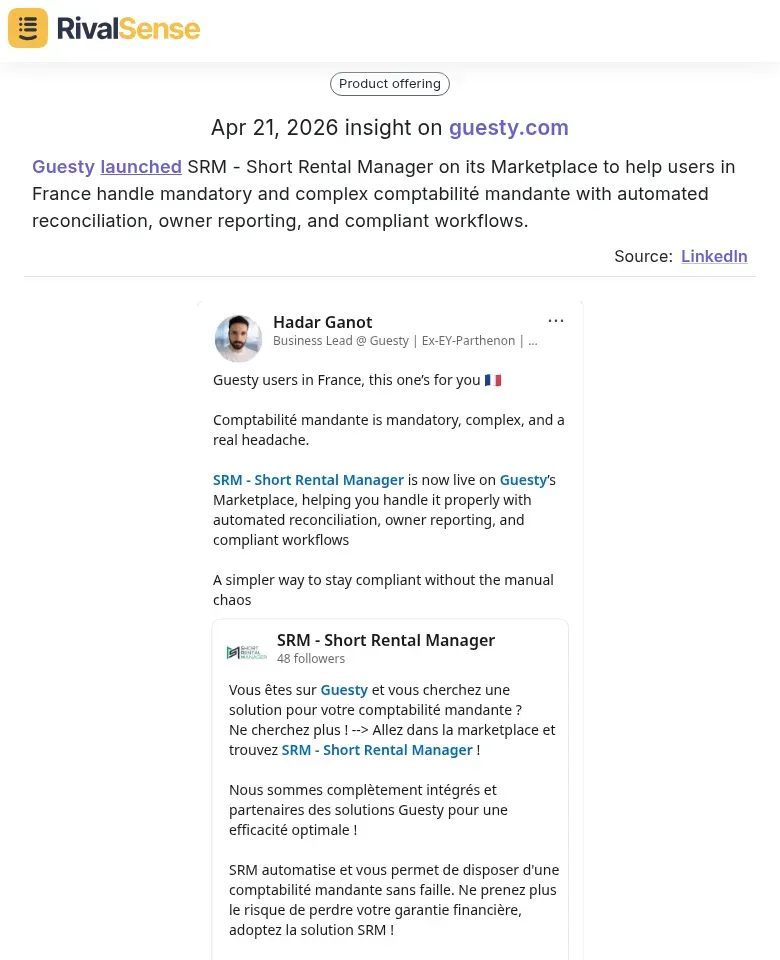
Insight: Guesty launched SRM — Short Rental Manager on its Marketplace to help users in France handle mandatory and complex comptabilité mandante with automated reconciliation, owner reporting, and compliant workflows.
Why this matters: This type of insight tells you that a competitor is building functionality specifically for a region or regulatory niche. If you have key accounts in France, this move directly threatens your relationship. You can proactively reach out, discuss your own roadmap, or offer a stopgap solution before your competitor does.
🌍 Partnership Expansions Signal New Market Attack Vectors
When a competitor extends its partner ecosystem, it often means they're targeting segments or geographies where your accounts operate. Example:
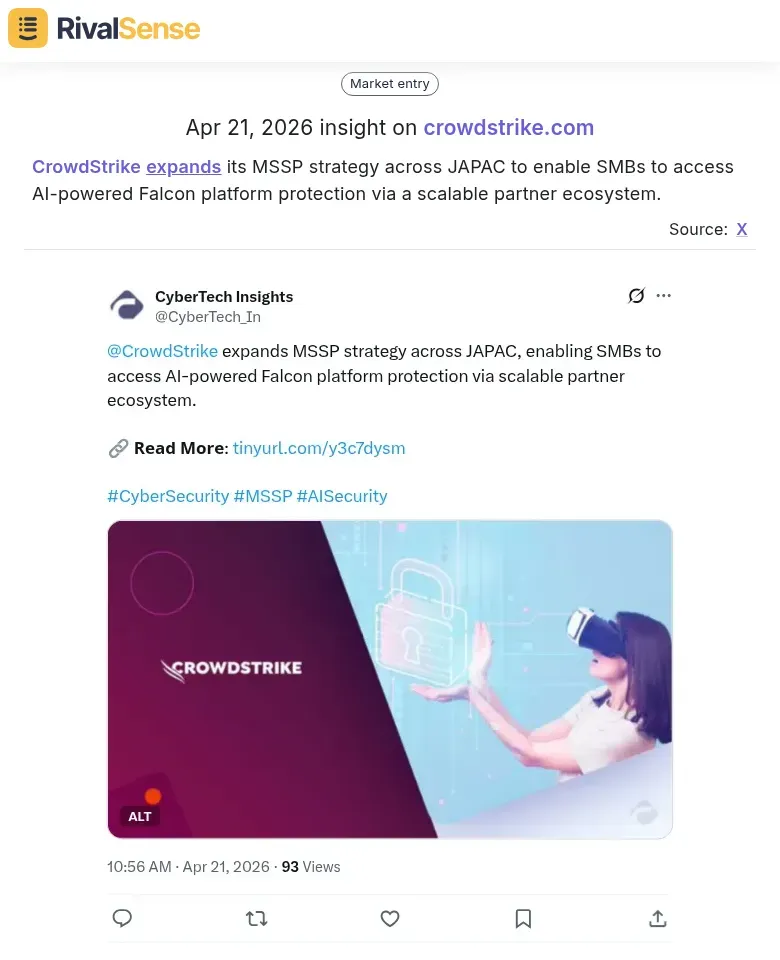
Insight: CrowdStrike expands its MSSP strategy across JAPAC to enable SMBs to access AI-powered Falcon platform protection via a scalable partner ecosystem.
Why this matters: If your key accounts are SMBs in Asia-Pacific, this partnership expansion could make CrowdStrike a more accessible alternative. Knowing this early lets you strengthen your own partnership pitch or adjust your pricing to defend against the coming wave.
📢 Regulatory & Policy Moves Impact Client Confidence
Competitors engaging in policy campaigns can shift the regulatory landscape — and your clients' priorities. Example:
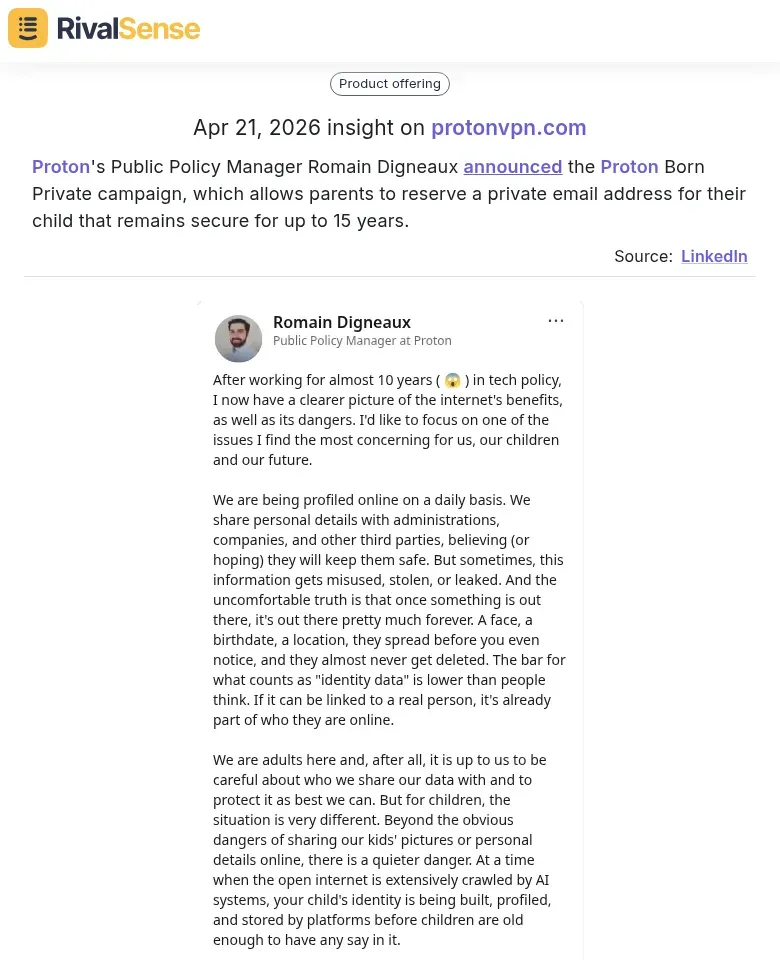
Insight: Proton's Public Policy Manager Romain Digneaux announced the Proton Born Private campaign, which allows parents to reserve a private email address for their child that remains secure for up to 15 years.
Why this matters: This kind of regulatory positioning builds brand trust and loyalty among privacy-conscious customers. If your accounts serve families or education sectors, Proton is directly appealing to their end-users. You need to monitor these policy moves to anticipate shifts in client expectations.
Practical Steps to Start Today
- Identify your top 10–20 accounts by revenue or strategic value
- Set up a simple scoring sheet with the four dimensions above
- Assign a risk owner for each account (usually the account manager or CSM)
- Integrate competitive intelligence — set up RivalSense to track your top 3–5 competitors
- Review scores monthly — and trigger an action plan for any account that moves to yellow or red
- Document everything — keep a log of risk changes, actions taken, and outcomes
A Weekly Account Risk Checklist
- [ ] Check RivalSense report for competitor moves relevant to your key accounts
- [ ] Review support tickets and NPS feedback for each top account
- [ ] Note any client leadership changes (LinkedIn is your friend)
- [ ] Check if any account has gone quiet (no meetings, no replies)
- [ ] Review contract renewal dates and procurement activity
- [ ] Update risk scores and flag changes to your team
The Bottom Line
Tracking key account risks isn't about paranoia — it's about being proactive. The same risk-based approach that keeps financial institutions compliant can keep your revenue streams secure. By combining a simple scoring model with automated competitive intelligence from RivalSense, you'll spot warning signs early, protect your most valuable relationships, and stay ahead of competitors who are gunning for your best accounts.
Start small. Pick three accounts. Score them today. Set up RivalSense for your top competitors. You'll be amazed at what you've been missing.
Ready to see what your competitors are up to? RivalSense tracks product launches, pricing changes, partnerships, regulatory moves, and more across 80+ sources — delivered weekly to your inbox. Try RivalSense for free today at https://rivalsense.co/ and get your first competitor report. Start tracking key account risks now.
📚 Read more
👉 Strategic Key Account Tracking for Media Buying Agencies: Best Practices and App Strategies
👉 Strategic Tech Partnerships: How Oticon and Google Revolutionized Pediatric Hearing Aids
👉 How to Use RivalSense to Grow and Retain Your Strategic Accounts
👉 5 Twitter Competitor Intelligence Mistakes That Give Rivals an Edge
👉 Best Practices for Tracking Competitor Content in Fleet Management