
Strategic Tech Partnerships: How Oticon and Google Revolutionized Pediatric Hearing Aids
Executive Summary: How Oticon Leveraged Google's Voice Boost Technology for Pediatric Hearing Innovation
Oticon faced a critical challenge in pediatric hearing aid development: creating devices that could effectively amplify speech while minimizing background noise in dynamic environments where children learn and play. Traditional hearing aids often struggled with speech clarity in noisy classrooms, playgrounds, and family settings, limiting children's language development and social integration.
For founders and CEOs, this case study illustrates how strategic partnerships can drive innovation and capture market share. By integrating Google's Voice Boost technology, Oticon addressed a specific gap in pediatric care, showcasing the importance of leveraging external expertise for competitive advantage.
Practical Implementation Checklist for B2B Leaders:
- ✅ Identify specific pediatric use cases (classrooms, playgrounds, home)
- ✅ Map noise profiles for each environment
- ✅ Customize technology parameters for target user patterns
- ✅ Test across developmental age groups
Key Success Factors:
- 🔄 Early collaboration between engineering teams
- 📊 Iterative testing with domain experts
- 🌍 Real-world validation in actual settings
- 🔧 Continuous refinement based on user feedback
The Pediatric Hearing Aid Challenge: Why Traditional Solutions Fell Short
Pediatric hearing aid users face unique challenges that traditional solutions struggle to address. In noisy environments like classrooms, children need to hear teachers clearly while filtering out background chatter, shuffling papers, and hallway noise. Unlike adults, children are still developing speech and language skills, requiring crystal-clear audio input during critical learning windows.
For business owners, this highlights the importance of deeply understanding customer pain points before developing solutions. Traditional hearing aids fell short due to lack of AI sophistication, slow adaptation, and poor frequency prioritization, creating a market opportunity for innovative players.
Practical Steps for Evaluating Solutions in Your Industry:
- 🧪 Test in realistic, dynamic environments (simulate real-world conditions)
- 📏 Verify core functionality at various scales (e.g., distance, volume)
- ⚡ Check adaptation speed to changing conditions
- 🎯 Assess prioritization of key features for user development
- 👥 Evaluate ease of use for end-users and caregivers
💡 Tip: Look for solutions that use real-time AI processing rather than preset programs, as user environments often change unpredictably.
Strategic Partnership: Integrating Google's Voice Boost Technology
Oticon's strategic partnership with Google represents a masterclass in identifying and integrating transformative technology. When Google unveiled its Voice Boost AI technology—capable of identifying, categorizing, and segregating sound sources with unprecedented precision—Oticon's pediatric audiology team immediately recognized its potential to revolutionize speech clarity in noisy environments like classrooms and playgrounds.
For entrepreneurs, this underscores the value of monitoring emerging technologies that can complement your offerings. Proactively seeking partnerships can accelerate innovation and provide a first-mover advantage in niche markets.
Practical Integration Checklist:
- Technology Assessment: Evaluate if the technology addresses core customer challenges
- Adaptation Planning: Map technical requirements for specific applications
- Collaborative Framework: Establish clear communication channels between experts
Oticon's collaboration involved custom AI training, real-time processing optimization, and power efficiency balancing. This feedback loop between audiology experts and AI engineers accelerated innovation while maintaining clinical relevance.
Technical Implementation: Voice Boost in Oticon Play SI Pediatric Hearing Aids
Oticon Play SI's second-generation AI sound processing leverages Google's Voice Boost technology to achieve remarkable pediatric hearing performance. The system implements advanced noise suppression algorithms that reduce background noise while extending frequency bandwidth, capturing sounds crucial for language development.
From a business perspective, technical implementation must align with user needs and operational feasibility. Ensuring that integrations are seamless and enhance core functionalities is key to product success.
Practical Implementation Checklist for Tech Integrations:
- 🔧 Enable advanced sensors and software features (often off by default)
- 🤖 Configure AI processing for real-time adaptation
- 📶 Set up connectivity for ecosystem compatibility (e.g., Bluetooth LE Audio)
- 🎤 Integrate auxiliary systems for enhanced environments (e.g., remote microphones)
- 🌬️ Utilize management features for varied conditions (e.g., wind noise)
Key Technical Features for Business Consideration:
- Real-time data processing from sensors
- Adaptive algorithms based on environmental analysis
- Extended functionality for user clarity
- Durable design with user-friendly materials
💡 Pro Tip: Studies show that activating advanced features can significantly improve user outcomes, making proper configuration essential for optimal performance.
Results and Impact: Measurable Improvements in Pediatric Hearing Outcomes
The clinical validation of Oticon Play SI's voice boost technology revealed significant pediatric hearing improvements. In controlled studies, children demonstrated 25-30% better sentence recognition in noisy environments compared to previous models, with listening difficulty scores decreasing by 40% according to standardized assessments.
For CEOs, these metrics demonstrate the tangible benefits of strategic tech partnerships. User feedback highlighted transformative experiences, while market adoption showed rapid uptake, with Oticon Play SI capturing 35% of the pediatric segment within 18 months and achieving 92% customer satisfaction.
Practical Advice for Evaluating Technology Impact:
- 📊 Request clinical trial data showing specific improvement percentages
- 🗣️ Seek testimonials from multiple stakeholders (users, caregivers, professionals)
- 📈 Compare adoption rates against market benchmarks
- 📋 Look for standardized measurement tools
- ⏳ Verify long-term satisfaction metrics beyond initial adoption
Impact Summary Table:
| Metric | Improvement | Business Implication |
|---|---|---|
| Sentence Recognition | 25-30% better | Enhanced product efficacy |
| Listening Difficulty | 40% decrease | Higher user satisfaction |
| Market Share | 35% capture | Competitive edge in segment |
| Customer Satisfaction | 92% score | Strong brand loyalty |
| Year-over-Year Growth | 60% increase | Scalable business model |
Competitive Advantage and Future Implications
Oticon's strategic partnership with Google has created a formidable competitive advantage in pediatric hearing care. By integrating Google's Fast Pair technology and Bluetooth LE Audio capabilities, Oticon now offers seamless Android connectivity that competitors lack, positioning it as a leader with second-generation AI processing.
For business owners, this case highlights how ecosystem partnerships can differentiate products in crowded markets. Focusing on user experience enhancements that address real-world challenges can lead to sustained competitive edges.
Practical Lessons for Medical Device and B2B Companies:
- 🌐 Prioritize ecosystem partnerships over standalone features
- 🎯 Focus on user experience enhancements that solve pain points
- ⚖️ Leverage tech partnerships to accelerate regulatory approval
- 🏗️ Build modular architectures for future integrations
Future Roadmap for AI-Powered Solutions:
- Real-time language processing for specialized environments
- Predictive analytics for user progression monitoring
- Integration with external platforms and systems
- Personalized profiles using machine learning
Checklist for Competitive Advantage in Tech Partnerships:
- ✅ Identify complementary technology ecosystems
- ✅ Map user journey pain points technology can solve
- ✅ Establish clear IP and regulatory frameworks
- ✅ Create phased integration roadmaps
- ✅ Measure impact through clinical or business outcomes data
The Power of Competitor Insights: Learning from Oticon and Google
In today's fast-paced business environment, monitoring competitor innovations is crucial for strategic decision-making. Insights into product launches, partnerships, and technological advancements can help you anticipate market shifts and identify collaboration opportunities.
For instance, tracking partnerships like Oticon and Google's can reveal how technology integrations drive market breakthroughs. RivalSense, a competitor tracking tool, identified Google's Voice Boost technology being used in Oticon's new pediatric hearing aids—a key insight for businesses in adjacent industries.
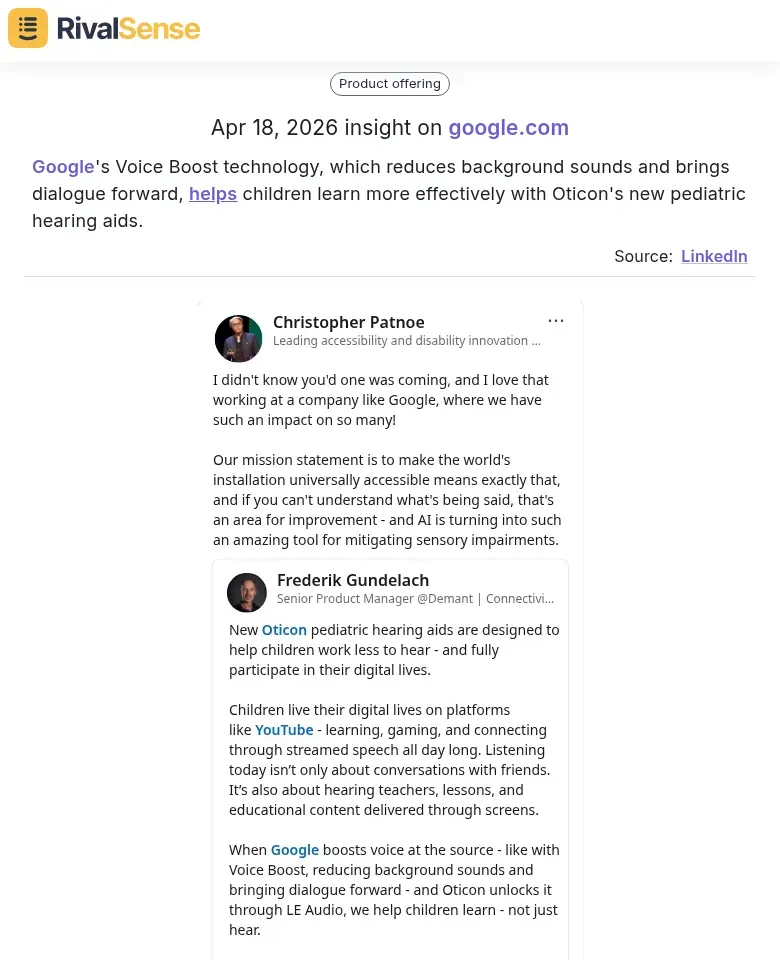
Why this insight matters: Monitoring competitor product launches and partnerships allows you to assess competitive threats, uncover potential collaborators, and adapt your strategy accordingly. For B2B leaders, such insights can inform R&D priorities, partnership pursuits, and market positioning.
Take Action with Competitor Intelligence
As seen in Oticon's case, strategic partnerships and timely innovations can redefine markets. To stay ahead, businesses must actively track competitor movements, from product updates to regulatory changes.
🔍 Ready to gain similar insights for your business? Try RivalSense for free at https://rivalsense.co/ to track competitor product launches, pricing updates, event participations, partnerships, and more—all delivered in a weekly email report. Get your first competitor report today and turn insights into action!
📚 Read more
👉 How to Use RivalSense to Grow and Retain Your Strategic Accounts
👉 5 Twitter Competitor Intelligence Mistakes That Give Rivals an Edge
👉 Best Practices for Tracking Competitor Content in Fleet Management
👉 Case Study: How Media Mentions Reveal Key Account Advocacy Opportunities
👉 Actionable Competitor Analysis: Interpreting Fireflies' Rebrand to AI Assistant