
Strategic Key Account Tracking for Media Buying Agencies: Best Practices and App Strategies
In today's hyper-competitive media landscape, traditional media buying approaches that rely on spreadsheets, manual reporting, and fragmented data sources are fundamentally inadequate. Agencies that lack comprehensive account intelligence operate blindfolded, missing critical insights into client performance, competitive positioning, and market opportunities. This data gap creates reactive relationships where agencies simply execute media plans rather than driving strategic value.
Integrated tracking systems provide a transformative competitive advantage by enabling proactive client management. Practical steps for implementation include:
- Centralize all client data in a single dashboard.
- Set up automated alerts for key performance indicators.
- Establish competitive benchmarking against industry standards.
- Create regular strategic review cadences.
These systems shift the agency-client dynamic from vendor to strategic partner, dramatically improving retention rates and unlocking growth opportunities through data-driven recommendations. Modern tracking apps revolutionize media buying by transforming tactical execution into strategic partnership. Key implementation tips: Start with your top 3-5 accounts, focus on metrics that directly impact client business outcomes, and use tracking insights to anticipate client needs before they arise. This approach positions agencies as indispensable partners who deliver measurable business impact rather than just media placements.
Essential Features of Effective Key Account Tracking Applications
When selecting key account tracking applications, media buying agencies should prioritize three essential features that transform raw data into actionable intelligence. These features enable agencies to move from reactive reporting to proactive strategy development, ensuring they stay ahead in a dynamic market.
First, real-time campaign monitoring with competitive benchmarking capabilities is non-negotiable. Look for platforms that provide live dashboards showing your clients' performance alongside key competitors across channels. This enables immediate tactical adjustments when competitors launch aggressive campaigns or shift messaging. Practical tip: Set up automated alerts for competitor budget spikes exceeding 20% or creative changes in high-value placements.
Second, automated data integration across all media platforms and client systems eliminates manual reporting headaches. The best applications connect seamlessly to Google Ads, Meta, programmatic DSPs, and client CRM/analytics tools. Checklist for integration:
- Verify API connections to your top 5 media platforms.
- Ensure hourly data refresh rates.
- Confirm the system can handle custom client KPIs beyond standard metrics.
Third, predictive analytics for budget optimization and ROI forecasting separates reactive tools from strategic partners. Advanced applications should analyze historical patterns to recommend optimal budget allocations across channels and predict campaign outcomes. Implementation step: Start with 70/30 testing—allocate 70% of budgets based on predictive recommendations while reserving 30% for control groups to validate accuracy.
For example, tracking competitor product updates can reveal strategic shifts that impact media buying decisions. Consider this insight from RivalSense: Palo Alto Networks Chief Product & Technology Officer Lee Klarich outlines a new mandate for resilience, including auditing code with AI, achieving 100% protection and coverage, and hitting single-digit response times.
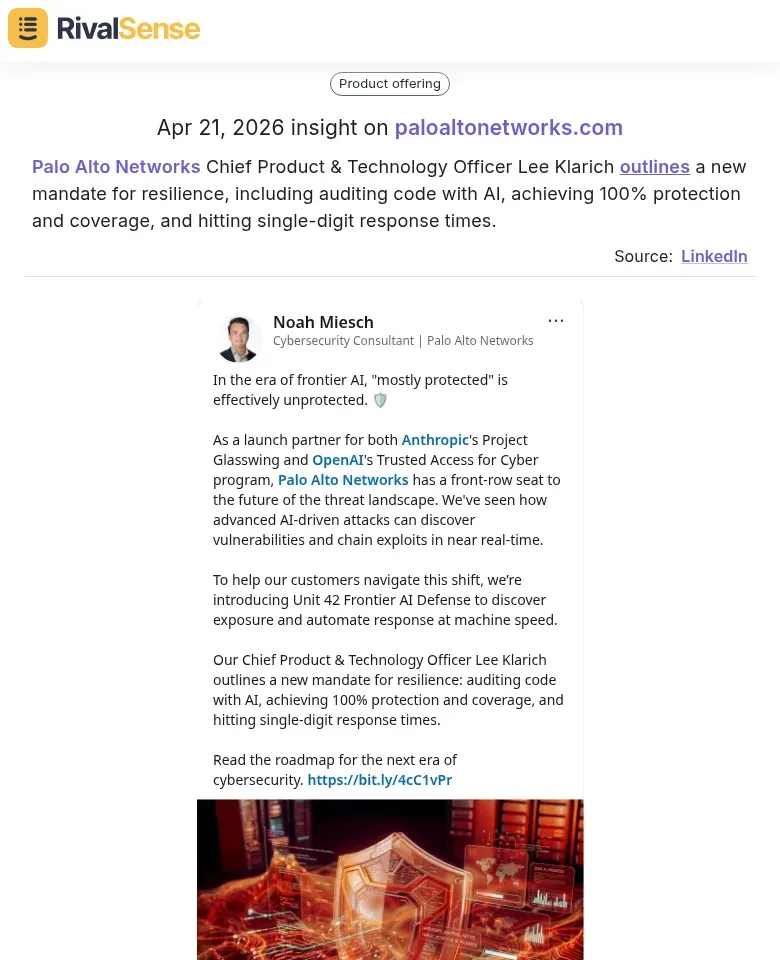
Monitoring such product mandates is valuable for business strategy because it provides early signals of competitor innovation and market positioning, allowing agencies to adjust client campaigns to align with emerging trends or counter new messaging.
Implementation Strategies: Integrating Tracking Apps into Agency Workflows
For media buying agencies, successful tracking app integration requires workflow optimization across three key areas. By systematically integrating these apps, agencies can enhance efficiency and deliver greater value to clients through streamlined processes and actionable insights.
1. Dashboard Customization by Client Tier
- Enterprise clients: Create comprehensive dashboards with real-time competitive intelligence, market share analysis, and cross-channel performance metrics.
- Mid-market clients: Focus on campaign-specific KPIs, competitor ad spend tracking, and ROI optimization metrics.
- SMB clients: Streamline dashboards to show key performance indicators, budget pacing, and basic competitive positioning.
2. Automated Reporting & Communication Protocols
- Weekly cadence: Automated performance summaries with competitor insights for all clients.
- Bi-weekly: Strategic review reports highlighting market shifts and optimization opportunities.
- Monthly: Comprehensive competitive analysis with actionable recommendations.
- Pro tip: Use tracking apps to automatically flag significant competitor moves (new ad creatives, budget shifts, messaging changes) for immediate client communication.
Tracking competitor events and partnerships can inform these reports. For instance, RivalSense captured this insight: Fortinet hosts the SMB Summit on April 22 for partners to discuss cybersecurity solutions for small and medium businesses.
Insights into competitor-hosted events are valuable for business strategy as they reveal market segmentation and partnership focus, helping agencies identify potential opportunities or threats in specific client verticals.
3. Team Training & Action Planning
- Data interpretation workshops: Train teams to distinguish between normal fluctuations and significant market shifts.
- Strategic action templates: Create standardized response plans for common competitive scenarios.
- Checklist for team onboarding:
- Dashboard navigation proficiency.
- Alert configuration for client-specific triggers.
- Competitor analysis framework application.
- Client reporting customization skills.
- Implementation tip: Start with pilot clients to refine workflows before agency-wide rollout.
Competitive Intelligence Integration: Beyond Basic Performance Tracking
Competitive intelligence integration transforms media buying from reactive to strategic. It provides a deeper understanding of the market dynamics that influence client success, enabling agencies to anticipate changes and act proactively. Move beyond basic performance metrics by implementing these key practices:
-
Competitor Media Placement Tracking: Use automated tools to monitor where competitors place ads for key accounts. Track pricing strategies across platforms—are they using premium placements or volume discounts? Create alerts for new competitor campaigns to identify emerging opportunities.
-
Industry Trend Monitoring: Set up automated alerts for industry publications, trade shows, and platform updates. Track emerging media opportunities before competitors capitalize on them. Monitor which channels competitors are testing for specific client verticals.
-
Client Retention Analysis: Analyze competitor client retention patterns—which clients stay longest and why? Identify service differentiators through client testimonials, case studies, and service offerings. Track competitor staffing changes and specialization areas.
Practical Checklist:
- Weekly competitor ad placement review.
- Monthly pricing strategy analysis.
- Quarterly service offering comparison.
- Automated alerts for competitor announcements.
- Client retention pattern tracking dashboard.
Pro Tip: Create a "competitor intelligence dashboard" that aggregates placement data, pricing trends, and client retention metrics. This enables real-time strategic adjustments and helps identify underserved market segments before competitors do.
Incorporating insights from competitor events can enhance this dashboard. For example, RivalSense identified that Palo Alto Networks CEO Nikesh Arora will be the keynote speaker at CyberArk IMPACT 2026 (May 11-13) in Austin, sharing his vision for the future of the industry and the role of identity security.

Tracking such event participations is valuable for business strategy because it highlights competitor thought leadership and industry influence, allowing agencies to gauge market sentiment and adjust client strategies to align with or counter emerging narratives.
Best Practices for Client Communication and Value Demonstration
Effective client communication is crucial for demonstrating the value of your tracking efforts. By translating data into actionable insights, you can strengthen client relationships and position your agency as a strategic advisor. Transform raw data into strategic insights by analyzing competitor ad spend patterns, identifying market gaps, and recommending tactical adjustments.
For example, if a competitor increases spend on LinkedIn targeting C-suite executives, suggest reallocating budget to counter their messaging. Create compelling visualizations that demonstrate value: Use side-by-side comparison dashboards showing your client's market share growth vs. competitors, ROI trendlines, and competitive positioning heatmaps. Include before/after snapshots of campaign performance and market position shifts.
Establish a regular review cadence:
- Weekly tactical updates (15 mins) - quick performance highlights.
- Monthly strategic reviews (60 mins) - deep dive on competitive landscape.
- Quarterly business reviews (90 mins) - market trends and strategic recommendations.
Pro tip: Always frame data in terms of business outcomes—show how your insights directly impact client revenue, market position, and competitive advantage. Use the tracking app to provide real-time alerts on competitor moves, then immediately translate these into actionable recommendations during client calls.
Future-Proofing Your Agency: Advanced Tracking Strategies for 2026 and Beyond
Future-proof your media buying agency with these advanced tracking strategies for 2026 and beyond. As technology evolves, adopting these strategies will ensure your agency remains competitive and adaptable in an increasingly automated landscape.
First, leverage AI and machine learning for predictive optimization by implementing algorithms that analyze historical performance data to forecast optimal bid prices, timing, and channel allocation. Practical tip: Start with pilot programs testing AI-driven bid optimization on 20% of your campaigns before full-scale implementation.
Second, integrate cross-channel attribution with multi-touchpoint tracking by implementing unified customer journey mapping across all platforms. Use server-side tracking solutions to overcome privacy restrictions and maintain data accuracy. Checklist:
- Implement identity resolution technology.
- Establish standardized UTM parameters across all channels.
- Create centralized data warehouses.
- Develop custom attribution models aligned with client business goals.
Third, build scalable tracking frameworks for enterprise operations by adopting modular architecture that separates data collection, processing, and visualization layers. Implement automated quality assurance protocols and establish clear governance policies for data access and usage. Key steps:
- Design API-first infrastructure for seamless platform integration.
- Create tiered access controls for different client needs.
- Implement real-time monitoring dashboards.
- Develop automated reporting templates that scale with client growth.
These strategies ensure your agency remains competitive as media buying evolves toward complete automation and data-driven decision making.
Putting It All Together: Leveraging Tools for Comprehensive Competitor Insights
To effectively implement these strategies and gain a holistic view of the competitive landscape, consider integrating specialized tools that automate competitor tracking. For instance, RivalSense tracks competitor product launches and updates, pricing changes, event participations, partnerships, regulatory aspects, management changes, and media mentions across websites, social media, and various registries. It delivers all this intelligence in a weekly email report, saving you time and ensuring you never miss a critical move.
By using such tools, media buying agencies can stay ahead of market shifts, anticipate client needs, and deliver proactive recommendations. Try RivalSense for free at https://rivalsense.co/ to streamline your competitor intelligence efforts and get your first competitor report today!
📚 Read more
👉 Strategic Tech Partnerships: How Oticon and Google Revolutionized Pediatric Hearing Aids
👉 How to Use RivalSense to Grow and Retain Your Strategic Accounts
👉 5 Twitter Competitor Intelligence Mistakes That Give Rivals an Edge
👉 Best Practices for Tracking Competitor Content in Fleet Management
👉 Case Study: How Media Mentions Reveal Key Account Advocacy Opportunities