
Twitter vs. Website: Competitive Intelligence Analysis for Strategic Advantage
In today's fast-paced business environment, relying solely on website analysis for competitive intelligence is like driving with only your rearview mirror. While websites provide essential static data about competitors' positioning, product offerings, and messaging, they miss the dynamic, real-time insights that shape market momentum. Traditional website monitoring reveals what competitors want you to see—their polished, carefully crafted public face.
Twitter intelligence offers the missing dimension: real-time strategic insights into competitors' immediate priorities, customer sentiment, emerging partnerships, and crisis responses. Unlike static websites, Twitter provides unfiltered glimpses into competitors' daily operations, leadership thinking, and market reactions. You can track product launches as they happen, monitor customer complaints before they escalate, and identify emerging trends weeks before they appear on official websites.
Practical Tip: Create a dual-monitoring dashboard with these key metrics:
- Website: Product updates, pricing changes, career postings
- Twitter: Engagement patterns, customer sentiment, leadership announcements
- Combined: Timing gaps between Twitter announcements and website updates
By integrating both sources, you gain a comprehensive competitive advantage framework that combines strategic positioning with tactical agility. This dual-lens approach transforms reactive monitoring into proactive strategy, giving you the complete picture needed to anticipate moves rather than just react to them.
Twitter Intelligence: Capturing Real-Time Strategic Moves
Twitter delivers competitor intelligence 10-15x faster than traditional methods, transforming reactive tracking into strategic advantage. By monitoring competitors' tweets, you can capture announcements as they happen and gauge immediate market reactions. Focus on three critical areas for maximum insight.
-
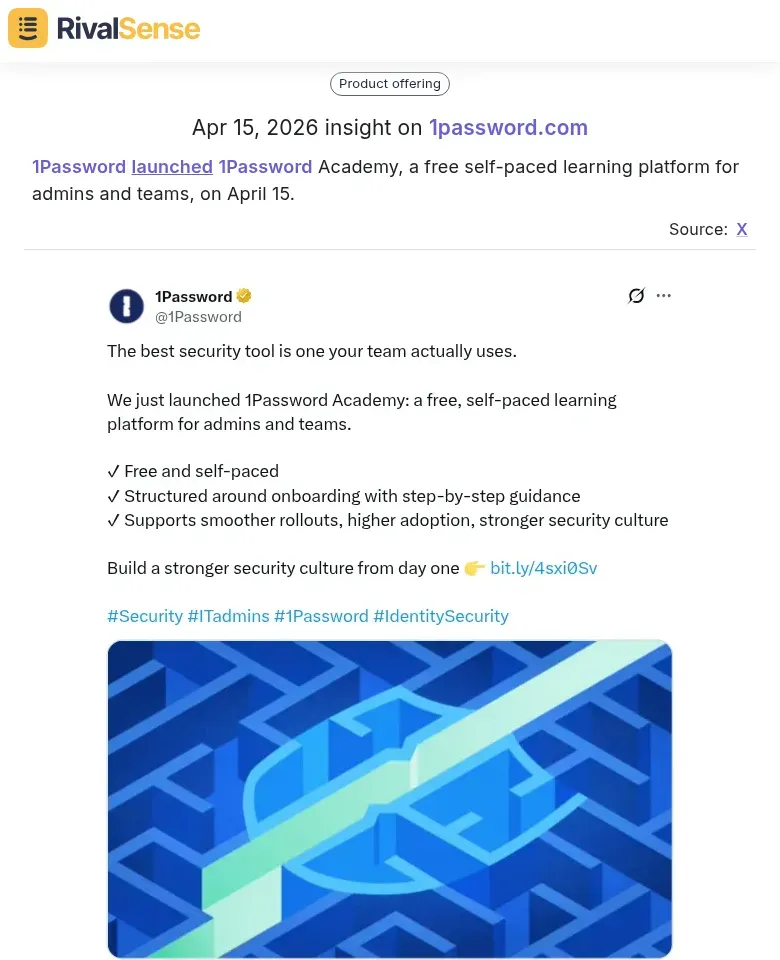
Product Launch Tracking: Capture announcements as they happen. For example, RivalSense tracked that 1Password launched 1Password Academy, a free self-paced learning platform for admins and teams, on April 15. This type of insight is valuable because it reveals how competitors are investing in customer education to reduce support costs and improve adoption, allowing you to adjust your own product training strategies.
🛠️ Practical tip: Create private Twitter lists for competitor product accounts and track hashtags like #NewFeatureAlert.
-
Partnership Monitoring: Watch for ecosystem expansions. ✅ Checklist: Set alerts for partnership keywords (#collaboration, #integration) and note tagged accounts.
-
Community Validation Signals: Analyze traction metrics for market validation. 🛠️ Practical step: Monitor engagement patterns around competitor announcements to gauge market reception.
Actionable Framework:
- Create specialized Twitter lists (competitors, influencers, target accounts)
- Set up Boolean search alerts for announcements
- Track sentiment around competitor launches
- Review alerts daily, analyze trends weekly
- Update monitoring lists monthly
Twitter intelligence enables you to anticipate competitor moves, validate market signals, and prepare counter-strategies before announcements impact your business.
Website Analysis: Understanding Core Positioning and Structure
Website analysis reveals your competitor's core positioning and strategic structure. By systematically evaluating their online presence, you can uncover gaps in their offerings and opportunities for differentiation. Start by mapping their product positioning: analyze homepage messaging, feature pages, and pricing sections to understand their value proposition clarity.
Next, evaluate their content strategy systematically. Audit their educational resources - whitepapers, case studies, webinars - and map the customer journey from awareness to conversion. Look for content gaps you can exploit. Use tools like SEMrush or Ahrefs to analyze their top-performing content and keyword strategy.
Assess technical capabilities by examining their integration ecosystem, API documentation, and enterprise features. Check for developer resources, SDK availability, and partner integrations. Analyze their site architecture for scalability signals like dedicated enterprise sections, security certifications, or compliance documentation.
Practical checklist:
- Document homepage hero messaging and value props
- Map content funnel stages and conversion paths
- List all integrations and API endpoints
- Note enterprise readiness signals (SLAs, SOC2, dedicated support)
- Analyze navigation structure for user experience insights
This structured approach transforms website analysis from surface observation to strategic intelligence.
Strategic Insights from Combined Analysis: Learning from Competitor Examples
Analyzing competitors' Twitter and website content together reveals powerful strategic patterns that inform your business strategy. By cross-referencing real-time announcements with official updates, you can decode their priorities and execution speed. Here are key examples from recent competitive intelligence.
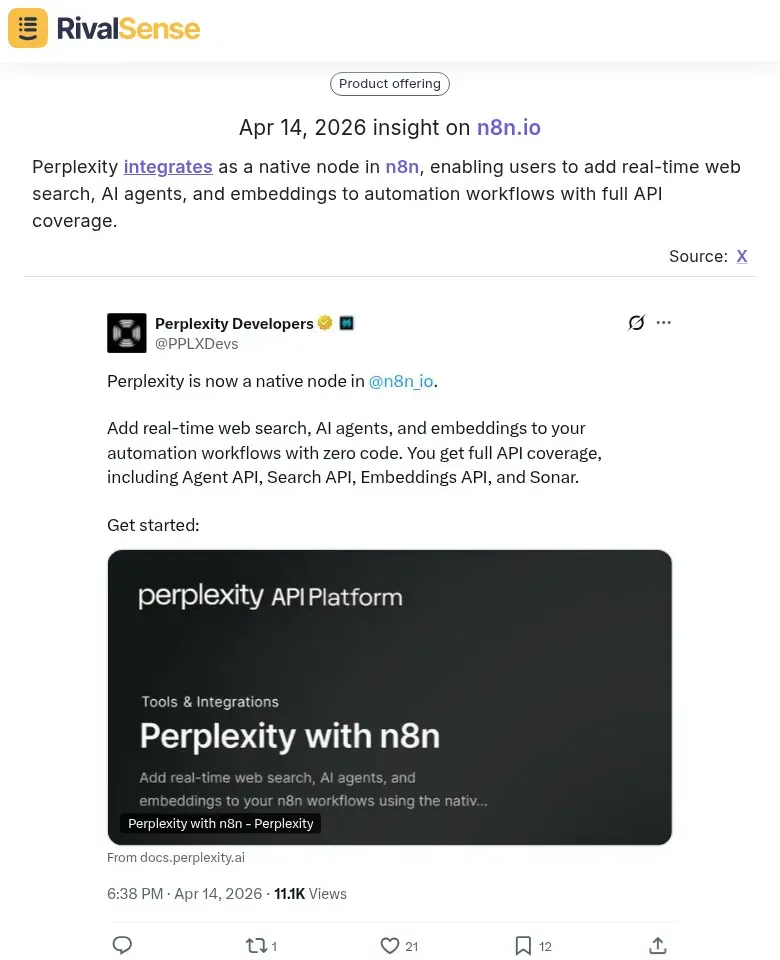
Ecosystem Expansion via Partnerships: Track how competitors integrate with other platforms to expand their reach. For instance, RivalSense identified that Perplexity integrates as a native node in n8n, enabling users to add real-time web search, AI agents, and embeddings to automation workflows with full API coverage. This insight is valuable because it shows Perplexity's strategy to embed itself into automation ecosystems, highlighting opportunities for you to form similar partnerships or differentiate your integration offerings.
✅ Checklist for partnership analysis:
- Monitor competitor websites for new integration pages
- Track Twitter announcements for partnership hashtags
- Analyze the types of platforms they integrate with
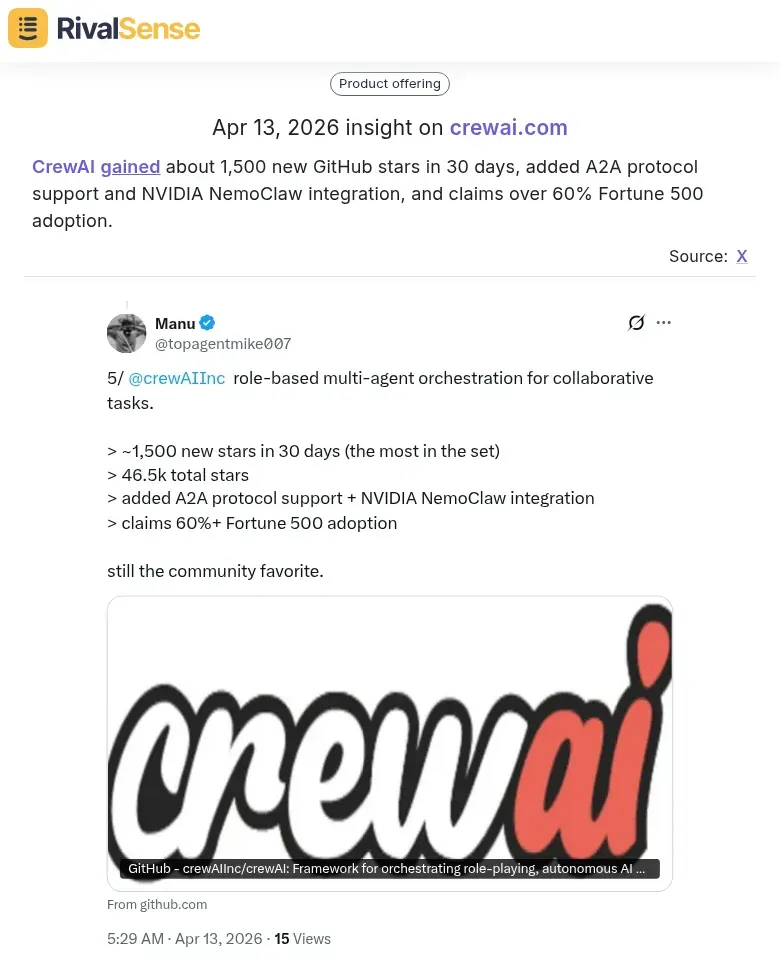
Product-Market Fit and Adoption Signals: Community engagement and enterprise adoption metrics provide validation of competitor success. RivalSense reported that CrewAI gained about 1,500 new GitHub stars in 30 days, added A2A protocol support and NVIDIA NemoClaw integration, and claims over 60% Fortune 500 adoption. This type of insight is crucial for benchmarking your own growth and understanding which features or partnerships drive market traction, helping you prioritize your development roadmap.
🛠️ Practical step: Regularly monitor competitor GitHub repositories, community forums, and case studies to gauge adoption trends.
Combine these insights to reveal competitors' strategic priorities and execution capabilities beyond surface-level announcements.
Actionable Intelligence: Turning Insights into Strategic Advantage
Transform raw competitor data into strategic advantage with these actionable frameworks. Implementing structured approaches ensures that insights lead to concrete business decisions and measurable outcomes.
-
Counter-Strategy Development: Track competitor product announcements on Twitter to reverse-engineer their development timeline. When you spot a pattern (e.g., "beta testing" tweets followed by launch announcements 6-8 weeks later), accelerate your own roadmap or prepare defensive messaging. 📊 Checklist: Monitor launch frequency, feature gaps vs. your offerings, and customer feedback on their releases.
-
Partnership Intelligence: Analyze competitor website partnerships sections and Twitter mentions to identify integration gaps. Look for patterns: Are they consistently partnering with specific SaaS categories? Which integrations are missing from their ecosystem? This reveals underserved market segments ripe for your own partnerships.
-
Metrics Benchmarking: Use website traffic data (estimated via tools) and Twitter engagement metrics to set realistic growth targets. 🎯 Practical tip: Don't just compare follower counts—analyze engagement rates per post type. If competitors get 3x engagement on tutorial content, prioritize educational content in your strategy.
Actionable steps:
- Create a monthly competitive intelligence dashboard tracking these three areas
- Assign ownership for each insight category
- Schedule quarterly strategy sessions to implement findings
Implementation Framework: Building Your Competitive Intelligence System
Building an effective competitive intelligence system requires a structured approach. Without a clear process, data collection can become overwhelming and ineffective, leading to missed opportunities. Start by setting up monitoring systems: For Twitter, use social listening tools to track competitor mentions, hashtag usage, content performance, and customer sentiment. For websites, implement tracking for product updates, pricing changes, feature launches, and content strategy shifts.
Establish a clear analysis cadence: Daily monitoring for urgent alerts (price changes, crisis mentions), weekly analysis for tactical insights (content performance, campaign launches), and monthly strategic reviews for market positioning. Create tailored reports for different stakeholders: Executive summaries for leadership, tactical insights for marketing/product teams, and competitive battle cards for sales.
Integrate insights into decision-making: Product teams should use feature gap analysis to prioritize development. Marketing teams can benchmark content performance and identify messaging opportunities. Sales teams need real-time competitive intelligence to handle objections and position your solution effectively.
Practical checklist:
- Select monitoring tools for both social and web intelligence
- Define key metrics and alert thresholds
- Create standardized reporting templates
- Establish stakeholder communication channels
- Schedule regular review meetings
- Document competitive responses and outcomes
💡 Tip: Start with 2-3 key competitors and expand as your system matures. Focus on actionable insights rather than data collection for its own sake.
Conclusion: Leverage Automated Competitive Intelligence
Manually tracking competitors across Twitter and websites is time-consuming and prone to missing critical updates. To stay ahead, consider using tools that automate this process for you, ensuring you never miss a strategic move.
RivalSense tracks competitor product launches, pricing updates, event participations, partnerships, regulatory aspects, management changes, and media mentions across company websites, social media, and various registries. It delivers all these insights in a weekly email report, saving you hours of manual research.
Try RivalSense for free today at https://rivalsense.co/ and get your first competitor report to start gaining a strategic advantage.
📚 Read more
👉 Agentic AI Key Account Management Certification: Your Ultimate Cheat Sheet
👉 Competitor Product Offering Analysis: A Step-by-Step Workflow for B2B Leaders
👉 Turning Personnel Changes into Competitive Insights: A Real-World Example
👉 The Ultimate Key Account Management Whitepaper: Practical Strategies for 2026
👉 Advanced Key Account Management Tactics for Data Processing Outsourcing