
How ComplyAdvantage's AI Rebranding Prompted Rivals' Strategic Pivot
In October 2025, ComplyAdvantage's launch of Mesh—an AI-native platform—marked a pivotal strategic rebranding from traditional AML compliance to AI-driven financial crime prevention. This move created immediate market pressure on established competitors like Dow Jones Risk & Compliance and LSEG World-Check, while forcing emerging AI-first startups to accelerate their roadmaps. RivalSense tracking revealed how this single strategic move triggered a domino effect across the RegTech landscape, with competitors scrambling to announce AI enhancements, platform integrations, and rebranding initiatives within weeks.
Practical Insight: When a market leader makes a bold strategic pivot, monitor these competitive signals:
- Immediate PR responses announcing "enhanced AI capabilities"
- Accelerated product roadmap announcements
- Strategic partnership announcements with AI/ML providers
- Rebranding initiatives emphasizing AI/automation
- Pricing adjustments or new packaging
Track these signals systematically to anticipate market shifts and identify opportunities for differentiation before the competitive landscape solidifies around the new paradigm.
The Catalyst: ComplyAdvantage's AI-Native Platform Launch
The catalyst for industry-wide disruption came in October 2025 when ComplyAdvantage launched Mesh, an AI-native platform built on a revolutionary three-layer architecture. The foundation combines proprietary real-time risk intelligence (processing 30M+ documents daily), configurable API-first applications for screening and monitoring, and agentic AI workflows that automate up to 95% of AML reviews. Their strategic messaging shifted dramatically from compliance as a cost center to positioning it as a growth catalyst and competitive advantage.
Practical Checklist for Analyzing Competitor Platform Launches:
- Architecture Analysis: Map their three-layer approach vs. your single-point solutions
- Performance Metrics: Benchmark their 70% false positive reduction and 84% faster investigations against your current capabilities
- Messaging Shift: Document how they reframed compliance from cost to competitive advantage
- Automation Assessment: Evaluate what 95% automation means for your team's workflow efficiency
- Strategic Response Planning: Identify gaps in your offering that require immediate attention
Key Takeaway: When competitors launch with quantifiable performance improvements (70-95% metrics) and reframe market positioning, it signals time for strategic reassessment. Track how their messaging influences customer expectations and forces rivals to accelerate their own AI roadmaps.
Real-World Example: Tracking Product Rebranding with RivalSense
Monitoring how competitors rebrand and restructure their product offerings can provide critical insights into their strategic direction. For instance, RivalSense captured that ComplyAdvantage Mesh rebranded its product offerings from individual screening and monitoring modules to unified financial crime risk applications, financial crime risk intelligence, and agentic AI workflows that autonomously resolve up to 85% of routine alerts.
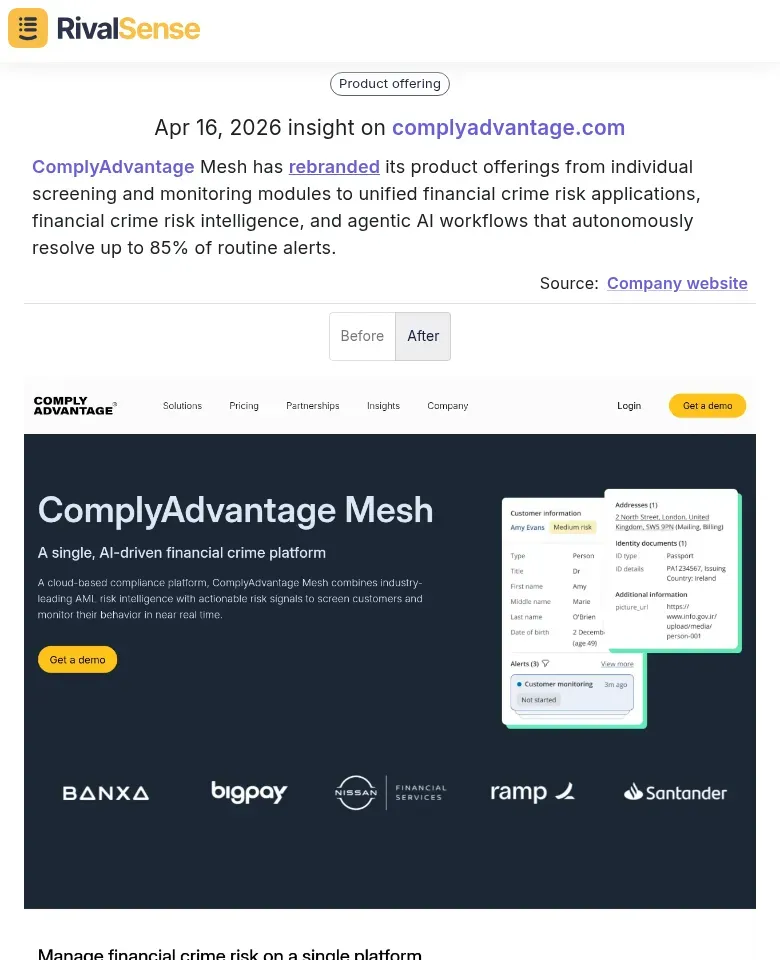
This type of insight is valuable for business strategy because it reveals a shift from fragmented solutions to integrated, AI-driven platforms. By tracking such rebranding moves, you can anticipate market trends, identify gaps in your own offerings, and adjust your strategy to stay competitive. It shows how competitors are consolidating features to provide more value and automation, which can influence customer expectations and competitive benchmarks.
Competitive Landscape Analysis: Pre-Rebranding Market Dynamics
Before ComplyAdvantage's AI rebranding, the AML compliance market was dominated by traditional vendors like Dow Jones, LSEG, and LexisNexis who focused primarily on data aggregation and regulatory compliance rather than AI innovation. These established players leveraged their legacy customer bases and comprehensive data repositories, creating significant barriers to entry for emerging AI-first competitors. Market share distribution showed Dow Jones leading with approximately $300 million in AML KYC revenue (2024), followed by LSEG and LexisNexis, while ComplyAdvantage held a smaller but growing position as an AI-forward challenger.
Practical Analysis Framework:
- Map Legacy Advantages: Identify how established players use data depth and customer inertia as competitive moats
- Track AI Adoption Gaps: Monitor where traditional vendors lag in real-time processing and predictive analytics
- Assess Market Penetration: Evaluate AI startups' limited traction against enterprise customer stickiness
- Benchmark Innovation Velocity: Compare feature development cycles between traditional and AI-native vendors
Key Insight: The pre-rebranding landscape revealed a market ripe for disruption, where AI capabilities represented the next competitive frontier rather than table stakes. Traditional vendors' focus on compliance-as-checklist created opportunities for AI-native players to differentiate through proactive risk intelligence.
The Ripple Effect: How Competitors Responded Strategically
ComplyAdvantage's October 2025 Mesh launch triggered immediate competitive responses across the financial crime compliance sector. Within 60-90 days, traditional vendors like SAS, Oracle, and LexisNexis accelerated AI roadmap announcements, with SAS unveiling its 'Agentic AI for AML' initiative in January 2026 and Oracle announcing enhanced AI capabilities for its Financial Crime suite.
Competitors pursued strategic partnerships to close capability gaps quickly. Dow Jones Risk & Compliance partnered with AI startup Kobalt Labs in December 2025, while Thomson Reuters acquired machine learning specialist FinCrime AI in early 2026. These moves aimed to match Mesh's agentic AI workflows and real-time intelligence capabilities.
Pricing and packaging adjustments followed as market expectations shifted. Vendors introduced tiered AI-native pricing models, with premium tiers offering automated case remediation and predictive risk scoring. Many competitors added 'AI-enhanced' modules to existing platforms while developing full AI-native offerings.
Practical Advice for Monitoring Competitor Responses:
- Track AI roadmap announcements within 90 days of major competitor launches
- Monitor partnership and acquisition activity in adjacent AI/ML sectors
- Analyze pricing changes and feature bundling strategies
- Watch for 'AI-native' rebranding of existing products
- Note how competitors position against new market benchmarks
Strategic Pivots Observed Through RivalSense Tracking
When ComplyAdvantage launched its AI-native Mesh platform in October 2025, RivalSense tracking revealed immediate strategic pivots across the compliance landscape. Dow Jones Risk & Compliance accelerated integration of predictive analytics and machine learning capabilities, responding to the 889% surge in AI-enabled financial crime that ComplyAdvantage highlighted. LSEG World-Check responded with enhanced AI-driven risk scoring and behavioral analysis features in their World-Check On Demand platform, addressing the 98% of financial institutions demanding real-time data for compliance workflows.
Specialized AI startups like Quantexa and Quantifind shifted from niche solutions to comprehensive platform offerings, recognizing the market demand for unified systems.
Practical Advice:
- Monitor competitor AI announcements for market signals
- Track feature release timelines to identify strategic gaps
- Analyze customer feedback on new AI capabilities
- Benchmark your own AI roadmap against industry leaders
- Identify partnership opportunities with specialized AI startups expanding their offerings
Market Impact and Future Implications
ComplyAdvantage's AI rebranding has fundamentally reshaped customer expectations in the RegTech space. Clients now demand AI-driven risk prevention partners rather than mere data providers. This shift has forced competitors to pivot from traditional data aggregation to predictive analytics and automated compliance workflows.
Industry valuation metrics have evolved accordingly. Investors now prioritize AI-native capabilities, machine learning model sophistication, and real-time threat detection over historical data repositories. Companies demonstrating genuine AI integration command premium valuations, while traditional data aggregators face margin pressure.
Practical Implications for Competitors:
- Audit your AI capabilities: Assess whether you're truly AI-native or just using AI as a marketing term
- Develop predictive risk scoring: Move beyond retrospective compliance to proactive prevention
- Build automated workflow integration: Ensure AI insights translate directly into operational efficiency
- Monitor emerging M&A patterns: Watch for consolidation as AI leaders acquire data assets
Future market dynamics suggest rapid consolidation. AI-first platforms will likely acquire traditional data providers to expand their training datasets, while legacy players may struggle to build AI capabilities organically. The winners will be those who successfully bridge the gap between regulatory data and actionable intelligence.
Take Action: Stay Ahead with Competitor Insights
To effectively monitor competitor moves like rebranding, product launches, and strategic pivots, you need a systematic approach. RivalSense tracks competitor product launches/updates, pricing updates, event participations, partnerships, regulatory aspects, management changes, and media mentions across company website, social media, internet, and various registries, delivering all in a weekly email report.
Try RivalSense for free today to get your first competitor report and start anticipating market shifts. Visit https://rivalsense.co/ to sign up and gain the insights needed to refine your strategy and stay competitive.
📚 Read more
👉 Twitter vs. Website: Competitive Intelligence Analysis for Strategic Advantage
👉 Agentic AI Key Account Management Certification: Your Ultimate Cheat Sheet
👉 Competitor Product Offering Analysis: A Step-by-Step Workflow for B2B Leaders
👉 Turning Personnel Changes into Competitive Insights: A Real-World Example
👉 The Ultimate Key Account Management Whitepaper: Practical Strategies for 2026