
Agentic AI Key Account Management Certification: Your Ultimate Cheat Sheet
In today's hyper-competitive enterprise landscape, AI-powered account management has become a strategic imperative. With agentic AI transforming how businesses interact with key accounts, certification in this domain is no longer optional but essential. For instance, tracking competitor adoption rates can reveal market trends; for example, RivalSense insights show that:
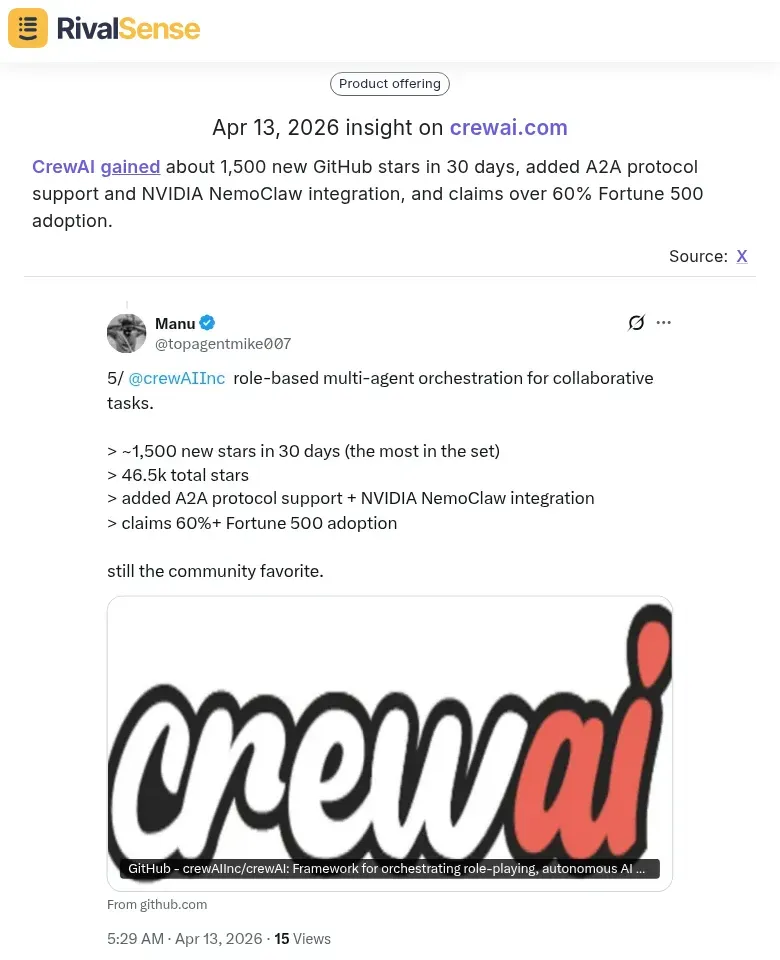
CrewAI gained about 1,500 new GitHub stars in 30 days, added A2A protocol support and NVIDIA NemoClaw integration, and claims over 60% Fortune 500 adoption.
This type of insight is valuable for business strategy as it helps gauge market traction and validate technology choices based on real-world adoption.
Practical Tip: Start by mapping your key accounts to specific AI agent workflows—identify which customer touchpoints can be automated while maintaining personalization. Certification validates your ability to create multi-agent systems where specialized AI agents handle different aspects of account management, from predictive analytics to proactive support.
Key Checklist:
- Understand CrewAI's enterprise adoption patterns across industries
- Master orchestration of specialized agents for different account tiers
- Learn to measure AI-driven account health metrics
- Develop protocols for human-AI collaboration in critical account decisions
As 100% of enterprises plan to expand agentic AI adoption in 2026, certified professionals will lead the transformation of key account management from reactive relationship-building to proactive, data-driven customer success orchestration.
Core Certification Concepts: Mastering Agentic AI Fundamentals
Mastering agentic AI fundamentals is crucial for effective key account management. This certification covers essential concepts that enable you to design and deploy intelligent agent systems. First, autonomous agent architecture involves orchestrating specialized agents (research, analysis, negotiation) through frameworks like LangChain or AutoGen. Practical tip: Map your key account workflows to agent roles before implementation.
Second, certification covers key protocols and integrations. A2A (Agent-to-Agent) protocols enable secure communication between agents, while NVIDIA NemoClaw provides enterprise-grade orchestration. Checklist: Ensure your system supports both synchronous and asynchronous agent interactions.
Third, security and identity management are critical for enterprise deployment. Implement zero-trust principles with role-based access controls and audit trails for all agent actions. Essential step: Establish clear agent identity management before scaling deployments.
Practical advice: Start with a pilot program focusing on one key account process, document all agent interactions, and validate security protocols before full deployment. Remember: Successful agentic AI implementation balances autonomy with appropriate human oversight.
Strategic Integration: Applying Certification to Real-World Account Management
Applying your certification to real-world account management requires strategic integration with existing systems. By leveraging certified frameworks, you can enhance workflows without disrupting current operations. For example, insights from RivalSense reveal how competitors integrate agent-auth solutions:
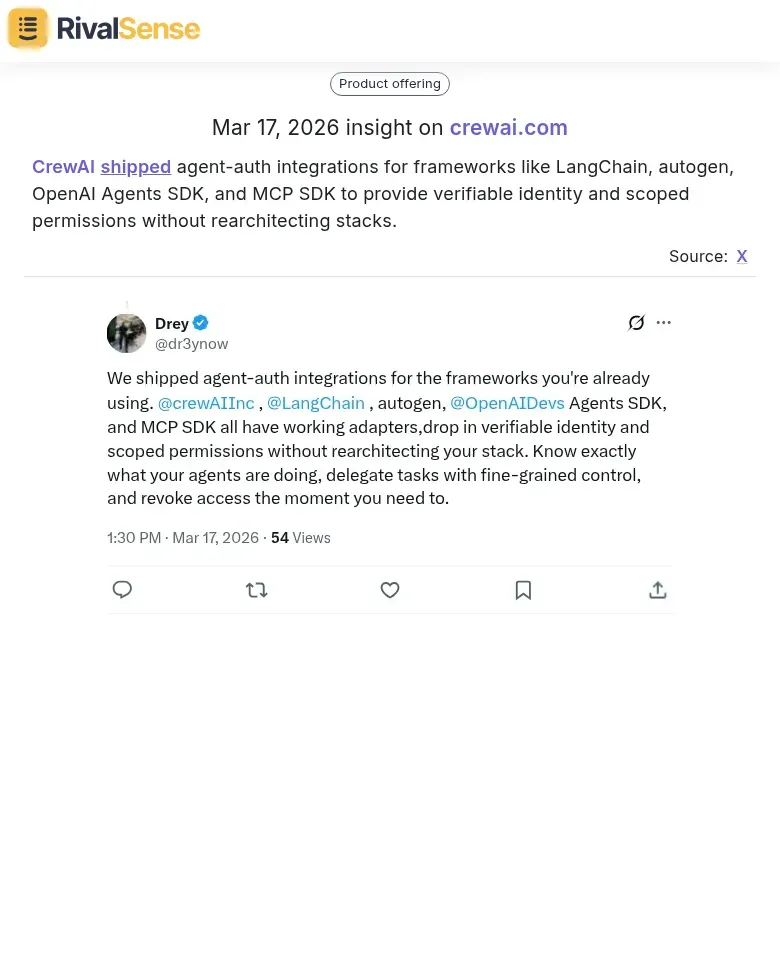
CrewAI shipped agent-auth integrations for frameworks like LangChain, autogen, OpenAI Agents SDK, and MCP SDK to provide verifiable identity and scoped permissions without rearchitecting stacks.
This insight is valuable for business strategy as it demonstrates practical ways to implement security and integration, reducing deployment time and costs.
To leverage agentic AI certifications without rearchitecting, start with these practical steps:
1. Framework Integration Checklist:
- Use LangChain's modular components to add certified agents to existing workflows
- Implement autogen's conversational patterns for multi-agent coordination
- Deploy OpenAI Agents SDK with minimal code changes using wrapper functions
- Create integration bridges between certified agents and legacy systems
2. Security Implementation Guide:
- Assign verifiable digital identities using blockchain-based certificates
- Implement scoped permissions through role-based access controls (RBAC)
- Use API gateways to enforce authentication and authorization layers
- Establish audit trails for all agent interactions with key account data
3. Business Outcome Translation Framework:
- Map certification capabilities to specific account KPIs (e.g., response time, resolution rate)
- Create measurement dashboards linking agent performance to revenue metrics
- Develop ROI calculators showing certification impact on account profitability
- Implement A/B testing to validate improvements in customer satisfaction scores
💡 Pro Tip: Start with a single high-value account as a pilot, measure results, then scale. Use the certification as a competitive differentiator in account reviews, demonstrating both technical compliance and business value delivery.
Competitive Intelligence: Learning from Market Leaders' Success Patterns
Understanding how market leaders execute their strategies can accelerate your certification's adoption. By analyzing competitor activities, you can identify best practices and avoid common pitfalls. For instance, tracking event participation and partnerships provides insights into market engagement:

CrewAI CEO João (Joe) Moura announced that CrewAI is hosting five in-person events across Silicon Valley during GTC week, including executive briefings with Snowflake, enterprise AI training, technical deep-dives, and a builders happy hour with partners Arize AI, SambaNova, and Snowflake.
This type of insight is valuable for business strategy as it reveals how successful companies build credibility through events and partnerships, enhancing brand visibility and network effects.
To accelerate your Agentic AI Key Account Management certification's market adoption, study how successful competitors build credibility. Track GitHub stars growth as an early traction indicator—projects gaining 200+ stars daily signal rapid developer adoption. Monitor enterprise event strategies: analyze executive briefing formats, technical deep-dive content structures, and partner collaboration models that drive enterprise adoption.
Practical Checklist:
- Use Star-History.com to track competitor GitHub star velocity
- Reverse-engineer successful executive briefing agendas (focus on ROI frameworks)
- Map partner ecosystem relationships—identify which partnerships drive certification credibility
- Analyze technical workshop content that converts attendees to certified practitioners
Key Insight: Market leaders leverage ecosystem partnerships to validate certification value. Study how AWS, Microsoft, and Google Cloud certifications gain credibility through partner integrations—these create network effects where each partner implementation reinforces the certification's industry relevance. Focus on partnerships that solve real enterprise pain points rather than superficial endorsements.
Implementation Roadmap: From Certification to Operational Excellence
Transforming your certification into operational excellence requires a structured approach. By following a phased roadmap, you can ensure gradual implementation and measurable outcomes. Begin by integrating professional development with hands-on practice to build confidence.
Phase 1: Professional Development Integration (Months 1-2)
- Schedule certification completion within your next performance review cycle
- Allocate 5-7 hours weekly for hands-on practice with AI tools
- Document 3-5 key learnings to share with your team each month
- 💡 Tip: Pair certification modules with real account challenges for immediate application
Phase 2: Implementation Planning (Months 3-4)
- Create a 90-day action plan mapping certified techniques to your top 5 accounts
- ✅ Checklist: Identify 2-3 AI-powered workflows per account (proactive monitoring, personalized outreach, predictive analytics)
- Assign metrics to each workflow (response time reduction, engagement increase, risk detection accuracy)
- 💡 Hint: Start with low-risk accounts to build confidence before scaling
Phase 3: ROI Measurement & Optimization (Months 5-6+)
- Track retention rate improvements quarterly (target: 5-15% increase)
- Monitor expansion metrics: upsell velocity, cross-sell success rates, account growth
- Calculate certification ROI: (Value of retained/expanded accounts) ÷ (Certification cost + implementation time)
- 🛠️ Practical step: Create a dashboard comparing certified vs. non-certified account performance
- 💡 Pro tip: Share success stories internally to build organizational buy-in for continued AI investment
Future-Proofing Your Career: Advanced Certification Pathways
To stay ahead in the rapidly evolving field of agentic AI, future-proofing your career is essential. Pursuing advanced certifications and continuous learning will keep your skills relevant and in demand. Start by identifying vendor-specific credentials that align with your business goals.
Adopt continuous learning strategies: subscribe to AI research newsletters, join professional communities like the AI Alliance, and attend quarterly workshops on emerging capabilities like multi-agent orchestration and autonomous decision-making. Create a 90-day learning cycle where you master one new AI capability per quarter.
Build thought leadership by combining certifications with practical implementation experience. Document case studies of successful AI deployments, contribute to industry forums, and present at conferences. Create a portfolio showcasing certified expertise applied to real business challenges—this demonstrates both theoretical knowledge and practical problem-solving abilities.
Practical Checklist:
- Identify 2-3 target platforms for certification within 6 months
- Allocate 5 hours weekly for continuous learning
- Document 3 implementation case studies annually
- Present at least once yearly at industry events
- Mentor junior professionals to reinforce expertise
Accelerate Your Strategy with Competitor Insights
Staying ahead in agentic AI requires not only certification but also keen market intelligence. By tracking competitor movements, you can anticipate trends and adjust your strategy accordingly. Tools like RivalSense provide weekly reports on product launches, pricing updates, event participations, partnerships, and more, helping you make informed decisions.
Try RivalSense for Free: To assist with the challenges described in this post, sign up for a free trial at https://rivalsense.co/ and get your first competitor report today. Gain insights into competitor activities and enhance your key account management strategy.
📚 Read more
👉 Competitor Product Offering Analysis: A Step-by-Step Workflow for B2B Leaders
👉 Turning Personnel Changes into Competitive Insights: A Real-World Example
👉 The Ultimate Key Account Management Whitepaper: Practical Strategies for 2026
👉 Advanced Key Account Management Tactics for Data Processing Outsourcing
👉 From Data to Dominance: Using Copilot Insights to Win Microsoft Teams Users