
Competitor Product Offering Analysis: A Step-by-Step Workflow for B2B Leaders
Introduction: Why Competitor Product Offering Analysis Matters
In today's hyper-competitive B2B landscape, systematic competitor product offering analysis isn't just an exercise—it's the foundation of strategic product decisions that determine market leadership. By methodically analyzing competitors' features, pricing, and positioning, you transform raw data into actionable intelligence that drives product roadmaps, feature prioritization, and market entry strategies.
The business impact is substantial: companies that conduct regular competitor analysis identify 37% more market gaps and opportunities than those relying on ad-hoc research. This systematic approach reveals underserved customer segments, emerging feature trends, and pricing vulnerabilities that competitors overlook.
Practical tip: Create a quarterly competitor scorecard tracking key metrics like feature parity, pricing tiers, and customer satisfaction scores. 📊
Real-time competitor tracking transforms reactive analysis into proactive strategy. Instead of responding to competitor moves after they've gained traction, automated monitoring tools provide early warnings about product launches, pricing changes, and market expansions.
Checklist item: Set up alerts for competitor website changes, job postings, and patent filings to anticipate strategic shifts before they impact your market position. 🔍 By integrating competitor intelligence into your strategic planning process, you move from playing catch-up to setting the competitive agenda.
Step 1: Define Your Analysis Scope and Competitor Universe 🎯
Before diving into competitor analysis, clearly define your scope and competitor universe. Start by categorizing competitors: direct competitors offer similar solutions to the same target market, while indirect competitors address the same customer needs with different approaches. For example, a project management tool's direct competitor might be Asana, while an indirect competitor could be a spreadsheet-based workflow.
Establish clear analysis objectives aligned with business goals. Ask: Are you evaluating pricing strategies, feature gaps, or market positioning? Create SMART objectives like "Identify 3 key feature gaps in competitor offerings within 30 days."
Create comprehensive competitor profiles capturing:
- Core product offerings and key features
- Target customer segments and value propositions
- Pricing models and packaging
- Market positioning and messaging
Practical checklist:
- Map competitors on a 2x2 matrix (price vs. features)
- Document each competitor's ideal customer profile
- Note their primary marketing channels
- Track their product release frequency
Tip: Start with 3-5 key competitors to avoid analysis paralysis. Update profiles quarterly as markets evolve.
Step 2: Map and Analyze Core Product Features and Capabilities ⚙️
Now that you've identified key competitors, dive deep into their product offerings. Start by creating a feature matrix spreadsheet comparing your product against each competitor across 15-20 core capabilities. For each feature, note implementation quality, user experience, and pricing tiers.
Analyze how competitors position their value propositions to different audiences. Enterprise-focused competitors might emphasize security certifications and scalability, while SMB-targeted solutions highlight ease of use and quick setup. Examine their messaging across website copy, case studies, and sales materials.
Practical checklist:
- Document feature availability across pricing plans
- Rate each feature (1-5 scale) for quality and user experience
- Note unique capabilities competitors have that you lack
- Identify gaps where you excel but competitors fall short
Evaluate technical capabilities and integration ecosystems. Check API documentation quality, available endpoints, and developer resources. Map out their integration partners and app marketplaces. Tip: Sign up for free trials to test API limits and documentation accuracy firsthand.
This analysis reveals where you can differentiate through superior features, better integrations, or more targeted positioning for specific customer segments.
Step 3: Assess Strategic Positioning and Market Evolution 🔄
Track how competitors evolve their messaging and target audiences over time by analyzing their website content, social media posts, and marketing materials from the past 6-12 months. Look for changes in value propositions, feature emphasis, and customer testimonials.
Identify strategic shifts by monitoring product roadmap announcements, pricing changes, and new market entries. Create a timeline of major positioning changes to spot patterns. For example, if a competitor shifts from targeting SMBs to enterprise clients, note the accompanying messaging changes.
Real-World Insight: Monitoring strategic shifts is crucial for anticipating market moves. RivalSense recently detected that You.com shifted its demo focus from building enterprise AI with data security and ROI to building AI with real-time, reliable data through its Search API, emphasizing citation-backed results, reduced hallucinations, and integration into AI workflows. 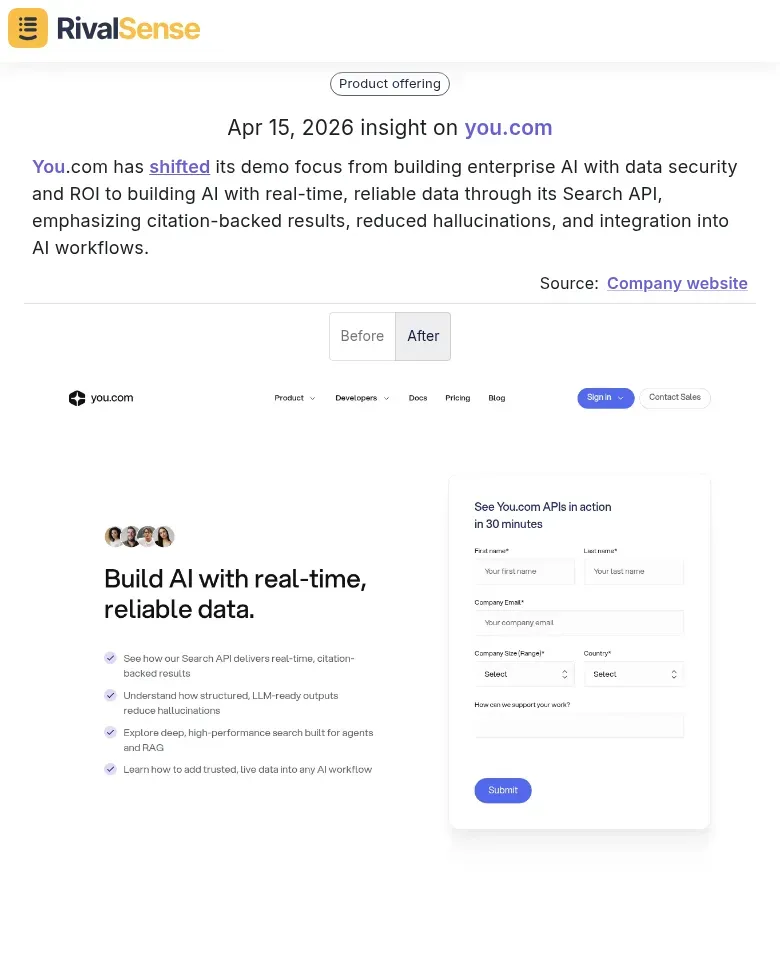 This type of insight is valuable because it reveals how a competitor is pivoting to highlight real-time data and reliability, which can inform your own positioning if you're in the AI space or competing on data-driven features.
Analyze adaptation to market trends by comparing how different competitors respond to the same industry developments. Track which features they prioritize when customer needs evolve.
Practical tip: Set up quarterly reviews of competitor positioning using a standardized checklist:
- Review website messaging changes
- Analyze recent case studies and customer stories
- Monitor social media for new audience targeting
- Track feature announcements and product updates
- Compare pricing and packaging changes
Watch for subtle shifts like moving from "ease of use" to "enterprise-grade security" messaging, which signals strategic repositioning. These insights help you anticipate market moves and refine your own positioning strategy.
Step 4: Evaluate Integration Ecosystems and Partnership Strategies 🤝
Strategic partnerships and integrations are where competitors create exponential value beyond their core product. Start by mapping each competitor's integration ecosystem - categorize them by type (native APIs, third-party connectors, marketplace apps) and strategic importance (must-have vs. nice-to-have).
Assess how competitors expand their ecosystems: Are they acquiring complementary tools, building strategic alliances, or creating open platforms? Look for patterns in their partnership announcements - do they focus on specific industries, workflow stages, or customer segments?
Real-World Insight: Partnership updates can signal new market opportunities. For instance, RivalSense tracked that Lumia added support for Harvey AI on April 14, enabling enterprises to govern its use for data protection and compliance. 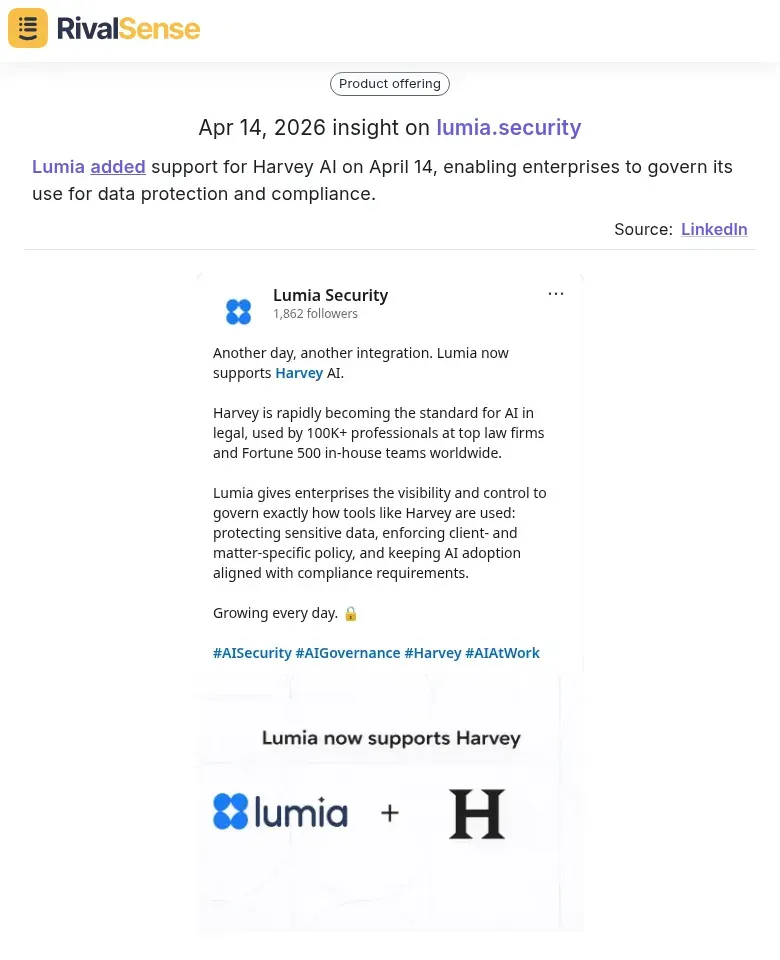 This insight is valuable because it shows how competitors are enhancing their offerings with AI governance features, which is critical for enterprise customers concerned with compliance and data security.
Practical Checklist:
- Document all partner logos on competitor websites
- Test integration workflows end-to-end
- Analyze partnership announcements for strategic direction
- Evaluate API documentation quality and developer support
Key Insight: The most valuable integrations aren't just technical connections - they're workflow enhancements. Analyze how competitors' integrations reduce manual work, eliminate data silos, or create new automation possibilities. For example, if a competitor integrates with Salesforce, Slack, and Zapier, they're targeting sales teams who need automated workflows across communication and CRM platforms.
Actionable Tip: Create a 'workflow gap analysis' - identify where your target customers still have manual processes that competitors' integrations don't address. These gaps represent your biggest opportunities for differentiation through superior automation capabilities.
Step 5: Synthesize Insights and Develop Actionable Strategies 🚀
Now that you've gathered competitive intelligence, the real value comes from translating insights into action. Start by creating a prioritization matrix that maps competitor features against customer value and implementation effort. Focus on high-value, low-effort opportunities first.
For differentiation strategies, identify gaps where competitors are weak but customers care. Consider three approaches: 1) Feature parity on essentials, 2) Superior execution on key differentiators, and 3) Blue ocean innovation in underserved areas. Use a competitive positioning map to visualize where you can create unique value.
Real-World Insight: Ecosystem additions can reveal unmet customer needs. RivalSense observed that Guesty added bnbills to its ecosystem on April 14, offering automated e-invoicing and real-time sync to address manual billing and accounting workflows for property managers. 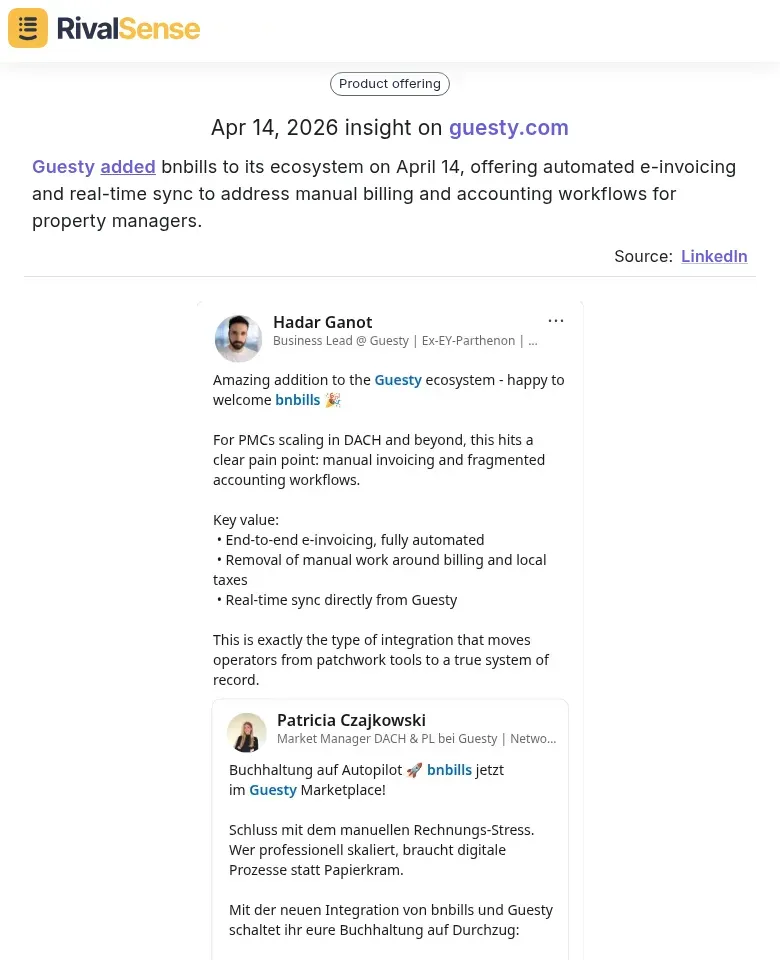 This type of insight is valuable because it highlights how competitors are solving specific pain points through partnerships, which can inspire similar initiatives in your own product strategy to address workflow inefficiencies.
Create implementation plans with clear ownership and timelines. For each strategic initiative, define:
- Success metrics (adoption rate, customer satisfaction)
- Resource requirements (team, budget, timeline)
- Risk mitigation strategies
- Competitive response scenarios
Practical tip: Use a "competitive advantage scorecard" to track progress. Score each initiative on market impact, technical feasibility, and alignment with your core strengths. Revisit quarterly to adjust based on competitor moves and market feedback.
Putting It All Together: From Analysis to Action 📈
Competitor product offering analysis is an ongoing process that requires diligence and the right tools. By following this step-by-step workflow, you can systematically uncover opportunities, anticipate market shifts, and craft strategies that keep you ahead.
To streamline this process, consider using automated competitor tracking tools. For example, RivalSense tracks competitor product launches/updates, pricing changes, event participations, partnerships, regulatory aspects, management changes, and media mentions across company websites, social media, and various registries. It delivers all this intelligence in a weekly email report, saving you hours of manual research.
Ready to transform your competitor analysis? Try out RivalSense for free at https://rivalsense.co/ and get your first competitor report today to start making data-driven decisions with confidence.
📚 Read more
👉 Turning Personnel Changes into Competitive Insights: A Real-World Example
👉 The Ultimate Key Account Management Whitepaper: Practical Strategies for 2026
👉 Advanced Key Account Management Tactics for Data Processing Outsourcing
👉 From Data to Dominance: Using Copilot Insights to Win Microsoft Teams Users
👉 Twitter Competitor Tracking: Ultimate Checklist for Key Account Models