
5 Real-World Competitor SWOT Examples for B2B Leaders
Introduction: Why SWOT Matters for B2B Leaders
In today’s fast-paced B2B landscape, understanding your competitors isn’t just about watching their pricing—it’s about systematically analyzing their strengths, weaknesses, opportunities, and threats (SWOT). A well-executed SWOT analysis helps you uncover blind spots, spot market shifts early, and make strategic moves that keep you ahead. Whether you’re a startup founder or a seasoned CEO, this framework turns raw competitor data into actionable strategy.
🔥 Practical Tip: Involve your sales, product, and customer success teams when building your SWOT. They often have frontline intel that won’t appear in press releases. Rank each factor by impact (1-5) and urgency (1-5), then assign owners and deadlines for mitigation or exploitation.
Below are five real-world examples of how RivalSense insights can feed into your competitor SWOT—each one demonstrating a different dimension.
Example 1: Strengths – Spotting Thought Leadership
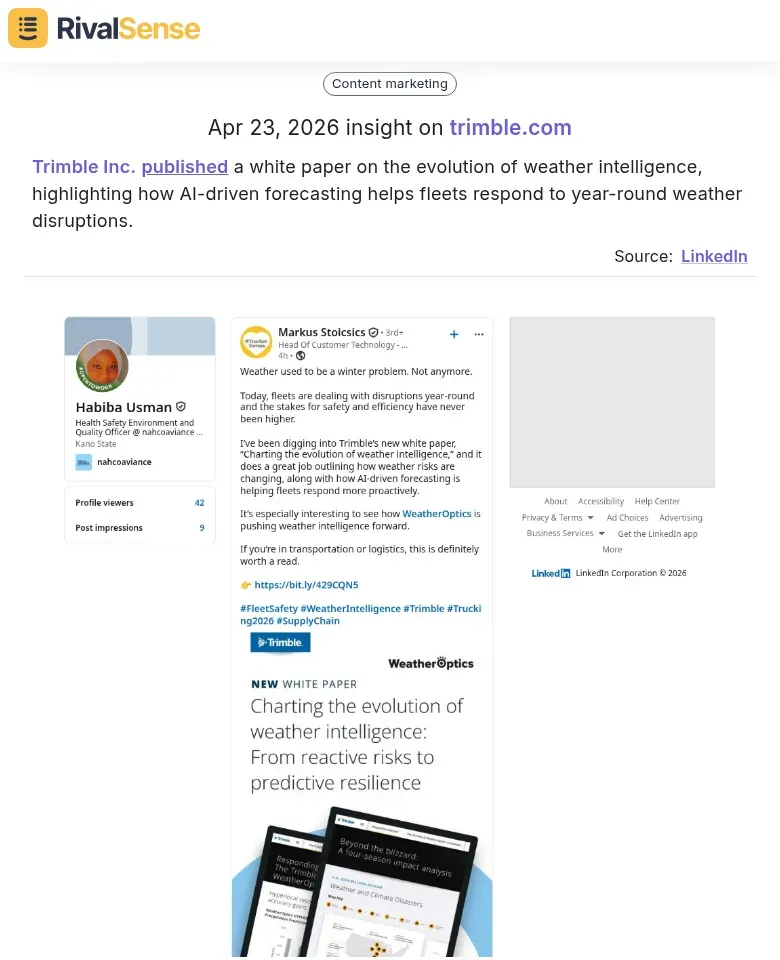
When a competitor publishes a high-quality white paper, it signals deep expertise and investment in R&D. For example, Trimble Inc. recently released a white paper on the evolution of weather intelligence, highlighting how AI-driven forecasting helps fleets respond to year-round disruptions. This is a clear strength: they control a narrative, educate buyers, and position themselves as innovators.
Why this matters for your strategy: A competitor’s strength becomes a benchmark for your own content. If they’re dominating a niche topic, you might need to carve out a different angle or invest in deeper expertise to differentiate.
✅ Action Steps:
- Monitor competitor content regularly (RivalSense automates this).
- Evaluate whether their white paper is gaining traction (shares, downloads).
- Decide if you should publish a rebuttal, a complementary guide, or shift focus to an adjacent topic.
Example 2: Weaknesses – Detecting Operational Slips
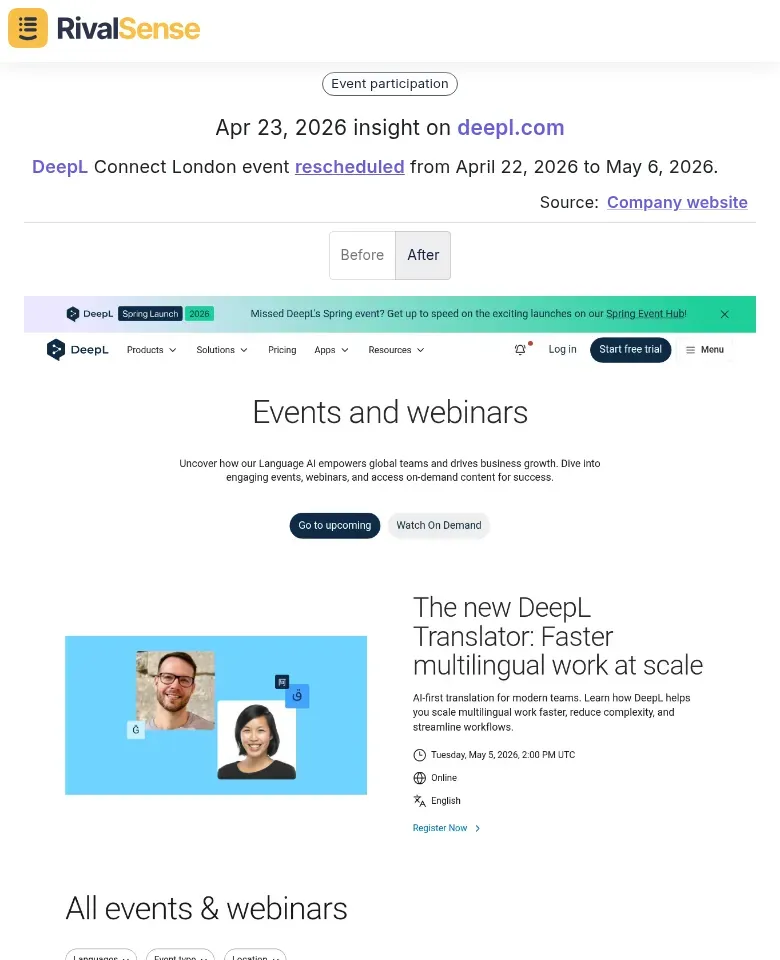
A competitor’s weakness can be subtle—like a rescheduled event that hints at internal disorganization or resource constraints. Recently, DeepL rescheduled its Connect London event from April 22 to May 6, 2026. While minor, this change can indicate planning issues, budget reallocation, or speaker availability problems.
Why this matters for your strategy: Weaknesses are opportunities for you to capitalize. If DeepL is struggling with event logistics, you could host a competing webinar or in-person event during their original date to capture mindshare.
✅ Action Steps:
- Track competitor event changes (dates, venues, cancellations).
- Use delays as signals to accelerate your own campaigns.
- Offer your audience alternatives if your competitor’s event falters.
Example 3: Opportunities – Watching Competitor Innovation
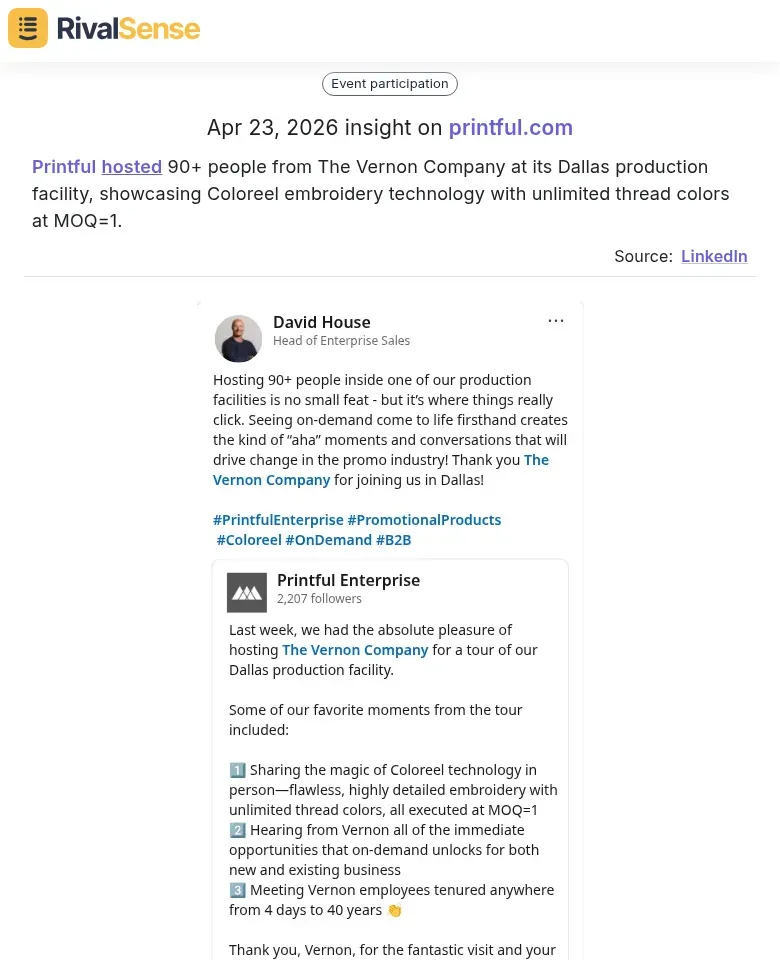
Sometimes a competitor’s move creates an opportunity for you—by validating a new market or technology. Printful hosted 90+ people from The Vernon Company at its Dallas production facility, showcasing its Coloreel embroidery technology with unlimited thread colors at MOQ=1. This demonstrates a growing demand for high-mix, low-volume customization.
Why this matters for your strategy: If a competitor is investing in new capabilities, it signals a market trend. You can either partner with them (if complementary), develop your own competing offering, or focus on a different segment that they’re ignoring.
✅ Action Steps:
- Analyze the event’s attendance and feedback.
- Assess whether their new capability threatens your positioning or opens adjacent niches.
- Decide whether to invest in similar tech or build a partnership.
Example 4: Threats – Price Competition from Low-Cost Rivals
A common threat in B2B is price undercutting from new entrants or offshore competitors. Imagine a mid-tier SaaS company facing a rival offering a similar product at 40% less. The threat is real: margin erosion, churn, and downward pricing pressure.
🔧 Mitigation Strategies:
- Bundle value-added services – Offer free onboarding, dedicated support, or custom integrations that justify your price.
- Leverage your existing customer base – Introduce loyalty discounts or early renewal incentives to reduce switching.
- Differentiate on outcomes – Shift sales conversations from features to ROI metrics (e.g., “Our clients see 30% faster implementation”).
✅ Checklist for Resilience:
- [ ] Map your pricing against top 3 competitors quarterly.
- [ ] Develop a “battle card” for sales to counter price objections.
- [ ] Invest in thought leadership to reduce pure price comparison.
Example 5: Threats – Competitor Partnerships That Change the Game
When a competitor announces a strategic partnership with a major platform (e.g., AWS, Salesforce), it can suddenly expand their reach and capabilities. For instance, a niche analytics tool partnering with HubSpot becomes a threat to your own integrated offering. RivalSense tracks such partnership announcements across websites and registries.
Why this matters for your strategy: Partner moves can shift competitive dynamics overnight. You need to assess whether you need a similar alliance or if you can exploit gaps in their integration depth.
✅ Action Steps:
- Identify the strongest potential partner for your own business.
- Launch a targeted outreach campaign before your competitor solidifies exclusivity.
- Monitor partnership news weekly using automated alerts.
Conclusion: Turn Insights into Action with RivalSense
Each of these examples shows how a single competitor data point—a white paper, an event change, a facility tour—can feed directly into your SWOT analysis. But manual tracking is inefficient and slow. The best leaders automate competitor monitoring so they can focus on strategy, not data collection.
Your 4-Step Competitor SWOT Framework:
- Collect – Use RivalSense to automatically gather competitor updates: product launches, pricing, events, partnerships, media mentions, and more.
- Categorize – Map each insight into SWOT quadrants. For example, a competitor’s new partnership = their strength, your threat.
- Prioritize – Rank by impact and urgency, then assign action items.
- Act – Execute with clear ownership and deadlines.
🚀 Try RivalSense for free today: https://rivalsense.co/. Get your first competitor report within minutes and start turning insights into your competitive edge.
📚 Read more
👉 How CrewAI's New Coding Skills Signal a Shift in Agentic AI Strategy
👉 5 Best Practices for Mining Competitor Insights from Twitter (with Real-World Examples)
👉 Competitor Customer Testimonials Analysis Template for Social Media Agencies
👉 Uncover Key Account Opportunities Through Competitor Event Analysis
👉 Sendible's Strategic Pivot: From Small Business to Software Integrators – What It Means for You