
The Real Benefits of Competitor Analysis (And How to Do It Without Getting Lost in the Weeds)
Let’s be honest: competitor analysis can feel like a chore. You’re busy building your business, and the last thing you want to do is spend hours stalking other companies’ websites, social feeds, and press releases. But here’s the truth: the businesses that grow fastest aren’t the ones that ignore competition—they’re the ones that use it as fuel.
Done right, competitor analysis gives you a clear-eyed view of your market, reveals gaps you can exploit, and helps you avoid costly mistakes. In this post, we’ll break down the real benefits of competitor analysis, share a practical step-by-step process, and show you how to keep it from becoming a time-suck.
🚀 1. Competitor Analysis Validates Your Market
If you’re launching something new, it’s tempting to think “no competition = guaranteed success.” In reality, the opposite is often true. Competition validates that there’s a real market for your product.
When other businesses are solving the same problem, it means customers are willing to pay for a solution. You don’t have to convince people they have a problem—they already know. Your job is to show them why your solution is better.
Example: Imagine you’re launching a project management tool for remote teams. If there are already 10 tools doing similar things, that’s a good sign. The market exists. Your challenge is differentiation, not market creation.
🎯 2. It Helps You Spot Opportunities Others Miss
Most businesses only track their top 2–3 direct competitors. That’s a mistake. The biggest opportunities often come from indirect competitors or adjacent markets.
When you systematically analyze competitors—their features, pricing, customer reviews, and marketing—patterns emerge. You’ll see what customers love and, more importantly, what they complain about. Those complaints are your goldmine.
Practical step: Create a simple competitive matrix with columns for your business and 5–7 competitors. Rate each on factors like price, features, customer support, ease of use, and target audience. Look for cells where you can score higher than everyone else.
💡 3. It Forces You to Differentiate
Without competition, it’s easy to get complacent. You might add features that don’t matter or drift away from your core value proposition. Competitor analysis keeps you focused on what makes you unique.
When you see what competitors are doing, you can ask: What are we doing better? What do we do differently? Why would a customer choose us? If you can’t answer those questions clearly, you’ve got work to do.
Checklist for differentiation:
- [ ] List your top 3 competitors.
- [ ] For each, write down their primary value proposition.
- [ ] Now write yours. Is it distinct? If not, refine it.
- [ ] Test your positioning with a customer: “How would you describe what we do differently?”
📉 4. It Reduces the Cost of Customer Education
Being first-to-market sounds great, but it comes with a hidden cost: you have to educate the market from scratch. Every dollar you spend explaining why someone needs your product is a dollar you can’t spend on closing deals.
When competitors enter the space, they share the burden of education. Customers already understand the problem and the category. Your job becomes simpler: show why you’re the best choice.
Example: When Salesforce launched, it had to convince companies that cloud CRM was safe and effective. Today, new CRM entrants benefit from that groundwork—they just need to prove they’re better or cheaper.
⚡ 5. It Keeps You Honest (and Agile)
Markets shift. Competitors launch new features, change pricing, or enter new segments. If you’re not tracking these moves, you risk being blindsided.
Regular competitor analysis helps you:
- Anticipate threats before they become crises.
- React quickly to market changes.
- Benchmark your progress against industry standards.
Tip: Set a recurring calendar reminder to review your competitive landscape. Monthly is good; quarterly is the minimum. Use a tool to automate the data collection so you’re not manually checking 20 websites every week.
💼 6. It Strengthens Your Investor Pitch
Investors want to know you understand your market. A well-researched competitive analysis shows you’re not naive. It demonstrates that you’ve thought about positioning, risks, and your unique advantage.
When you present your analysis, include:
- A positioning map (price vs. quality, or another relevant axis).
- A competitive matrix showing how you stack up.
- A clear statement of your competitive edge.
Pro tip: Be honest about your weaknesses. Investors respect self-awareness. If you claim to be better than everyone on every dimension, they’ll assume you’re either lying or delusional.
🔍 Real Competitor Insights That Drive Strategy
To make this practical, let’s look at three real examples of competitor changes tracked by RivalSense and how each type of insight can impact your business strategy.
📦 Pricing & Category Updates
Insight: Bank of Lamps added a 'Plug-in night light' to its Luminaires category and increased prices on multiple OSRAM products, removing previous price validity dates.
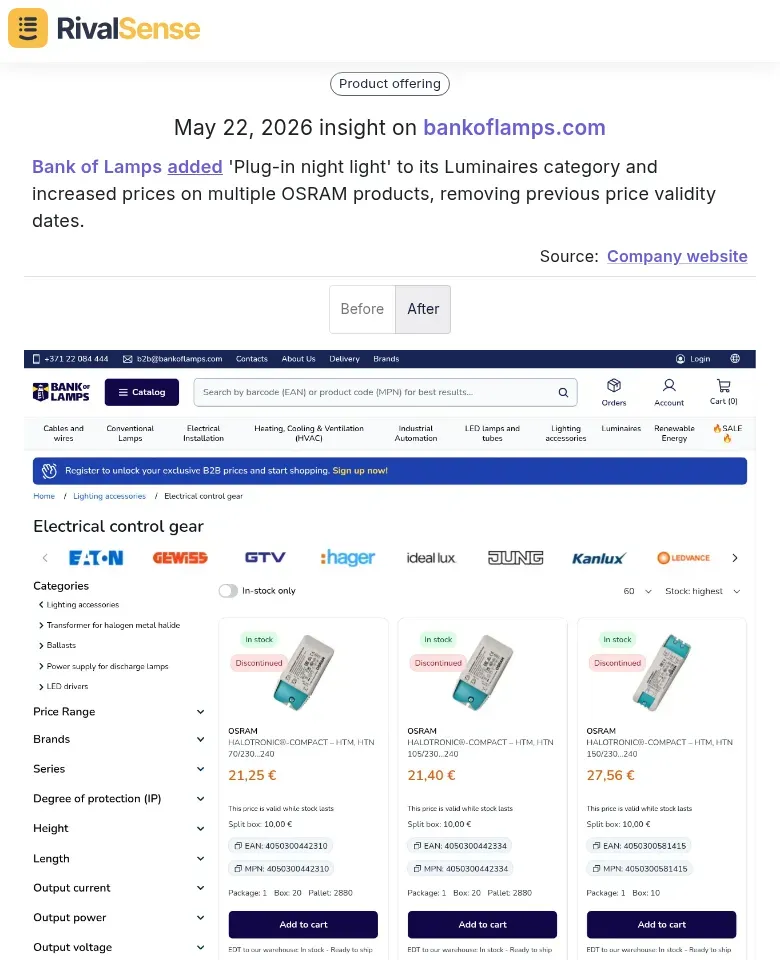
Why this matters: Pricing moves signal market positioning and margin pressure. If a competitor raises prices and removes validity dates, they may be testing price elasticity or preparing for supply chain changes. You can decide whether to follow, undercut, or highlight your own price stability.
🔄 Supplier & Product Line Shifts
Insight: Bank of Lamps added PATRON brand fluorescent tubes and removed SPL Lighting brand, updated product listings with new PATRON series and discontinued OSRAM T5 HO tube.
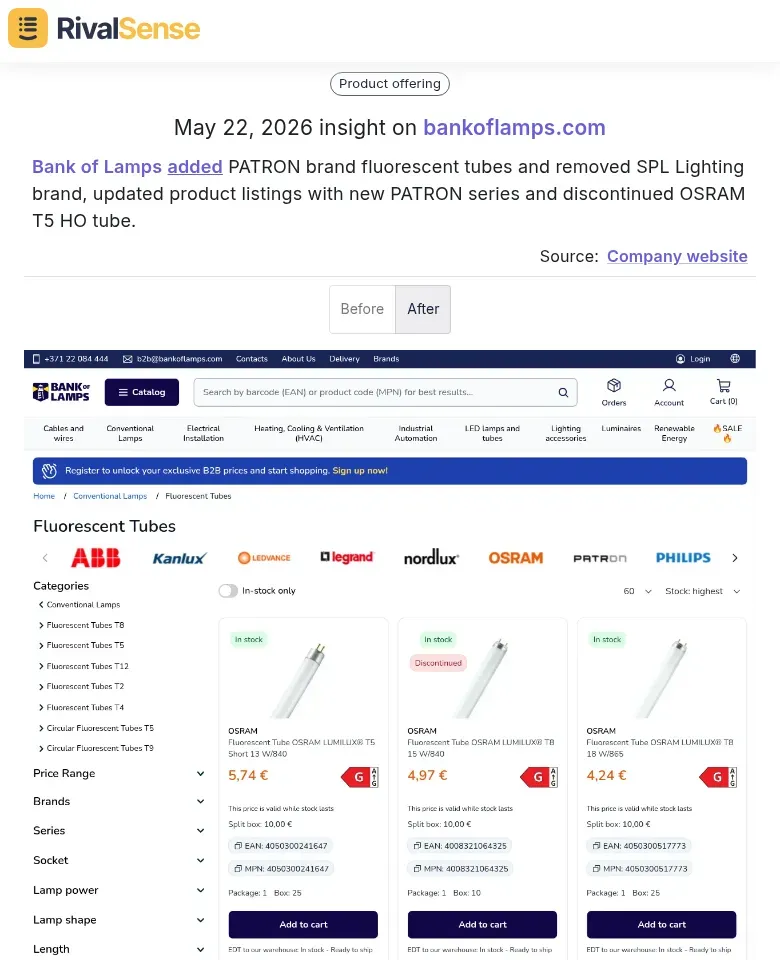
Why this matters: Brand and product line changes reveal strategic pivots. Dropping a supplier and adding another might indicate better margins, quality issues, or a shift in target audience. Tracking these lets you adjust your own sourcing or messaging before customers notice a change in the market.
🧩 Platform Expansion & New Features
Insight: Shufti added QES (Qualified Electronic Signature) to Business Onboarding, Fraud Hub to Authentication, and expanded its platform with features like Global Trust Platform, Case Management, Journey Builder, Shufti AI, and more.
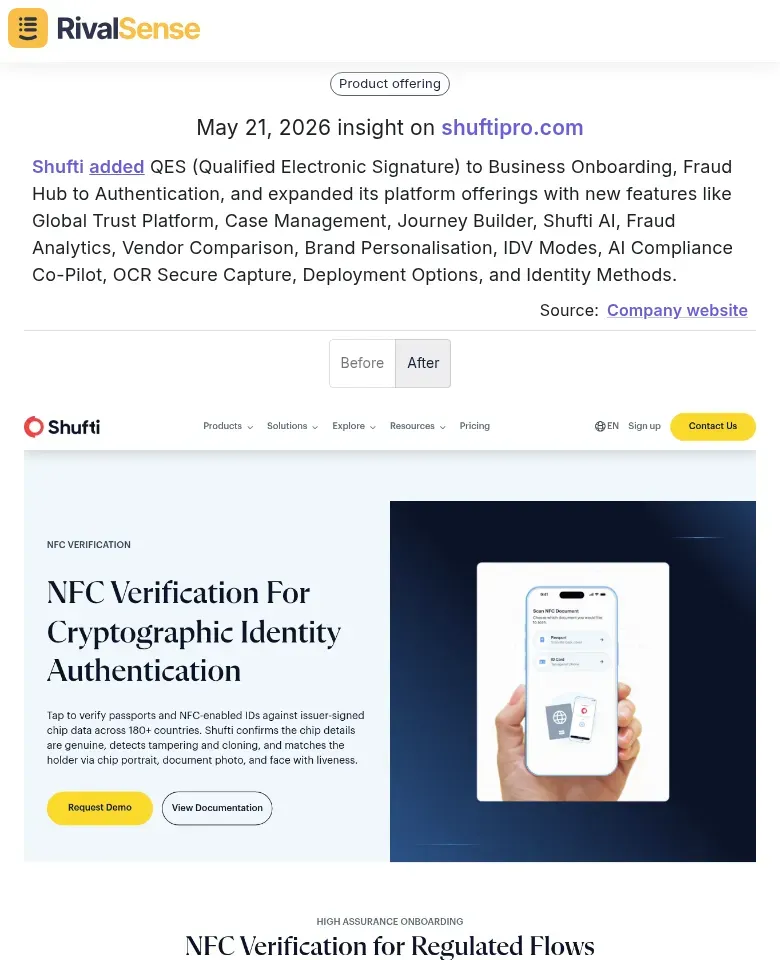
Why this matters: Feature rollouts show where a competitor is investing. If they’re adding compliance tools or AI features, they’re likely trying to capture a regulated or more sophisticated segment. You can decide whether to match, partner, or differentiate by focusing on a niche they’re ignoring.
🛠️ How to Do Competitor Analysis Without Drowning in Data
The biggest risk of competitor analysis is that it becomes a black hole of time. You start with good intentions, and suddenly you’re reading every blog post, watching every webinar, and analyzing every pricing page of 15 different companies.
Here’s a practical, time-boxed process:
Step 1: Identify Your Competitors (30 minutes)
List 5–10 competitors. Include direct competitors (same product, same audience) and indirect competitors (different product, same problem).
Step 2: Choose Your Comparison Criteria (15 minutes)
Pick 5–7 factors that matter to your customers. Common ones:
- Price
- Features
- Ease of use
- Customer support
- Target audience
- Distribution channels
Step 3: Gather Data (2–3 hours, then automate)
Visit competitor websites, read reviews, check social media, and look at press releases. But here’s the key: don’t do this manually every time.
Instead, set up ongoing monitoring. For example, RivalSense tracks competitor product launches, pricing updates, event participations, partnerships, management changes, and media mentions across 80+ sources—company websites, social media, news, and registries. It delivers a weekly email report so you stay informed without the manual grind.
Step 4: Analyze and Act (1 hour per month)
Review your findings and update your competitive matrix. Identify 1–2 actions to take based on what you learned. Maybe you need to adjust pricing, add a feature, or refine your messaging.
⚠️ Common Pitfalls to Avoid
- Analysis paralysis. Don’t try to know everything. Focus on the 20% of competitors that matter 80%.
- Copycat syndrome. If all you do is match competitors, you’ll never lead. Use analysis to find your own path.
- Ignoring indirect competitors. They can disrupt your market from a different angle.
- Forgetting the customer. Competitor analysis is a means to an end—serving your customers better. Don’t obsess over competitors at the expense of customer conversations.
Final Thoughts
Competitor analysis isn’t about paranoia or copying. It’s about clarity. When you know the landscape, you can make smarter decisions, spot opportunities faster, and build a business that stands out.
And remember: you don’t have to do it all manually. Tools like RivalSense can handle the heavy lifting of monitoring, so you can focus on strategy and execution.
Want to see how easy competitor tracking can be? Try RivalSense for free and get your first competitor report today.
📚 Read more
👉 Free Key Account Management Software Trial: Unlock Growth for B2B Service Businesses
👉 How Revolut's $120M NZ Expansion Alerted a Rival to Act
👉 Unlock Competitor Insights from Instagram to Boost Key Account ROI
👉 Key Account Tracking Framework for Travel Industry Growth
👉 Track Competitor Financials & M&A to Boost Customer Satisfaction