
Case Study: How Media Mentions Reveal Key Account Advocacy Opportunities
Media mentions aren't just PR metrics; they're strategic intelligence goldmines that reveal competitor moves before they hit the market. When competitors secure coverage in industry publications, they're often signaling strategic shifts, new product launches, or key partnership announcements. These mentions serve as early warning systems, giving you 2-4 weeks of lead time to prepare counter-strategies.
More importantly, media coverage creates natural advocacy opportunities. When a publication quotes your competitor's customer, that customer has publicly endorsed their solution—creating a powerful third-party validation you can't replicate with marketing alone. Track which accounts are being featured and why they're speaking up.
Common monitoring pitfalls include:
- Focusing only on volume, not context
- Missing regional or niche publications
- Ignoring executive quotes that reveal strategic intent
Practical steps:
• Set up alerts for competitor names + "customer" or "case study"
• Monitor industry publications your target accounts read
• Track which executives are being quoted and what they're revealing
• Create a media mention dashboard with sentiment analysis
Pro tip: When you see a competitor's customer featured, that's your signal to research that account's pain points and position your solution as the better alternative.
Decoding Service Excellence Signals: Turning Awards into Advocacy Opportunities
Competitor awards and recognition reveal critical service excellence insights that can inform your advocacy strategy. By analyzing these accolades, you gain visibility into what customers value most and where competitors excel.
Start by tracking industry-specific awards like Customer Service Excellence Awards, analyzing judging criteria and winning case studies. Identify patterns: which service aspects consistently earn recognition? Is it response time, personalization, or problem resolution?
Example RivalSense Insight:
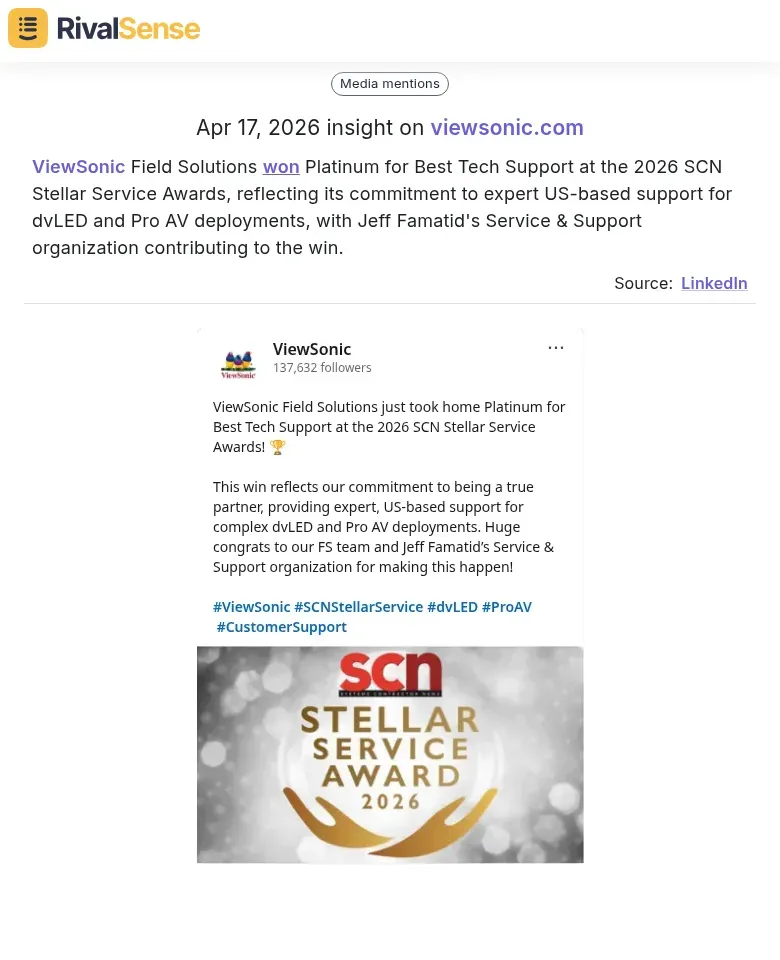
ViewSonic Field Solutions won Platinum for Best Tech Support at the 2026 SCN Stellar Service Awards, reflecting its commitment to expert US-based support for dvLED and Pro AV deployments, with Jeff Famatid's Service & Support organization contributing to the win.
Why this insight is valuable: Award announcements highlight competitor strengths and customer priorities. They help you identify key personnel and service methodologies that drive advocacy, allowing you to target similar accounts or improve your own service offerings.
Practical Checklist:
- Create a competitor awards database with categories, dates, and specific achievements
- Analyze award press releases for quoted personnel - these are your advocacy targets
- Map organizational structures: Who leads service teams? Which departments receive recognition?
- Note specific service methodologies mentioned in award submissions
Key Personnel Identification: Look beyond executives to mid-level managers and team leads mentioned in award announcements. These individuals often drive day-to-day service excellence and can become powerful advocates when approached correctly.
Turning Insights into Action: Translate competitor strengths into your advocacy strategy by:
- Developing similar service protocols that address identified gaps
- Creating targeted outreach to customers who value specific service aspects
- Building case studies around service improvements inspired by competitor successes
- Implementing recognition programs that mirror award-winning approaches
Remember: Awards signal what customers value most. Use this intelligence to build advocacy programs that address those exact priorities, positioning your company as equally committed to service excellence.
Content Expansion Patterns: Identifying Emerging Media Formats and Partnerships
When analyzing competitor media mentions, track their content diversification patterns to anticipate market trends. These patterns reveal where audience attention is shifting and where you can establish thought leadership.
Look beyond traditional press releases to identify emerging media formats like podcasts, video series, webinars, or interactive content that competitors are leveraging. For example, if a competitor suddenly appears on industry podcasts or launches a video interview series, this signals where you should consider expanding your presence.
Example RivalSense Insight:
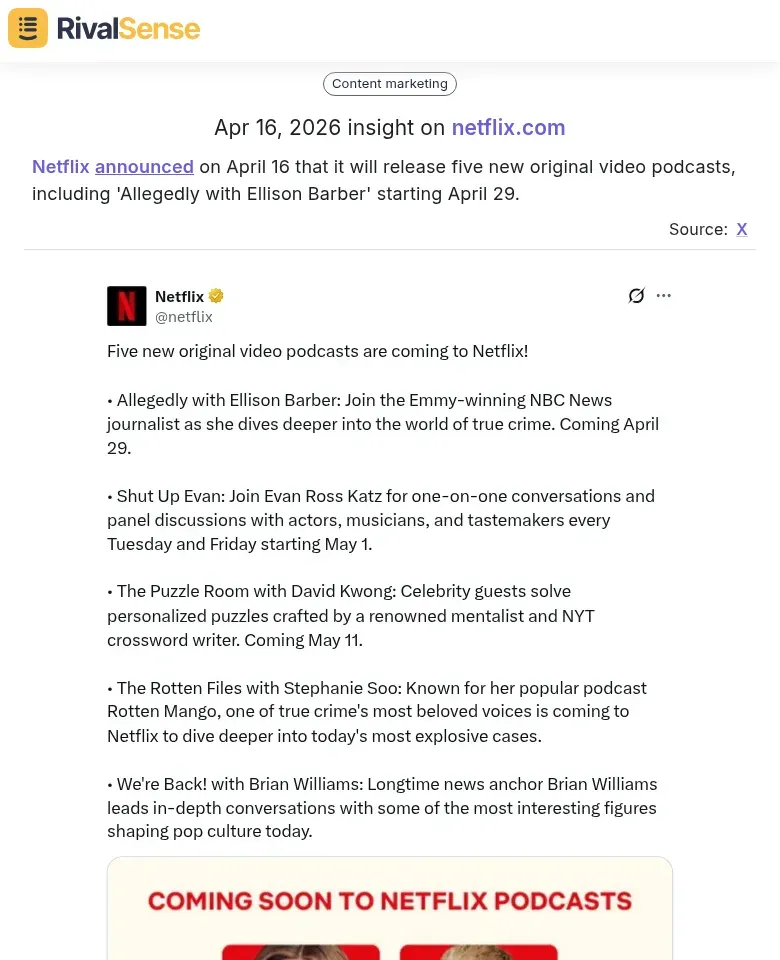
Netflix announced on April 16 that it will release five new original video podcasts, including 'Allegedly with Ellison Barber' starting April 29.
Why this insight is valuable: Content expansion insights show where competitors are investing in new media formats. This indicates emerging channels for audience engagement and partnership opportunities, helping you allocate resources to untapped areas before competitors dominate.
Practical steps:
- Create a media format matrix tracking competitors across channels (podcasts, video, webinars, newsletters)
- Monitor partnership announcements for co-branded content or guest appearances
- Identify content gaps where competitors aren't present but your audience is active
- Analyze engagement metrics on different formats to prioritize your expansion
These patterns reveal where to establish thought leadership before competitors dominate new channels. If competitors focus on technical webinars but neglect executive-level podcasts, that's your opportunity to target C-suite audiences. Track quarterly shifts in media format distribution to stay ahead of trends rather than reacting to established patterns.
Executive Vision Analysis: Extracting Strategic Direction from Leadership Statements
Executive interviews offer a goldmine of strategic intelligence when decoded systematically. Leadership statements provide early signals of future investments and strategic pivots that can impact your competitive landscape.
Here’s how to extract actionable insights from leadership statements:
Step 1: Track Executive Appearances
Monitor where competitors' CEOs and CTOs speak - industry conferences, podcasts, and media interviews. Each appearance reveals evolving priorities.
Step 2: Analyze Language Patterns
Look for repeated keywords and phrases. When a CEO mentions "AI integration" 15 times in interviews versus 3 times last quarter, you've identified a strategic shift.
Example RivalSense Insight:

Databricks CEO Ali Ghodsi says current AI agents struggle with end-to-end tasks and increasing model size is not the solution, expecting a 5 to 10 year transition to focus on organizational context and internal processes.
Why this insight is valuable: Executive statements reveal strategic direction and long-term vision. By understanding where competitors are heading, you can anticipate market shifts, adjust your product roadmap, and position your offerings to address future needs.
Practical Checklist:
- Document technology mentions (AI, automation, cloud platforms)
- Note market positioning statements ("enterprise-first" vs "SMB-focused")
- Track timeline references ("next 6 months" vs "long-term vision")
- Identify partnership announcements or ecosystem expansions
Step 3: Connect Dots to Roadmap
Leadership statements about "investing in customer success" often precede hiring sprees in support teams. Mentions of "platform expansion" signal upcoming feature releases.
Pro Tip: Compare executive statements across different media outlets. What they emphasize to technical audiences (CTO interviews) versus business audiences (CEO podcasts) reveals internal prioritization.
Example: When a competitor's CTO repeatedly discusses "API-first architecture" while the CEO emphasizes "enterprise security," anticipate upcoming enterprise-grade API security features in their roadmap.
Actionable Insight: Create a quarterly leadership statement dashboard tracking frequency of strategic themes to predict competitor investment areas before they materialize in products.
Building Your Media Intelligence Framework for Account Advocacy
Building a robust media intelligence framework is essential for turning insights into account advocacy wins. This systematic approach ensures you capture and act on competitor mentions before they impact your sales cycles.
To build an effective media intelligence framework for account advocacy, start by creating systematic processes for tracking competitor media mentions. Use tools like RivalSense to monitor industry publications, podcasts, and social media where your competitors appear. Create a centralized dashboard that categorizes mentions by competitor, publication authority, and sentiment.
Develop key metrics to measure media influence on account relationships:
- Share of Voice: Track what percentage of industry coverage features each competitor
- Authority Score: Weight mentions by publication credibility and audience reach
- Account Overlap: Identify which of your target accounts are mentioned alongside competitors
- Sentiment Analysis: Monitor positive/negative sentiment in competitor coverage
Integrate media intelligence into sales enablement by creating alerts when competitors are mentioned in publications your target accounts read. Equip account managers with talking points that contrast your strengths against competitor weaknesses highlighted in media coverage. Use competitor media appearances as conversation starters: "I noticed [Competitor] was featured in [Publication] discussing [Topic]. Here's how our approach differs..."
Practical checklist:
- Set up automated monitoring for top 5-10 competitors
- Create weekly media intelligence reports for sales teams
- Develop competitor response playbooks for common media scenarios
- Track competitor media mentions alongside account engagement metrics
- Schedule quarterly reviews to identify advocacy opportunities from media patterns
Case Study Application: Turning Media Insights into Account Advocacy Wins
Let's examine how a B2B SaaS company transformed media intelligence into account advocacy wins. This real-world example demonstrates the tangible benefits of proactive media monitoring.
When they noticed a key enterprise client featured in a major tech publication praising their platform's scalability, they immediately:
- Created a personalized advocacy package - Compiled the article, added internal testimonials, and developed a case study outline
- Engaged the champion - Reached out to the quoted executive with a thank-you package and co-marketing proposal
- Amplified the coverage - Shared across social channels, email newsletters, and sales enablement materials
Measuring Impact: Track advocacy-driven metrics including referral pipeline growth (aim for 15-20% increase), expansion deal velocity (30% faster), and customer satisfaction scores. Use attribution tags to connect media mentions to specific account activities.
Continuous Improvement Checklist:
- Weekly media monitoring reviews with sales teams
- Quarterly analysis of media coverage patterns by industry vertical
- Automated alerts for competitor mentions of your key accounts
- Regular updates to your media monitoring keyword list based on customer conversations
Pro tip: Create a 'media mention scorecard' for each strategic account to track coverage frequency, sentiment, and advocacy opportunities over time.
Ready to Turn Media Mentions into Advocacy Opportunities?
Tracking competitor media mentions manually can be time-consuming and prone to gaps. Tools like RivalSense automate this process, delivering weekly reports on product launches, pricing updates, event participations, partnerships, regulatory changes, management shifts, and media mentions across company websites, social media, and various registries.
Try RivalSense for free today at https://rivalsense.co/ and get your first competitor report to start uncovering advocacy opportunities in your market.
📚 Read more
👉 Actionable Competitor Analysis: Interpreting Fireflies' Rebrand to AI Assistant
👉 Key Account Management Summit 2026: The Ultimate Guide with Actionable Strategies for B2B Leaders
👉 SaaS Productivity: Track Competitor Content Performance Effectively
👉 How ComplyAdvantage's AI Rebranding Prompted Rivals' Strategic Pivot
👉 Twitter vs. Website: Competitive Intelligence Analysis for Strategic Advantage