
5 Twitter Competitor Intelligence Mistakes That Give Rivals an Edge
In today's hyper-competitive landscape, overlooking real-time Twitter intelligence creates dangerous strategic blind spots that rivals exploit. While most businesses rely on reactive website monitoring, proactive Twitter tracking reveals competitor moves weeks earlier—from product launches and pricing changes to customer complaints and partnership announcements. This creates a critical competitive advantage gap: companies tracking Twitter in real-time can pivot strategies immediately, while those stuck with static sources remain reactive.
Shockingly, 79% of businesses miss critical competitor intelligence by focusing only on traditional sources like websites and press releases. Twitter's conversational nature provides unfiltered insights into competitor challenges, customer sentiment, and emerging market trends that never appear in official communications.
Practical steps to avoid these mistakes:
- Set up real-time Twitter monitoring for competitor mentions, hashtags, and key personnel
- Track competitor customer service interactions for pain points and opportunities
- Monitor industry conversations for early signals of market shifts
- Use sentiment analysis to gauge public perception of competitor announcements
- Create alerts for competitor job postings revealing strategic priorities
Start today by identifying your top 3 competitors and setting up dedicated Twitter monitoring streams. The intelligence gap is widening—don't let your competitors gain the edge.
Mistake 1: Ignoring Early Warning Signals From Product Launches
Overlooking competitor product launches on Twitter can leave you blindsided by strategic shifts. For example, Motive launched AI-powered Lane Swerving Detection to catch early warning signs of distracted or fatigued driving, which is linked to 79% of collisions. Tracking such announcements is invaluable for business strategy because it reveals where competitors are investing and what market problems they're addressing, giving you early signals to adapt your own roadmap.

Practical steps to avoid this mistake:
- Set up alerts for competitor product announcements, especially those mentioning AI, automation, or new capabilities
- Analyze announcements through the lens of market problems - ask "What customer pain point does this solve?"
- Track how competitors position innovation against industry challenges
- Create a competitive feature matrix that maps solutions to specific customer problems
- Monitor early adoption patterns and customer reactions to new features
💡 Tip: Don't just track what competitors are building - understand why they're building it. The real intelligence comes from connecting their solutions to the market problems they're addressing, giving you insight into their strategic direction before they fully execute.
Mistake 2: Overlooking Cost & Efficiency Innovations
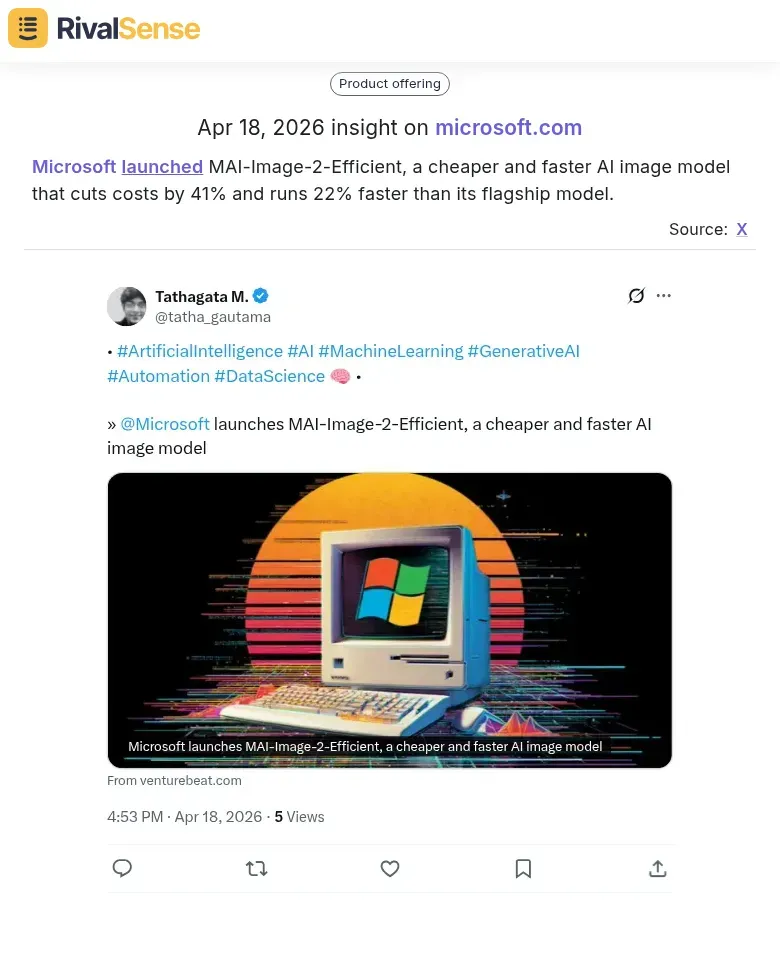
Failing to monitor efficiency breakthroughs on Twitter can hide competitors' pricing advantages. Consider Microsoft launched MAI-Image-2-Efficient, a cheaper and faster AI image model that cuts costs by 41% and runs 22% faster than its flagship model. This type of insight is crucial for business strategy as it signals potential pricing shifts and operational efficiencies that could undermine your competitive position.
Practical steps to avoid this mistake:
- Monitor technical blogs and research papers for efficiency breakthroughs
- Track cost-per-unit metrics in competitor financial disclosures
- Analyze how efficiency gains translate to pricing flexibility
- Watch for tiered product strategies where optimized versions complement flagship offerings
Key insight: Efficiency innovations create dual advantages—they lower operational costs while enabling more aggressive pricing strategies. Companies like Microsoft use these improvements to offer both premium flagship products and optimized alternatives, capturing different market segments simultaneously.
✅ Actionable checklist:
- Set up alerts for competitor technical announcements
- Calculate potential cost savings from efficiency gains
- Map how efficiency improvements affect pricing tiers
- Monitor customer adoption of optimized vs. flagship products
Remember: Every efficiency announcement is a pricing strategy clue. The 41% reduction wasn't just about technology—it was about market positioning.
Mistake 3: Missing Partnership & Ecosystem Expansions
Ignoring partnership announcements on Twitter can obscure competitors' strategic pivots. For instance, Zoom's chief ecosystem officer Brendan Ittelson announced on April 18 that World ID is coming to Zoom to verify users with live images and Orb-verified IDs to fight deepfakes, ensuring privacy and real-time verification without data leaving devices. Such insights are vital for business strategy because they reveal how competitors are expanding their ecosystems to address emerging threats and capture new market segments.

Practical Intelligence Checklist:
- Monitor Integration Announcements Weekly - Track competitor press releases, blog posts, and developer documentation for new partnerships
- Analyze Threat Response Patterns - When competitors address emerging threats (like deepfakes), map their solution architecture and positioning
- Decode Privacy & Security Messaging - Note how partnerships frame data protection (Zoom emphasizes "open ecosystem" vs. endorsing World ID)
- Assess Market Expansion - Evaluate whether partnerships target new verticals or strengthen existing positioning
- Track Regulatory Positioning - Monitor how competitors navigate privacy regulations (World ID faces GDPR scrutiny in Europe)
Key Insight: Zoom's partnership isn't just about features—it's defensive positioning against enterprise security concerns. The "Verified Human" badge addresses trust gaps that could drive platform switching. By tracking these ecosystem moves, you anticipate where competitors are building moats before they're fully constructed.
Mistake 4: Focusing Only on Follower Counts Instead of Engagement Patterns
Prioritizing follower counts over engagement metrics blinds you to competitors' real audience influence. A competitor with 100K followers but low engagement may have weak market connection, while a smaller account with high engagement wields genuine impact. This vanity metric obsession causes you to miss how competitors test messaging through Twitter polls, limited-time offers, and soft launches before official announcements.
Practical steps to fix this:
- Track engagement rate (likes + replies + retweets ÷ followers) weekly for each competitor
- Monitor sentiment shifts around competitor announcements using tools like Talkwalker or Brandwatch
- Create Twitter Lists for competitor testing accounts where they experiment with messaging
- Document which content formats (threads, videos, polls) generate highest engagement
- Set up alerts for competitor polls and limited-time offers to catch market testing
🔍 Key insight: Competitors often use Twitter as a low-cost testing ground before committing resources to full campaigns. By analyzing engagement patterns instead of just follower counts, you'll uncover their real market validation strategies and identify gaps where your messaging can outperform theirs.
Mistake 5: Treating Twitter as Separate from Overall Competitive Strategy
Siloing Twitter intelligence from broader competitive analysis fragments your strategic view and creates vulnerable blind spots. This approach prevents you from integrating real-time insights with website updates and market research, missing crucial connections that reveal competitor priorities. For instance, timing gaps between Twitter hints and official launches can give you weeks of advance notice if properly monitored.
Practical Checklist:
- Create specialized Twitter lists for competitor product accounts and leadership
- Set up alerts for partnership keywords (#collaboration, #integration) and tagged accounts
- Cross-reference Twitter announcements with website updates weekly
- Track sentiment around competitor launches to gauge market reception
- Document timing patterns between social media hints and official releases
⚡ By integrating Twitter intelligence into your overall competitive strategy, you transform reactive monitoring into proactive anticipation, gaining weeks of advance notice on competitor moves.
Conclusion: Building a Proactive Twitter Intelligence System
Don't let Twitter intelligence remain reactive. Build a proactive system that transforms real-time insights into strategic advantage. Start by creating structured monitoring for early warning signals: track competitor mentions, sentiment shifts, engagement patterns, and emerging conversations using dedicated tools and alerts. Integrate Twitter insights with broader competitive analysis by combining social data with market research, product launches, and pricing changes for a holistic view.
Practical steps:
- Set up keyword alerts for competitor names and industry terms
- Create a weekly review process to analyze trends
- Build a dashboard that combines Twitter data with other competitive metrics
- Establish clear escalation paths for critical insights
This proactive approach ensures you're not just watching rivals—you're staying ahead.
Ready to streamline your competitor tracking? Tools like RivalSense can automate this process by tracking competitor product launches, pricing updates, partnerships, and more across Twitter, websites, and registries, delivering consolidated weekly reports. Try RivalSense for free at https://rivalsense.co/ and get your first competitor report today to close those intelligence gaps!
📚 Read more
👉 Best Practices for Tracking Competitor Content in Fleet Management
👉 Case Study: How Media Mentions Reveal Key Account Advocacy Opportunities
👉 Actionable Competitor Analysis: Interpreting Fireflies' Rebrand to AI Assistant
👉 Key Account Management Summit 2026: The Ultimate Guide with Actionable Strategies for B2B Leaders
👉 SaaS Productivity: Track Competitor Content Performance Effectively