
Best Practices for Tracking Competitor Content in Fleet Management
Understanding what your competitors are doing can provide a strategic edge in today's competitive market. In the rapidly evolving fleet management landscape, competitor content tracking isn't just about monitoring rivals—it's about decoding market intelligence that reveals strategic direction and market positioning. When competitors announce new AI-powered telematics solutions or unified platform strategies, they're signaling where they believe the market is heading. For instance, tracking announcements about agentic AI adoption or data ownership policies can reveal whether competitors are targeting enterprise clients or SMBs, and whether they're positioning as premium innovators or cost-effective consolidators.
Consider this real-world example: Motive launched the AI Dashcam Plus, which uses AI to help organizations prevent accidents.
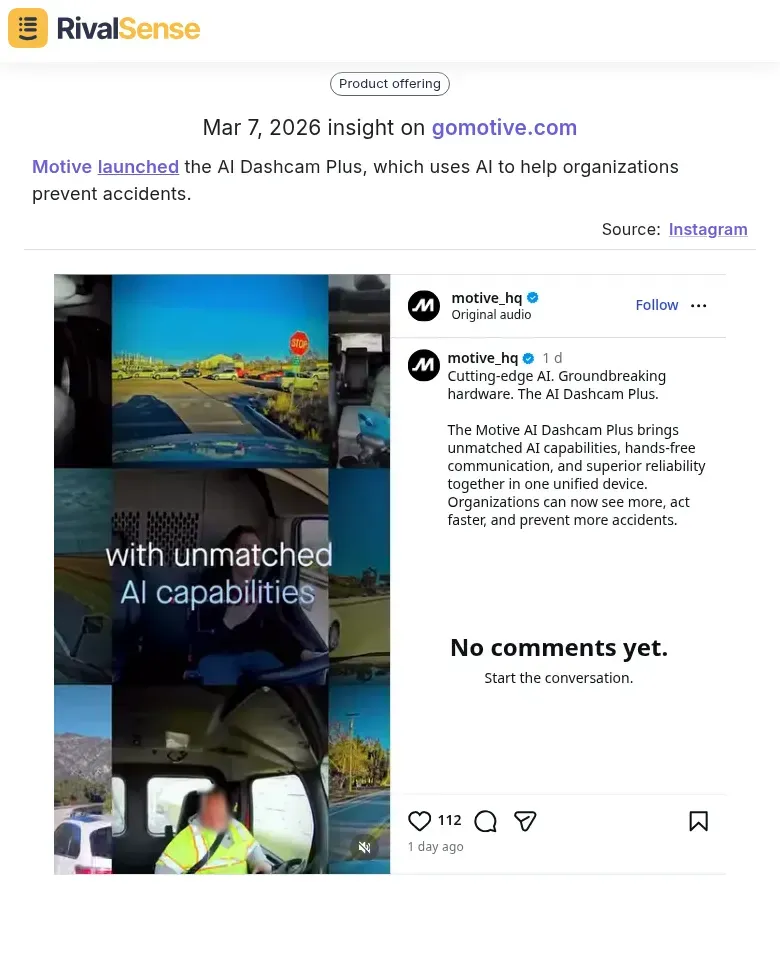
Tracking such product launches is invaluable for business strategy because it highlights where competitors are investing in innovation, allowing you to anticipate market shifts and adjust your own product roadmap accordingly.
Practical tip: Create a competitor content dashboard that monitors:
- Product launch announcements and feature updates
- White papers and case studies revealing target customer segments
- Pricing page changes indicating strategic shifts
- Blog content about emerging technologies (EV integration, predictive maintenance)
- Partnership announcements showing ecosystem expansion
By analyzing competitor content patterns, you can identify emerging trends like the shift toward unified platforms or the growing importance of data ownership—trends that might take months to appear in market reports. This intelligence helps you anticipate market shifts, adjust your product roadmap, and align messaging with evolving customer expectations before your competitors gain first-mover advantage.
Establishing Your Competitor Content Monitoring Framework
A systematic approach to monitoring ensures you capture all relevant insights without overwhelm. Establishing a robust competitor content monitoring framework is essential for fleet management companies to stay ahead. Start by identifying key content sources: monitor competitor press releases for new partnerships or funding rounds, blog posts for thought leadership on telematics trends, social media for real-time customer engagement insights, and product announcements for feature updates.
Practical checklist:
✅ Identify 5-7 primary competitors
✅ Create monitoring dashboard with all sources
✅ Set up automated alerts with filtering rules
✅ Categorize content by strategic dimension
✅ Schedule weekly review sessions
Tip: Focus on content that reveals competitor priorities—frequent posts about electric vehicle integration signal strategic focus on sustainability. Track content frequency patterns to predict competitor resource allocation and identify gaps in your own content strategy. Use tools like RivalSense to automate tracking and receive consolidated reports, saving time and ensuring consistency.
Analyzing Product Innovation and Feature Development
Keeping a pulse on product evolution is key to staying competitive. To effectively analyze product innovation in fleet management, start by creating a systematic tracking framework. First, monitor competitor AI integration patterns by cataloging their technology announcements—track which companies are implementing predictive maintenance, route optimization algorithms, or driver behavior analytics.
For example, Motive introduced live two-way calling built into its AI Dashcam Plus on March 26, allowing managers and drivers to connect directly.
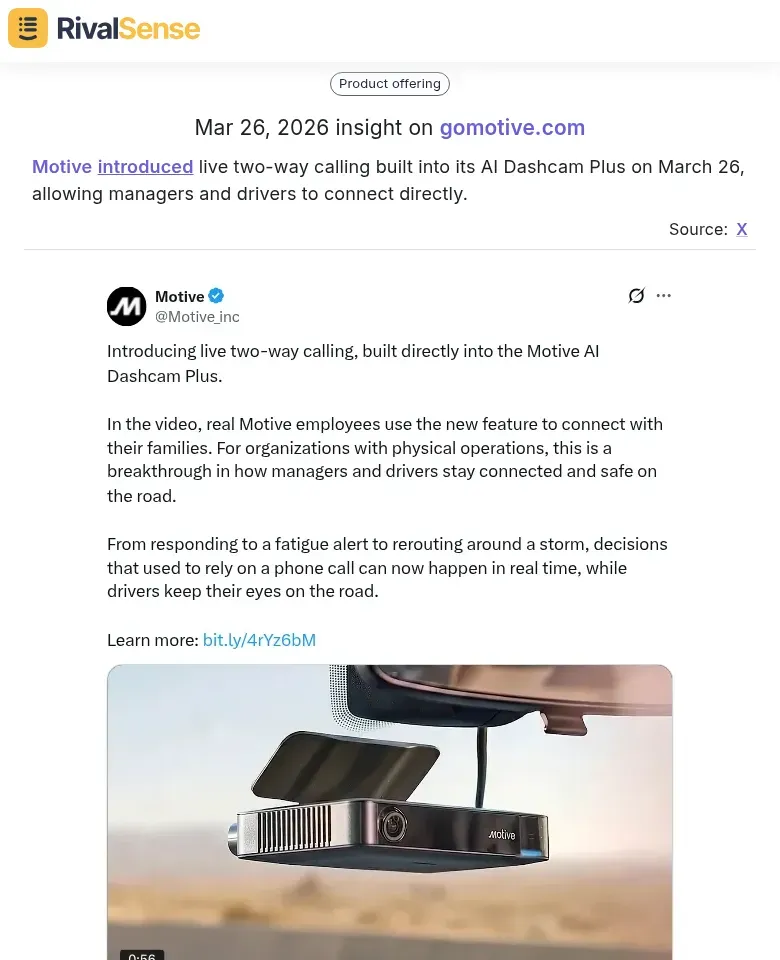
Monitoring such feature updates is crucial for business strategy as it reveals how competitors enhance user experience and address specific pain points, helping you benchmark your own development priorities and identify opportunities for differentiation.
Practical checklist:
- Set up alerts for competitor product launches and updates
- Create a feature comparison matrix updated quarterly
- Track technology adoption rates across your competitive landscape
- Analyze customer feedback on competitor features through review sites
- Monitor patent filings for emerging technology trends
Key insight: The most successful fleet management companies don't just copy features—they understand the underlying customer problems being solved and innovate around those pain points.
Monitoring Marketing and Partnership Strategies
Marketing moves and alliances reveal much about competitor ambitions. Analyzing influencer and celebrity partnerships reveals how competitors position themselves in the fleet management space. Track which industry experts, sustainability advocates, or transportation influencers they partner with. Look for patterns: Are they targeting EV evangelists, safety experts, or cost-reduction specialists?
Take Motive announces that PGA Tour superstar Jason Day will join its Vision 2026 event in Nashville to discuss using data and discipline for peak performance.
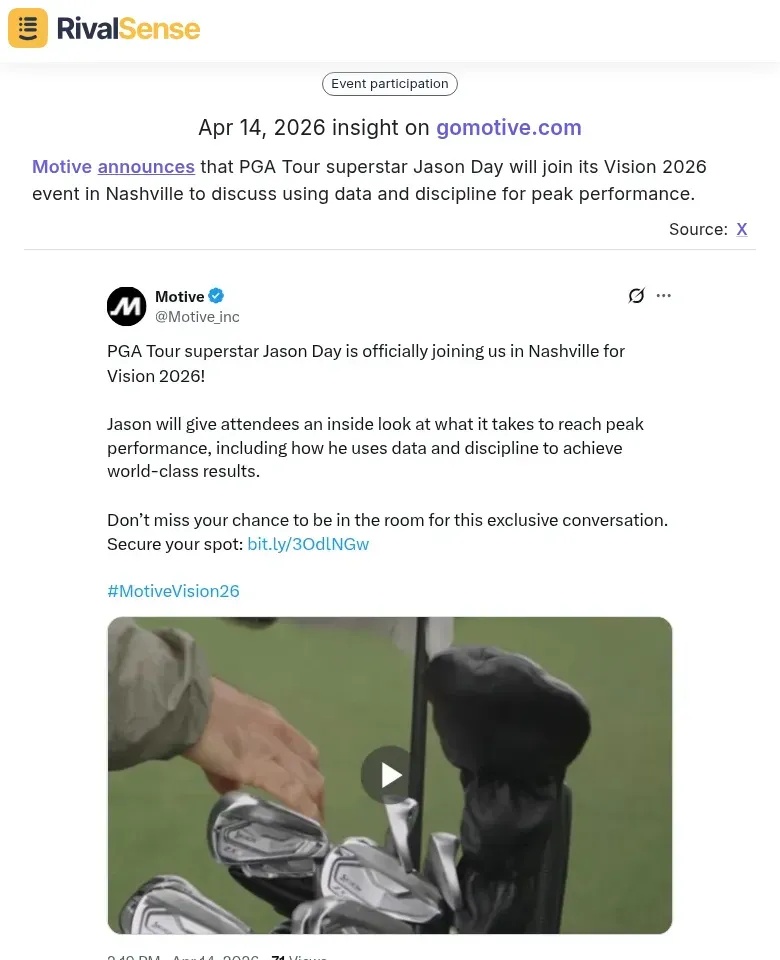
This type of insight is valuable for business strategy because it shows how competitors leverage high-profile partnerships and events to boost brand visibility and align with aspirational themes, informing your own marketing and event participation decisions.
Practical Checklist:
- Create a partnership tracker with influencer categories, engagement rates, and messaging themes
- Maintain an event calendar with competitor speaking slots and topic analysis
- Use content analysis tools to identify top-performing themes and formats
- Monitor social media for real-time partnership announcements and event coverage
- Set up alerts for competitor press releases about new partnerships or event participation
Identify content themes that resonate by analyzing competitor blogs, whitepapers, and social media. The most effective fleet management content typically focuses on: 1) EV transition strategies and ROI calculations, 2) Telematics data optimization for cost reduction, 3) Sustainability reporting and carbon reduction metrics, 4) Driver safety and compliance automation.
Translating Insights into Actionable Business Strategy
Turning data into decisions is where the real value lies. Once you've gathered competitor content insights, the real value comes from translating them into actionable business strategy. Here's how to move from analysis to action:
- Identify Market Gaps: Analyze competitor content to spot underserved topics or customer pain points they're ignoring. For example, if competitors focus on fuel efficiency but neglect driver safety features, you've found a strategic opening.
- Develop Counter-Strategies: Map competitor positioning and messaging. If a rival emphasizes "lowest cost," position yourself as "premium value with better ROI." Create content that directly addresses their weaknesses while highlighting your strengths.
- Align with Trends While Differentiating: Track emerging fleet management trends (electrification, telematics, sustainability), but find your unique angle. If everyone's discussing EV adoption, focus on charging infrastructure challenges or total cost of ownership comparisons.
Action Checklist:
- Create a quarterly "competitive positioning" report
- Develop content pillars that address competitor gaps
- Establish a rapid-response content system for competitor announcements
- Train sales teams on competitive differentiators
- Monitor content performance metrics against competitor benchmarks
Pro Tip: Don't just mirror competitors—use their content as a springboard for innovation. The best strategies emerge when you understand the competitive landscape but create your own path through it.
Best Practices for Ongoing Competitor Intelligence
Consistency transforms monitoring into a strategic asset. Establishing regular review cycles is foundational to effective competitor intelligence. Create a structured cadence—weekly for tactical moves, monthly for content analysis, and quarterly for strategic shifts. Use a simple checklist: 1) Monitor competitor blogs, whitepapers, and social media for new content themes; 2) Analyze engagement metrics (shares, comments) to gauge audience resonance; 3) Track feature announcements or pricing changes.
Integrate these insights into your product development and marketing planning. In product meetings, discuss competitor features that customers praise; prioritize enhancements that address gaps. For marketing, adapt successful content formats—like case studies or webinars—but add unique data or angles. A practical tip: Use a shared dashboard to visualize competitor trends, ensuring cross-team alignment.
Measure impact by linking competitor-informed strategies to key metrics. Set benchmarks: track market share shifts, lead quality improvements, or customer churn reductions post-implementation. For instance, after launching a counter-campaign based on competitor analysis, monitor website traffic and conversion rates for 90 days. Regularly review these metrics in strategy sessions to refine approaches, ensuring sustained growth and competitive advantage.
Ready to Transform Your Competitor Tracking?
Implementing these best practices can be time-consuming without the right tools. RivalSense automates competitor tracking by monitoring product launches, pricing updates, event participations, partnerships, regulatory changes, management shifts, and media mentions across websites, social media, and various registries—delivering concise weekly reports straight to your inbox. This saves you hours of manual research and ensures you never miss a critical update.
Try RivalSense for free today at https://rivalsense.co/ and get your first competitor report to start gaining a strategic edge in fleet management!
📚 Read more
👉 Case Study: How Media Mentions Reveal Key Account Advocacy Opportunities
👉 Actionable Competitor Analysis: Interpreting Fireflies' Rebrand to AI Assistant
👉 Key Account Management Summit 2026: The Ultimate Guide with Actionable Strategies for B2B Leaders
👉 SaaS Productivity: Track Competitor Content Performance Effectively
👉 How ComplyAdvantage's AI Rebranding Prompted Rivals' Strategic Pivot