
SaaS Product Offering Analysis Framework: Turn Competitor Insights into Strategy
In today's hyper-competitive SaaS landscape, systematically analyzing competitor product offerings isn't just a nice-to-have—it's a strategic imperative. A structured approach to competitor product analysis provides the intelligence needed to make informed decisions about your own product roadmap, pricing strategy, and market positioning.
Why does this matter? Because understanding what your competitors offer (and what they don't) reveals market gaps you can exploit, helps you differentiate your value proposition, and prevents you from being blindsided by emerging features or pricing changes. This analysis transforms raw data into actionable insights that drive competitive advantage.
Our comprehensive framework provides a practical template for turning competitor research into strategic action. You'll learn how to systematically evaluate competitor features, pricing tiers, packaging strategies, and target customer segments. We'll show you how to identify underserved market opportunities and position your product for maximum impact.
💡 Practical tip: Start by creating a simple spreadsheet to track 3-5 key competitors across these dimensions: core features, pricing models, target industries, and customer reviews. Update this quarterly to spot trends and anticipate market shifts. This disciplined approach ensures you're not just collecting data, but generating insights that inform your strategic decisions.
Framework Foundation: Setting Up Your Competitor Analysis Structure
Establishing a robust structure is the first step toward effective competitor analysis. Without a clear framework, you'll struggle to organize insights and act on them promptly. Begin by identifying your core competitors across different categories to ensure comprehensive coverage.
Start by identifying your core competitors: direct (similar solutions), indirect (different approaches to same problem), and aspirational (market leaders). Create monitoring categories like pricing, features, marketing messaging, customer reviews, and market positioning.
Develop a systematic tracking template with standardized fields: competitor name, category, data point, source, date collected, and analysis notes. Use tools like spreadsheets or competitive intelligence platforms for consistency. Include checklists for each category to ensure comprehensive data collection.
Determine analysis frequency based on your market dynamics: weekly for fast-moving segments, monthly for stable markets. Establish review processes with scheduled team meetings to discuss findings and update strategies. Set up automated alerts for competitor announcements and pricing changes to stay current.
📋 Practical checklist for setup:
- [ ] List 3-5 direct and indirect competitors
- [ ] Define key monitoring categories (e.g., features, pricing, positioning)
- [ ] Choose a tracking tool (spreadsheet or specialized platform)
- [ ] Set up alerts for competitor updates
- [ ] Schedule regular review meetings
Product Feature & Capability Analysis
Keeping a close eye on competitor product features and capabilities is essential for staying innovative and competitive. By tracking their technology evolution, you can anticipate market trends and identify opportunities for differentiation. Regular analysis helps you understand where the market is heading and how to align your product roadmap.
Track competitors' technology stack evolution systematically. Create a quarterly audit spreadsheet with columns for AI model integrations, core tech stack changes, and API updates. Monitor feature additions and removals by setting up alerts for competitor changelogs, release notes, and community forums. For user experience improvements, conduct monthly usability comparisons using tools to analyze interface changes, onboarding flows, and customer feedback patterns.
For instance, when VEED updated its AI video generation platform to include new models such as Google Veo 2, OpenAI Sora 2, and Kling variants, it highlighted a focus on cutting-edge AI capabilities. Tracking such feature updates can reveal strategic shifts toward advanced technology, helping you decide whether to integrate similar models or differentiate elsewhere.
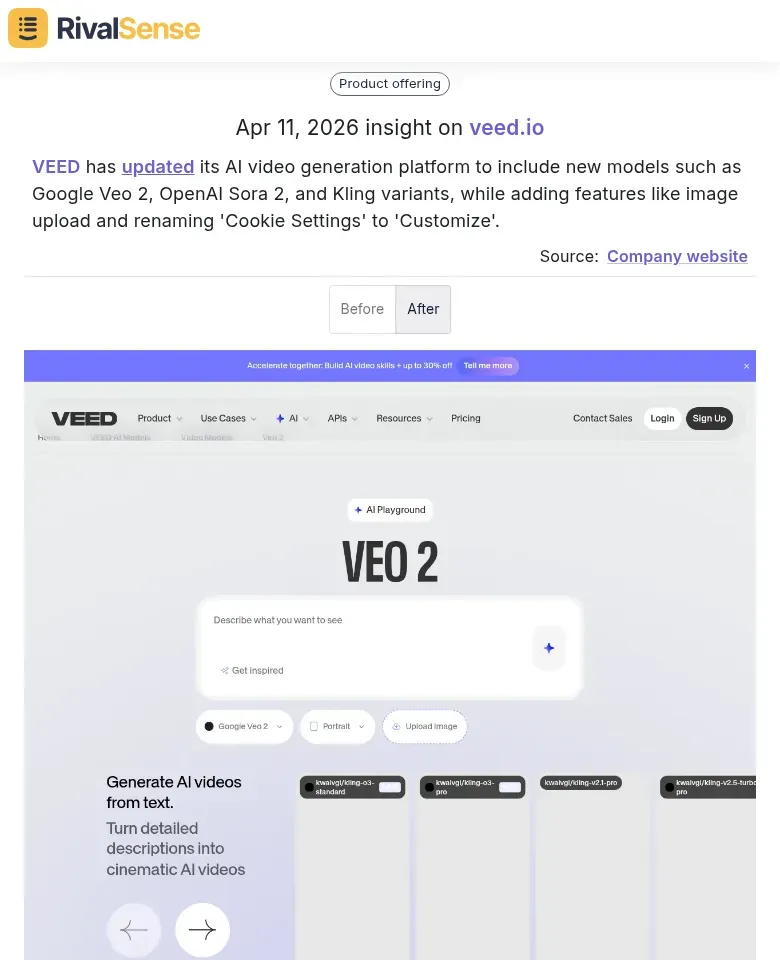
Why this insight matters: Monitoring feature launches helps you assess competitor innovation pace and identify gaps in your own offerings, enabling proactive product development.
Analyze product differentiation through a capability matrix. Map out unique features, integration ecosystems, and pricing tiers across competitors. Look for gaps where your SaaS can innovate—such as specialized AI workflows or niche market integrations.
🔧 Practical tip: Use automated tools like RivalSense to track feature announcements and technology partnerships, saving hours of manual research. Create a quarterly checklist:
- Audit tech stack changes
- Review feature change logs
- Compare UX improvements
- Map competitive capabilities
Pricing & Packaging Strategy Insights
Analyzing competitor pricing and packaging strategies reveals critical market intelligence that directly impacts your revenue and growth. Understanding how competitors structure their offers helps you position your product effectively and respond to market shifts. Regular monitoring ensures you're not caught off guard by sudden changes.
Start by tracking subscription model changes: when competitors alter trials or pricing tiers, it signals strategic adjustments. Monitor these patterns quarterly using a simple checklist: (1) Document current pricing tiers, (2) Note trial periods or freemium offerings, (3) Record any changes with dates. This helps predict market trends and identify gaps in your own strategy.
For example, Rebtel introduced a new Cote d'Ivoire Welcome Offer for new users only, providing 60 minutes of calling for £5 as a one-time offer, and updated its subscription plan to remove the free trial week. This indicates targeted geographic expansion and a shift in customer acquisition tactics.
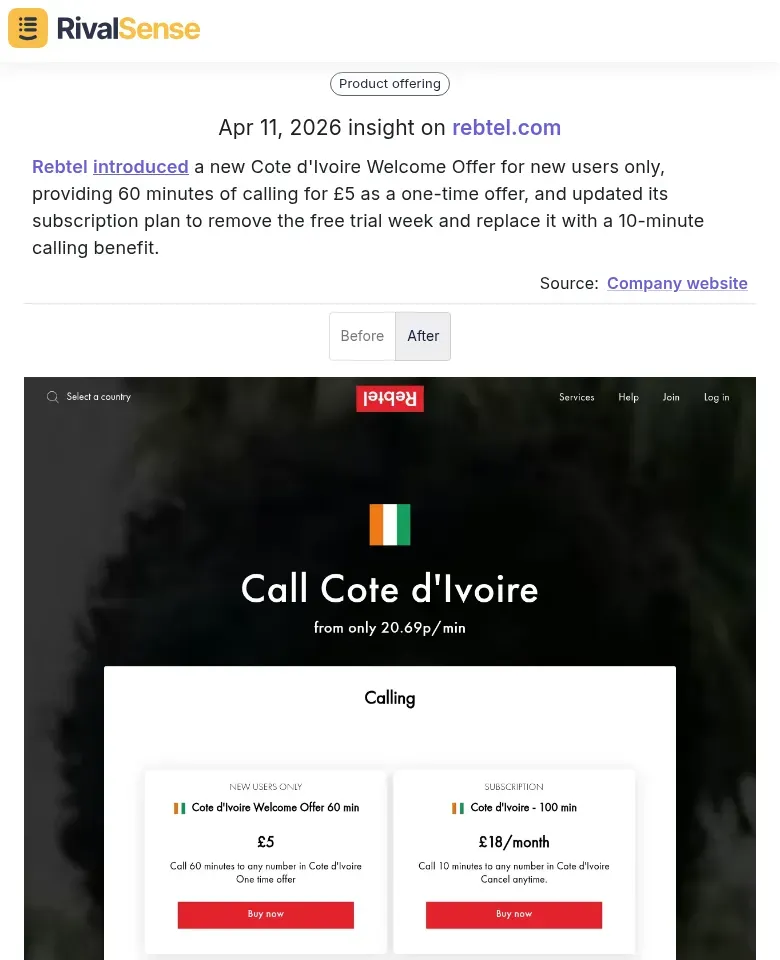
Why this insight matters: Tracking promotional offers and pricing changes helps you anticipate competitor moves in specific markets, allowing you to adjust your own pricing or launch counter-promotions.
Promotional offers and geographic pricing provide tactical insights. Set up alerts for new promotions and analyze their duration, discount levels, and target regions. Compare these against your own geographic pricing to spot opportunities or threats in emerging markets.
Value proposition evolution often manifests through pricing structure changes. When competitors add premium features or bundle services, it reflects shifting customer priorities. Evaluate these by mapping feature sets against price points over time.
📊 Practical tip: Create a quarterly pricing audit template that tracks feature additions, tier restructuring, and perceived value changes. This framework helps you anticipate competitor moves and adjust your own packaging to maintain competitive advantage.
Brand & Market Positioning Analysis
Brand and market positioning analysis uncovers how competitors strategically present themselves to attract customers and enter new markets. By monitoring rebranding efforts and localization strategies, you can infer their growth plans and adapt your own positioning accordingly. This analysis helps you stay aligned with market expectations and identify untapped opportunities.
Track rebranding initiatives and localization strategies that indicate market expansion or strategic pivots. Analyze brand messaging evolution by comparing website copy, social media posts, and press releases over time to detect positioning shifts.
A prime example is Digmatix rebranding its Estonian office from BCS Itera AS to DIGMATIX Estonia AS. Such moves often signal consolidation, rebranding for clarity, or preparation for regional growth, providing clues about competitor focus areas.
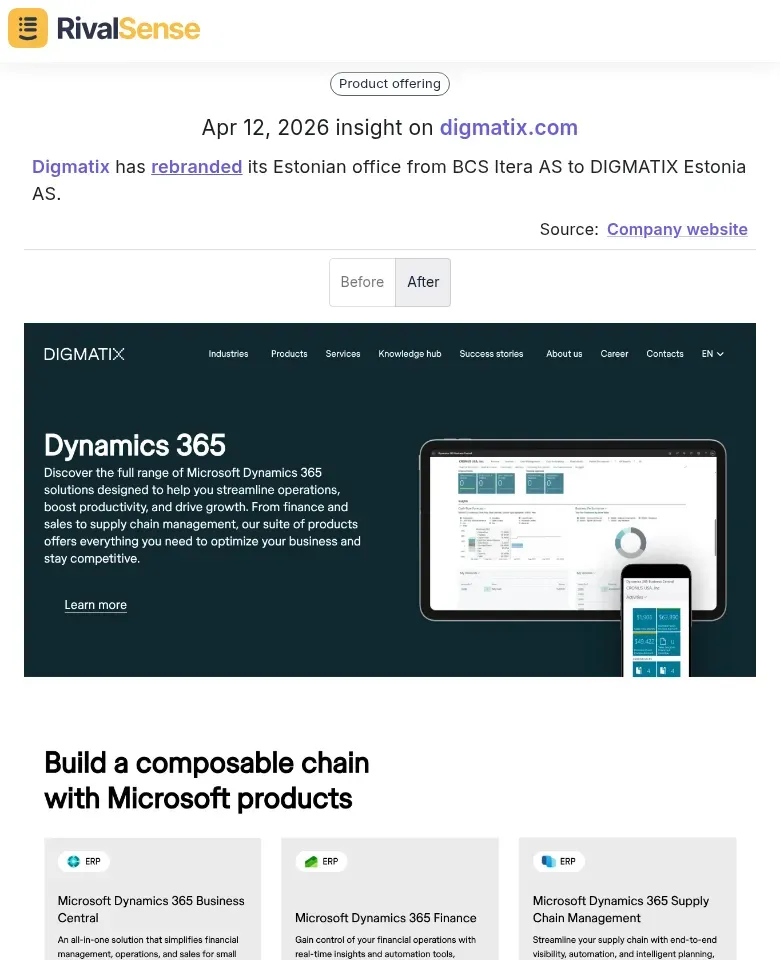
Why this insight matters: Observing rebranding and localization efforts helps you understand competitor market entry strategies, enabling you to strengthen your own presence in those regions or differentiate your brand.
Practical steps for tracking:
- 🗂️ Create a competitor brand tracking spreadsheet with columns for rebranding dates, localization efforts, and messaging themes.
- 🔍 Use tools like RivalSense to monitor website changes, social media updates, and news mentions.
- 📅 Conduct quarterly reviews to compare positioning statements and value propositions.
- 🌐 Analyze regional adaptations for country-specific domains and cultural references.
- 🎨 Track visual identity changes like logo updates or design overhauls.
💡 Tip: Look beyond obvious changes—subtle shifts in terminology (e.g., from 'software' to 'platform') can signal strategic repositioning. Combine this with market expansion signals like new office openings to build a comprehensive view.
Actionable Intelligence: Turning Insights into Strategy
Transforming competitor data into strategic advantage requires a proactive and systematic approach. The goal is to move from observation to execution, ensuring insights directly influence your business decisions. By implementing continuous improvement cycles, you can stay agile and responsive in a dynamic market.
First, identify market gaps by analyzing competitor weaknesses: What features do they lack? Where do customers complain? Use this to spot underserved segments and innovation opportunities.
Develop responsive strategies by monitoring competitor moves in real-time. When a competitor launches a new feature, assess its impact and respond within 48 hours with a tailored counter-strategy—whether it's enhancing your own offering or highlighting your unique value.
Implement continuous improvement cycles: Set up weekly competitor intelligence reviews, create a 'competitor response playbook' for common scenarios, and establish quarterly gap analysis sessions. Track key metrics like feature parity, pricing changes, and customer sentiment shifts to stay ahead.
✅ Actionable checklist:
- [ ] Map competitor feature gaps monthly
- [ ] Assign team members to monitor specific competitors
- [ ] Use intelligence to inform product roadmap decisions
- [ ] Test new strategies in small markets before full rollout
Remember: Turn insights into action—don't just collect data, use it to drive growth.
Put Your Insights into Action with RivalSense
Consistently tracking competitor moves across product features, pricing, and branding can be time-consuming without the right tools. Manual research often leads to missed opportunities or delayed responses, putting your business at a disadvantage.
RivalSense automates this process by tracking competitor product launches, pricing updates, event participations, partnerships, regulatory changes, management shifts, and media mentions across websites, social media, and registries. You receive all this intelligence in a concise weekly email report, saving you hours while keeping you informed.
Ready to streamline your competitor analysis? Try RivalSense for free today and get your first competitor report to start transforming insights into strategy. Visit https://rivalsense.co/ to sign up and gain a competitive edge!
📚 Read more
👉 Decodo's Residential Proxy Pricing Update: Competitive Insights and Actionable Tips
👉 Track Key Account Team Members: The Complete Guide to Competitive Intelligence for B2B Leaders
👉 Data-Driven Insights: Track Key Account Communications in B2B Fintech
👉 How NVIDIA's Nuclear AI Deal Enabled Competitors to Secure Energy Partnerships
👉 Quick Twitter Hacks: Competitor Intelligence for B2B Leaders