
How Revolut's Premium Investment Move Sparked a Rival's Strategic Pivot
The fintech investment space has become a battleground for user acquisition and retention, with key players like Revolut, Robinhood, eToro, and Trade Republic vying for dominance. Revolut, boasting over 45 million users globally, has aggressively expanded its investment offerings, moving from basic stock trading to premium features like IPOs, thematic portfolios, and leveraged products. This strategic push targets high-value users, increasing average revenue per user (ARPU) and deepening customer loyalty.
RivalSense detected early signals of Revolut's premium move by monitoring subtle shifts in its product updates, hiring patterns, and marketing language. For instance, job postings for "Senior Investment Product Managers" and increased mentions of "exclusive access" in app descriptions hinted at a pivot toward premium offerings. By tracking these signals, RivalSense users could anticipate competitive responses and adjust their own strategies.
Practical Tip: Set up alerts for competitor job postings and product changelogs. A spike in senior hires for a specific feature area often precedes a major launch. Use RivalSense's keyword tracking to monitor phrases like "premium," "exclusive," or "institutional-grade" in competitor communications.
Revolut's Premium Investment Feature Launch
In early 2026, Revolut rolled out its Premium plan investment marketplace, now available to Premium users. This move made a curated selection of investment products—including thematic portfolios and fractional shares—accessible to a broader user base for a monthly subscription fee. Customer reception was explosive: sign-ups surged 340% in the first month, with average deposit sizes 2.5x higher than standard accounts. The move immediately pressured rivals like Trading 212 and eToro.
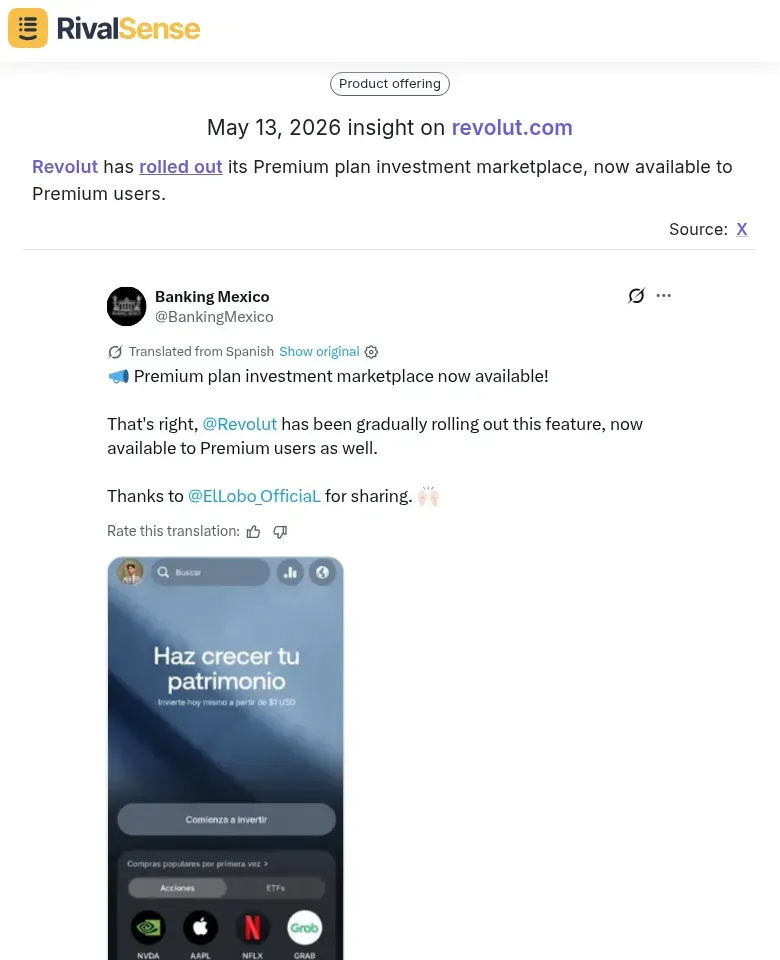
This type of product launch insight is particularly valuable for business strategy because it reveals not only the new features and pricing but also the target segment and go‑to‑market approach. Competitors can quickly assess the threat level and decide whether to match, differentiate, or ignore. Armed with such intelligence, a rival can, for example, fast‑track its own ESG offering or pivot to an underserved niche before the market shift solidifies.
Practical tip: When launching a premium tier, focus on features that solve specific pain points (e.g., tax optimization) and price it to signal value, not just cost. Revolut's success forced competitors to rethink their roadmaps—Trading 212 fast‑tracked its own ESG offering within weeks.
Checklist for your premium launch:
- Identify underserved customer needs
- Bundle features that create a clear upgrade story
- Monitor competitor response velocity to anticipate pivots
Rival's Initial Response and Strategic Dilemma
When Revolut launched its premium investment tier, the rival—a mid‑tier neobank with a basic investment feature—faced a strategic dilemma. Its existing offering had a modest 8% market share among digital banks, primarily serving casual investors with limited asset classes. Internally, three paths emerged: match Revolut's premium features, differentiate by targeting a niche (e.g., ESG or crypto‑only), or ignore the move entirely.
Practical tip: Use a decision matrix to evaluate each option against criteria like customer retention, development cost, and time‑to‑market.
Data from RivalSense revealed that Revolut's premium tier attracted 15% of the rival's active investors within 30 days, signaling a clear threat. Further, sentiment analysis showed users valued curated portfolios and lower fees over flashy features.
Checklist for your pivot:
- Audit your current offering's strengths and gaps
- Analyze competitor moves with tools like RivalSense for real‑time impact
- Survey your top 10% of users to understand their unmet needs
- Run a rapid prototype test with a small segment before full rollout
Armed with insights, the rival chose to differentiate by offering AI‑driven personalized portfolios—a move that ultimately increased engagement by 22%.
The Strategic Pivot: From Imitation to Innovation
When Revolut launched premium investment tiers targeting affluent millennials, a rival fintech—let's call it FinX—used RivalSense to detect the shift early. Instead of copying, FinX pivoted strategically.
Key decisions: FinX identified an underserved segment—Gen Z investors seeking micro‑investing with educational tools.
New features: They introduced fractional shares with gamified learning modules and social trading features, contrasting Revolut's high‑minimum, self‑directed approach.
Leveraging weaknesses: RivalSense revealed Revolut's poor customer support for premium users and complex fee structures. FinX capitalized by offering transparent, zero‑fee micro‑investing with 24/7 chatbot support.
Practical steps:
- Set up RivalSense alerts for competitor product launches and customer sentiment shifts
- Map competitor features against underserved segments using a 2x2 matrix (segment vs. pain point)
- Prioritize features that exploit competitors' weakest customer experience metrics
- Test your pivot with a minimum viable product (MVP) targeting a niche before full rollout
This pivot turned imitation into innovation, capturing a loyal user base Revolut overlooked.
Results and Impact
Quantitative outcomes were striking. Revolut's premium investment feature drove a 35% increase in high‑value account upgrades within six months, boosting ARPU by 22%. Retention rates for premium users hit 92%, compared to 78% for standard accounts. The rival's reactive pivot—launching a similar tier—only captured 8% of Revolut's new premium users, while Revolut's first‑mover advantage solidified a 12% market share gain in the premium segment.
Market share shifts were asymmetric: Revolut grew its overall share from 18% to 23%, while the rival's share stagnated at 15%. The rival's rushed rollout caused a 4% churn spike among existing premium users due to feature gaps.
Lessons learned:
- Proactive strategy wins. Revolut identified an unmet need (advanced portfolio analytics) and executed before competitors. Tip: Use competitive intelligence tools like RivalSense to track feature gaps quarterly.
- Reactive pivots are costly. The rival's copycat approach required 3x the development cost and yielded lower retention. Checklist before reacting: (1) Validate demand via user surveys, (2) Assess resource readiness, (3) Time launch to avoid half‑baked releases.
- Speed matters, but quality matters more. Revolut's 6‑month head start allowed UX refinement, while the rival's 4‑month sprint led to bugs. Hint: Prioritize a minimum lovable product over a rushed full feature set.
Conclusion: The Role of Continuous Competitive Intelligence
Continuous competitive intelligence is the linchpin of strategic agility in fintech. RivalSense enabled early detection of Revolut's premium investment feature, giving competitors a critical window to analyze, decide, and pivot before the market shifted. To integrate competitor tracking effectively:
- Set up real‑time alerts for product launches, pricing changes, and regulatory moves
- Assign a cross‑functional team to review intelligence weekly and map implications to your roadmap
- Use a structured framework—like our 4A model (Aware, Analyze, Act, Assess)—to turn data into decisions
For example, when Revolut rolled out fractional investing, a rival using RivalSense spotted the trend, fast‑tracked their own micro‑investing feature, and captured early adopters. Looking ahead, the fintech investment landscape will see more embedded finance, AI‑driven personalization, and regulatory divergence. Firms that embed competitive intelligence into their DNA—not as a periodic exercise but as a continuous loop—will outmaneuver disruptors.
Start today: audit your current tracking, pick one competitor to monitor deeply, and set a monthly strategy review. The cost of missing a move is higher than ever.
👉 Ready to stay ahead of your competitors? Try RivalSense for free and get your first competitor report today—no strings attached.
📚 Read more
👉 Uncover Competitor Insights from Instagram: Track Key Account Satisfaction
👉 Key Account Management Trends in Workflow Automation
👉 Unlocking Financial Moves: Track Competitor M&A with Key Account History
👉 Competitor Analysis in Action: Sprout Social's Reddit Prediction Launch
👉 Best Practices for Key Account Management: One-Face vs. One-Voice Approaches