
Key Account Tracking Setup: A Trend Analysis for B2B Companies
In today's fast-paced B2B landscape, relationships with key accounts are more complex than ever. With multiple stakeholders, evolving needs, and aggressive competitors, you can no longer rely on periodic reviews to stay ahead. Real-time visibility into account health and competitor activity is essential to anticipate client needs, identify cross-sell opportunities, and mitigate churn risk. A trend analysis approach—systematically tracking changes in client behavior, product usage, and competitor moves—provides a proactive framework for account management.
Practical steps to get started:
✅ Define key account criteria (e.g., revenue, strategic importance)
✅ Set up automated alerts for major events (e.g., leadership changes, new funding)
✅ Monitor competitor actions targeting your accounts (e.g., new product launches, pricing changes)
✅ Conduct monthly trend reviews to spot early warning signs
By embedding competitive intelligence into daily workflows, you can transform from a reactive service provider to a trusted strategic partner.
Identifying High-Value Accounts and Tracking Priorities
To identify high-value accounts, start by prioritizing based on three criteria:
- Revenue contribution – top 20% generating 80% of income
- Strategic importance – accounts with executive-level relationships or cross-selling potential
- Growth potential – companies in expansion phases or M&A activity
Segment accounts by industry (e.g., fintech vs. manufacturing), geography (domestic vs. international), and product usage (e.g., SaaS, consulting, finance) to tailor tracking efforts. For instance, a global tech firm may require monitoring of contract renewals and partnership shifts, while a regional healthcare provider might focus on regulatory changes.
Use a tiered approach:
| Tier | Accounts | Cadence | Focus |
|---|---|---|---|
| 1 | 5–10 | Daily | Competitor moves, RFPs, relationship changes |
| 2 | 20–30 | Weekly | Product usage shifts, market intelligence |
| 3 | Remaining | Monthly | Summaries |
Checklist for setup:
1️⃣ Rank accounts by revenue and growth potential
2️⃣ Map competitive overlap using win/loss data
3️⃣ Assign tracking cadence per tier
4️⃣ Set up automated alerts for trigger events (e.g., leadership changes, funding rounds)
This ensures resources are focused where competitive risk is greatest.
Data Sources and Collection Methods for Account Intelligence
To build a robust account intelligence system, you must blend internal and external data sources.
Internally, mine transaction histories, engagement metrics (e.g., meeting frequency, email opens), and product usage patterns to identify relationship depth and cross-sell opportunities.
Externally, monitor regulatory filings (e.g., SEC 8-Ks for material events), news feeds, social media sentiment, and competitor pricing changes via automated web scraping or APIs.
Practical Steps:
- Set up automated alerts using tools like Mention or Brandwatch for competitor news, and SEC EDGAR RSS feeds for filings.
- Integrate CRM data (e.g., Salesforce) with intelligence platforms like Crayon or Klue to unify internal notes with external signals.
- Create a dashboard that merges transaction trends (e.g., declining engagement) with external triggers (e.g., competitor product launch) to flag at-risk accounts.
💡 Pro Tip: Use natural language processing (NLP) to extract key entities from news and filings—such as new executive hires or partnership announcements—and automatically link them to relevant accounts in your CRM. This reduces manual effort and ensures no signal is missed.
Analyzing Trends in Account Behavior and Competitor Activity
To stay ahead, systematically analyze account behavior and competitor activity. Start by setting up alerts for early warning signs: monitor for sudden spikes in transaction volume, unusual payment patterns, or changes in cash flow cycles—these can signal financial distress or shifting needs.
Track executive departures via LinkedIn or news feeds; a CFO leaving may precede a review of your relationship. Watch for RFP activity using tools like RivalSense to detect when clients are evaluating competitors.
Benchmark competitor offerings quarterly. Create a matrix comparing your services against top rivals. Note differences in pricing, digital capabilities, or customer support response times. If a competitor launches a faster onboarding process, assess the impact on your client retention.
Use trend analysis to predict needs. For example, if a client’s receivables are growing 20% quarter-over-quarter, proactively offer supply chain financing. Build a simple dashboard tracking key metrics: account growth rate, product usage, and competitor win/loss data. Review monthly with your team to identify patterns and act before the client looks elsewhere.
🔍 Using Personnel Changes as Leading Indicators
Personnel moves—especially senior hires or departures—are powerful, often overlooked signals. When a key executive joins a competitor, it may indicate a new strategic direction or a push into a specific market. Similarly, losing a client’s trusted contact can destabilize the relationship.
Example insights from RivalSense:
Garik Shmois left Loop Capital as Managing Director to join D.A. Davidson Equity Capital Markets as Managing Director in the United States.
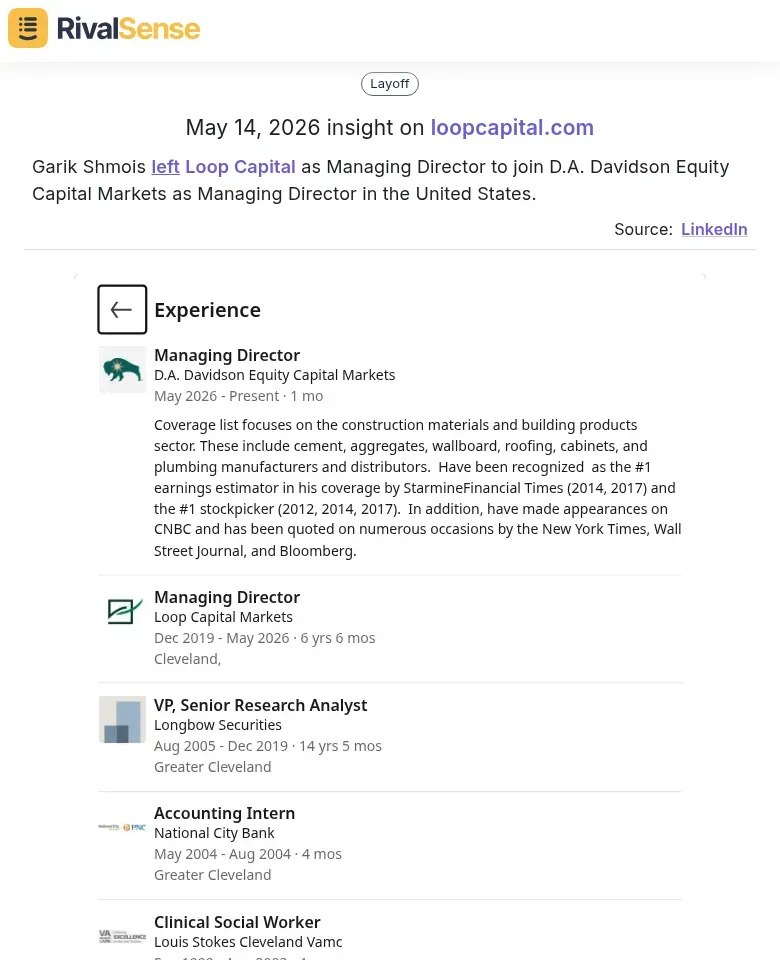
This type of move can signal a shift in capital markets strategy or a talent war. For B2B companies serving financial services, tracking such changes helps anticipate competitive dynamics and potential account opportunities.
Justin Dewiel joined Fanatics as Vice President, Head of Fan Community in the United States, previously Founder / Chief Strategy Officer at Dual Adventures.
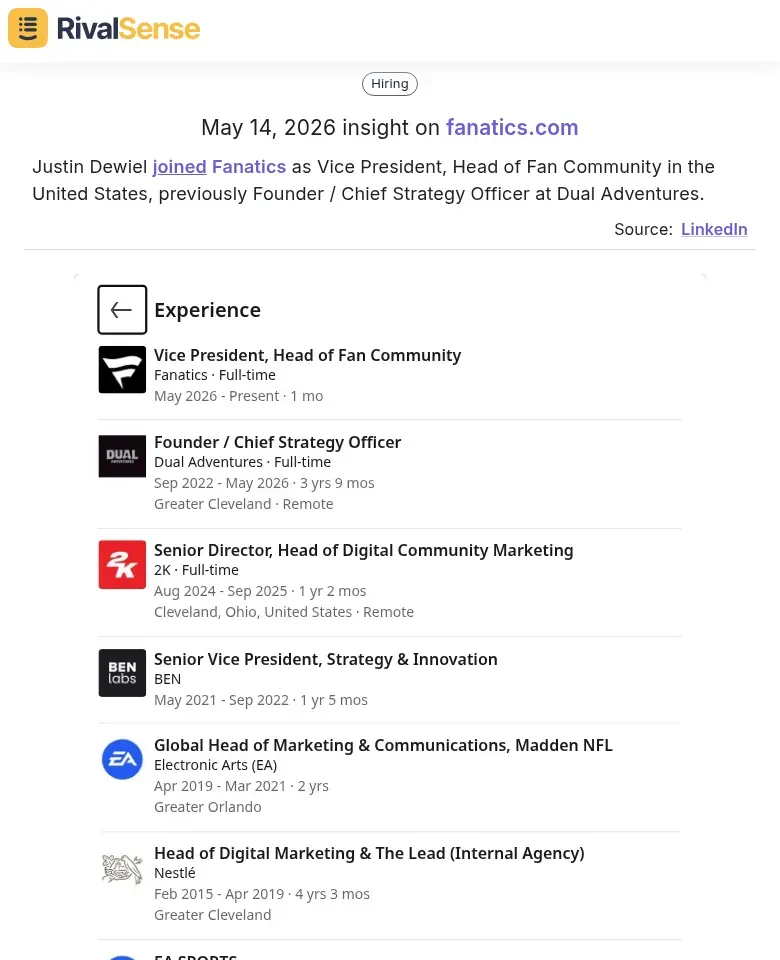
A founder moving to a corporate role often brings deep industry insight and a network that can reshape partnerships. Monitoring these shifts helps you identify new decision-makers and adapt your account approach.
Katie Strain joined Leya as Director of Workplace in the United States.
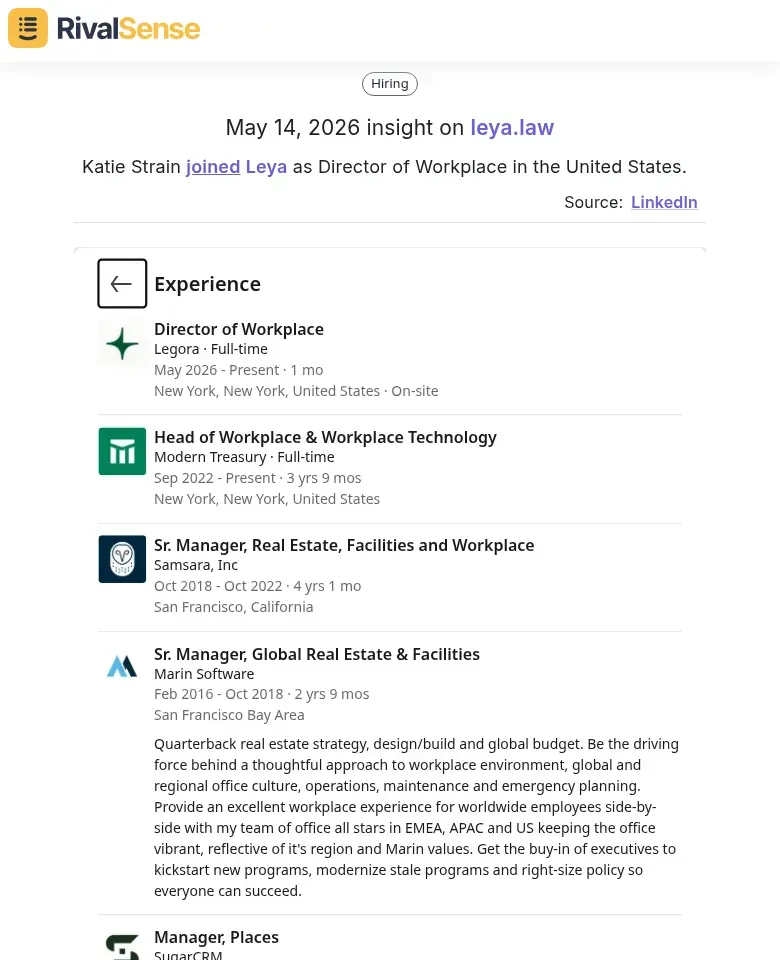
A Director of Workplace hire in a growing company can signal investment in employee experience and office expansion—potential triggers for new service needs.
By automating the tracking of personnel changes, you gain early insights into competitor strategies and client relationship dynamics.
Operationalizing Insights: From Data to Actionable Strategy
To turn competitive intelligence into action, you need structured workflows that connect insights to decision-makers.
Start by building role-specific dashboards: relationship managers should see real-time alerts on competitor pricing changes, product launches, or client churn signals, while leadership teams need aggregated views of market share shifts and win/loss trends.
Next, establish cross-functional workflows. For example:
- When a competitor drops pricing on a key product, trigger an automated alert to the pricing team for a rapid response.
- If a top client is identified as at-risk (e.g., they’re engaging with a competitor), route a task to the relationship manager for a retention outreach campaign.
- Define clear owners and SLAs for each action.
To measure ROI, track three metrics:
📊 Retention rates – are at-risk clients staying?
📊 Cross-sell success – are insights leading to new product adoption?
📊 Win/loss analysis – are you winning more deals against tracked competitors?
Set quarterly reviews to refine your tracking setup based on these KPIs.
💡 Tip: Start with a pilot for 5–10 key accounts, then scale based on measurable impact.
Conclusion: Building a Sustainable Competitive Advantage
To build a sustainable competitive advantage through key account tracking, prioritize scalability, culture, and technology.
Scalability: Establish a centralized tracking framework that integrates CRM data, public filings, and news alerts, ensuring consistency across account managers. Implement a tiered account model—assign high-touch monitoring for top-tier clients and automated alerts for mid-tier accounts.
Culture: Embed competitive intelligence into daily workflows by training teams to log competitor moves during client interactions. Create a "competitive insights" channel in your communication tools for real-time sharing. Reward proactive intelligence gathering with recognition or incentives.
Technology: AI-driven predictive analytics will transform tracking from reactive to proactive. Tools can now forecast client churn risk by analyzing competitor pricing shifts or leadership changes. Real-time monitoring—via NLP on earnings calls or regulatory filings—will become table stakes. Companies that invest in these capabilities today will outmaneuver rivals tomorrow.
Quick checklist:
- 🔲 Audit current tracking tools for scalability gaps
- 🔲 Define tiered monitoring criteria (e.g., revenue, strategic importance)
- 🔲 Schedule quarterly training on CI best practices
- 🔲 Pilot an AI alert system for 10 key accounts
- 🔲 Measure impact via win/loss analysis and retention rates
🚀 Ready to automate your competitive tracking?
Try RivalSense for free and start monitoring competitor key account moves, personnel changes, product updates, and more. Get your first competitor report today and never miss a signal that could protect or grow your most valuable accounts.
📚 Read more
👉 How Revolut's Premium Investment Move Sparked a Rival's Strategic Pivot
👉 Uncover Competitor Insights from Instagram: Track Key Account Satisfaction
👉 Key Account Management Trends in Workflow Automation
👉 Unlocking Financial Moves: Track Competitor M&A with Key Account History
👉 Competitor Analysis in Action: Sprout Social's Reddit Prediction Launch