
Best Practices for Key Account Management: One-Face vs. One-Voice Approaches
Key accounts—the 20% of customers that often generate 80% of revenue—deserve a dedicated management approach. But how you structure that approach can make or break your cross-selling success. A recent study in the Journal of Business Research (May 2026) sheds new light on two dominant KAM structures: the one-face and one-voice approaches. Here’s what the research reveals and how you can apply it.
The Two Approaches
When managing key accounts, you have two primary structural choices. Each comes with distinct trade-offs that affect how customers perceive your team.
- One-Face Approach: A single salesperson acts as the sole point of contact for the customer. This builds a strong personal relationship but limits the depth of expertise available.
- One-Voice Approach: Multiple representatives interact with the customer, but internal coordination ensures a unified message. This brings broader expertise but can feel less cohesive to the customer.
Key Research Findings
A recent study in the Journal of Business Research (May 2026) examined how these two approaches influence customer perceptions and cross-buying behavior. Here are the key insights:
- One-Face → Higher perceived reliability (the customer trusts the single contact)
- One-Voice → Higher perceived expertise (the customer sees a team of specialists)
Both perceptions positively influence cross-buying intentions. However, the effectiveness of each approach depends on sales cycle length:
- Short sales cycles: The one-voice approach drives greater cross-selling success.
- Long sales cycles: The advantage of one-voice diminishes, making the one-face approach relatively more effective.
Practical Steps to Choose Your KAM Approach
To determine which approach suits your business, follow these four steps. Each step considers your unique sales context and customer needs.
Step 1: Analyze Your Sales Cycle
- Short cycle (< 3 months): Lean toward a one-voice approach. Customers value quick access to specialized expertise.
- Long cycle (> 6 months): Consider a one-face approach. Customers need a stable, reliable point of contact through a lengthy process.
Step 2: Assess Your Cross-Selling Goals
- If you’re introducing complex, multi-product solutions, the one-voice approach’s expertise advantage is critical.
- If you’re deepening relationships with existing products, the one-face approach’s reliability may be more valuable.
Step 3: Build the Right Team Structure
- For one-voice: Create a dedicated cross-functional team with clear communication protocols. Use shared CRM tools to ensure everyone speaks with one voice.
- For one-face: Invest heavily in your key account manager’s training and product knowledge. They must be able to navigate internal resources effectively.
Step 4: Monitor and Adapt
- Track customer satisfaction, cross-sell conversion rates, and sales cycle length over time.
- Be prepared to shift approaches as the customer’s needs evolve.
Checklist for KAM Success
| Factor | One-Face | One-Voice |
|---|---|---|
| Sales cycle length | Long | Short |
| Customer need | Reliability | Expertise |
| Team coordination | Low | High |
| KAM skill set | Broad generalist | Specialist coordination |
How to Stay Ahead of Competitor Moves
Implementing the right KAM approach is only half the battle. To truly excel, you need to know what your competitors are doing with their own key accounts. Are they shifting to a one-voice model? Launching new products aimed at your top accounts? Changing pricing? Competitive intelligence tools like RivalSense can help you track these moves effortlessly.
Here are real examples of insights RivalSense delivers weekly, and why each type matters for your KAM strategy:
-
New market expansion – Competitors opening new locations can signal intent to compete for your key accounts in new regions.

Why this matters: If a rival opens a hub near your key customer’s headquarters, you may need to strengthen your local support or adjust pricing to defend the account. -
Product/feature updates – Small enhancements can make your offering less competitive overnight.

Why this matters: When a competitor improves a product attribute (like page count), your key accounts may start expecting the same—prompting you to innovate or communicate your unique value. -
Key personnel moves – Executive departures or hires often indicate strategic shifts.
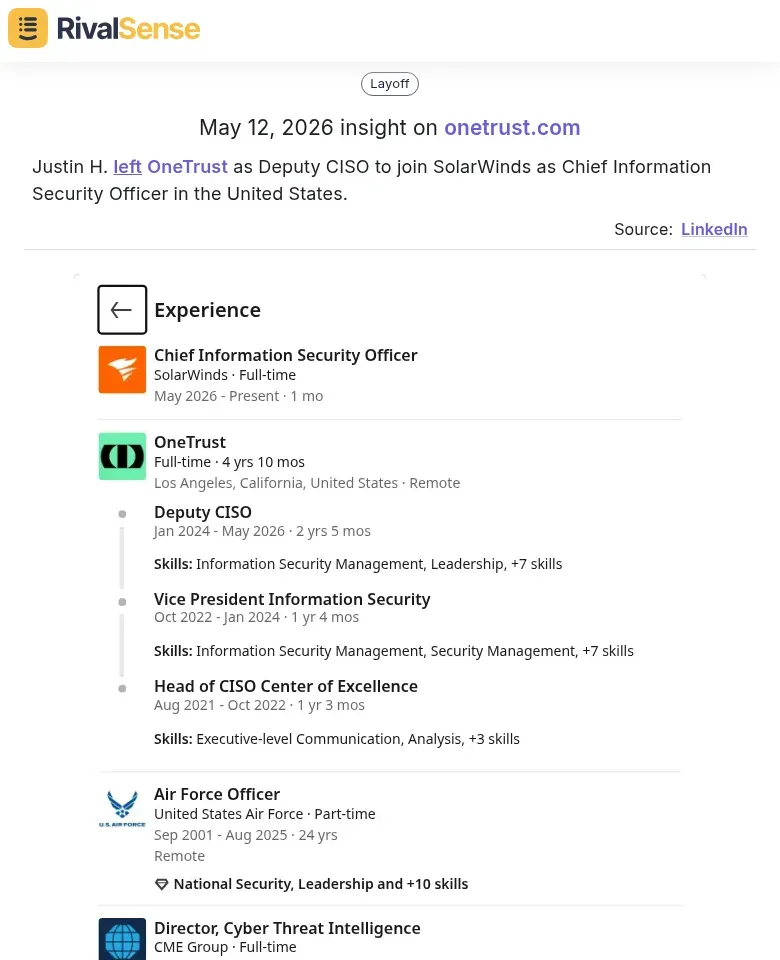
Why this matters: A competitor hiring a senior security leader from another firm might signal a new focus on compliance or data protection—potentially affecting how your key accounts perceive risk.
With RivalSense, you get a weekly email report covering product launches, pricing updates, partnerships, management changes, and more across 80+ sources—including company websites, social media, and registries. Use these insights to proactively adjust your KAM strategy before competitors steal your thunder.
Final Tips
- ✅ Don’t guess—test. Run a pilot with a subset of key accounts to see which approach works best in your context.
- ✅ Train your team. Whether one-face or one-voice, your team must understand the customer’s risk perception and address it directly.
- ✅ Use data. Track cross-selling metrics by account and approach to continuously refine your strategy.
By matching your KAM structure to the sales cycle and customer needs, you can unlock the cross-selling potential that many firms leave on the table. And with the right competitive intelligence, you’ll never be caught off guard by a competitor’s move.
Ready to take your KAM strategy to the next level? Try RivalSense for free at rivalsense.co and get your first competitor report today.
📚 Read more
👉 Boost Banking Productivity: Competitor Churn Analysis
👉 How a Simple Product Rename Revealed Palo Alto Networks' Strategic Shift
👉 How to Use Website Changes for Win-Loss Analysis Against Competitors
👉 3 Real-World Examples of Competitor Analysis in Cybersecurity