
Key Account Management Trends in Workflow Automation
Key account management (KAM) is the strategic discipline of nurturing a company's most valuable clients through personalized, high-touch engagement. As portfolios grow, manual processes—spreadsheets, scattered emails, and siloed CRM notes—become bottlenecks. Enter workflow automation: the use of software to orchestrate repetitive tasks like follow-ups, data syncing, and reporting. Automation is critical for scaling KAM without sacrificing the personal touch. It frees account managers to focus on relationship-building while ensuring no critical step is missed. Enterprise investments underscore this shift: Salesforce's 2025 State of Sales report reveals 74% of high-performing teams now use AI-driven workflow tools, and HubSpot's 2026 projections show a 40% increase in budget allocation for KAM automation. To start, audit your current KAM processes: list every recurring task (e.g., weekly check-ins, contract renewals). Rate each by time spent and impact. Prioritize automating high-effort, low-value tasks first—like auto-populating meeting notes into CRM or triggering renewal reminders 90 days before expiry. Then, pilot one workflow with a single account, measure time saved, and iterate. This gradual approach avoids overwhelm while building momentum toward a fully automated, AI-powered KAM engine.
Lesson 1: 🚀 Strategic Technology Investments Signal Long-Term Commitment to Automation
The workflow automation market is being validated by major enterprise investments, signaling a long-term commitment to automation that Key Account Management (KAM) teams can leverage. A prime example is SAP investing in n8n alongside acquiring Prior Labs for $1B and investing in Parloa AI.

Why this insight matters for your business strategy: Tracking major strategic investments by industry leaders like SAP helps you gauge market trends and the long-term viability of automation platforms. When a giant like SAP bets on a tool, it signals that the platform will likely receive continued development and enterprise-grade support—critical for KAM teams that need reliable, scalable solutions.
What this means for KAM teams:
- Access to scalable tools: Enterprise-grade automation platforms now offer pre-built connectors for CRM, ERP, and communication tools, enabling seamless data flow and reducing manual account tracking.
- AI-driven insights: AI-powered analytics can surface account health scores, churn risks, and expansion opportunities automatically.
Practical steps for KAM leaders:
- Audit your tech stack: Identify gaps where automation could reduce manual work (e.g., meeting notes, follow-ups).
- Evaluate low-code platforms: Tools like Microsoft Power Automate or Zapier allow non-technical team members to build workflows.
- Pilot AI features: Test AI summarization or predictive scoring in your CRM before full rollout.
Checklist for strategic investment:
- [ ] Does the platform integrate with your existing CRM?
- [ ] Can it handle complex, multi-step workflows?
- [ ] Does it offer AI capabilities for predictive analytics?
By betting on platforms backed by major investments, KAM teams gain access to tools that evolve with market needs—ensuring your account strategies remain competitive and data-driven.
Lesson 2: 🤝 Partnering with Automation Leaders Accelerates Real-World Impact
High-profile partnerships demonstrate how workflow automation turns Key Account Management (KAM) strategies into measurable outcomes. Consider Mercedes-Benz partnering with n8n to deploy AI-powered workflow automation across its business, with CIO Katrin Lehmann stating the platform enables teams to turn ideas into measurable impact.
Why this insight matters for your business strategy: Real-world adoption by a prestigious brand like Mercedes-Benz proves ROI and provides a credible case study. For KAM teams, it shows that even complex enterprise environments can benefit from workflow automation, and it offers a benchmark for your own automation ambitions.
To select the right automation partner, follow these steps:
- Map KAM workflows: Identify repetitive, manual tasks (e.g., data entry, follow-ups) that consume >20% of your team’s time.
- Evaluate integration depth: Ensure the platform connects seamlessly with your CRM (e.g., Salesforce, HubSpot) and communication tools (e.g., Slack, Outlook).
- Prioritize scalability: Choose a partner that supports complex logic (e.g., conditional triggers, multi-step workflows) to grow with your account portfolio.
- Demand analytics: Opt for tools that provide dashboards tracking automation impact on retention, upsell, and response times.
Checklist for partner evaluation:
- [ ] Does it offer pre-built KAM templates?
- [ ] Can it handle role-based permissions for account teams?
- [ ] Is there native support for SLA tracking?
By partnering with automation leaders, you transform KAM from a manual art into a data-driven science, delivering faster wins and stronger client loyalty.
Lesson 3: 👥 Community and Co-Creation Drive Adoption and Innovation
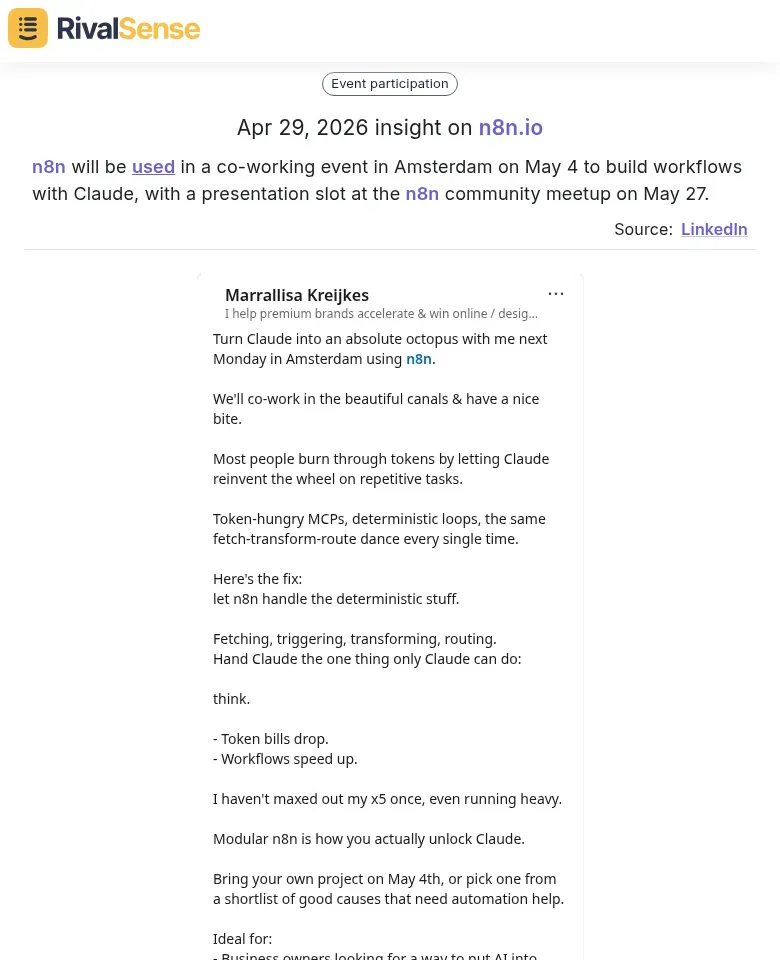
Automation adoption isn’t just about tools—it’s about people. Co-working events and community meetups create hands-on learning environments where KAM teams can experiment with workflows in real-time. A great example: n8n will be used in a co-working event in Amsterdam on May 4 to build workflows with Claude, with a presentation slot at the n8n community meetup on May 27.
Why this insight matters for your business strategy: Tracking community events and co-creation opportunities reveals how platforms foster innovation through peer learning. For KAM leaders, it suggests that investing in internal “automation jams” or joining vendor-hosted events can accelerate proficiency and uncover novel use cases specific to your accounts.
Why it works: When teams build workflows alongside AI models like Claude, they discover unexpected use cases—such as automating account health scoring or drafting personalized outreach sequences. Co-creation sparks innovation that top-down training rarely achieves.
Practical steps to get started:
- Host monthly “Automation Jams” – Invite team members to bring a repetitive task and build a workflow together.
- Create a peer-led “Workflow Library” – Encourage sharing successful automations with step-by-step guides.
- Pair AI with domain experts – Have KAMs describe ideal workflows while an AI specialist translates them into automation.
Checklist for a successful co-creation session:
- [ ] Define a clear problem (e.g., “reduce time spent on quarterly reviews”)
- [ ] Provide sandbox environments for safe experimentation
- [ ] Document outcomes and iterate based on feedback
Peer-driven knowledge sharing builds a culture of continuous improvement. When one team cracks a complex workflow, others adapt and enhance it—multiplying value across the organization. Start small, celebrate wins, and let the community fuel your automation maturity.
Lesson 4: 📈 From Pilot to Scale – Embedding Automation into KAM Processes
Scaling automation from isolated pilots to enterprise-wide KAM processes requires a structured approach. Start by identifying high-impact, repeatable workflows—like automated quarterly business reviews or renewal triggers—that deliver quick wins. Use a phased rollout: pilot with one account team, refine based on feedback, then expand to others.
Key metrics to track:
- Time saved per account manager (target: 20%+ reduction in manual tasks)
- Adoption rate across teams (aim for >80% within 3 months)
- Account health score improvements (e.g., NPS or churn risk reduction)
Common pitfalls & fixes:
- Pitfall: Over-automating without human oversight. Fix: Keep exception handling manual; use automation for routine data collection, not judgment calls.
- Pitfall: Ignoring team resistance. Fix: Involve account managers in design; offer training and a "feedback loop" for continuous improvement.
- Pitfall: Lack of integration. Fix: Ensure automation tools connect with CRM (e.g., Salesforce, HubSpot) and existing dashboards.
Checklist for scaling:
- Map current KAM workflows and identify bottlenecks.
- Select 3-5 processes for automation (e.g., data entry, report generation).
- Define success metrics per process.
- Run a 4-week pilot with one team.
- Gather feedback and iterate.
- Create a playbook for rollout.
- Monitor adoption and adjust incentives.
By following this roadmap, you'll embed automation into daily KAM routines, freeing teams to focus on strategic relationships.
Conclusion: Preparing Your KAM Team for the Automated Future
As workflow automation reshapes Key Account Management, the convergence of enterprise-grade scalability and community-driven agility defines the next frontier. Early adopters gain a decisive edge: faster response times, deeper account insights, and stronger client relationships.
Actionable Steps for KAM Leaders:
- Audit Current Workflows: Map repetitive tasks (report generation, follow-ups, data entry) and quantify time spent.
- Define Success Metrics: Set clear KPIs (e.g., reduction in manual hours, increase in proactive touches).
- Evaluate Tools Against Checklist:
- Integration with CRM (Salesforce, HubSpot)
- Customizable automation triggers
- Real-time collaboration features
- Analytics and reporting capabilities
- Pilot with a Small Team: Test 2-3 tools on a subset of accounts for 30 days.
- Gather Feedback & Iterate: Involve account managers early to ensure adoption.
Pro Tip: Prioritize platforms that offer low-code customization—they empower your team to adapt workflows without heavy IT dependency.
Stay Ahead with Competitive Intelligence: To keep your KAM strategy sharp, you need to be aware of what your competitors are doing with automation—new partnerships, investments, product launches, and events that might threaten your accounts. RivalSense tracks competitor product updates, pricing changes, event participations, partnerships, and more across websites, social media, and registries—delivering a concise weekly report straight to your inbox.
👉 Try RivalSense for free today and get your first competitor report to ensure your KAM team never misses a critical move in the automation race.
📚 Read more
👉 Unlocking Financial Moves: Track Competitor M&A with Key Account History
👉 Competitor Analysis in Action: Sprout Social's Reddit Prediction Launch
👉 Best Practices for Key Account Management: One-Face vs. One-Voice Approaches
👉 Boost Banking Productivity: Competitor Churn Analysis
👉 How a Simple Product Rename Revealed Palo Alto Networks' Strategic Shift