
Unlocking Financial Moves: Track Competitor M&A with Key Account History
In the fast-paced B2B landscape, mergers and acquisitions (M&A) are more than headline news—they are powerful signals of a competitor’s strategic direction. When a rival acquires a startup, enters a new geography, or absorbs a technology firm, they are revealing where they plan to invest resources and focus their growth. Tracking these moves gives you a front-row seat to their playbook.
Why M&A tracking matters:
- Spot market shifts: An acquisition into a new segment (e.g., a CRM company buying an AI analytics firm) signals a pivot toward data-driven offerings.
- Uncover tech priorities: Acquiring a niche tool often means your competitor plans to integrate that capability into their core product.
- Anticipate competitive moves: A series of acquisitions in a specific vertical can foreshadow a bundled solution or aggressive go-to-market push.
Practical steps to get started:
- Set up alerts for key competitors on platforms like Crunchbase, PitchBook, or SEC filings.
- Analyze the ‘why’ behind each deal: read investor presentations and press releases for stated rationale.
- Map the acquisition to your own strategy—does it threaten your position or open a gap you can exploit?
By systematically monitoring M&A activity, you transform raw data into actionable intelligence, enabling you to adjust your roadmap, refine your positioning, and stay one step ahead.
Decoding Strategic Intent from Acquisitions
To decode a competitor's strategic intent from acquisitions, start by identifying the capability gaps or customer segments they're targeting. Acquisitions often fill missing pieces in their product stack or open doors to new markets. For example, a services company acquiring a SaaS platform signals a pivot to product-led growth.
Real insight from RivalSense: For instance, VistaPrint's parent company Cimpress acquired Saxoprint to focus on helping over ten million businesses build their brands through customized physical marketing products, as stated by CEO Robert Keane.

Tracking such strategic acquisitions helps you understand where competitors are investing and whether they are expanding their customer base or technology stack. This allows you to proactively adjust your own offering or marketing approach.
Step 1: Read the CEO’s statement in the acquisition press release. They’ll explicitly state the rationale—e.g., "This accelerates our entry into the healthcare vertical."
Step 2: Look for patterns. If a competitor acquires three data analytics firms in two years, they’re building a data moat. Use a simple tracker: list each acquisition, the target’s core offering, and the stated reason. Then categorize by pattern—vertical expansion, tech stack fill, or talent acquisition.
Step 3: Map to your own gaps. If they’re buying AI startups, expect AI features soon. Prepare counter-strategies or partnerships.
Pro tip: Set up Google Alerts for your competitors + "acquires" to catch moves in real time. Then update a shared doc monthly with your team to spot trends before they materialize.
Valuation Surges as a Signal of Market Validation
When a competitor secures a strategic investment from a major tech firm, their valuation can double overnight. This isn't just a financial boost—it's a powerful signal of market validation. Such deals often involve plans to integrate the startup's technology into the investor's ecosystem, giving them access to vast distribution channels, data, and credibility.
Real insight from RivalSense: For example, n8n's valuation doubled to $5.2bn after SAP made a strategic investment and plans to embed n8n's AI platform into Joule Studio.
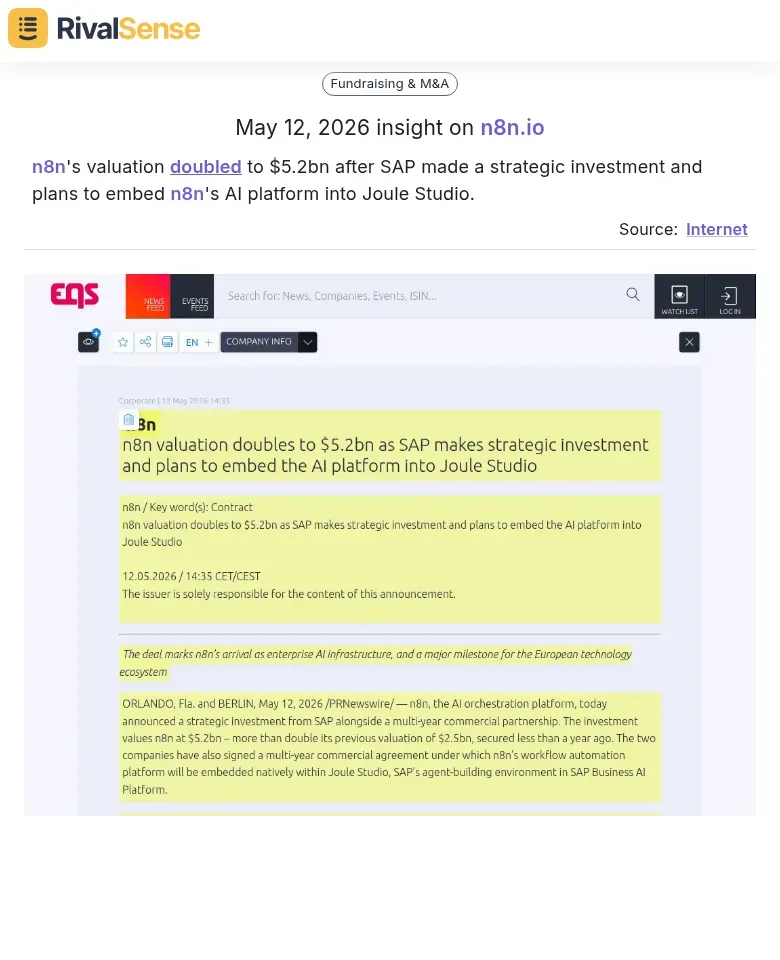
Monitoring such valuation surges reveals which competitors are gaining resources and credibility, allowing you to anticipate their growth trajectory. To track these signals, set up alerts for funding announcements in your industry using tools like Crunchbase or PitchBook. When you spot a valuation surge, dig into the deal terms: Is there a technology integration roadmap? Are there exclusivity clauses? This tells you how the competitor's product might evolve and where they’ll gain unfair advantages. Practical steps: 1) Create a watchlist of competitors and their investors. 2) Monitor SEC filings and press releases for investment rounds. 3) Analyze the investor's recent acquisitions and partnerships to anticipate integration moves. By tracking valuation jumps, you can identify which competitors are gaining resources and credibility—and adjust your strategy accordingly.
Financial Transparency as a Competitive Weapon
Financial transparency isn't just a regulatory checkbox—it's a competitive weapon. When a competitor publishes audited annual reports, they signal operational maturity and build trust with investors and customers. But the real insight lies in comparing audited vs. unaudited statements. A sudden discrepancy—say, revenue adjustments or expense reclassifications—can reveal hidden risks or aggressive accounting.
Real insight from RivalSense: For instance, Mapon published its audited 2025 annual report, showing continued growth with no material differences from unaudited statements.
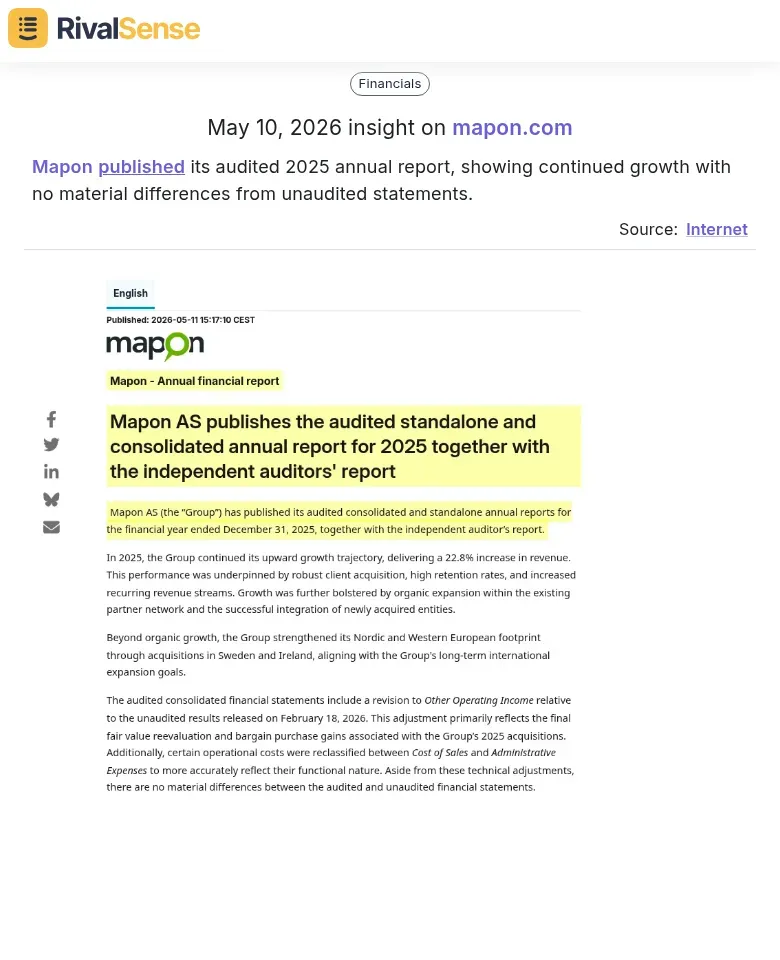
Tracking such financial disclosures helps you benchmark your own transparency and identify competitors' operational maturity. If a competitor consistently releases timely audited reports, they are likely more stable; unexplained delays might signal trouble.
Practical steps to weaponize financial data:
- Track filing patterns. Note when competitors release audited vs. unaudited reports. Delays may indicate internal issues.
- Compare key metrics side-by-side. Look for gaps in revenue, COGS, or EBITDA between versions. A >5% variance warrants deeper investigation.
- Pressure competitors to disclose more. If you publish transparent financials, your rivals may feel compelled to follow suit, leveling the playing field. Use your own audited reports as a benchmark to call out opacity in the market.
Checklist for financial analysis:
- [ ] Collect last 3 years of audited and unaudited statements.
- [ ] Highlight any restatements or qualification notes.
- [ ] Cross-reference with news (e.g., layoffs, acquisitions) to validate findings.
Transparency isn't just about compliance—it's about turning their numbers into your strategic advantage.
Building a Systematic M&A Tracking Process
To build a systematic M&A tracking process, start by setting up real-time alerts. Use Google Alerts with keywords like "[competitor name] acquires" or "[competitor name] acquisition." Monitor SEC filings (e.g., 8-K forms for material acquisitions) and press releases on their investor relations pages. Tools like Feedly or Mention can aggregate these sources.
Once you capture a deal, categorize it by type: tech acquisition (buying IP or products), talent acquisition (acqui-hires), or market entry (expanding geography or customer base). This reveals strategic patterns—e.g., a series of tech buys signals a platform play.
Create a timeline using a spreadsheet or project management tool. For each deal, log: date, target company, deal value (if public), category, and strategic rationale. Visualize this with a Gantt chart or timeline view to spot growth trajectories and pivots. For example, if a competitor acquires three AI startups in six months, they're likely betting on AI.
Pro tip: Cross-reference M&A with product launches—acquisitions often precede new features. Review quarterly earnings calls for mentions of integration progress. This systematic approach transforms raw data into actionable competitive intelligence.
Turning M&A Insights into Actionable Strategy
Uncovering a competitor’s acquisition isn’t just about knowing what they bought—it’s about shaping your next move. Here’s how to turn those insights into strategy:
1. Spot gaps and decide your stance.
When a rival acquires a company, ask: What gap are they filling? Is it a new technology, a customer segment, or a geographic market? Then choose your path:
- Compete: Build or buy a similar capability.
- Partner: Collaborate with the acquired firm’s competitors.
- Differentiate: Go after a different gap entirely.
2. Benchmark your valuation.
Public M&A filings often disclose deal multiples (e.g., EV/Revenue). Use these to gauge how the market values similar companies. Compare against your own metrics to see if you’re undervalued—or overvalued—for fundraising or exit planning.
3. Upgrade your own reporting.
Analyze the financial disclosures in the acquirer’s filings. How do they present segment performance, synergies, or risks? Adopt best practices to make your investor communications clearer and more credible.
Quick checklist:
- [ ] Identify the gap the M&A fills.
- [ ] Decide: compete, partner, or differentiate.
- [ ] Note the deal multiple.
- [ ] Compare with your own valuation.
- [ ] Revise your financial reporting style.
Turn every competitor’s move into a strategic advantage.
Staying on top of all these signals—M&A, valuations, financial reports—manually can be overwhelming. That’s where RivalSense comes in. We track competitor product launches, pricing updates, event participations, partnerships, regulatory changes, management moves, and media mentions across websites, social media, and registries—all delivered in a weekly email. Try RivalSense for free at https://rivalsense.co/ and get your first competitor report today.
📚 Read more
👉 Competitor Analysis in Action: Sprout Social's Reddit Prediction Launch
👉 Best Practices for Key Account Management: One-Face vs. One-Voice Approaches
👉 Boost Banking Productivity: Competitor Churn Analysis
👉 How a Simple Product Rename Revealed Palo Alto Networks' Strategic Shift
👉 How to Use Website Changes for Win-Loss Analysis Against Competitors