
How to Use Website Changes for Win-Loss Analysis Against Competitors
Most companies treat competitor website changes as background noise—a new case study here, a pricing page tweak there. But these updates are real-time signals of strategic shifts. When a competitor adds a new feature page, updates their pricing model, or launches a customer success section, they’re telegraphing their go-to-market priorities. The connection between these subtle web updates and win-loss patterns is direct: a new integration announcement often precedes a wave of competitive wins in that ecosystem, while a pricing change can signal a pivot to enterprise or SMB segments. By proactively tracking these changes, you gain a decisive edge in deal reviews. Instead of wondering why you lost a deal, you can correlate the loss with a specific competitor update—perhaps they introduced a whitepaper on a topic your sales team hadn’t addressed, or they added a testimonial from an industry similar to your prospect.
Start by setting up automated monitoring of competitor websites. Tools like RivalSense or Visualping work well. Categorize changes: pricing, features, content, team, and case studies. Then, in your weekly win-loss review, map each lost deal against recent competitor changes. Over time, patterns emerge: a pricing change leads to a 20% loss rate in mid-market, or a new integration causes a spike in wins in the fintech vertical. This proactive approach transforms website changes from noise into a strategic early warning system.
🌍 Geographic Expansion Signals: Spotting New Market Entries
When a competitor adds a new country page or service area to their website, it's a strong signal they're scaling. Watch for new localized content, translated pages, or region-specific landing pages. These often precede formal market entries by weeks.
Why this matters for your strategy: Tracking geographic expansions helps you defend your territory. If a competitor enters a region where you have active deals, you can prioritize retention or accelerate outreach before they gain traction.
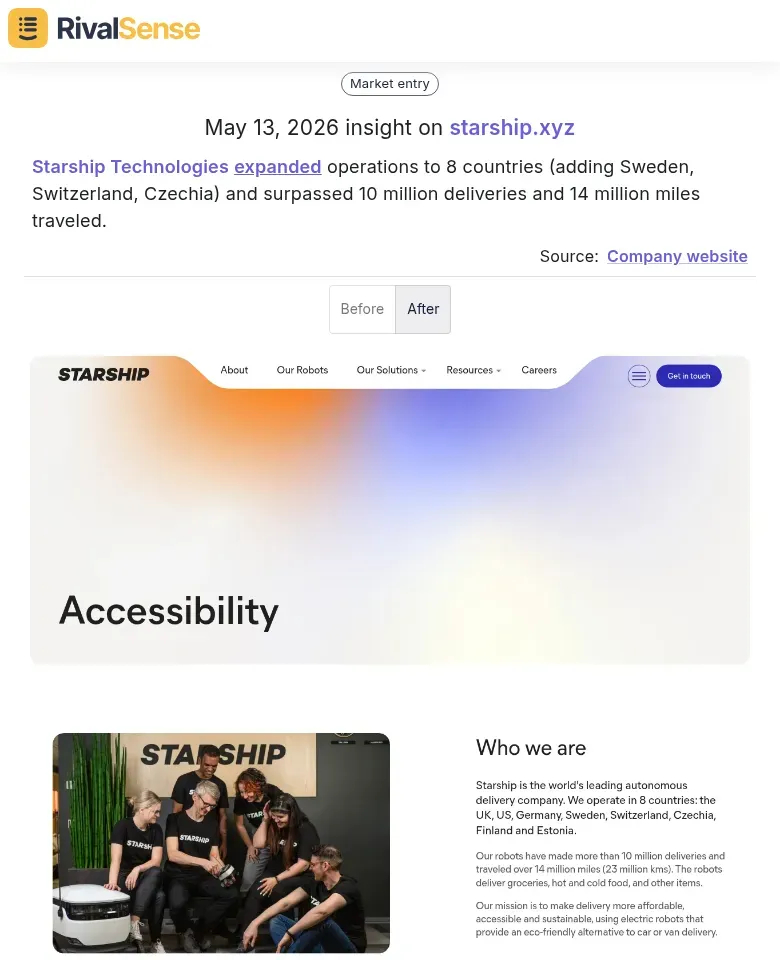
Real Insight from RivalSense: Starship Technologies expanded operations to 8 countries (adding Sweden, Switzerland, Czechia) and surpassed 10 million deliveries and 14 million miles traveled.
This milestone reveals rapid scaling in European markets—a signal to any delivery or logistics company active in those regions to prepare competitive responses.
How to track this:
- Set up alerts for new subdirectories (e.g.,
/de/,/fr/) or new service pages. - Use a tool like RivalSense to monitor page additions automatically.
Milestone announcements (e.g., “1 million deliveries in Europe”) reveal growth velocity. If a competitor announces a milestone in a region you target, they’re gaining traction fast.
Cross-reference with your own pipeline:
- Map your pipeline deals by region.
- If a competitor enters a region with multiple deals, prioritize those accounts for retention or accelerated outreach.
- Flag new market entries to your sales team so they can prepare competitive talking points.
Quick checklist:
- Monitor new country pages weekly.
- Log milestone announcements in a shared tracker.
- Alert sales when a competitor enters a region with active deals.
🚀 Product & Service Launch Timelines: From 'Coming Soon' to Reality
When a competitor removes 'Opening 2026' or 'Coming Soon' labels from their website, it's a strong signal that a launch is imminent. Similarly, new location pages or facility openings hint at capacity expansion.
Why this matters for your strategy: Anticipating product launches lets you update your sales playbook and differentiation points before the competitor hits the market. You can emphasize your proven reliability, existing customer base, or unique features that the new competitor lacks.
Real Insight from RivalSense: Clinique La Prairie's Longevity Hub in Beijing is now open, removing the 'opening 2026' label.
This signals a major market entry in luxury wellness. Competitors in the same space can immediately prepare counter-messaging and reinforce their own local partnerships.

To leverage these cues:
- Set up website change alerts using tools like RivalSense to detect removals or additions in real time.
- When you spot a launch signal, review your sales playbook and update your differentiation points.
- Create a checklist for your sales team:
- [ ] Confirm the competitor's launch date via press releases or social media.
- [ ] Identify their target segments and pricing.
- [ ] Prepare counter-messaging highlighting your advantages (e.g., faster support, more integrations).
- [ ] Train reps on handling objections like 'But they have a new feature.'
- Monitor their new location pages to gauge capacity—if they're expanding, they may be targeting your key accounts. Proactively reach out to those accounts with a value proposition that underscores your stability and partnership depth.
⚖️ Regulatory & Compliance Pivots: Reading the Policy Tea Leaves
When competitors publish new white papers or resources on upcoming legislation, they're signaling a strategic pivot. For instance, if a rival in fintech releases a guide on the EU's Digital Operational Resilience Act (DORA), they're likely retooling their product for compliance. Track these shifts using website change monitoring tools—set alerts for new pages under /resources or /insights.
Why this matters for your strategy: Competitors who move early on compliance can capture security-conscious customers. By monitoring these shifts, you can prioritize similar features in your product roadmap and avoid being caught off guard.
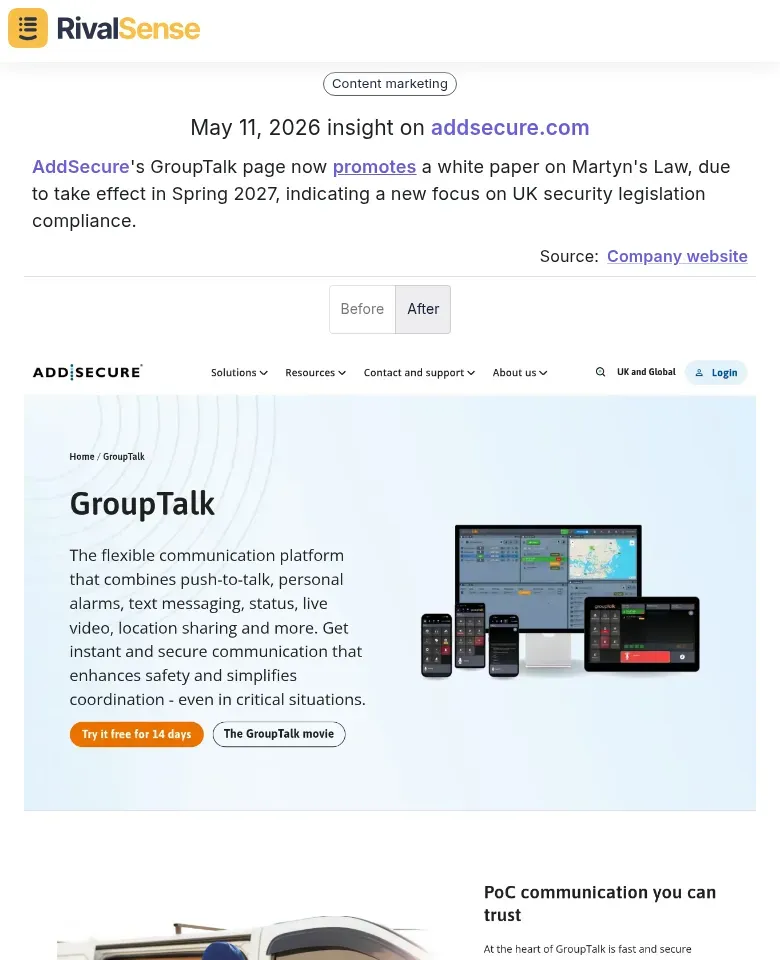
Real Insight from RivalSense: AddSecure's GroupTalk page now promotes a white paper on Martyn's Law, due to take effect in Spring 2027, indicating a new focus on UK security legislation compliance.
This shows a competitor proactively addressing upcoming regulation. If you serve UK customers, you should immediately review your own compliance messaging and product capabilities.
Actionable Steps:
- Identify regulatory keywords (e.g., 'GDPR', 'ESG reporting', 'AI Act', 'Martyn's Law') and monitor competitor sites for new content containing them.
- Categorize changes by compliance area (data privacy, security, environmental) to spot target market evolution.
- Map to your roadmap: If a competitor addresses a regulation you've ignored, prioritize that feature. Create a 'regulatory response' column in your product backlog.
Pro Tip: Use a shared tracker (e.g., Airtable) to log each competitor's compliance content, noting the regulation, publication date, and potential impact on your customers. This turns policy signals into actionable product decisions.
🧠 Building a Systematic Win-Loss Analysis Framework from Web Changes
To build a systematic win-loss analysis framework from web changes, start by creating a categorized change log. Use a spreadsheet or tool to track changes in three buckets:
| Bucket | Examples |
|---|---|
| Expansion | New markets, pricing, funding rounds |
| Product | Features, UI/UX updates, integrations |
| Compliance | Certifications, security badges, privacy policies |
For each change, note the date, source URL, and a brief description.
Next, map each change to specific wins or losses in your CRM. For example, if a competitor added a SOC 2 badge and you lost a deal in a security-sensitive vertical, tag that loss with the change. Conversely, if they removed a feature and you won, note that too. This creates a feedback loop between web intelligence and deal outcomes.
Establish a weekly review cadence: every Monday, spend 30 minutes reviewing the change log with your sales and product teams. Discuss:
- Which changes correlated with recent wins/losses?
- Are there patterns (e.g., competitor pricing changes causing churn)?
- What actions can we take (e.g., update sales battle cards, prioritize a feature)?
Pro tip: Use a shared Slack channel or project board to log changes in real time. Assign a team member to scan competitors’ websites every Friday and populate the log. Over time, you’ll spot leading indicators that predict competitive shifts before they impact your pipeline.
🏁 Conclusion: Turning Web Signals into Strategic Wins
Website changes are a goldmine of competitive intelligence, revealing shifts in product focus, pricing, and positioning before they hit the market. By systematically tracking these signals—new features, updated case studies, pricing tweaks, or leadership hires—you can move from reactive firefighting to predictive strategy. Instead of scrambling when a competitor launches, you'll anticipate their next move and adjust your own roadmap, messaging, and sales plays accordingly.
Practical steps to get started:
- Set up alerts for competitor website changes using a tool like RivalSense (or Visualping).
- Categorize changes (e.g., product, pricing, content) and log them weekly.
- Map each change to a potential win/loss scenario: Does this address a known customer pain point? Does it undercut your pricing?
- Review findings monthly with your product and sales teams to adjust strategy.
Don't let competitor moves catch you off guard. Implement a structured tracking process today—your next strategic win depends on it.
Try RivalSense for free 👉 https://rivalsense.co/
Get your first competitor report today and start turning web changes into winning strategies.
📚 Read more
👉 3 Real-World Examples of Competitor Analysis in Cybersecurity
👉 How Competitor Layoffs Reveal Key Account Opportunities
👉 How to Analyze a Competitor's Flash Sales Campaign: Akulaku Indonesia Case Study
👉 Competitor Thought Leadership Analysis: A Step-by-Step Guide
👉 5 Key Account Management Strategies for Environmental Consultants (and Any B2B Firm)