
3 Real-World Examples of Competitor Analysis in Cybersecurity
In cybersecurity, the threat landscape evolves daily—new vulnerabilities, regulations, and attack vectors emerge constantly. Competitor analysis isn't just about keeping tabs; it's a strategic lens to spot market trends and innovation gaps before they become obvious. By systematically tracking rivals, you can anticipate moves in hot areas like AI-driven detection, identity management, and zero-trust architectures.
Why it matters: A competitor's product launch, partnership, or hiring spree often signals a shift in customer demand or technology direction. For example, if a rival invests heavily in AI-based threat hunting, it may indicate that manual SOC workflows are losing favor.
Practical tips for cybersecurity teams:
- 🔍 Monitor job postings – A surge in roles for "AI security engineer" suggests a pivot toward machine learning.
- 📜 Track patent filings – New patents in identity verification can reveal upcoming features.
- 💵 Analyze pricing changes – A price drop might signal a commoditization play or a new freemium model to capture market share.
Below, three real-world examples show how to extract actionable insights from competitor activities—turning raw data into strategic decisions.
Lesson 1: Acquisitions Signal Strategic Pivots and Talent Flows
When a competitor acquires a security automation firm, it’s a clear signal they’re betting on automation to scale. But the real insight comes 12–24 months post-acquisition: founders and key engineers often depart to launch new startups. Their exits reveal emerging pain points they couldn’t solve inside the acquirer.
Real-world example from RivalSense:
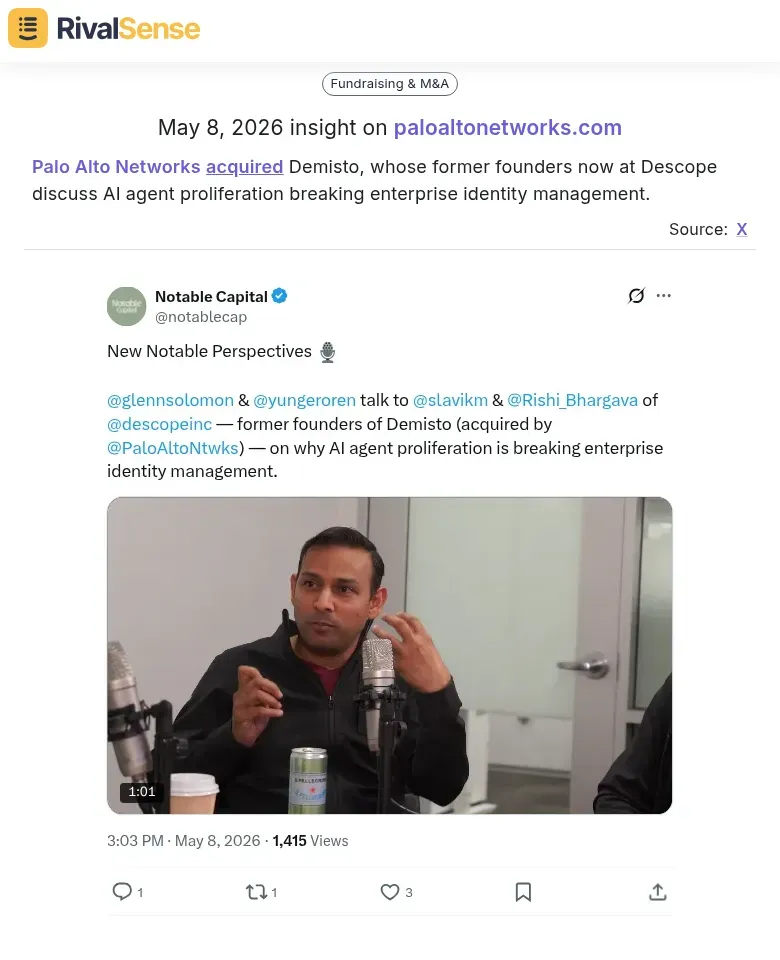
Palo Alto Networks acquired Demisto, whose former founders now at Descope discuss AI agent proliferation breaking enterprise identity management. This type of insight is valuable for business strategy because tracking talent flow pinpoints the next wave of innovation. If ex-employees from a major player like Palo Alto Networks target the identity gap for AI agents, it’s a strong signal to adjust your own roadmap toward that niche.
Practical steps:
- Track acquisition announcements via Crunchbase or SEC filings.
- Set LinkedIn alerts for "left [Acquirer]" or "former [Acquirer]" to spot departures.
- Analyze new startups from those leavers: their pitch decks and job postings highlight unmet needs.
- Map talent flows quarterly—if multiple ex-employees target the same niche (e.g., AI agent identity), that’s a market gap.
Checklist:
- [ ] Identify last 3 acquisitions by top 5 competitors.
- [ ] List key people who left within 2 years.
- [ ] Note the focus of their new ventures.
- [ ] Cross-reference with your product roadmap.
By monitoring talent migration, you can uncover adjacent market opportunities before they become crowded.
Lesson 2: Platform Adoption by Customers Reveals Integration Opportunities
When a competitor’s platform is adopted by other companies to power AI initiatives, it signals platform stickiness and ecosystem value. Analyzing these use cases reveals integration opportunities: if a competitor enables AI safely for enterprise search, you might build a similar capability or partner with AI vendors.
Real-world example from RivalSense:
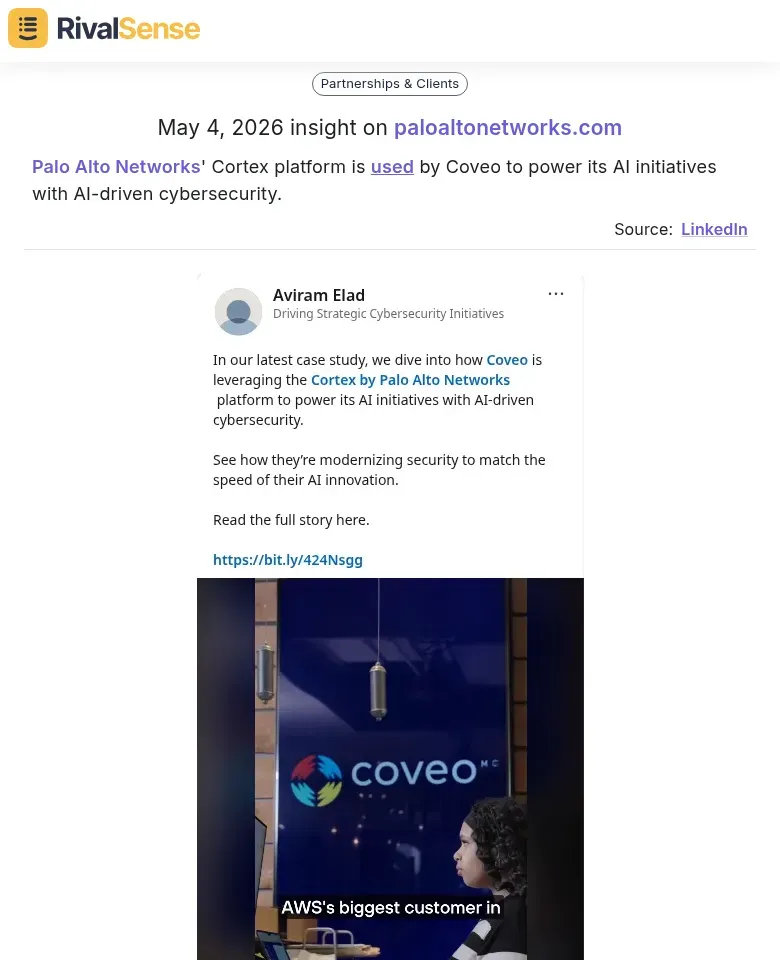
Palo Alto Networks' Cortex platform is used by Coveo to power its AI initiatives with AI-driven cybersecurity. This type of insight is valuable for business strategy because it shows a competitor’s platform is being leveraged by high-profile customers for cutting-edge use cases. You can then assess whether your own platform supports similar AI workloads or if you need to build integrations with AI platforms like Coveo.
Practical steps:
- Identify top use cases by searching customer case studies or press releases for phrases like "secures AI" or "AI-powered."
- Map integrations—note which third-party tools (e.g., Snowflake, Databricks) the competitor connects with.
- Audit your platform for gaps in AI support (e.g., model training security, inference monitoring).
Checklist for action:
- [ ] List 3 customer stories where a competitor enables AI.
- [ ] Compare their integration partners to yours.
- [ ] Prioritize 1–2 integration opportunities that align with your roadmap.
This insight guides your product strategy—either by building native AI features or by forming partnerships to close capability gaps before customers switch.
Lesson 3: Event Participation Indicates Thought Leadership and Community Focus
A competitor’s choice of cybersecurity conferences reveals their target audience and messaging priorities. For example, a vendor speaking at RSA Conference on zero-trust signals enterprise focus, while sponsoring BSides indicates grassroots community engagement. Event themes—AI, identity, compliance—show the topics they aim to own.
Real-world example from RivalSense:
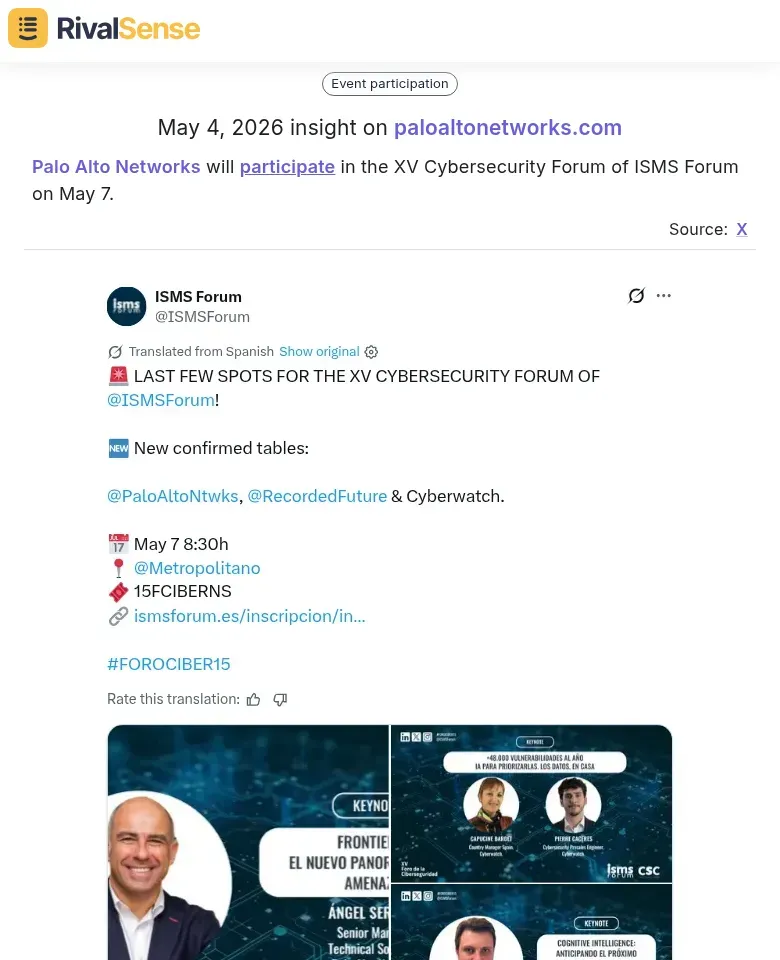
Palo Alto Networks will participate in the XV Cybersecurity Forum of ISMS Forum on May 7. This type of insight is valuable for business strategy because it tells you which communities and regions a competitor is prioritizing. Attending a specialized forum like ISMS (focused on information security management) signals they are targeting compliance-conscious buyers. You can use this data to decide whether to compete in that space or differentiate by focusing on a different niche.
Practical Steps to Track Event Participation:
- Monitor speaker lists of major events (e.g., Black Hat, Gartner Security & Risk Management Summit) using tools like RivalSense or manual checks.
- Analyze session titles for keywords (e.g., "cloud security," "threat intelligence") to map their narrative.
- Check sponsorship tiers – Diamond sponsors often have different goals than exhibitors.
- Review post-event content – Whitepapers or webinars tied to the event reveal follow-up strategies.
Pro Tip: Create a simple spreadsheet tracking competitors’ events, session topics, and booth themes. Over 6 months, patterns emerge—e.g., a competitor consistently sponsoring compliance-focused events may be pivoting to regulated industries. Use this to identify partnership gaps (e.g., no presence at a key conference) or competitive gaps (e.g., they ignore a growing niche like OT security).
Checklist:
- [ ] List top 5 industry events your competitors attend.
- [ ] Note session themes and speaker titles.
- [ ] Compare their event calendar to yours for missed opportunities.
Synthesizing Insights: Building a Competitive Intelligence Framework
To build a competitive intelligence framework that truly drives strategy, you must synthesize signals from multiple sources—acquisitions, customer use cases, and industry events—into a cohesive picture. Start by mapping each competitor’s moves: an acquisition might signal a shift toward cloud security, while a new customer case study reveals their go-to-market focus. Cross-reference these with event announcements (e.g., product launches at RSA) to validate trends.
Practical steps:
- Create a signal tracker – Use a tool like RivalSense to log acquisitions, product updates, and customer wins weekly.
- Hold a monthly synthesis session – With your team, map signals to strategic themes (e.g., "zero-trust expansion").
- Prioritize your roadmap – If competitors double down on XDR, decide whether to match, differentiate, or partner.
- Update messaging quarterly – Reflect new competitor strengths/weaknesses in your sales battle cards.
Checklist for regular updates:
- [ ] Review competitor news daily (RSS, alerts).
- [ ] Analyze quarterly earnings calls for strategic hints.
- [ ] Attend 2–3 key cybersecurity events per year to observe competitor booths and talks.
- [ ] Revisit your CI framework every 90 days to adjust for rapid changes.
By weaving these signals together, you’ll move from reactive monitoring to proactive strategy—staying ahead of shifts in the cybersecurity landscape.
Conclusion: Turning Competitor Insights into Action
Competitor analysis isn’t about copying—it’s about anticipating market shifts and carving your unique advantage. In cybersecurity, where threats and solutions evolve daily, the winners are those who spot patterns first: a rival’s acquisition signals a new capability; a customer story reveals a pain point they’re solving; a conference talk hints at their roadmap. Tools like RivalSense automate the tracking of these signals, freeing you to focus on strategy.
Start small: pick one competitor and map their moves across three lenses—acquisitions, customer stories, and events. For each, ask: What does this mean for the market? Where is our gap or opportunity? Then act—adjust your product roadmap, refine your messaging, or target an underserved segment. Repeat weekly. Over time, you’ll shift from reactive to proactive, turning insights into decisive action that sets you apart.
👉 Ready to put this into practice? Try RivalSense for free at rivalsense.co. Get your first competitor report today and start making data-driven decisions.
📚 Read more
👉 How Competitor Layoffs Reveal Key Account Opportunities
👉 How to Analyze a Competitor's Flash Sales Campaign: Akulaku Indonesia Case Study
👉 Competitor Thought Leadership Analysis: A Step-by-Step Guide
👉 5 Key Account Management Strategies for Environmental Consultants (and Any B2B Firm)
👉 How a Rival Used Palo Alto's Terraform Move to Outmaneuver Them