
How Competitor Layoffs Reveal Key Account Opportunities
Layoffs are more than just cost-cutting measures—they are strategic signals. When a competitor reduces headcount, it often indicates a pivot, financial strain, or restructuring. By monitoring where laid-off talent lands, you can decode shifting priorities: Are they abandoning a product line? Doubling down on a new market? These movements reveal gaps in their coverage—accounts they can no longer serve effectively. For example, if a rival lays off its enterprise sales team, those accounts are now vulnerable. Actionable steps: 1) Track layoff announcements via news alerts and LinkedIn. 2) Identify the roles eliminated (e.g., customer success vs. R&D) to infer strategic shifts. 3) Reach out to former employees for insights—they often know which clients are dissatisfied. 4) Map displaced talent to your target account list and prioritize outreach. Layoffs are a leading indicator of market opportunity; act before competitors regroup.
Tracking Talent Movements: The First Clue to Competitor Weakness
Tracking talent movements is one of the earliest indicators of shifting competitive dynamics. Each hire or departure tells a story about a competitor's strategic focus—or lack thereof. Let's look at three recent examples and understand why each type of move matters for your business strategy.
Example 1: Key Hire Strengthening a Function
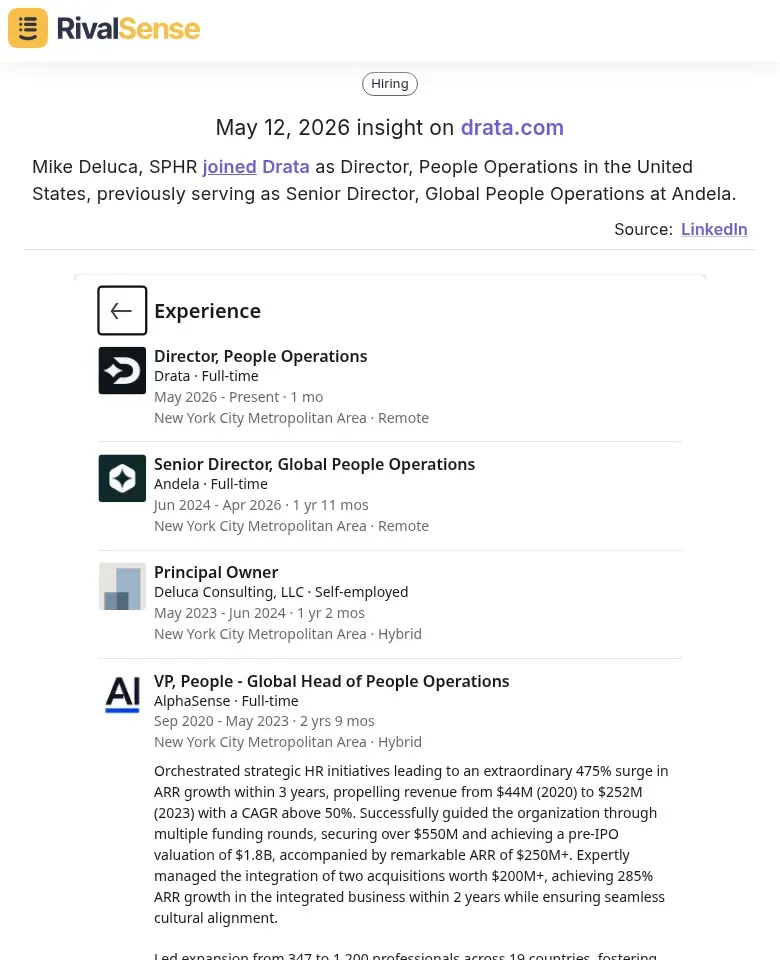
When a competitor brings in a seasoned leader like Mike Deluca, SPHR as Director, People Operations at Drata (previously Senior Director, Global People Operations at Andela), it signals a deliberate investment in scaling their people operations. Why this matters: It reveals that Drata is prioritizing HR infrastructure—likely to support rapid growth or improve culture. If you target the same talent pool or compete for similar clients, this move suggests Drata will become more efficient in hiring and retention, potentially tightening the labor market or improving their service quality.
Example 2: Interim Appointment Indicating Instability
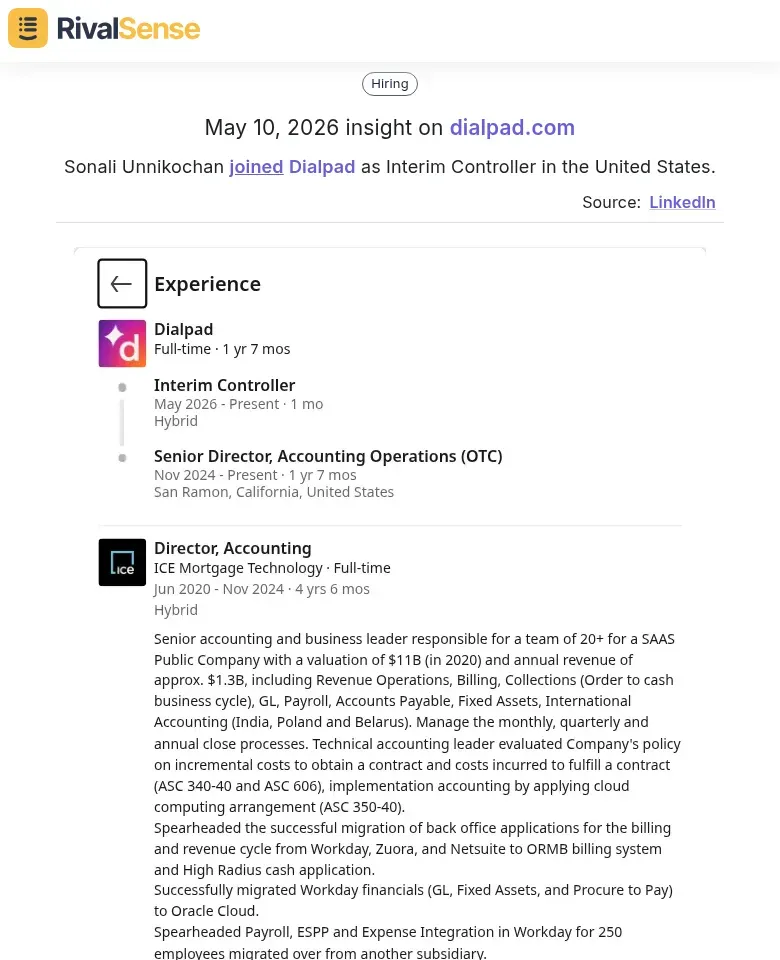
When Sonali Unnikochan joins Dialpad as Interim Controller, it's a red flag. Interim roles often mean the company couldn't find a permanent hire quickly—or that the previous finance leader left abruptly. Why this matters: Financial leadership gaps can slow decision-making, delay audits, and create uncertainty. For your sales team, this is a cue to approach Dialpad's customers with stability-focused messaging: "We have a permanent, experienced finance team ensuring your continuity."
Example 3: Departure of a Regional Sales Leader
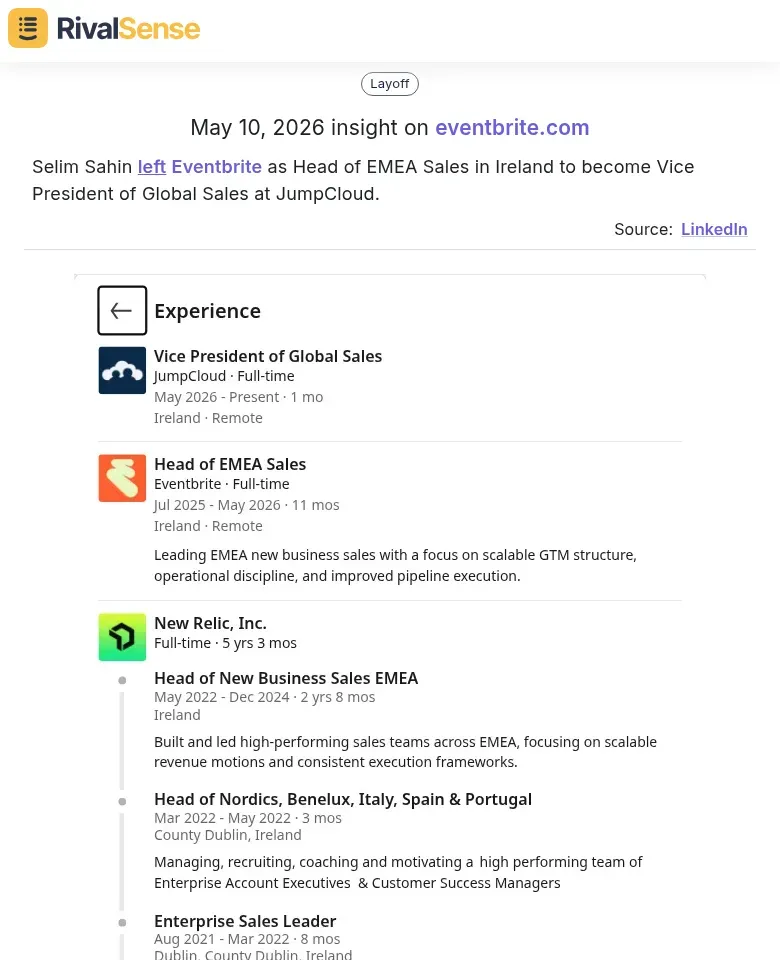
Selim Sahin left Eventbrite as Head of EMEA Sales to become Vice President of Global Sales at JumpCloud. Why this matters: Departures of senior sales leaders often sever key client relationships and regional expertise. Eventbrite loses its EMEA sales champion—who may have been the sole point of contact for major accounts. This creates a prime window for you to poach those accounts by offering dedicated, stable relationship management.
Practical steps to monitor talent signals:
- Set up alerts for senior-level job changes using LinkedIn or tools like RivalSense.
- Categorize moves by function (e.g., sales, product, finance) to spot patterns.
- Track interim roles—they often precede permanent hires or signal instability.
- Cross-reference with company news (funding rounds, product launches) to gauge impact.
Tip: Focus on C-suite and VP-level changes in revenue-generating or strategic functions. A sudden cluster of departures in sales leadership may indicate churn risk, opening doors for your team to poach top talent or win over disgruntled clients.
Identifying Account Opportunities from Departing Leaders
When a competitor loses a senior sales leader—like Selim Sahin leaving Eventbrite—their departure often severs key relationships with major accounts. Without that executive's influence, account teams lose momentum, leaving clients feeling neglected or uncertain. This creates a prime opening for your outreach.
How to identify and act on these opportunities:
-
Monitor leadership changes. Set up Google Alerts for competitor C-suite and VP-level titles. Follow their LinkedIn activity for "new role" or "open to work" updates.
-
Map the departing leader's portfolio. On LinkedIn, review their profile for client logos, testimonials, or posts mentioning accounts they managed. Cross-reference with your CRM to spot overlaps or high-value targets.
-
Prioritize accounts with weak coverage. Look for accounts where the competitor has no clear replacement or where the departing leader was the sole relationship holder. These are your best bets.
-
Craft timely outreach. Reach out within 2–4 weeks of the departure. Reference the change subtly: "Noticed recent shifts at [Competitor]. If your team's priorities are evolving, we'd love to share how we're helping similar companies achieve [specific result]."
Pro tip: Use tools like RivalSense to automate competitor leadership tracking and receive alerts when key departures happen—so you never miss an opening.
Capitalizing on Operational Gaps During Transition
When a competitor undergoes layoffs or key departures, operational gaps emerge that you can exploit. Here's how to turn their transition into your advantage:
1. Identify Interim Hires
Look for roles like "Interim Controller" or "Interim Head of Sales." These signal instability—decisions slow, service slips. Pro tip: Use LinkedIn to spot interim titles and note the start date. If a key role has been interim for >3 months, the competitor is likely struggling to stabilize.
2. Monitor People Operations Departures
If a competitor loses a People Ops leader (e.g., Mike Deluca moving to Drata), their hiring pipeline stalls. This gives you a talent window. Action step: Reach out to affected employees with a clear value prop—your company offers stability and growth.
3. Craft a Value Proposition for Competitor Clients
Address their pain directly. Example: "We understand transitions can disrupt service. Our dedicated team ensures continuity—no interim gaps." Include a checklist in your outreach:
- [ ] Acknowledge their potential frustration
- [ ] Offer a free audit of their current setup
- [ ] Guarantee a dedicated account manager
4. Time Your Outreach
Reach out 2–4 weeks after a layoff announcement—when clients feel the impact most. Use tools like RivalSense to track competitor job changes and trigger alerts.
By capitalizing on these gaps, you convert competitor chaos into client wins.
Building a Systematic Competitor Talent Monitoring Process
To systematically monitor competitor talent movements, start by setting up automated alerts. Use LinkedIn to track job changes of key competitor employees, Crunchbase for executive moves, and tools like RivalSense to aggregate signals across sources. Create a dashboard that flags departures in real time.
Next, categorize departures by function. Sales departures indicate vulnerable accounts—your sales team should proactively reach out to those clients. Finance departures (CFO, controller) suggest potential risk discussions; approach them with value propositions around stability and cost savings. Operations exits may signal internal disruption, opening doors for efficiency-focused pitches.
Build a playbook for each type:
- Sales exit: Within 48 hours, have your sales team contact the departed rep's top accounts with a tailored message highlighting your team's continuity.
- Finance exit: Prepare a risk assessment deck and schedule a meeting with the CFO's replacement or the CEO to discuss financial resilience.
- Operations exit: Offer a free process audit to demonstrate your operational advantages.
Checklist: (1) Set up alerts, (2) Categorize departures weekly, (3) Execute playbook actions within 5 business days. This systematic approach turns competitor churn into your growth pipeline.
Conclusion: Turning Competitor Churn into Your Growth Engine
Competitor layoffs and key departures are more than industry gossip—they are a direct signal of account vulnerability. When a competitor loses talent, especially in client-facing or leadership roles, the accounts they managed often feel neglected, creating a prime opening for your outreach. To turn this churn into growth, adopt a systematic approach:
- Monitor Talent Movements: Use tools like LinkedIn, layoff trackers, or competitor intelligence platforms to spot departures in real time.
- Map Accounts to Leavers: Identify which accounts were handled by the departing employees—these are your highest-probability targets.
- Integrate into CRM: Tag these accounts with a "competitor churn" label and set automated reminders for follow-up sequences.
- Craft Empathetic Outreach: Reach out with a message like, "Noticed changes at [Competitor]. If your service has slipped, we're here to help." Avoid gloating; focus on value.
- Track and Iterate: Log responses and win rates to refine your targeting.
By embedding competitor talent insights into your sales cadence, you gain a first-mover advantage. Every departure is a door—systematic tracking ensures you're the first to knock.
Ready to turn competitor chaos into your growth engine? Start today—try RivalSense for free at https://rivalsense.co/ and get your first competitor report in minutes.
📚 Read more
👉 How to Analyze a Competitor's Flash Sales Campaign: Akulaku Indonesia Case Study
👉 Competitor Thought Leadership Analysis: A Step-by-Step Guide
👉 5 Key Account Management Strategies for Environmental Consultants (and Any B2B Firm)
👉 How a Rival Used Palo Alto's Terraform Move to Outmaneuver Them
👉 5 Best Practices for Twitter Competitor Analysis (Free Tools)