
Boost Banking Productivity: Competitor Churn Analysis
In today's hyper-competitive banking landscape, fintech disruptors and neobanks are eroding traditional market share. Customer retention has become a strategic imperative—acquiring a new customer costs 5–25x more than retaining an existing one. Churn analysis is the key to understanding why customers leave, enabling proactive retention strategies before attrition accelerates. By tracking competitor churn rates, you benchmark your bank's performance, uncover industry-wide pain points, and identify opportunities to differentiate. Practical steps to start: 1) Segment churn by product (checking, loans, credit cards) to pinpoint weak spots. 2) Analyze exit survey data for recurring themes (e.g., fees, digital experience). 3) Monitor competitor churn via public reports, social listening, or tools like RivalSense. 4) Calculate your Net Promoter Score (NPS) and compare it to industry benchmarks. 5) Implement a win-back campaign for high-value churned customers. Remember: a 5% reduction in churn can boost profits by 25–95%. Start analyzing today to stay ahead.
Understanding Competitor Churn: Metrics and Benchmarks
Churn rate measures the percentage of customers lost over a period. In banking, retail churn often runs 5–10% annually, while commercial banking sees 2–5% due to higher switching costs. Customer Lifetime Value (CLV) = (Average Revenue per Customer × Gross Margin) / Churn Rate. Retention rate = 1 – Churn Rate.
Gathering Competitor Churn Data
- Public Reports: Check SEC filings (e.g., 10-K) for customer metrics; some banks disclose churn or attrition rates.
- Customer Reviews: Analyze review volumes on Trustpilot, Google Play, or App Store. A spike in negative reviews often signals rising churn.
- Market Research: Use tools like RivalSense to track competitor mentions, product changes, and customer sentiment.
- LinkedIn & Job Boards: Sudden hiring of retention specialists or customer success managers hints at churn problems.
Real-World Insight: Pricing Changes as Churn Signals
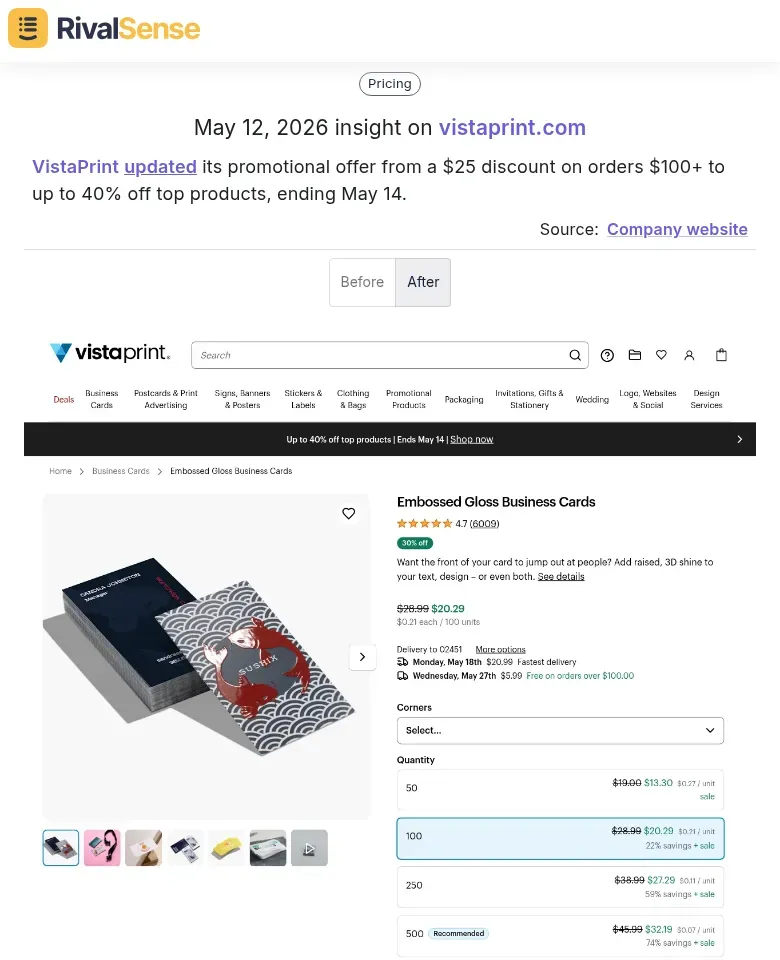
Tracking competitor pricing updates is crucial because they often trigger customer churn. For example, VistaPrint recently shifted its promotional offer from a $25 discount on orders $100+ to up to 40% off top products, ending May 14. This type of change reveals pricing strategy adjustments that can affect customer loyalty. If a rival bank quietly eliminates a fee waiver or changes interest rates, similar churn may follow. Monitoring such updates helps you anticipate market reactions and adjust your own pricing to retain customers.
Practical Tips
- Calculate CLV for each competitor using estimated churn and average revenue per account.
- Benchmark your churn against industry averages: retail banks should aim <5% annually; commercial banks <3%.
- Track churn trends quarterly to spot shifts before they impact your strategy.
Checklist
☐ Identify top 3 competitors
☐ Gather public churn data
☐ Analyze review sentiment
☐ Estimate CLV
☐ Compare vs. benchmarks
Analyzing the Root Causes of Competitor Churn
To uncover why customers leave competitors, blend qualitative and quantitative analysis. Start by mining social media (e.g., Reddit, Twitter) and review sites (Trustpilot, G2) for recurring complaints. Common churn drivers include poor digital experience (e.g., slow apps, clunky UX), hidden fees (e.g., unexpected overdraft charges), and lack of personalization (e.g., irrelevant offers). Create a pain-point matrix: list each competitor, tag complaints by theme, and note frequency.
Next, perform quantitative analysis. Correlate churn spikes with specific events: product changes (e.g., a UI overhaul), pricing shifts (e.g., fee increases), or service outages (e.g., downtime). Use tools like Google Trends or social listening platforms to track sentiment over time. For example, if a competitor raised ATM fees in Q2 and churn jumped 15% in Q3, that's a causal signal.
Real-World Insight: Product Expansions as Strategic Moves
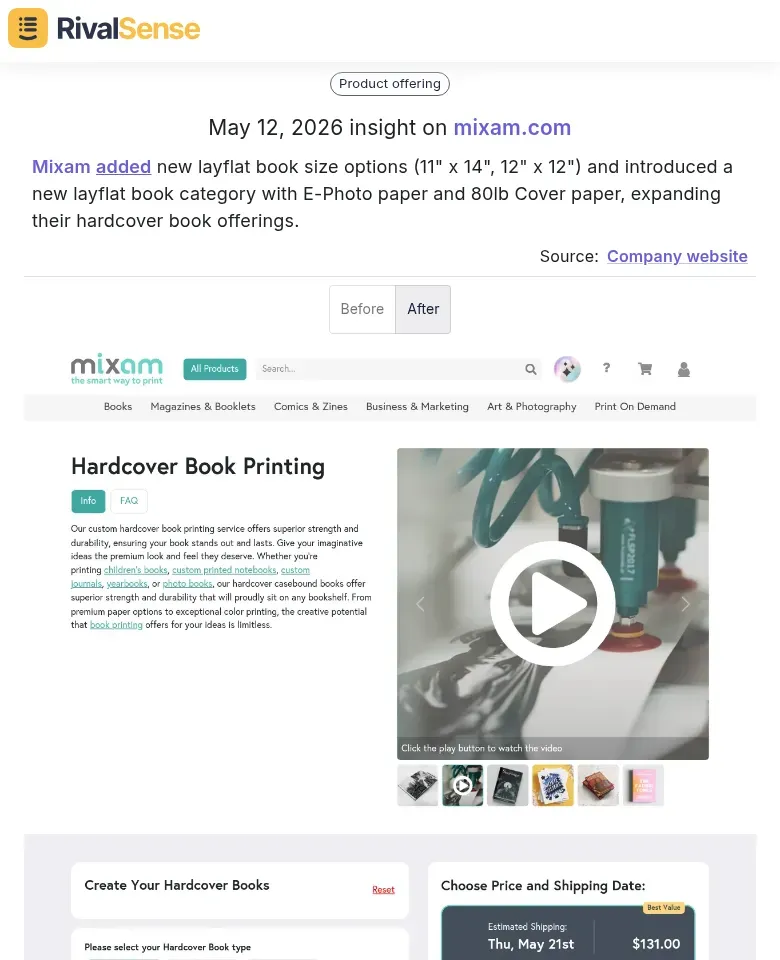
Competitor product launches can reveal where they are investing and how they might attract or retain customers. For instance, Mixam added new layflat book size options (11" x 14", 12" x 12") and introduced a new layflat book category with E-Photo paper and 80lb Cover paper, expanding their hardcover book offerings. For a bank, a comparable move might be launching a new savings account tier or a feature-rich mobile app. Watching these expansions helps you understand competitors' growth priorities and identify gaps in your own product line that could cause customer churn.
Practical steps:
- Set up alerts for competitor mentions on social media.
- Export review data monthly and categorize complaints.
- Overlay churn data with your own product release timeline to spot patterns.
Checklist for root cause analysis:
- [ ] Identify top 3 complaint categories per competitor.
- [ ] Map churn rates to competitor pricing changes.
- [ ] Compare digital experience scores (e.g., app store ratings) with churn.
By triangulating qualitative and quantitative signals, you can pinpoint exactly what drives customers away—and avoid those pitfalls in your own product.
Leveraging Churn Insights to Boost Your Bank's Productivity
To boost your bank's productivity, start by mining competitor churn data for actionable insights. First, prioritize product improvements that directly address competitor weaknesses. For example, if a rival loses customers due to poor mobile app performance, invest in app speed and UX. Use a simple checklist: (1) Identify top 3 churn drivers for competitors, (2) Map them to your product gaps, (3) Rank fixes by impact and effort.
Second, optimize onboarding and support workflows to reduce friction. Analyze competitor churn reasons—e.g., long account setup or slow support response. Then streamline your own: implement a 5-step onboarding checklist (welcome email, ID verification walkthrough, first transaction tutorial, 24-hour check-in, feedback survey) and set support SLAs (e.g., <2 min chat response).
Third, implement predictive churn models to flag at-risk customers early. Use logistic regression or random forest on features like login frequency, transaction volume, and support tickets. A practical tip: start with a simple rule-based model (e.g., flag if login drops >50% in 30 days) before scaling to ML. Run weekly alerts to your retention team, who can then trigger personalized offers or outreach.
Real-World Insight: Internal Process Innovation as a Competitive Edge
Sometimes competitor actions aren't directly about customers but about internal efficiency, which indirectly improves retention. For example, Metaview brand designer Juliet Faldin built a brand hub and asset builder on Lovable to prevent off-brand assets and inconsistent output. For a bank, similar internal tools can streamline marketing, reduce errors, and deliver a consistent customer experience—a key retention driver. Monitoring such moves helps you adopt best practices that keep customers loyal.

By systematically applying these steps, you'll reduce churn and boost operational efficiency.
Building a Continuous Competitor Churn Monitoring System
To stay ahead, build a continuous competitor churn monitoring system. Start by setting up automated alerts for churn signals: monitor app store ratings (e.g., sudden drops), review sites (G2, Capterra), social media sentiment, and news (layoffs, executive departures). Use tools like Google Alerts, Brandwatch, or a dedicated competitive intelligence platform to aggregate these signals.
Next, integrate churn data into your competitive intelligence dashboard. Track metrics like customer count changes, revenue shifts, and support ticket volume (if public). Visualize trends over time to spot patterns early.
Finally, establish a cross-functional review cadence. Schedule monthly meetings with product, marketing, and analytics teams to review churn alerts. Use a structured template:
- Signal: What happened?
- Impact: How does it affect their market position?
- Action: Should we adjust our strategy?
Pro tip: Create a Slack channel (#competitor-churn) for real-time alerts and quick discussions. Assign a rotating owner each week to monitor and summarize signals. This ensures no critical insight slips through the cracks.
Conclusion: Turning Churn into a Strategic Advantage
Competitor churn analysis isn't a one-off project—it's a continuous cycle that keeps your bank ahead. Here's your action checklist:
- Benchmark: Track churn rates across competitors monthly. Use RivalSense to automate data collection.
- Diagnose: Identify patterns—are competitors losing customers due to fees, poor service, or feature gaps? Cross-reference with reviews and product updates.
- Act: Launch targeted retention campaigns. For example, if a rival's churn spikes after a price hike, test a loyalty discount.
- Monitor: Set up alerts for churn signals (e.g., sudden review drops, leadership changes). Reassess quarterly.
Pro tip: Create a churn heatmap—map competitor losses to your own customer segments to spot vulnerabilities.
By embedding this process, you transform churn from a threat into a strategic lever. Start today with a free trial of RivalSense to track competitor churn trends in real time. Try RivalSense for free and get your first competitor report—no strings attached.
📚 Read more
👉 How a Simple Product Rename Revealed Palo Alto Networks' Strategic Shift
👉 How to Use Website Changes for Win-Loss Analysis Against Competitors
👉 3 Real-World Examples of Competitor Analysis in Cybersecurity
👉 How Competitor Layoffs Reveal Key Account Opportunities
👉 How to Analyze a Competitor's Flash Sales Campaign: Akulaku Indonesia Case Study