
Unlock Revenue Growth: Competitor Benchmarking via Internet Insights
In today’s fast-paced B2B landscape, your competitors’ strategic moves are often hiding in plain sight—on the internet. Every product launch, pricing tweak, partnership announcement, or even a service outage sends a signal that can reveal their priorities, operational gaps, and market positioning. By systematically benchmarking these internet signals, you can spot revenue opportunities before they become obvious and avoid costly missteps.
Why internet insights matter:
- Real-time intelligence: Traditional competitor reports are outdated by the time you read them. Internet signals—like a sudden spike in job postings for a new tech stack or a competitor’s A/B test on pricing pages—give you live data.
- Strategic pivots: A shift in messaging, new case studies, or a redesigned homepage can indicate a pivot toward a new customer segment or value proposition.
- Operational weaknesses: Public outages, negative reviews, or delayed feature launches highlight areas where you can differentiate.
Practical steps to start benchmarking:
- Define your signal categories: Group signals into product (new features, changelogs), marketing (ad copy, SEO experiments), and operations (uptime, support response times).
- Set up monitoring tools: Use Google Alerts, RSS feeds, or dedicated competitor tracking tools like RivalSense to capture changes.
- Create a scoring system: Rate each signal by impact (e.g., 1–5) and frequency to prioritize threats and opportunities.
- Build a weekly review cadence: Dedicate 30 minutes weekly to analyze signals and update your competitive playbook.
Pro tip: Don’t just track—act. If a competitor launches a feature you’ve been planning, accelerate your roadmap or pivot to a differentiator. If they suffer an outage, reach out to their disgruntled customers with a solution.
By turning internet noise into a structured benchmarking process, you transform passive observation into a revenue growth engine.
Spotting New Revenue Channels Through Partnership Launches
To spot new revenue channels, start by monitoring competitor integrations with platforms like Salesforce, Shopify, or Slack. Use tools like RivalSense to track API partnerships or integration announcements. For example, if a competitor integrates with a CRM, it signals a distribution channel you can replicate. Next, analyze friction-reducing models: a competitor offering a no-inventory dropshipping service likely scales revenue faster by removing logistics overhead. Evaluate partnership announcements—joint webinars, co-marketed ebooks, or bundled offerings—to predict market expansion.
Real insight from RivalSense: Printify launched a Pop-Up Store integration with Eventbrite, enabling creators to design and sell custom event merchandise on demand without holding inventory. This type of insight is valuable because it reveals a low-risk, high-reward channel that removes inventory barriers—perfect for testing new revenue streams without upfront cost.
Create a checklist:
- [ ] Set alerts for competitor integration news
- [ ] Map each integration to a potential revenue stream
- [ ] Test similar partnerships on a small scale
- [ ] Measure customer acquisition cost (CAC) vs. lifetime value (LTV) for each channel
Tip: Prioritize integrations with platforms your target audience already uses daily—this lowers adoption barriers. By systematically analyzing competitor moves, you can replicate successful models and unlock untapped revenue streams.
Identifying Operational Weaknesses from Public Failures
Competitors' public failures—service outages, product recalls, or security breaches—are goldmines for identifying operational weaknesses in your own business. When a rival pauses service or issues a recall, dig into their incident reports, press releases, and customer complaints. Map the root cause: was it a supply chain gap, insufficient testing, or poor contingency planning? Use this to benchmark your risk management.
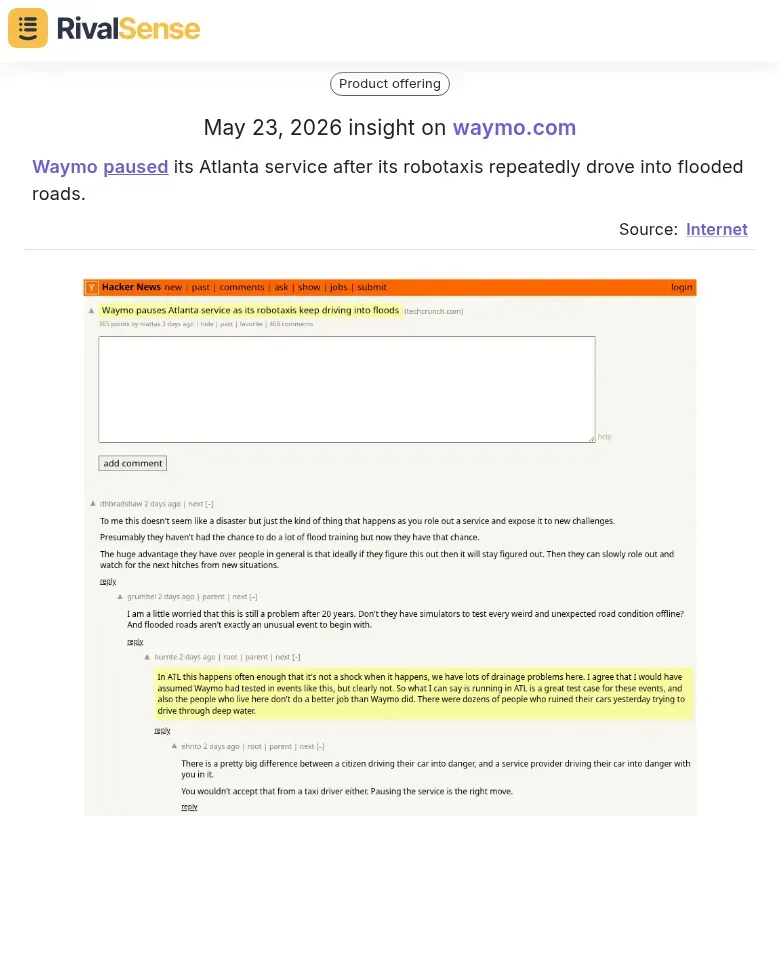
Real insight from RivalSense: Waymo paused its Atlanta service after its robotaxis repeatedly drove into flooded roads. This type of insight is valuable because it highlights operational risks that can damage brand trust—and shows you where to strengthen your own safety and contingency protocols before a similar crisis hits.
For example, if a competitor's cloud provider outage took them down for 12 hours, audit your own multi-cloud redundancy and run a tabletop exercise simulating a similar failure.
Checklist:
- [ ] Identify the failure type (e.g., downtime, quality defect)
- [ ] Trace the operational breakdown (e.g., single vendor dependency)
- [ ] Assess your own exposure
- [ ] Document a mitigation plan
Turn their loss into your gain: when a competitor stumbles, proactively reach out to their frustrated customers with a message like, "We saw what happened—here's how we ensure 99.99% uptime." This positions your reliability as a competitive advantage while continuously strengthening your operations.
Leveraging Marketing Experiments That Drive Viral Growth
To drive viral growth, start by monitoring competitors' referral mechanics. Use tools like RivalSense to detect when they embed share links in product flows or add referral incentives. For example, if a competitor introduces a 'share to unlock' feature, test a similar low-cost variant—like a one-click social share button after signup—to gauge traffic uplift.
Next, measure subtle UX tweaks. A/B test changes such as simplifying your signup form (e.g., removing non-essential fields) or adding social proof badges. Track conversion rate and brand visibility (e.g., social mentions). Even a 0.5% conversion lift can compound significantly.
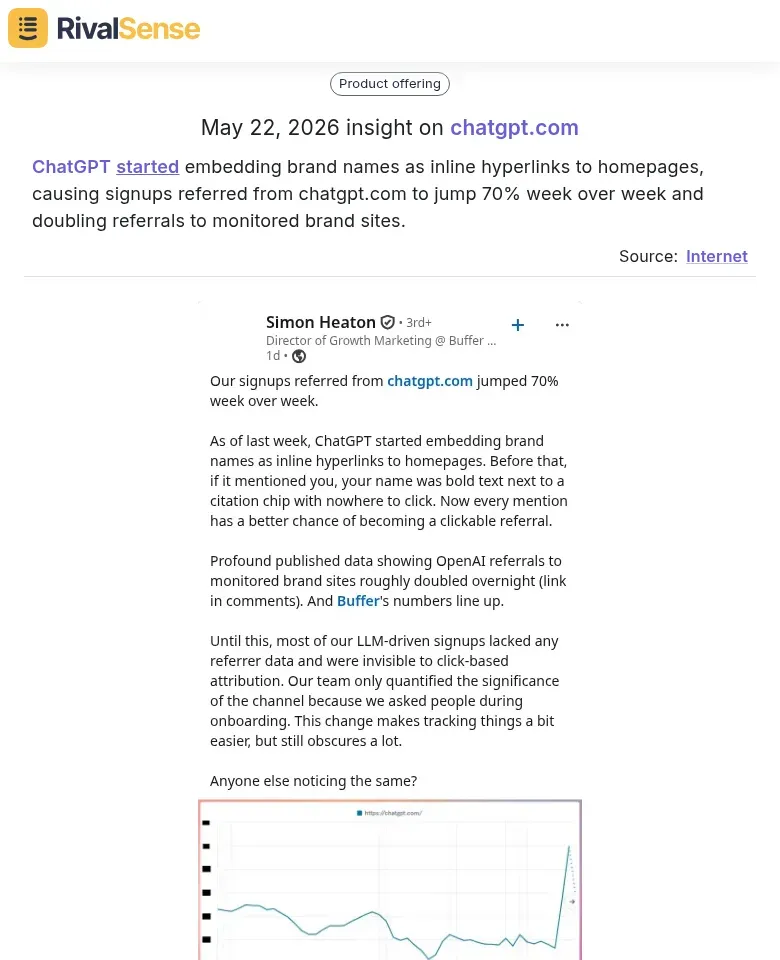
Real insight from RivalSense: ChatGPT started embedding brand names as inline hyperlinks to homepages, causing signups referred from chatgpt.com to jump 70% week over week and doubling referrals to monitored brand sites. This type of insight is valuable because it shows how a subtle UX experiment can create a powerful acquisition channel—tying together content and conversion without intrusive ads.
Finally, act fast. Competitors will scale successful tactics. Create a checklist:
- [ ] Identify top 3 competitor referral changes weekly
- [ ] Prioritize low-effort tests (e.g., adding a referral link in onboarding emails)
- [ ] Run tests for 2 weeks minimum
- [ ] Scale winning variants
By iterating on proven patterns, you capture growth before competitors dominate the channel.
Building a Systematic Internet Insights Pipeline
To build a systematic internet insights pipeline, start by automating competitor monitoring. Use tools like Google Alerts for press releases, Mention or Brandwatch for social media, and services like Visualping or Distill for website change detection. Set up daily or weekly digests to avoid information overload.
Next, categorize insights into three buckets: Growth (e.g., new feature launches, pricing changes), Risk (e.g., negative reviews, leadership departures), and Innovation (e.g., patents, strategic partnerships). This framework helps prioritize actions—growth insights feed marketing campaigns, risks trigger competitive response plans, and innovations inform product roadmaps.
Finally, establish a cross-functional review cadence. Schedule a 30-minute weekly sync with product, marketing, and strategy leads to discuss top 3 insights per category. Use a shared dashboard (e.g., Airtable or Notion) to track action items and owners. Pro tip: assign a rotating "intelligence lead" each month to keep the process fresh and accountable.
Checklist:
- [ ] Automated alerts configured
- [ ] Taxonomy defined (Growth/Risk/Innovation)
- [ ] Weekly review slot booked
- [ ] Shared tracker live
- [ ] First review completed
Conclusion: Turning Insights into Revenue Action
To turn competitor insights into revenue growth, build a benchmark dashboard that synthesizes key signals—pricing shifts, feature launches, content strategy changes—into a single view for leadership. Use tools like RivalSense to automate data collection and update weekly. Then, act fast: assign owners to each signal with a 48-hour response window. For example, if a competitor drops prices, run a customer win-back campaign immediately. First-mover advantage comes from observing and iterating, not waiting for perfect data. Finally, continuously refine your monitoring framework. As competitors evolve their digital footprint, adjust your tracking parameters quarterly.
Checklist:
- [ ] Identify top 3 signals per competitor
- [ ] Set up automated alerts
- [ ] Schedule weekly review with cross-functional team
- [ ] Document response playbooks
This turns monitoring into a revenue engine. Ready to get started? Try out RivalSense for free at rivalsense.co to assist with the challenges described above. Nudge yourself to get your first competitor report today—it only takes a few minutes to set up and start seeing actionable insights.
📚 Read more
👉 Monitor Competitor Brand Perception in DevOps: A Workflow Breakdown
👉 Master Key Accounts with Competitor Hiring Insights
👉 How to Spot Competitor Moves with Event Intelligence
👉 The Real Benefits of Competitor Analysis (And How to Do It Without Getting Lost in the Weeds)
👉 Free Key Account Management Software Trial: Unlock Growth for B2B Service Businesses