
Master Key Accounts with Competitor Hiring Insights
Introduction: Why Competitor Hiring Signals Matter for Key Accounts
In the high-stakes world of key account management, knowing your competitor's next move can be the difference between winning and losing a critical deal. Hiring patterns are a goldmine of strategic intelligence: when a competitor posts a role dedicated to a specific account or industry vertical, they're signaling where they plan to invest resources and compete. For example, a new 'Enterprise Account Executive – Healthcare' role at a rival suggests they're targeting your top healthcare accounts. By tracking these signals, you can anticipate their playbook—whether it's expanding into a new region, launching a tailored solution, or ramping up support for a key account. This foresight lets you proactively strengthen relationships, address vulnerabilities, and differentiate your offering before the competitor even makes their pitch.
💡 Practical tip: Set up alerts for job titles that include your key account names or industry terms. When a relevant hire appears, schedule a strategic review with your account team to assess the threat and adjust your engagement plan. Turn competitor hiring into your early warning system.
Decoding Strategic Shifts Through Senior Leadership Hires
When a competitor hires a senior leader like a Sr. Director of Product Management or VP of Engineering, it's rarely a routine move—it's a signal. Such hires often precede major product launches or vertical expansions. Here's how to decode the roadmap from their hiring moves:
1. Map the Role to Strategy
- A new VP of Sales focused on enterprise suggests they're moving upmarket.
- A Head of AI/ML hire hints at embedding intelligence into their product.
2. Track the Source
- Did they poach from a known competitor? That signals a direct attack on that competitor's market.
- Hiring from a different industry (e.g., fintech into SaaS) may indicate a new vertical play.
3. Look for Clusters
- Multiple hires in a short period (e.g., 3 product leaders in 60 days) point to a new product line or major revamp.
4. Cross-Reference with Job Descriptions
- Job postings for the same role reveal responsibilities: "Lead expansion into healthcare" = vertical focus.
📋 Actionable Checklist:
- [ ] Set up alerts for C-suite and VP-level hires on LinkedIn.
- [ ] Maintain a spreadsheet mapping each hire to a strategic hypothesis.
- [ ] Review quarterly: do their product releases align with your predictions?
🔍 Real Insight from RivalSense
Tracking senior leadership moves is easier with automated competitor monitoring. For instance, RivalSense recently detected that Salla Eckhardt joined Autodesk as Sr. Director of Product Management for AEC Data in the United States.
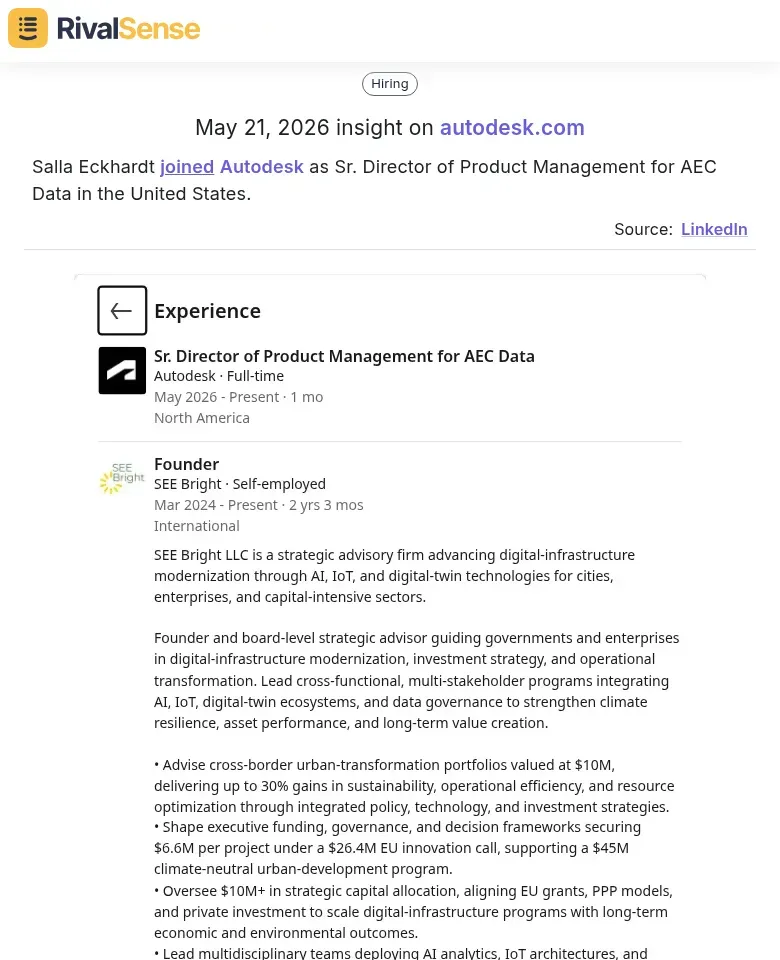
Why this matters: A senior product management hire in AEC (Architecture, Engineering, Construction) Data signals Autodesk's intention to double down on data-driven solutions for construction and infrastructure. If you compete in that vertical, you know they're building new capabilities—so you can proactively address gaps or accelerate your own roadmap to defend key accounts.
By systematically mapping senior hires to strategic shifts, you can anticipate competitor moves before they launch—and adjust your own roadmap accordingly.
Identifying New Market Entry or Expansion via Role Geography
When a competitor hires for a location-specific role—like a UK-based Product Director or a Germany-based Sales Lead—it's a strong signal of geographic expansion. Cross-border hires often reveal intent to penetrate a new region or industry vertical before any official announcement.
How to act on this:
- Monitor job postings for location-specific senior roles. Tools like LinkedIn, Glassdoor, or competitor tracking platforms can alert you to new hires.
- Map the geography of new roles against your key accounts. If a competitor hires a regional manager in a territory where you hold major accounts, prepare defensive plays.
- Prioritize accounts based on overlap: accounts in the same region or vertical as the new hire need immediate attention.
📋 Quick checklist:
- [ ] Set up alerts for competitor job postings by location.
- [ ] Cross-reference new hire locations with your top 20 accounts.
- [ ] Assign account owners to develop retention or expansion strategies for at-risk accounts.
🔍 Real Insight from RivalSense
Another example: RivalSense spotted that Fanatics is hiring a Product Director for F1 in the United Kingdom to lead the global F1 collectibles portfolio, driving product strategy, innovation, and partnerships.
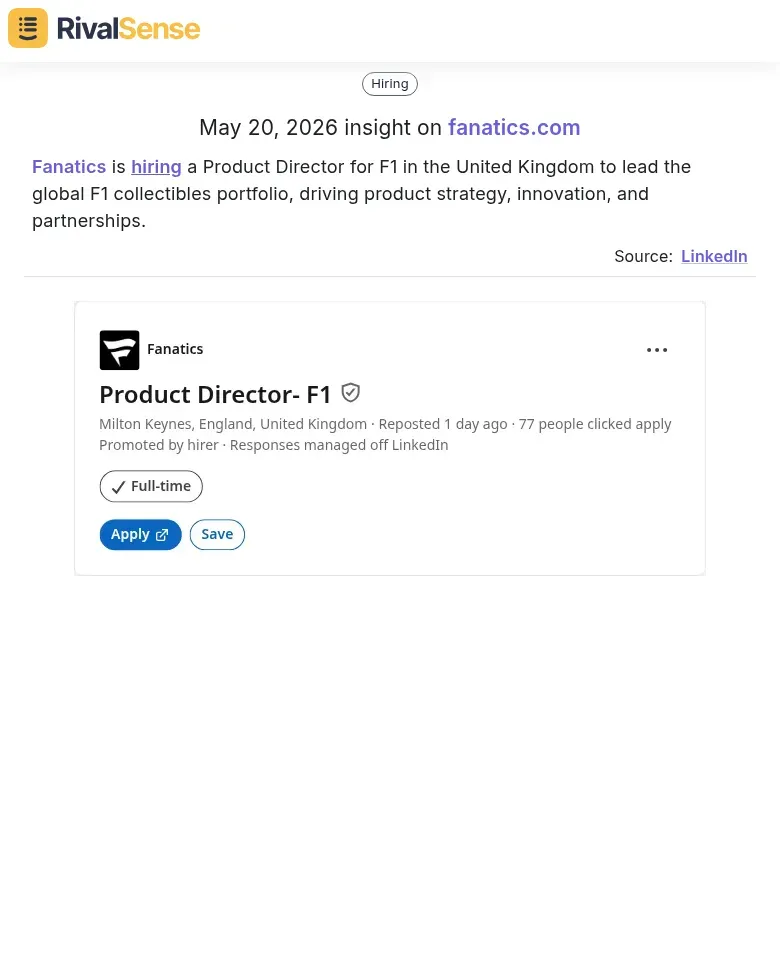
Why this matters: Fanatics is expanding into a niche vertical (Formula 1 collectibles) and is doing so with a dedicated senior role in the UK—the heart of F1. If you serve similar sports-licensed merchandise or digital collectibles, this signals a direct competitor push into a new market. You can now prepare counter-strategies for accounts in sports merchandising or explore partnerships to strengthen your position.
By using geography clues from hiring, you can proactively defend your key accounts or even identify new expansion opportunities for your own team.
Uncovering Compliance and Risk Priorities from Legal & Privacy Hires
When a competitor hires a Privacy Counsel or Product Counsel, it's a strong signal that regulatory compliance is becoming a strategic priority. These roles often precede shifts in data handling, product features, or market entry into regulated regions (e.g., GDPR, CCPA). For key account managers, this is a critical intelligence point: your shared accounts may soon face new compliance requirements from that competitor.
Actionable Steps:
- Track legal & privacy hires using tools like LinkedIn or RivalSense. Flag any new counsel roles, especially those with "global" or "product" in the title.
- Map the timeline: If a competitor hired a Privacy Counsel 3–6 months ago, expect policy changes or feature updates soon. Check their privacy policy or product changelog for clues.
- Prepare your key accounts: Proactively share how your own compliance posture aligns with emerging regulations. For example, if a competitor tightens data retention, highlight your own transparent data lifecycle practices.
- Create a compliance watchlist: For each key account, note which regulations matter most (e.g., HIPAA for healthcare, GDPR for EU clients). Monitor competitor hires in those specific domains.
💡 Tip: Use hiring spikes as triggers for account check-ins. If a competitor bulks up on privacy lawyers, schedule a meeting with your key account to discuss their evolving compliance needs—positioning yourself as a proactive partner.
🔍 Real Insight from RivalSense
RivalSense captured that Fanatics is hiring a Privacy & Product Counsel for a remote position in the United States, focusing on global privacy and product counseling for its digital sports platform.
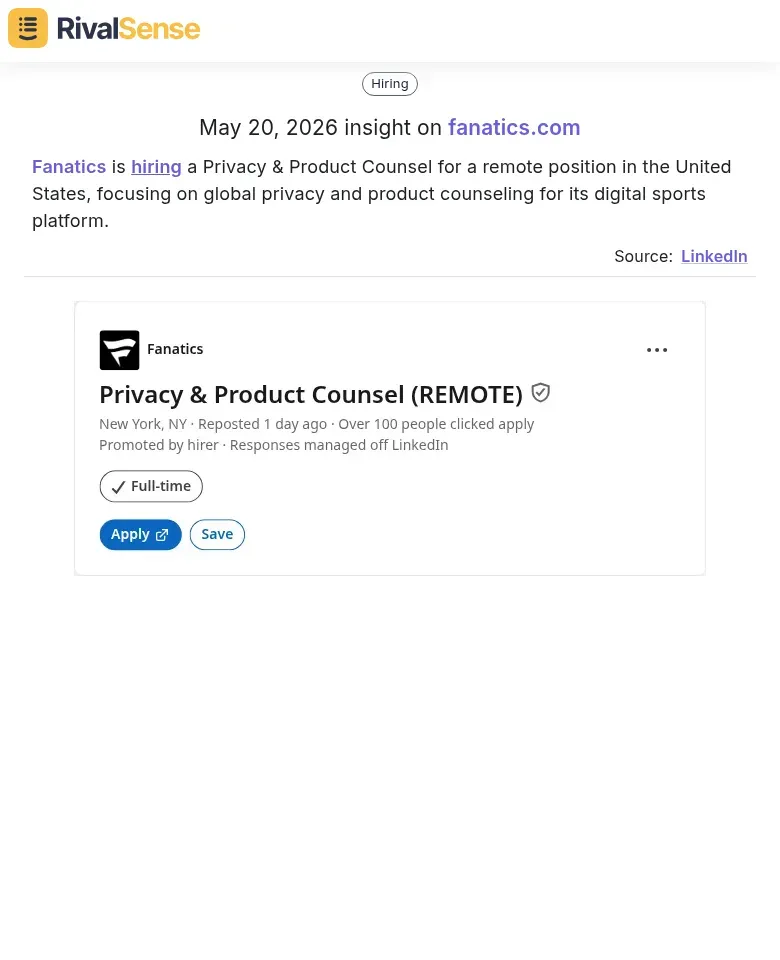
Why this matters: Fanatics is investing in privacy and product legal expertise—likely to navigate data regulations as they expand their digital platform globally. For key accounts in e-commerce or sports tech, this means Fanatics will have stronger compliance posture, potentially making them a safer choice. You can counter by highlighting your own robust privacy frameworks and proactive risk management.
Building a Competitive Intelligence Playbook from Hiring Patterns
To build a competitive intelligence playbook from hiring patterns, start by systematically tracking hires across functions—product, legal, sales, and engineering. Use tools like LinkedIn, company career pages, and job boards to capture job titles, departments, and posting dates. Create a spreadsheet or dashboard to log this data weekly.
Next, correlate hires with public signals. For example, a spike in product management hires may foreshadow a new feature launch; a surge in legal roles could indicate expansion into regulated markets. Cross-reference with funding announcements (e.g., Series B → sales team buildout) and product changelogs.
Set up alerts for key triggers: when a competitor hires a VP of Sales, it often signals a go-to-market push. Combine hiring data with earnings calls, press releases, and review sites (G2, Capterra) to validate hypotheses.
Finally, turn raw data into actionable insights. Use a simple scoring system: assign points for hires in strategic functions (e.g., +3 for VP of Product, +1 for junior roles). When a score crosses a threshold, flag the account for proactive outreach or competitive positioning. Share a monthly dashboard with your team highlighting top hiring trends and recommended actions.
Conclusion: Turning Insights into Action for Key Account Wins
Turning competitor hiring insights into action is your edge for winning key accounts. Start by synthesizing signals into account-specific threat and opportunity assessments. For example, if a competitor hires a VP of Customer Success from your target account, it signals a potential poaching risk—proactively strengthen your relationship with that account's decision-makers. Conversely, if they hire a product manager focused on a feature you already excel at, double down on that differentiator in your pitch.
Actionable Steps:
- Map hires to accounts: For each key account, list recent competitor hires that touch that account (e.g., former employees, new roles targeting similar needs).
- Assess impact: Rate each hire as a threat (e.g., poaching, competitive product) or opportunity (e.g., misalignment, weakness to exploit).
- Adjust your approach: Update your value proposition to highlight strengths where competitors are weak, or adjust sales cadence to address emerging pain points.
- Update your roadmap: If a competitor hires heavily for a new capability, consider accelerating your own development or counter-positioning.
🚀 Pro Tip: Set up a monthly review of competitor hiring changes for your top 10 accounts. Use a simple traffic-light system (🟢 = opportunity, 🟡 = monitor, 🔴 = threat) to prioritize actions.
Stop leaving key account wins to chance. Turn competitor hiring signals into your secret weapon today. Try RivalSense for free and get your first competitor report delivered weekly—no strings attached. Start tracking product launches, pricing updates, partnerships, regulatory moves, and yes, those critical hiring changes that reveal your rivals' next moves. Sign up here and start protecting your key accounts now.
📚 Read more
👉 How to Spot Competitor Moves with Event Intelligence
👉 The Real Benefits of Competitor Analysis (And How to Do It Without Getting Lost in the Weeds)
👉 Free Key Account Management Software Trial: Unlock Growth for B2B Service Businesses
👉 How Revolut's $120M NZ Expansion Alerted a Rival to Act
👉 Unlock Competitor Insights from Instagram to Boost Key Account ROI