
How to Turn Competitor Intelligence into a Growth Engine for Your B2B Company
Most founders and CEOs rely on gut instinct or sporadic manual checks to track competitors—scrolling websites, setting Google Alerts, or asking sales teams. This reactive approach leads to missed signals (price changes go unnoticed for weeks), slow reactions (a competitor launches a new feature while you’re still planning), and strategic blind spots (you don’t see the partnership that just gave them a market edge).
Automated competitor intelligence changes the game. With the right tools, you can:
- Get alerted on product launches, pricing updates, and partnership announcements as soon as they happen.
- Centralize all competitor signals in one weekly report.
- Integrate with your CRM or Slack to trigger strategic actions (e.g., “competitor dropped price → schedule pricing review”).
Practical steps to start:
- Audit your current competitor sources (websites, social media, registries).
- Choose a tool like RivalSense that scans websites, social media, and registries automatically.
- Define which signals matter most: product updates, pricing changes, partnerships, management moves.
- Run a two-week trial to validate the signal-to-noise ratio before scaling.
Automated competitor monitoring turns passive observation into a proactive growth lever—data-driven, fast, and strategic.
Identifying Which Competitor Signals Matter Most for Your Growth
To focus on the signals that actually move the needle, categorize competitor activities by business impact:
| Type of Signal | Why It Matters | Example Trigger |
|---|---|---|
| Product updates | Reveal new features, UX changes, or tech shifts that could steal your market share | "Competitor A launched AI-powered reporting" |
| Pricing changes | Directly affect your positioning and negotiation | "Competitor B dropped monthly subscription by 20%" |
| Partnerships | Signal new distribution channels or integrations | "Competitor C partnered with major CRM" |
| Management changes | Indicate shifts in strategy or instability | "Competitor D hired a new CRO from your industry" |
| Regulatory moves | Impact compliance costs or market access | "Competitor E updated privacy policy in EU" |
Practical prioritization checklist:
- ☐ List your top 3 competitors.
- ☐ Define which signal types are most relevant to your current stage (e.g., pricing if you're entering a price war, product if you're developing a feature).
- ☐ Assign a severity level to each signal (high/medium/low).
- ☐ Set up automated alerts for high-severity signals only to avoid noise.
Pro tip: Start by tracking just one high-impact competitor for two weeks. Review which insights actually changed your strategy—then scale.
Setting Up Automated Capture of Competitor Signals
The goal is a single, organized feed of competitor moves. Here’s how to build it:
- Select your data sources: Competitor websites (product pages, blog, pricing page), social media (LinkedIn, Twitter, Facebook), regulatory registries (SEC, GDPR databases), and news aggregators.
- Use automated tools: Tools like RivalSense handle multiple sources in one place. Alternatively, set up scraper scripts (Python + BeautifulSoup) or use no-code platforms like Zapier to pipe updates into a shared spreadsheet.
- Apply AI for extraction: OCR and NLP can pull specific data points—e.g., new pricing tiers, feature names, partnership announcements—from raw webpage text or PDFs.
- Create a central repository: Use a tool like Notion, Airtable, or a dedicated CRM module. Structure it with fields: competitor name, signal type, date detected, source URL, summary, action taken.
Checklist for setup:
- ☐ Define 3–5 competitors to track.
- ☐ List their web pages and social handles.
- ☐ Choose a monitoring tool (e.g., RivalSense).
- ☐ Set up weekly email digest (so you don’t get overwhelmed).
- ☐ Assign one team member to review and triage the digest each Monday.
Example real insight from RivalSense — why product updates matter:
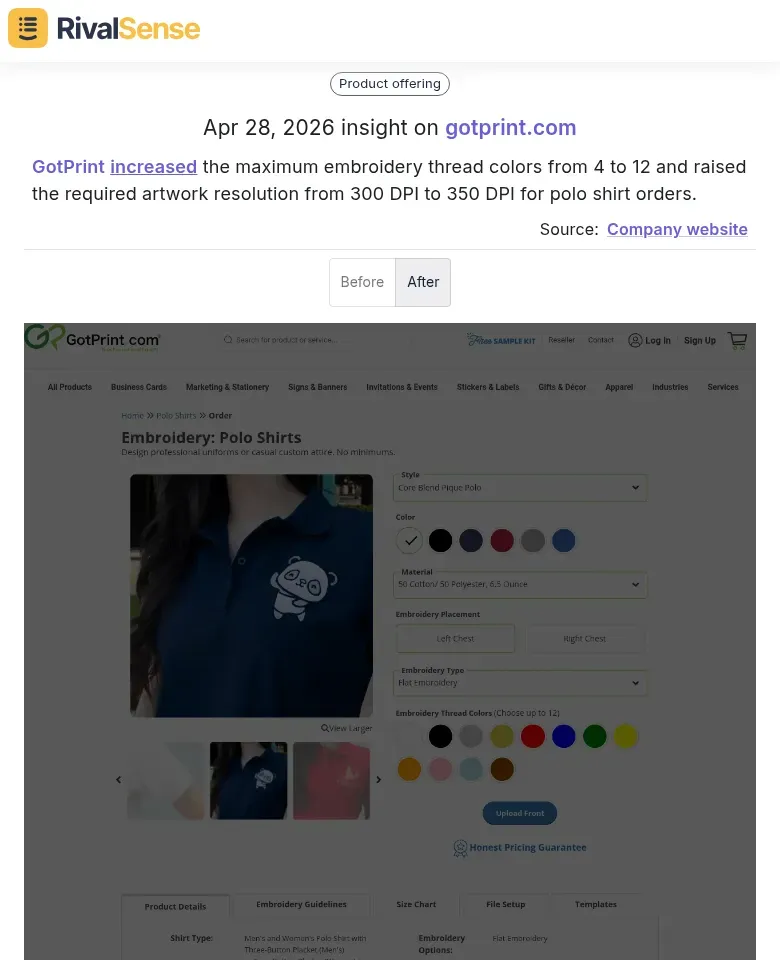
Product updates like this one from GotPrint (a printing competitor) signal a quality improvement. If you’re also in the print-on-demand space, you can immediately assess whether this changes your value proposition—perhaps you need to match the embroidery quality or highlight a different strength like faster turnaround.
Leveraging Competitor Insights for Proactive Strategy
Once you have a steady stream of competitor intelligence, it’s time to act. Here’s how to turn insights into decisions:
- Pricing alerts: When a competitor raises or lowers prices, schedule a pricing strategy meeting within 48 hours. Use the insight to adjust your own pricing, deepen discounts, or reposition your value proposition.
- Product features: When a competitor launches a new capability, assess if it’s a table-stakes feature or a market changer. If table-stakes, plan to match it in your next sprint. If a game-changer, consider a strategic response (partnership, acquisition, or pivot).
- Partnership signals: A competitor’s new partnership could open distribution channels you lack. Evaluate whether to form a competing partnership or differentiate by focusing on a different niche.
- Regulatory updates: If a competitor aligns with a new regulation (like the Colorado AI Act), review your own compliance posture. Early alignment can be a selling point.
Example real insight from RivalSense — why pricing changes matter:
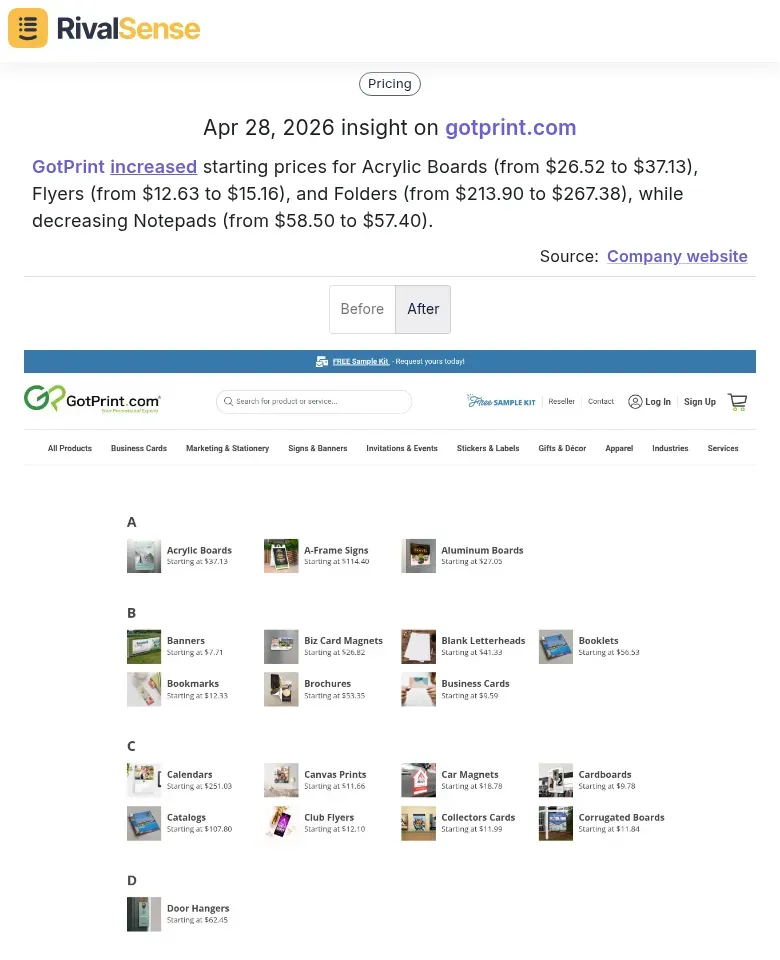
Pricing changes like these from GotPrint (increases in Acrylic Boards, Flyers, Folders; slight decrease in Notepads) reveal their cost structure and market strategy. You can map their pricing against yours to find where you’re left with margin—or where they’re undercutting you. Pro tip: update your competitive pricing matrix quarterly.
Example real insight from RivalSense — why naming changes and AI moves matter:
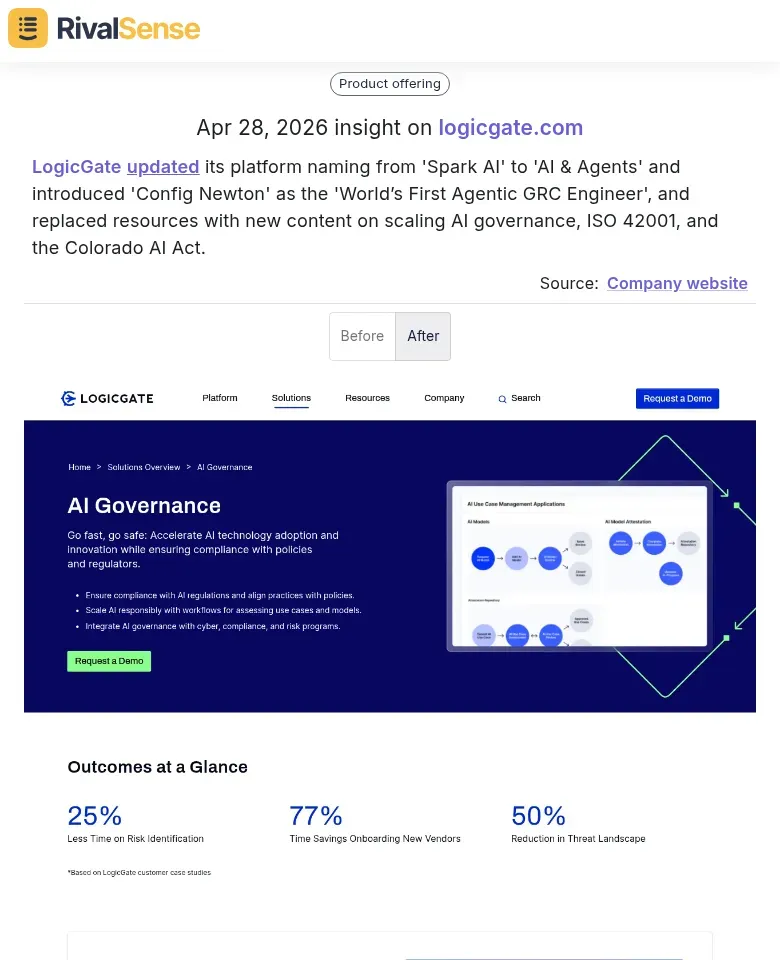
Naming shifts like LogicGate’s move from “Spark AI” to “AI & Agents” signal a strategic pivot toward agentic AI in GRC. If you’re in the compliance software space, this tells you where your competitor is investing R&D. Update your road map and marketing to either compete directly or emphasize your own unique angle (e.g., simpler implementation, better UX).
Weekly strategy checklist:
- ☐ Scan this week’s competitor digest (from RivalSense or your tool).
- ☐ Tag each signal as “act now,” “monitor,” or “archive.”
- ☐ Assign action items to relevant teams (product, sales, pricing).
- ☐ Log the response in a shared file.
- ☐ Review monthly: which signals actually influenced decisions?
Measuring the Impact of Competitor Intelligence on Growth Metrics
To prove ROI, track these three KPIs:
1. Signal-to-action conversion rate — Percentage of detected competitor signals that led to a concrete business action (e.g., pricing change, feature adjustment, marketing pivot). Aim for 20%+ for high-severity signals.
2. Reaction time — Average hours/days from signal detection to first internal discussion. Before automation: often weeks. After: target 48 hours for critical signals.
3. Competitive win rate — Percentage of deals where you competed against a tracked competitor and won. Compare quarterly before and after implementing intelligence.
How to measure:
- Tag each deal in your CRM with the competitor name.
- Use a simple spreadsheet to log every signal and the action taken.
- Create a dashboard in your BI tool that overlays competitor activity dates with deal pipeline movements.
Pro tip: Run a quarterly competitive intelligence review with your leadership team. Present top 5 signals, actions taken, and resulting revenue impact. This builds buy-in for continued investment.
Best Practices and Common Pitfalls in Competitor Intelligence Automation
Best practices:
- Set clear alert thresholds. Don’t notify the whole team for every minor blog update. Use tiers: push notifications for pricing changes, feature launches, and partnerships; weekly digest for blog posts, social media blips.
- Maintain data privacy. If you scrape competitor websites, respect robots.txt and terms of service. Use tools like RivalSense that aggregate public data legally.
- Involve cross-functional teams. Product, marketing, and sales each need different slices. Share a monthly “Competitor Watch” summary tailored to each audience.
Common pitfalls:
- Alert fatigue. Too many notifications → ignored signals. Solution: review and refine your filter rules every month. Start with just 3 competitors and 4 signal types.
- Hoarding without acting. Collecting intelligence is useless if it stays in a spreadsheet. Create a “decision trigger” document: if X happens, we do Y.
- Missing the “why.” A competitor’s price drop could mean they’re desperate or they found cost efficiencies. Always seek context before reacting.
Final checklist for success:
- ☐ Start small: 3 competitors, 4 signal types, weekly report.
- ☐ Assign accountability (one person reviews the digest).
- ☐ Tie insights to specific goals (e.g., “reduce churn by spotting competitor pricing moves”).
- ☐ Quarterly review of what’s working, retire noisy signals.
Ready to Stop Guessing and Start Outsmarting Competitors?
Manual competitor tracking wastes time, misses crucial signals, and leaves you reacting late. Automated competitor intelligence from RivalSense delivers weekly reports covering product launches, pricing updates, partnerships, management changes, and more—across websites, social media, and registries.
Try RivalSense free today and get your first competitor report in minutes. No setup hassle, no noise—just actionable insights to fuel your growth.
👉 Start your free trial and get your first competitor report today.
📚 Read more
👉 Spotting Competitor Moves Before They Scale: How RivalSense Uncovered Barings Law's PPI 2.0 Strategy
👉 Uncover Competitor Moves: Website Change Insights for Key Account Wins
👉 Track Competitor Podcasts: A Data Quality Guide
👉 Key Account Intelligence: A Content Marketing Framework for Competitor Media Mentions
👉 How to Leverage Competitor Insights: The NAVEX Guide Example