
How Internet Sleuthing Revealed a Rival's UX Flaws
In the digital age, your rivals leave a trail of breadcrumbs across the web—job postings, support threads, changelogs, and social media rants. Savvy founders and CEOs monitor these public footprints to gain a competitive edge without spending a dime on expensive consultants. Unstructured online data—scattered across forums, review sites, and GitHub commits—reveals product gaps (e.g., users begging for a feature your competitor ignores), strategic moves (e.g., a sudden hiring spree in AI signals a pivot), and financial signals (e.g., a price hike or discount code hints at cash flow issues).
Practical Steps:
- Set up Google Alerts for competitor names + keywords like "bug," "roadmap," or "pricing."
- Scrape job boards (LinkedIn, Indeed) weekly to spot hiring trends.
- Monitor changelogs and release notes for feature additions or removals.
- Analyze support forums (Reddit, Capterra) for recurring complaints—those are your opportunities.
Checklist for Weekly Sleuthing:
- [ ] New job postings (roles, locations, tech stacks)
- [ ] Product updates (new features, deprecations)
- [ ] Pricing changes (announcements, discount codes)
- [ ] Customer sentiment (negative reviews, feature requests)
- [ ] Leadership moves (hires, exits, speaking engagements)
This section introduces three real-world insight categories we’ll explore: product launches, feature updates, and financial signals—each turning scattered data into actionable strategy.
Spotting Product Launches and Licensing Deals Before They Hit the Market
One of the most powerful competitive intelligence moves is spotting product launches and licensing deals before they go public. By monitoring trademark filings, press releases, and partner announcements, you can predict a rival’s next move weeks or months in advance. This type of insight is valuable because it reveals new market entries, partnership strategies, and potential disruptions to your own positioning.
Real-World Insight from RivalSense:
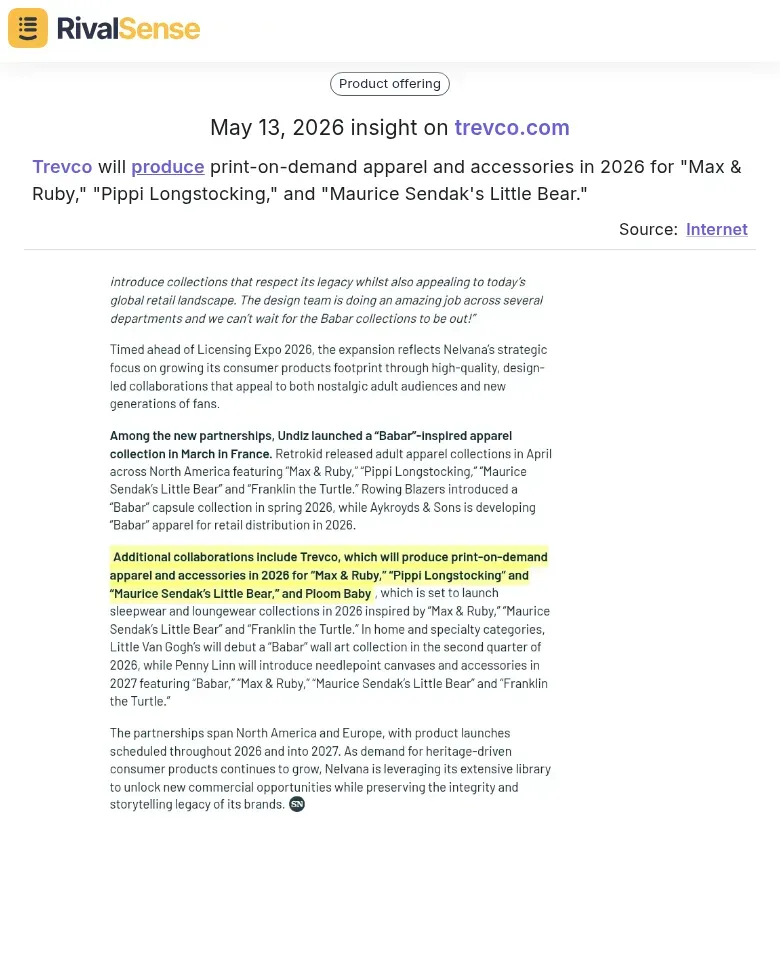
Trevco will produce print-on-demand apparel and accessories in 2026 for "Max & Ruby," "Pippi Longstocking," and "Maurice Sendak's Little Bear." This signals a major licensing play into children's entertainment merchandising—an opportunity to assess whether your competitor is diversifying or targeting a new audience segment.
How to set up your early warning system:
- Trademark alerts: Use USPTO or EUIPO databases to monitor your competitors’ filings.
- Press release monitoring: Set up Google Alerts for your rivals + keywords like “partner,” “launch,” “beta,” or “licensing.”
- Partner announcements: Track the news sections of key suppliers, distributors, and technology partners.
- Actionable checklist:
- List your top 5 competitors.
- Identify 3–5 partners each works with.
- Create alerts for each combination.
- Review weekly for patterns.
This approach turns fragmented data into a clear roadmap of your competitor’s strategy.
Uncovering Feature Updates and Platform Integrations from Social Signals
Social media and community forums are goldmines for uncovering competitor feature updates and integrations before official announcements. By monitoring platforms like Reddit, Twitter, LinkedIn, and niche industry forums, you can spot beta features, user feedback, and integration announcements in real time. This type of insight helps you benchmark your product roadmap and identify gaps your competitor is filling—or missing.
Real-World Insight from RivalSense:

Sprout Social launched Reddit Prediction, enabling users to track news stories on Reddit live and set up Trellis Monitoring Agents for alerts. This new feature directly addresses social listening needs—a move that could challenge other analytics tools and signals where the market is heading.
Actionable Steps:
- Set up social listening tools (e.g., Brandwatch, Talkwalker, or even Google Alerts) with keywords related to your competitors and industry terms like "new feature," "integration with," or "beta."
- Monitor specific subreddits (e.g., r/SaaS, r/startups) and LinkedIn groups where users discuss tools.
- Track sentiment: Note recurring complaints or praises—these reveal UX flaws or strengths.
- Create a competitive intelligence dashboard to aggregate mentions and spot trends.
Pro tip: Use Boolean search strings (e.g., "competitor name" AND ("beta" OR "new feature")) to filter noise. Check platforms like G2 or Capterra reviews for candid user feedback on recent updates.
Decoding Financial Health and Growth Trajectories from Analyst Reports
Financial analyst reports are treasure troves of competitive intelligence, revealing not just past performance but future trajectories. By decoding metrics like earnings estimates, growth scores, and cash flow trends, you can anticipate a rival’s strategic moves—especially R&D investment. This insight is crucial because financial health signals indicate whether a competitor can afford aggressive innovation or might be cutting back, which opens windows for your own moves.
How to Interpret Key Metrics:
- Zacks Growth Score: A composite of earnings estimate revisions, momentum, and growth rates. A score of A or B signals strong upward revisions, often indicating aggressive R&D spending. A C or lower may suggest stagnation.
- EPS Revisions: Track the direction and magnitude of earnings per share estimate changes. A string of upward revisions—especially for future quarters—often correlates with new product launches or tech investments.
- Cash Flow Trends: Operating cash flow growing faster than net income can signal heavy capital expenditure (e.g., building new labs or software platforms).
Real-World Insight from RivalSense:
Paymentus has a Zacks Growth Score of A, with projected EPS growth of 19.7% this year, cash flow growth of 18.4%, and upward earnings estimate revisions of 7% over the past month. These strong fundamentals suggest Paymentus is reinvesting heavily—likely into product development or market expansion—which could impact competitive dynamics in the payment processing space.
Actionable Takeaway: Integrate financial data sources (e.g., Zacks, Yahoo Finance, SEC filings) into your competitor tracking dashboard. Set alerts for:
- Growth Score changes (A→B or vice versa)
- EPS revision clusters (3+ upward revisions in 30 days)
- Cash flow-to-income ratio shifts
By monitoring these signals, you'll spot investment patterns months before product launches, giving you time to adjust your roadmap.
Synthesizing Disparate Clues into a Cohesive Competitive Picture
Connecting the dots between product updates, feature releases, and financial signals can reveal a rival's strategic pivot before they announce it. For example, a sudden hiring spree for mobile engineers, coupled with a job posting for a 'Mobile SDK Lead,' and a quarterly earnings call mentioning 'mobile-first initiatives' strongly suggests a shift toward mobile. To avoid confirmation bias, cross-reference at least three independent sources—e.g., job boards, product changelogs, and investor transcripts. Build a repeatable workflow: 1) Collect raw signals (tools like RivalSense, Crunchbase, LinkedIn), 2) Tag each signal by category (product, hiring, funding), 3) Map signals to a timeline, 4) Identify patterns (e.g., hiring precedes feature launches by 3–6 months), 5) Form hypotheses, 6) Validate with additional sources (e.g., patent filings, support forums). Use a simple checklist: ❏ Are signals from different categories? ❏ Do they align temporally? ❏ Are there alternative explanations? This systematic approach turns noise into a cohesive competitive picture.
Conclusion: Turning Internet Sleuthing into a Sustainable Competitive Practice
Turning occasional internet sleuthing into a sustainable competitive practice requires moving from ad-hoc investigations to continuous monitoring. Start by assigning a dedicated team member—perhaps a product manager or UX researcher—to spend 30 minutes weekly reviewing competitor websites, app stores, and social channels for UX changes. Use tools like Visualping or Distill.io to automatically track specific pages for updates, and set up Google Alerts for competitor brand names and feature keywords. Create a shared dashboard (e.g., Trello or Notion) to log findings, categorize them (e.g., navigation changes, onboarding flows, error handling), and tag action items for your product team. As you scale, introduce automation: RivalSense can aggregate competitor updates, while Hotjar-like session recordings (if publicly available) reveal friction points. Monthly competitive UX reviews should feed into your product roadmap. Remember: the goal isn't to copy but to anticipate—spotting a confusing checkout flow or a broken search bar before your users do. Start small: pick one competitor, set two alerts, and schedule a 15-minute weekly review. Then layer in automation and expand your scope. Consistent digital reconnaissance turns UX flaws into opportunities and keeps your product ahead of the curve.
Ready to streamline your competitor intelligence? Try RivalSense for free and get your first competitor report today—no strings attached. Turn scattered online clues into a weekly edge.
📚 Read more
👉 2026 Identity Verification Benchmarking: Competitor Matrix Insights
👉 How Financial Insights Drove Key Account Wins: 3 Case Studies
👉 How to Use Competitor Cost Data for Smarter KYC/KYB Strategy
👉 Competitor Thought Leadership Analysis: A Step-by-Step Guide
👉 Key Account Tracking Setup: A Trend Analysis for B2B Companies