
2026 Identity Verification Benchmarking: Competitor Matrix Insights
The identity verification (IDV) market in 2026 has matured into a multi-layered ecosystem where AI-driven liveness detection, passive biometrics, and decentralized identity standards coexist. Key trends include the rise of reusable digital identity wallets, regulatory convergence around eIDAS 2.0 and GDPR+ frameworks, and the shift from document-centric to risk-based, continuous authentication. For B2B onboarding, the challenge is no longer just verifying identity—it's doing so in under 10 seconds while maintaining a 99.9% pass rate and full privacy compliance.
Balancing security, speed, and privacy is the new trifecta. Too much friction leads to drop-offs; too little invites fraud. Best-in-class solutions now employ adaptive workflows: low-risk users get a selfie + NFC chip scan, while high-risk cases trigger step-up checks like proof of address or video call.
Why benchmark competitors? Because the IDV landscape shifts quarterly—new spoofing techniques, updated regulation, and faster UX patterns emerge constantly. A competitor matrix helps you spot gaps (e.g., your rival lacks passive liveness), prioritize roadmap features, and justify vendor switches. Practical tip: Create a scorecard with weighted criteria (accuracy, speed, cost, privacy, compliance) and update it every 90 days using public demos, analyst reports, and user reviews.
Section 1: Privacy-First Verification Models – Handling Biometric Data Without Direct Access
In 2026, privacy-first identity verification is a competitive differentiator. Companies can verify users without ever storing biometric data by employing a zero-retention architecture. Here’s how:
-
Document Capture & Biometric Selfie Comparison: The user captures a photo of their ID and a live selfie. The system compares the two using liveness detection and facial matching algorithms. Crucially, the raw biometric data is processed ephemerally—only a verification token (pass/fail) is returned to the client. The provider never stores the selfie or ID image beyond the transaction window.
-
Client-Side Encryption: Some models encrypt biometric data on the user’s device before transmission. The service provider processes the encrypted data using secure enclaves or homomorphic encryption, ensuring even the provider cannot see the raw biometrics. The client (e.g., a bank) receives only the verification result.
-
Practical Steps to Implement:
- Choose a vendor that offers API-based verification with explicit SLAs on data deletion (e.g., within 24 hours).
- Audit data flows: Ensure no raw biometric data is logged or cached in server logs.
- Use synthetic data for testing: Validate accuracy without exposing real biometrics.
Tip: Look for certifications like ISO 27701 (privacy management) and SOC 2 Type II. A vendor that cannot demonstrate zero-retention is a liability.
Checklist for Privacy-First Verification:
- [ ] Vendor deletes biometric data post-verification
- [ ] No raw biometrics stored in client systems
- [ ] Liveness detection (passive or active) is mandatory
- [ ] Encryption in transit and at rest (even if temporary)
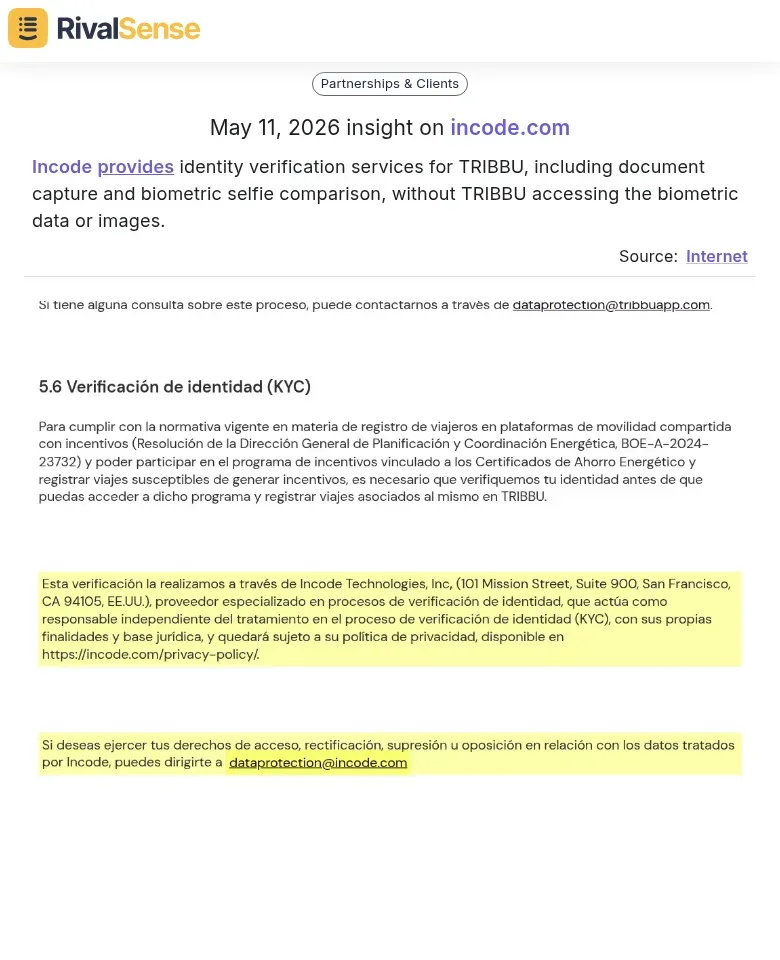
🔍 Real-World Insight: Using RivalSense, you can track how competitors implement privacy-first models. For example, we spotted that Incode provides identity verification services for TRIBBU, including document capture and biometric selfie comparison, without TRIBBU accessing the biometric data or images. This is a textbook zero-retention architecture. Why is this valuable? It shows a concrete implementation that you can evaluate as a benchmark for your own vendor selection—and it reveals the exact privacy claims your competitors are making in the market.
By adopting these models, companies build trust and reduce regulatory risk while maintaining high verification accuracy.
Section 2: AI-Powered Fraud Prevention – Adapting to Crypto-Specific Risks
Crypto platforms face unique fraud vectors—synthetic identities, deepfake KYC bypasses, and account takeovers. Generic fraud models fail here. The fix: Build in-house AI models that can be retrained within hours, not weeks.
Why In-House Models Matter
Off-the-shelf solutions lack speed and specificity. Synthetic identities evolve daily; deepfake generation tools improve monthly. Your fraud model must adapt at the same pace. Recognition as a Leader in analyst reports (e.g., Gartner Magic Quadrant for Identity Verification) signals that your approach is battle-tested—but only if you continuously update it.
Practical Steps to Build Adaptable Fraud Detection
- Start with crypto-specific signals: Analyze wallet creation patterns, transaction velocity, and device fingerprinting. Generic IP checks miss crypto-native fraud.
- Retrain weekly, not quarterly: Use automated pipelines that ingest new fraud cases and update model weights. Aim for <48 hours from detection to model update.
- Combine liveness detection with behavioral analytics: Deepfakes bypass static checks. Add passive liveness (e.g., micro-movement analysis) and session behavior scoring.
- Benchmark against industry peers: Use competitor intelligence tools (like RivalSense) to track how top-tier crypto platforms structure their fraud stacks.
Quick Checklist for Crypto Fraud Models
- [ ] Retraining cycle ≤ 7 days
- [ ] Synthetic identity detection via graph analysis
- [ ] Deepfake detection with passive liveness
- [ ] Real-time transaction risk scoring
- [ ] Integration with blockchain analytics
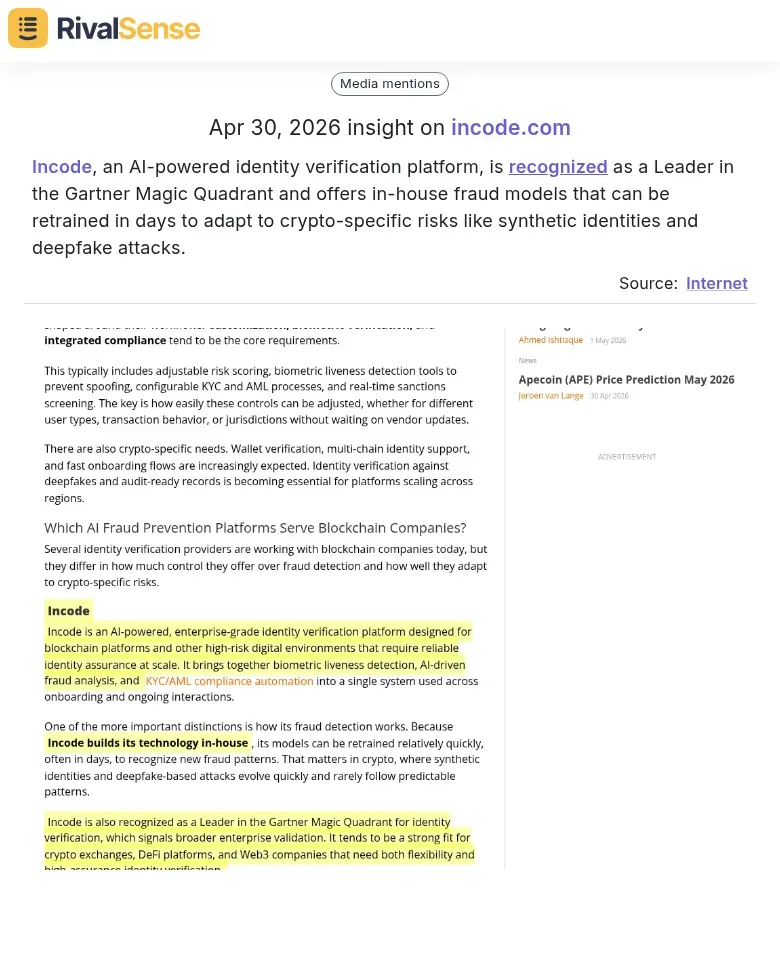
⚡ Real-World Insight: RivalSense recently flagged that Incode, an AI-powered identity verification platform, is recognized as a Leader in the Gartner Magic Quadrant and offers in-house fraud models that can be retrained in days to adapt to crypto-specific risks like synthetic identities and deepfake attacks. This insight is gold for your strategy: it confirms that top-tier players prioritize rapid model retraining, and it gives you a concrete competitor to benchmark your own fraud detection capabilities against.
Bottom line: Adaptability is your only defense. Build models that learn as fast as attackers evolve.
Section 3: Thought Leadership in Digital Onboarding – Balancing Security and Speed
Industry leaders increasingly advocate for a friction-first approach to digital onboarding, where user experience is prioritized without sacrificing security. The core insight: reduce steps, not checks. Instead of asking for all documents upfront, progressive profiling collects data in stages, verifying identity incrementally. For example, start with email and phone verification, then request ID only when risk signals trigger. This balances speed and safety.
Executive perspectives from guest contributors at companies like Onfido and Jumio highlight that market perception hinges on transparency. Publish your security philosophy—explain why you ask for certain data. This builds trust and differentiates your brand.
Practical checklist for balancing security and speed:
- Risk-based authentication: Use device fingerprinting and behavioral analytics to adjust verification rigor.
- Biometric liveness checks: Prevent spoofing without adding friction.
- Document-free verification: Leverage open banking or government databases for instant, secure checks.
- A/B test onboarding flows: Measure drop-off vs. fraud rates to find the sweet spot.
- Communicate clearly: Tell users why each step exists—reduces anxiety and abandonment.
Key trade-off: More data = more security, but less conversion. The winning design decision is to ask for the minimum viable data to make a trust decision, then upgrade verification later if needed.
💡 Real-World Insight: Tracking thought leadership is a powerful way to understand competitor messaging. Using RivalSense, we found that Incode Founder & CEO Ricardo Amper shared a perspective on how companies are rethinking digital onboarding to balance security and speed in a guest contribution to ITSecurityWire. This insight tells you exactly what narrative your competitor is pushing—and helps you refine your own positioning or identify gaps in their approach you can exploit.

Section 4: Building a Competitive Intelligence Matrix for Identity Verification
To build a competitive intelligence matrix for identity verification, start by defining three core pillars: privacy features, fraud detection capabilities, and thought leadership. For each pillar, select measurable metrics. For privacy, track data handling policies (e.g., data retention periods, encryption standards, compliance with GDPR/CCPA). For fraud detection, measure model retraining speed (how often models are updated with new fraud patterns), false positive/negative rates, and liveness detection accuracy. For thought leadership, assess analyst recognition (presence in Gartner, Forrester reports) and executive visibility (speaking engagements, published research).
Structure your matrix as a table with competitors as rows and metrics as columns. Use a scoring system (e.g., 1–5) based on public data, product documentation, and customer reviews. For example, a competitor with daily model retraining scores 5, while quarterly retraining scores 2. Include a column for “gap analysis” where you note opportunities your product can exploit, such as offering transparent data deletion policies if competitors lack them.
Practical checklist:
- List top 5 competitors.
- Collect data on each metric via websites, whitepapers, and review platforms.
- Score each competitor.
- Identify your strengths and weaknesses relative to the matrix.
- Prioritize gaps that align with customer pain points.
Pro tip: Update the matrix quarterly—identity verification tech evolves fast, and stale data leads to flawed strategy.
Conclusion: Key Takeaways and Future Outlook
The 2026 identity verification landscape is defined by three core differentiators: privacy, adaptability, and thought leadership. Companies that embed privacy-by-design, pivot quickly to new fraud vectors, and shape industry discourse are pulling ahead.
Actionable steps for founders and business leaders:
- Audit your privacy posture – Map data flows and minimize collection to what’s strictly necessary. Consider zero-knowledge proofs or on-device verification to reduce liability.
- Build adaptability into your roadmap – Use modular architectures that allow swapping verification methods (e.g., biometrics, document checks) without rewriting core logic. Run quarterly “fraud scenario” drills to test response times.
- Invest in thought leadership – Publish benchmark reports, speak at industry events, and contribute to standards bodies. This builds trust and attracts top talent.
Predictions beyond 2026:
- Decentralized identity will move from niche to mainstream, with self-sovereign identity (SSI) wallets becoming standard for KYC.
- AI-driven continuous verification will replace one-time checks, using behavioral biometrics and device telemetry to monitor sessions in real time.
- Regulatory convergence – Expect global frameworks like the EU’s eIDAS 2.0 to harmonize cross-border verification, forcing compliance-by-default design.
Start preparing now: the winners will be those who treat identity verification not as a compliance checkbox, but as a strategic advantage.
📊 Ready to build your own competitor matrix? RivalSense automatically tracks competitor product updates, pricing, partnerships, and executive moves across the web, social media, and registries—delivered weekly in a concise email report. Stop relying on manual searches and start making data-backed decisions. Try RivalSense for free here and get your first competitor report today.
📚 Read more
👉 How Financial Insights Drove Key Account Wins: 3 Case Studies
👉 How to Use Competitor Cost Data for Smarter KYC/KYB Strategy
👉 Competitor Thought Leadership Analysis: A Step-by-Step Guide
👉 Key Account Tracking Setup: A Trend Analysis for B2B Companies
👉 How Revolut's Premium Investment Move Sparked a Rival's Strategic Pivot