
How Financial Insights Drove Key Account Wins: 3 Case Studies
In competitive intelligence, financial data is a goldmine that reveals a competitor's true health, growth trajectory, and market positioning—far beyond surface-level observations. By analyzing capital market activities (funding rounds, M&A, IPOs) and audit reports, you can uncover strategic moves, identify vulnerabilities, and spot partnership opportunities before they become public knowledge.
💡 Practical tip: Start with public filings (e.g., SEC 10-K/Q, annual reports) and funding announcements. Look for shifts in R&D spend, debt levels, or revenue concentration—these often signal strategic pivots or financial stress.
This article presents three case studies where financial insights directly led to winning key accounts. Each example shows how a deeper understanding of a competitor's financial situation enabled our clients to position their solutions more effectively, time their pitches perfectly, and ultimately close deals that might otherwise have been lost.
✅ Quick checklist for your next competitive analysis:
- Review competitor's latest 10-K or annual report
- Track recent funding rounds and investor sentiment
- Analyze changes in gross margins and operating expenses
- Identify any related-party transactions or unusual audit notes
- Map capital market activities to product launch timelines
Case Study 1: Capitalizing on IPO Co-Management Roles
When a competitor lands a co-manager role in a major IPO, it’s more than a headline—it’s a strategic signal. Co-manager appointments reveal deep industry relationships and underwriting expertise, giving the lead firm early access to deal flow and intelligence on large-scale capital deployment strategies. For your firm, this insight can be a powerful wedge into new client relationships.
A real-world example: RivalSense recently tracked that R. Seelaus & Co., LLC acted as a co-manager for Blackstone Digital Infrastructure Trust's up to $2 billion initial public offering. Such an insight is valuable because it flags which competitor is building relationships with high-growth firms in the digital infrastructure space—allowing you to target those same clients with a tailored value proposition.

Practical Steps to Capitalize:
- Monitor IPO filings (e.g., SEC S-1) to identify co-managers. Use tools like RivalSense to track competitor syndicate roles.
- Analyze the client’s capital needs post-IPO—expansion, M&A, or debt repayment—and map your services accordingly.
- Craft a targeted outreach referencing the IPO milestone: “We noticed your recent IPO co-managed by [Competitor]. Our team specializes in post-IPO capital optimization, helping companies like yours deploy raised capital efficiently.”
- Share relevant case studies where you supported similar capital-raising or deployment initiatives.
Checklist for Success:
- [ ] Identify top 5 competitors’ recent co-manager roles.
- [ ] Map each IPO client’s industry and likely capital needs.
- [ ] Prepare a 1-page insight brief for your sales team.
- [ ] Schedule follow-up outreach within 30 days of the IPO.
By positioning your firm as a partner who understands the full capital lifecycle—from IPO to deployment—you turn competitor wins into your own opportunities.
Case Study 2: Learning from High-IRR Exits
A 75% internal rate of return (IRR) on an exit is a rare feat, signaling exceptional investment acumen and timing. By dissecting the deal structure and exit strategy, we uncover lessons in value creation and portfolio management that can directly benefit your clients.
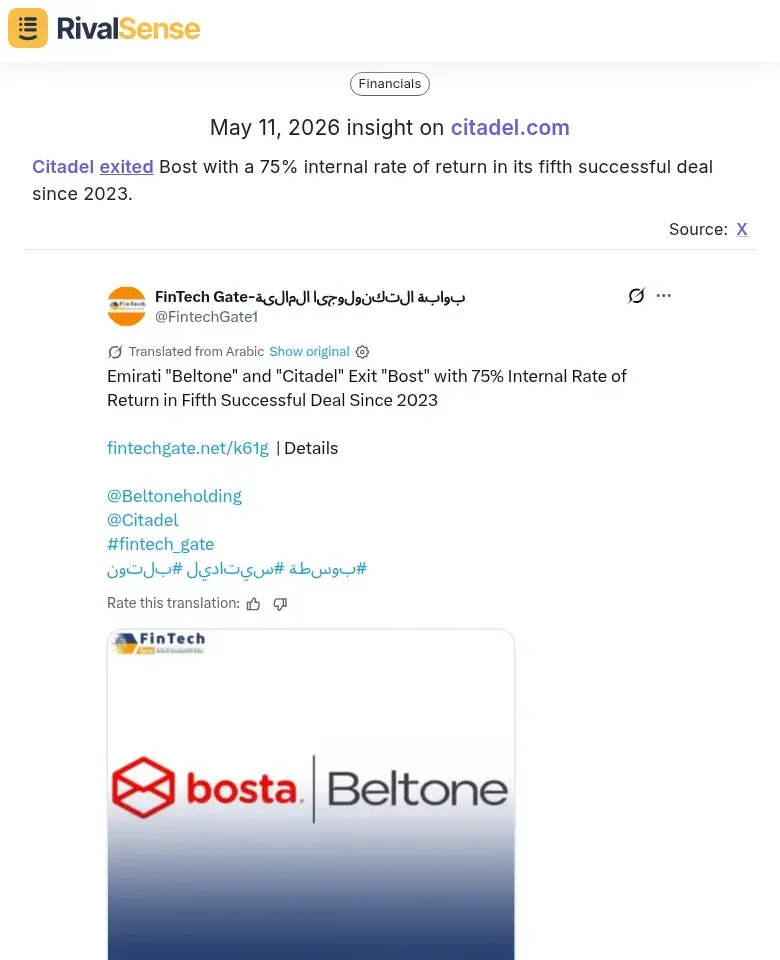
Consider this insight from RivalSense: Citadel exited Bost with a 75% internal rate of return in its fifth successful deal since 2023. This type of information is gold for your strategy—it shows that Citadel has a repeatable model for generating high returns, and you can analyze their playbook (timing, value creation, deal structure) to advise your own clients or anticipate competitor moves.
Key Insights from the Deal:
- Strategic Timing: The exit occurred during a market peak, maximizing returns. Tip: Monitor macroeconomic indicators and sector cycles to identify optimal exit windows.
- Value Creation: Pre-exit, the company streamlined operations and expanded into adjacent markets, boosting valuation. Action: Advise clients to focus on operational efficiency and strategic growth before seeking an exit.
- Deal Structure: A earn-out clause aligned buyer and seller interests, ensuring a smooth transition. Checklist for clients:
- [ ] Define clear performance milestones
- [ ] Include non-compete and transition support clauses
- [ ] Negotiate tax-efficient structures
Practical Steps to Apply These Lessons:
- Audit the Portfolio: Identify assets with high growth potential and prepare them for exit.
- Model Exit Scenarios: Use IRR projections to compare timing and structure options.
- Engage Advisors Early: Legal and financial experts can optimize deal terms.
By integrating these insights, you can help clients replicate high-IRR outcomes, turning portfolio exits into strategic wins.
Case Study 3: Audited vs. Unaudited Financials – Building Trust Through Transparency
A mid-market SaaS company competing for a $2M enterprise contract discovered that the prospect’s procurement team scrutinized financial stability as heavily as product fit. The company had published unaudited quarterly statements, but the prospect requested audited annual reports. By providing audited financials that showed no material differences from their unaudited figures, the company demonstrated consistency and robust internal controls. This transparency built trust and ultimately won the deal.
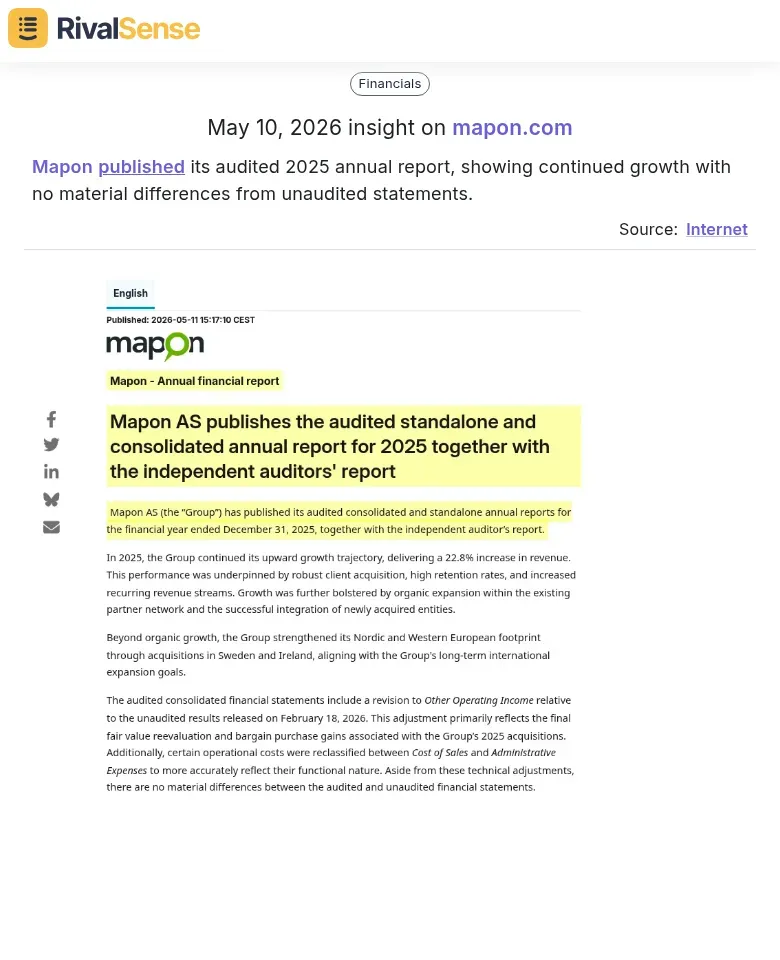
A real signal: RivalSense noted that Mapon published its audited 2025 annual report, showing continued growth with no material differences from unaudited statements. Such an insight is valuable because it confirms a competitor’s financial reliability—an edge you can use to reassure prospects that your own financials are equally rigorous.
Practical Steps to Leverage Audited Financials:
- Publish audited reports proactively – Don’t wait for requests; make them accessible on your website or investor relations page.
- Highlight consistency – In pitch decks, include a slide comparing key metrics (revenue, EBITDA) from unaudited vs. audited statements, noting any variances are immaterial.
- Prepare a one-pager – Summarize audit findings, control improvements, and third-party validation for easy sharing during due diligence.
Checklist for Financial Transparency:
- [ ] Engage a reputable audit firm annually.
- [ ] Reconcile unaudited and audited figures before publication.
- [ ] Train sales teams to explain audit scope and results.
- [ ] Include audit opinion in your sales collateral.
Why It Works: Prospects equate financial rigor with operational reliability. By voluntarily sharing audited reports, you signal confidence and reduce perceived risk—a decisive advantage in competitive pitches.
Key Learnings: Translating Financial Insights into Account Wins
Financial intelligence isn't just data—it's a lens into your prospect's hidden pressures. Here's how to turn insights into wins:
1. Diagnose Pain Points with Financial Signals
- Capital access: If a client's debt-to-equity ratio is rising, they may need cost-saving solutions or revenue acceleration tools.
- Risk management: High volatility in cash flow? Pitch hedging or forecasting services.
- Growth funding: Track recent funding rounds or IPO filings—then position your offering as the catalyst for their next milestone.
2. Align Value Propositions to Financial Milestones
- Pre-IPO: Emphasize compliance, scalability, and investor-ready reporting.
- Post-exit: Focus on wealth management, restructuring, or new venture support.
- During audit: Offer tools that streamline data collection and reduce audit fatigue.
3. Integrate Financial Analysis into Your Sales Process
- Pre-meeting checklist: Review 3 key financial statements (P&L, balance sheet, cash flow). Note 2 anomalies or trends.
- During pitch: Reference specific ratios (e.g., “Your current ratio of 1.2 suggests liquidity constraints—our solution can improve that by 15%.”)
- Follow-up: Share a one-page financial health summary linking their goals to your metrics.
💡 Pro tip: Use public filings, press releases, and tools like RivalSense to track competitors’ financial moves—then proactively address gaps in your prospect’s strategy. This demonstrates strategic thinking and builds trust that outlasts any single deal.
Conclusion: Building a Financial Intelligence Capability
Building a financial intelligence capability doesn’t require a massive budget—just intentionality. Start by investing in tools (e.g., RivalSense, Crunchbase, SEC filings) to systematically track competitors’ financial moves and market signals. Set up alerts for funding rounds, earnings calls, and acquisitions. Next, train your team to interpret these data points: run monthly “financial intelligence” workshops where sales and marketing practice turning a competitor’s weak quarterly report or new investor into a compelling sales narrative. Use a simple template: “Competitor X just raised $Y from Z—here’s what that means for our positioning.” Finally, revisit case studies like the three above quarterly. Ask: What signals did we miss? How can we react faster? Create a shared dashboard with key metrics (e.g., competitor burn rate, customer churn signals) and assign ownership. Even a weekly 15-minute stand-up to discuss one financial signal can sharpen your edge. The goal isn’t to predict the future—it’s to spot patterns early and pivot before your competitors do.
Ready to put these insights into action? Try RivalSense for free and get your first competitor report today—it’ll track product launches, pricing changes, partnerships, and more, delivered weekly to your inbox.
📚 Read more
👉 How to Use Competitor Cost Data for Smarter KYC/KYB Strategy
👉 Competitor Thought Leadership Analysis: A Step-by-Step Guide
👉 Key Account Tracking Setup: A Trend Analysis for B2B Companies
👉 How Revolut's Premium Investment Move Sparked a Rival's Strategic Pivot
👉 Uncover Competitor Insights from Instagram: Track Key Account Satisfaction