
Strategic Competitor Analysis in 2026: Mastering Media Mentions and Content Marketing Trends
In 2026's hyper-competitive digital landscape, tracking competitor media mentions has evolved from a nice-to-have to a strategic imperative. Media visibility directly correlates with market positioning and brand awareness—when your competitors secure coverage in key publications, they're not just gaining exposure; they're shaping market narratives and influencing buyer perceptions. By monitoring their earned media, you gain critical intelligence about their messaging strategies, target audiences, and industry positioning.
This year's content marketing trends create unprecedented competitive intelligence opportunities. The rise of AI-generated content, interactive formats, and personalized experiences means competitors are experimenting with new engagement tactics. Tracking these innovations reveals where they're investing resources and what resonates with your shared audience.
Practical steps to leverage this intelligence:
- Set up automated monitoring for competitor mentions across industry publications, podcasts, and social media 📡
- Analyze the sentiment and context of coverage to understand narrative positioning
- Identify gaps where your competitors aren't being covered
- Track which content formats generate the most engagement for them
- Use these insights to refine your own media outreach and content strategy
Media visibility isn't just about awareness—it's a growth driver that builds credibility, attracts partnerships, and establishes thought leadership. In 2026, the connection between strategic media coverage and business growth has never been more direct or measurable.
Methodology: How to Systematically Track and Analyze Competitor Media Activity
To systematically track and analyze competitor media activity in 2026, implement this three-phase methodology. Consistent monitoring transforms raw data into actionable insights that inform your strategic decisions.
Phase 1: Monitoring Setup
Use AI-powered tools like Brand24, Semrush, and Contify to track mentions across traditional media, social platforms, blogs, and review sites. Create competitor profiles with keywords, domains, and key personnel. Set up automated alerts for spikes in mentions, sentiment shifts, or new content launches.
Phase 2: Impact Measurement
Establish these core metrics:
- Share of Voice: Percentage of industry mentions vs. competitors
- Sentiment Analysis: Positive/negative ratio using AI classification
- Media Value: Advertising Value Equivalent (AVE) calculations
- Engagement Quality: Comments, shares, and saves per mention
- Influence Score: Authority of media sources mentioning competitors
Phase 3: Structured Framework
Create a weekly intelligence dashboard with:
- Competitive Comparison Matrix: Track mentions, sentiment, and reach across 3-5 key competitors
- Content Gap Analysis: Identify topics competitors cover that you're missing
- Media Relationship Mapping: Document which journalists/influencers feature competitors
- Trend Detection: Use AI anomaly detection to spot emerging patterns
Practical Checklist:
- [ ] Update competitor profiles quarterly
- [ ] Set up Google Alerts for competitor names + "announces" or "launches"
- [ ] Use Similarweb for traffic source analysis
- [ ] Benchmark your media performance monthly against competitors
- [ ] Create a media mention scoring system (1-10 based on outlet authority, sentiment, and reach)
This structured approach reveals opportunities to improve your media strategy and content marketing effectiveness.
Industry Recognition & Awards Analysis: Learning from Competitor Success Stories
Tracking industry recognition and awards provides a clear window into your competitors' strategic priorities. By analyzing which accolades they pursue and win, you can infer their focus areas, from innovation to customer experience.
For instance, RivalSense tracked that Coop received nine nominations for the sponsor and event awards from the Sponsor and Event Association, including categories like Sponsor of the Year and social sponsorships, with the award ceremony scheduled for April 23. 
This type of insight is valuable because it reveals how competitors leverage awards for brand credibility and media exposure, helping you identify gaps in your own recognition strategy and align with industry trends.
Analyze which categories competitors target—innovation awards signal R&D focus, while sustainability awards indicate ESG priorities. Create a spreadsheet mapping competitors to award types, noting nomination frequency and win rates.
For sponsorship patterns, monitor event calendars and social media for competitor participation. Note sponsorship tiers (platinum vs. bronze) and speaking opportunities secured. Higher-tier sponsorships correlate with increased media mentions.
Extract insights with this checklist:
- Identify relevant industry awards and track competitor nominations quarterly 🏆
- Analyze award criteria alignment with business goals
- Measure media coverage impact post-win to understand ROI
- Benchmark against industry standards to refine your own strategy
This systematic approach helps you enhance your industry positioning and capitalize on recognition opportunities.
Thought Leadership & Community Engagement: Analyzing Expert Positioning
Thought leadership and community engagement represent the most sophisticated competitive positioning strategies in 2026. To gain a competitive edge, you must analyze how competitors establish authority through expert interactions and value-driven participation.
Monitor competitor executives' activities on platforms like Reddit, where they address niche topics. For example, RivalSense captured that Speechmatics founder Tony Robinson answered questions on Reddit about voice AI topics like the one-second rule and low resource languages on March 27. 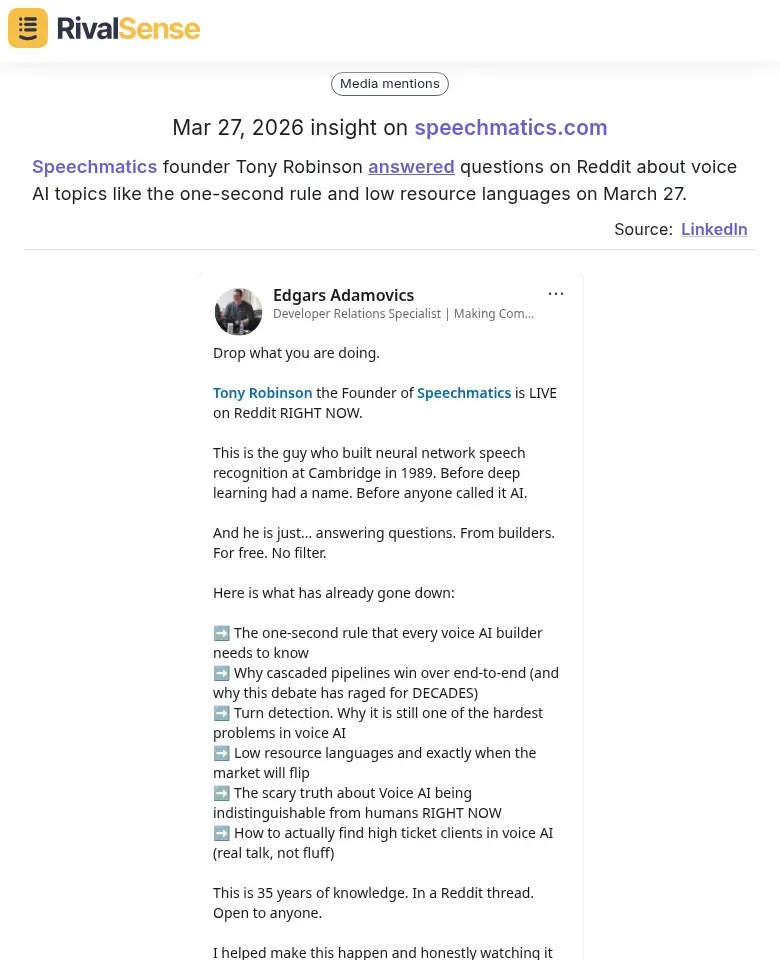
This insight is valuable because it shows how competitors build thought leadership by engaging directly with community concerns, offering insights into their technical expertise and audience engagement tactics that can inform your own expert positioning.
Create a monitoring checklist:
- Identify key competitor executives on LinkedIn, Twitter, and industry platforms
- Track their speaking engagements at major conferences
- Monitor their responses to industry questions in forums and communities
- Analyze the depth of their technical content versus promotional messaging
Examine how competitors establish authority through specialized content. Look for original research, proprietary frameworks, and technical deep-dives that demonstrate genuine expertise rather than surface-level marketing.
Community engagement strategies that build credibility include:
- Hosting expert-led Q&A sessions
- Participating in niche industry forums
- Creating educational content that solves specific problems
- Building relationships with industry influencers
Focus on quality over quantity—meaningful interactions with key stakeholders often outweigh broad but shallow reach. Use tools to track these patterns and benchmark your engagement against industry leaders.
Innovation & Technology Positioning: Tracking Industry Leadership Narratives
In 2026, savvy competitors use technology announcements as strategic media hooks to secure industry recognition. They craft narratives that position themselves as problem-solvers addressing market shifts, connecting innovations to broader trends like AI adoption or sustainability.
For example, RivalSense observed that Deezer's CEO Alexis Lanternier shared how the company's GenAI detection solutions support collecting rights societies in addressing fraud at the CISAC assembly. 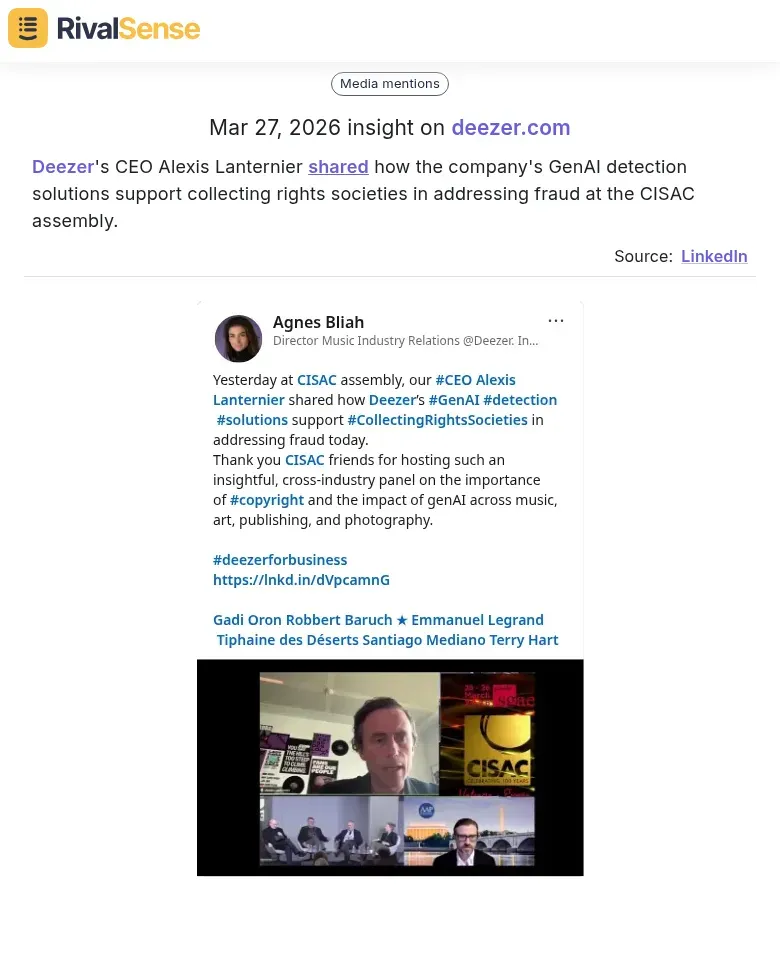
This insight is valuable because it highlights how competitors position their technology in regulatory and industry contexts, revealing their innovation narratives and partnership strategies that can guide your own market positioning.
Practical Checklist for Analyzing Competitor Technology Positioning:
- Monitor announcement timing relative to industry events and competitor launches ⏰
- Analyze how they frame innovations—as solutions to specific pain points or as visionary market shifts
- Track media coverage quality: Are they featured as thought leaders or just product vendors?
- Identify narrative patterns: Do they use customer success stories, data-driven claims, or founder authenticity?
- Measure message consistency across channels—press releases, social media, and industry publications
Key Insight: The most effective competitors don't lead with specifications. They embed technology within larger value narratives that resonate emotionally while demonstrating market transformation. They show the "why" before the "what," positioning customers as heroes and their solutions as enablers.
Actionable Tip: Create a competitor narrative matrix tracking how each positions technology announcements against industry problems, customer aspirations, and market trends. This reveals gaps where you can establish differentiated leadership.
Actionable Insights: Turning Competitor Analysis into Strategic Advantage
Transform competitor analysis into strategic advantage with these actionable steps. By systematically applying insights, you can outmaneuver competitors and capture market attention.
Media Mention Response Strategy:
- Create a real-time alert system for competitor media coverage patterns
- Develop templated responses for common competitor narratives
- Identify 3-5 key journalists covering your competitors and build relationships
- Monitor competitor crisis responses to learn from their successes/failures
Content Marketing Initiatives:
- Conduct quarterly content gap analysis using tools like Ahrefs or SEMrush
- Create comparison content addressing underserved topics competitors miss
- Develop original research that competitors can't easily replicate
- Build content clusters around high-value keywords competitors dominate
Proactive Media Relations:
- Map competitor media placements by outlet and journalist
- Identify 2-3 unique angles your competitors aren't covering
- Create a media outreach calendar based on competitor coverage patterns
- Develop credibility-weighted insights to differentiate from AI-generated noise
Quick Checklist for Immediate Action:
- [ ] Set up competitor monitoring dashboards
- [ ] Identify 5 content gaps monthly
- [ ] Build relationships with 3 competitor journalists quarterly
- [ ] Create quarterly competitive intelligence reports
- [ ] Test 2 new content formats based on competitor success
Pro Tip: Use AI-powered tools to detect early signals in competitor narratives, but maintain human analysis to interpret emotional intensity and narrative coherence that machines miss.
Take Your Competitor Analysis to the Next Level
Leveraging these strategies requires consistent tracking and insights. Try RivalSense for free at https://rivalsense.co/ to automate competitor monitoring across product launches, pricing updates, event participations, partnerships, regulatory aspects, management changes, and media mentions. Get your first competitor report today and turn competitive intelligence into a strategic advantage! 🚀
📚 Read more
👉 Competitor Analysis in Action: Decoding Web Scraper's Marketplace Expansion
👉 Key Account Tracking Permissions: The Complete Guide for B2B Leaders in 2026
👉 Renewable Energy SEO Benchmarking: Outperform Competitors Strategically
👉 How Genspark's Voice Launch Prompted a Rival's AI Workspace Acceleration