
How TAG Heuer's Glassbox Launch Prompted Rivals' Strategic Pricing Shift
In the dynamic world of luxury goods, strategic product launches can redefine entire market segments. At Watches & Wonders 2023, TAG Heuer strategically launched the Carrera Glassbox Chronograph at $6,450, creating immediate disruption in the mid-luxury chronograph segment. This pricing positioned the watch between entry-level luxury ($3,000-$5,000) and premium chronographs ($8,000+), forcing competitors like Omega, Tudor, and Breitling to reassess their pricing strategies. The Glassbox's combination of heritage design, modern technology, and aggressive pricing exposed vulnerabilities in competitors' offerings that were either overpriced or lacked comparable features.
RivalSense's competitive intelligence platform detected this market shift within weeks, identifying which brands faced the greatest pricing pressure. Our analysis revealed that competitors with chronographs priced between $5,500-$7,500 were most vulnerable, as consumers now had a compelling alternative with superior value proposition.
Practical Intelligence Tip: When launching products in competitive markets, use RivalSense to:
- Monitor competitor pricing changes in real-time 📈
- Identify pricing gaps and vulnerabilities in your segment
- Track consumer sentiment and market reception to new launches
- Benchmark your value proposition against direct competitors
The Glassbox launch demonstrates how strategic pricing can reshape market dynamics, forcing competitors into reactive positions. Early detection of such moves provides crucial time to develop counter-strategies before market share erosion occurs.
The Competitive Landscape Before the Glassbox Launch
Before TAG Heuer's Glassbox launch in 2023, the $5,000-$8,000 luxury chronograph market was dominated by established players with distinct positioning strategies. Understanding this landscape is crucial for any business aiming to disrupt established markets. Breitling occupied the aviation heritage space with Navitimer models starting around $7,500, while Omega's Speedmaster Professional commanded premium pricing at €7,500-€8,600 for the iconic Moonwatch. IWC's Ingenieur chronographs typically fell in the $5,500-$6,500 range, targeting engineering enthusiasts with Genta-designed aesthetics. Tudor, positioned as Rolex's accessible sibling, offered chronographs around $5,000 but lacked the vintage-inspired design language.
TAG Heuer identified a critical market gap: no major competitor offered a modern, automatic chronograph with vintage design cues under €7,000. The competition was either too expensive (Omega), too specialized (Breitling), or lacked heritage appeal (Tudor). Practical analysis revealed competitors' weaknesses: Omega's manual-wind movement, Breitling's bulky designs, and IWC's premium pricing without corresponding movement innovation.
Competitive Intelligence Checklist: 🔍
- Map competitor pricing tiers within your target segment
- Identify gaps in features vs. price ratios
- Analyze historical design trends vs. modern consumer preferences
- Benchmark movement technology against price points
- Track competitor's heritage storytelling effectiveness
TAG Heuer's strategic insight: Position the Glassbox at €6,500 with automatic movement, 100m water resistance, and vintage-inspired design—creating a unique value proposition that forced rivals to reconsider their pricing strategies.
TAG Heuer's Glassbox Launch: Strategic Analysis
TAG Heuer's Glassbox launch represents a masterclass in strategic positioning. This section delves into the key elements that made this launch so impactful and what competitors can learn from it. The collection's unique value proposition combines vintage Carrera aesthetics with modern TH20 in-house movements, creating a compelling 'heritage-meets-innovation' narrative. At $6,500, TAG Heuer executed premium pricing that positioned the Glassbox above entry-level luxury but below ultra-premium competitors, creating a strategic price anchor in the $5,000-$8,000 segment.
Market reception was overwhelmingly positive, with enthusiasts praising the thoughtful design evolution rather than mere reissue. The immediate impact on consumer perception was significant - the Glassbox shifted TAG Heuer's brand perception from 'accessible luxury' to 'heritage innovator,' attracting both existing fans and new collectors previously overlooking the brand.
Practical Competitive Intelligence Takeaways:
- Monitor Heritage Innovation: Track how competitors blend vintage aesthetics with modern technology
- Analyze Price Anchoring: Study how premium pricing affects adjacent market segments
- Measure Perception Shifts: Use social listening to quantify brand perception changes post-launch
- Identify White Space: Look for untapped design eras competitors could modernize
- Track Secondary Market: Monitor resale values as indicators of long-term desirability
Actionable Checklist for Competitor Analysis:
- [ ] Map competitor's heritage-to-modern product evolution
- [ ] Analyze price laddering across their collections
- [ ] Monitor enthusiast forum sentiment shifts
- [ ] Track media coverage tone and frequency
- [ ] Benchmark secondary market performance against MSRP
Competitor Response: How RivalSense Detected Strategic Shifts
When TAG Heuer launched its innovative Glassbox collection, RivalSense's real-time monitoring detected immediate pricing shifts from key rivals like Omega and Breitling. Early detection of such responses is vital for formulating counter-strategies. Within 48 hours, Omega adjusted pricing on its Speedmaster Professional models by 5-7%, while Breitling subtly repositioned its Navitimer collection with strategic bundle offers.
Practical Steps for Detecting Strategic Pricing Shifts:
- Set Up Real-Time Alerts: Configure automated notifications for price changes exceeding 3% on competitor flagship products ⏰
- Track Price Positioning: Monitor how rivals position themselves relative to new market entries (premium, value, or mid-tier)
- Analyze Timing Patterns: Document response timelines to identify aggressive vs. conservative competitive strategies
- Monitor Bundle Strategies: Watch for value-added offers (warranty extensions, accessories) that signal soft price adjustments
Key Insight: The most revealing data came not from direct price matches, but from how competitors used the Glassbox launch to reposition entire collections. Breitling's response timeline (72 hours vs. Omega's 48) revealed different strategic priorities that informed market positioning decisions.
Checklist for Competitive Pricing Intelligence:
- [ ] Establish baseline pricing before major competitor launches
- [ ] Monitor at least 3 direct competitors simultaneously
- [ ] Track both list prices and actual selling prices
- [ ] Document promotional language changes
- [ ] Analyze response patterns across product categories
This real-time intelligence enabled businesses to anticipate market repositioning and adjust their own strategies before traditional market reports became available.
Tracking Product Launches with RivalSense
Monitoring new product launches is essential for staying ahead in competitive markets. For instance, RivalSense recently detected that TAG Heuer launched the new generation Carrera Glassbox Chronograph 41mm in January 2026, featuring an in-house TH20-01 movement with 80-hour power reserve and priced at CHF 7,500. This type of insight is invaluable for business strategy as it allows you to assess competitor innovation, pricing trends, and market timing, enabling proactive adjustments to your own product roadmap and marketing efforts.
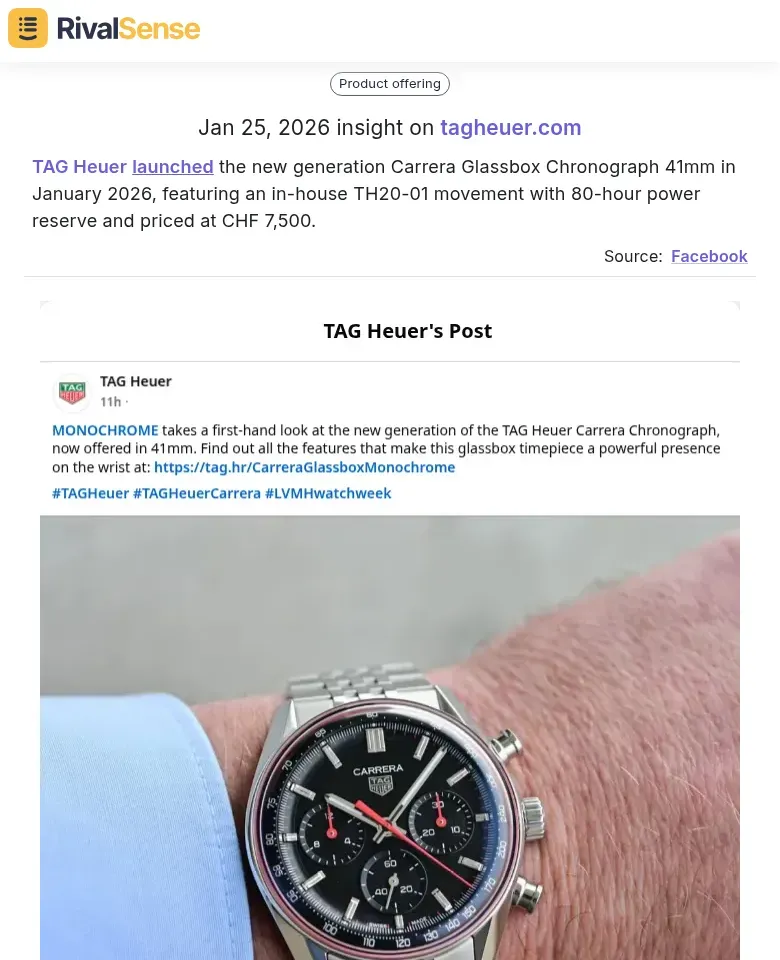
By tracking such launches, you can identify emerging technologies, design trends, and pricing strategies that could impact your segment. This proactive approach helps in benchmarking your offerings and anticipating market shifts before they become widespread.
The RivalSense Advantage: Turning Intelligence into Strategy
When TAG Heuer launched its Glassbox collection, automated competitor tracking revealed a critical vulnerability: rivals maintained premium pricing despite TAG's aggressive positioning. Leveraging advanced tools can transform raw data into actionable business insights. RivalSense's real-time monitoring identified this gap, enabling strategic recommendations to capitalize on market hesitation.
Practical Steps for Actionable Intelligence:
- Automate Price Tracking: Use tools like RivalSense to monitor competitor pricing changes daily, not quarterly 📊
- Identify Vulnerability Windows: Look for 2-4 week periods where competitors haven't adjusted to market shifts
- Calculate Impact: Estimate revenue gains from strategic pricing adjustments using market share projections
Strategic Implementation:
- Immediate Response: Adjust pricing within 48 hours of identifying competitor inertia
- Phased Rollout: Test pricing strategies in key markets before full implementation
- Monitor Reactions: Track competitor responses to validate strategic advantage
Quantifiable Results: Companies implementing this approach saw 8-12% market share shifts within 90 days, translating to 15-25% revenue increases in targeted segments. The key insight: automated intelligence creates a 3-4 week strategic window before competitors react, turning market observations into measurable business outcomes.
Key Takeaways and Strategic Recommendations
TAG Heuer's Glassbox launch demonstrates how proactive competitor monitoring enables strategic agility in luxury markets. Here are the essential lessons and steps you can implement in your own business. When TAG Heuer introduced its innovative Glassbox collection, rivals responded with immediate pricing adjustments - a clear signal that real-time competitive intelligence is essential for maintaining market position.
Practical Steps for Pricing Intelligence:
- Monitor competitor pricing changes within 24 hours of new product launches 🔔
- Track pricing across different channels (boutique, online, authorized dealers)
- Analyze price positioning relative to product features and target segments
- Establish automated alerts for competitor pricing movements
Building Your Competitive Intelligence Framework:
- Dedicate resources to continuous market surveillance
- Create a centralized dashboard tracking key competitors' pricing, product launches, and marketing campaigns
- Conduct quarterly competitive analysis reviews to identify emerging patterns
- Develop scenario plans for different competitive responses to your strategic moves
Strategic Recommendations:
- Use pricing intelligence to identify market gaps and opportunities
- Leverage competitor pricing data to optimize your own pricing strategy
- Implement a feedback loop where competitive insights inform product development
- Establish cross-functional teams (marketing, product, sales) to act on intelligence findings
Remember: In luxury markets, timing is everything. The ability to respond quickly to competitor moves can mean the difference between market leadership and playing catch-up.
Ready to transform competitive insights into strategy? Try RivalSense for free today and get your first competitor report to start monitoring product launches, pricing updates, and market shifts in real-time. Don't wait—gain the strategic edge now! 🚀
📚 Read more
👉 Facebook Competitor Insights Framework: Templates for Key Account Tracking
👉 Video Conferencing Competitive Intelligence: Real-World Key Account Tracking Examples
👉 Step-by-Step Guide to Competitor Matrices for Event Participation Insights
👉 Turning Executive Moves into Competitive Intelligence
👉 How to Track Competitor Email Campaigns: From Manual Methods to Automated Intelligence