
Air Freight Podcast Intelligence: A Strategic Guide to Tracking Competitors
In the competitive air freight industry, tracking competitor podcast appearances provides critical strategic intelligence. When rivals appear on industry podcasts, they reveal their market positioning, target customer segments, and emerging service offerings. This podcast intelligence helps you understand how competitors are positioning themselves in the market—whether they're emphasizing speed, reliability, sustainability, or specialized cargo handling.
Practical steps to implement podcast monitoring:
- 🎯 Create a competitor podcast tracking list with key industry shows
- 🔔 Set up alerts for competitor mentions and appearances
- 📊 Analyze messaging patterns across multiple appearances
- 📈 Track frequency of appearances as an indicator of marketing investment
Podcast presence often correlates with market share growth, as consistent appearances build brand authority and customer trust. By monitoring these appearances, you can identify gaps in your own messaging and anticipate competitor moves before they impact your market position.
Identifying Key Air Freight Podcasts and Industry Voices
To effectively track competitor appearances on air freight podcasts, start by identifying the most influential shows in the logistics space. Key podcasts include 'FreightWaves TV' (large audience, broad industry coverage), 'The Logistics of Logistics' (mid-sized, operational focus), and 'Air Cargo Next' (niche, air freight-specific). These platforms often feature competitors like Flexport, C.H. Robinson, or Expeditors as guests, offering insights into their strategies.
Industry voices hosting these shows include Joe Monaghan (FreightWaves), Joe Lynch (The Logistics of Logistics), and Alex Lennane (Air Cargo Next). Follow them on LinkedIn and Twitter to monitor upcoming episodes and guest lineups.
Categorize podcasts using this checklist:
| Criteria | Description | Example |
|---|---|---|
| Audience Size | Large (>10K listeners), Mid (1K-10K), Small (<1K) | FreightWaves TV (Large) |
| Niche Focus | General logistics, Air freight-specific, Technology/SaaS | Air Cargo Next (Air freight-specific) |
| Influence | Measured by guest quality, social media engagement | The Logistics of Logistics (High influence) |
💡 Practical tip: Use tools like RivalSense to automate tracking of competitor mentions across these podcasts. Set up alerts for competitor names and keywords like 'air cargo,' 'freight tech,' or 'supply chain.' This helps you analyze their messaging strategies and identify partnership opportunities without manual effort.
Monitoring Competitor Appearances and Content Analysis
Effective monitoring of competitor podcast appearances requires a systematic approach to capture and analyze content. Begin by creating a comprehensive tracking system that lists key competitors and industry-relevant podcasts they might target. Utilize specialized tools or set up Google Alerts with specific queries to automate detection.
For content analysis, systematically review each appearance: transcribe key segments to analyze messaging patterns, value proposition evolution, and strategic announcements. Create a spreadsheet to track frequency, timing (seasonal patterns, product launch alignment), and podcast types (industry-specific vs. broad business). Look for recurring themes in how competitors position themselves against market trends.
Practical checklist for weekly monitoring:
- ✅ Conduct competitor podcast appearance audits
- ✅ Analyze message consistency across different shows
- ✅ Correlate timing with product launches or market events
- ✅ Map host relationships (which podcasts feature competitors repeatedly)
- ✅ Review audience engagement metrics when available
🔍 Key insight: Competitors often use podcast tours before major announcements—increased appearance frequency can signal upcoming strategic moves. Track not just what they say, but how they adapt messaging for different audiences to anticipate their next steps.
Extracting Strategic Insights from Podcast Intelligence
Podcast intelligence transforms casual listening into strategic foresight for your air freight business. When competitors discuss expansion plans or new service offerings on podcasts, they're revealing their roadmap, allowing you to prepare countermeasures. For instance, a logistics company mentioning 'expanding our Asian network' signals market entry plans you can address proactively.
Practical Steps for Strategic Insights:
- Track Expansion Signals: Monitor for location mentions, partnership announcements, or capacity increases that reveal growth trajectories.
- Identify Service Gaps: When competitors discuss 'challenges in cold chain logistics' or 'customer requests we can't fulfill,' you've found market opportunities to exploit.
- Anticipate Market Shifts: Notice patterns in multiple competitor podcasts discussing similar trends (like sustainability demands) to predict industry-wide movements.
Quick Analysis Checklist:
- 📝 Document specific service mentions and launch timelines
- 🌍 Note geographic references and expansion language
- 🔄 Track recurring pain points across multiple episodes
- ⚖️ Compare competitor priorities against your own capabilities
🚀 Pro Tip: Create a 'podcast intelligence dashboard' with columns for: Competitor, Episode Date, Key Mentions, Strategic Implications, and Action Items. This transforms passive listening into active competitive intelligence that drives decision-making.
Implementing a Systematic Podcast Monitoring Framework
Implementing a systematic podcast monitoring framework requires three key components: automated tracking, structured analysis, and workflow integration. First, set up automated tracking using tools like RivalSense to monitor competitor appearances across major podcast platforms, saving time and ensuring no critical insight is missed.
Second, establish a structured analysis process with a standardized template for each competitor appearance. Capture: 1) Key messages and positioning, 2) Product/service announcements, 3) Market insights and trends discussed, 4) Audience questions and reactions, 5) Partnership or collaboration hints. Use sentiment analysis to gauge tone and messaging effectiveness.
Third, integrate podcast intelligence into your broader competitive intelligence workflow. Create a centralized dashboard that combines podcast data with other competitive signals. Schedule monthly review sessions to identify patterns and strategic shifts, and share insights with marketing, product, and sales teams to inform messaging, feature development, and competitive positioning.
Implementation Checklist:
- ✓ Set up automated alerts for top 5 competitors
- ✓ Create analysis template with 5 key data points
- ✓ Establish monthly review cadence
- ✓ Integrate findings into competitive intelligence reports
- ✓ Share actionable insights with relevant teams
Turning Insights into Competitive Advantage
Transform podcast intelligence into tangible competitive advantage with actionable steps that drive business outcomes. By analyzing competitor revelations, you can develop proactive strategies to stay ahead in the air freight market.
Actionable Steps:
- Develop Counter-Strategies: When competitors reveal new services or target markets on podcasts, create immediate response plans. Example: If a rival mentions expanding to Europe, accelerate your own European launch or strengthen local partnerships.
- Optimize Your Podcast Strategy: Analyze competitor podcast performance metrics (downloads, engagement, guest quality) to identify gaps. Secure higher-profile guests or create superior content on topics they highlight.
- Measure Business Impact: Establish clear KPIs linking podcast intelligence to outcomes, such as product roadmap adjustments or sales win rates, using a scoring system for each competitive revelation.
💼 Practical tip: Create a monthly 'competitive podcast insights' report that maps revelations to specific business actions, with clear owners and timelines. This ensures insights translate into proactive strategy execution rather than remaining passive data.
Expanding Your Intelligence: Tracking Competitor Moves Beyond Podcasts
While podcast monitoring is valuable, comprehensive competitive intelligence includes tracking other key activities like personnel changes, acquisitions, and partnerships. These insights can reveal strategic shifts that complement what you learn from podcasts. For example, monitoring management changes can indicate new operational focuses, while acquisitions signal technology investments or market expansions.
RivalSense Insights in Action:
-
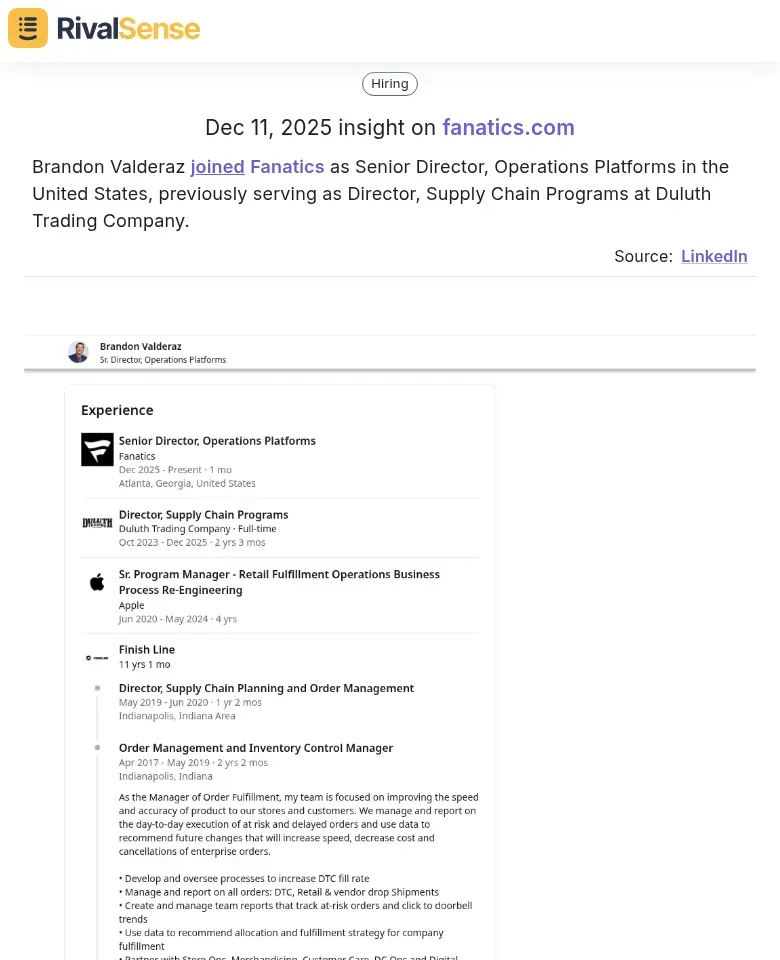
Personnel Change Insight: Tracking key hires, like Brandon Valderaz joining Fanatics as Senior Director, Operations Platforms, can reveal shifts in operational strategy or expansion into new supply chain areas. This type of insight helps you anticipate competitor investments in specific capabilities.
-
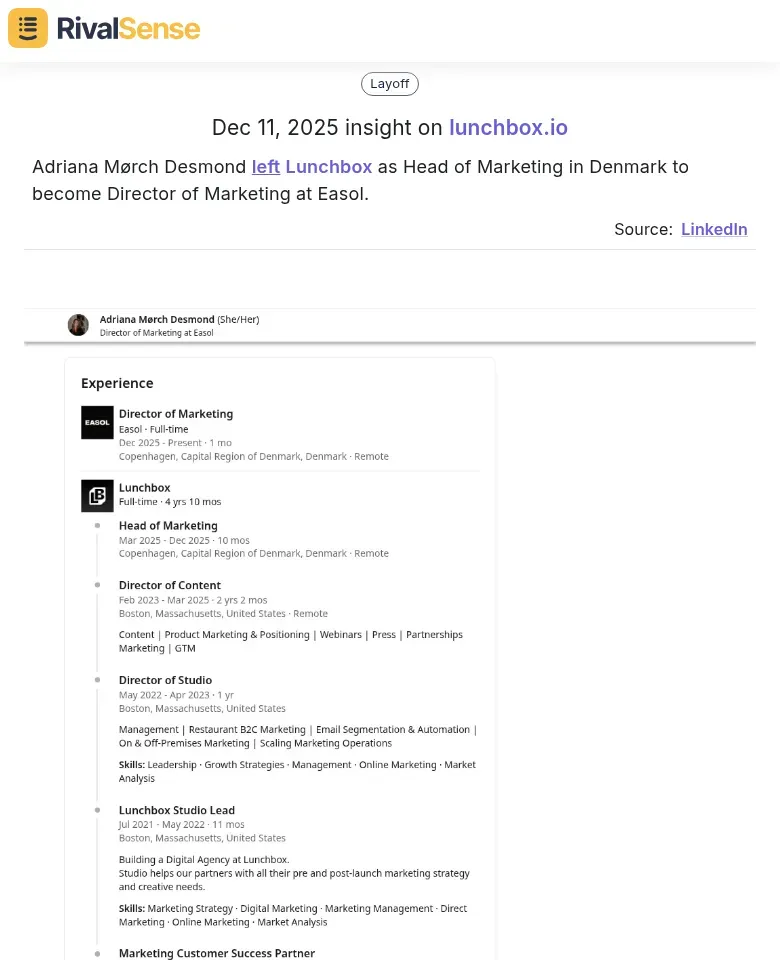
Leadership Departure Insight: When Adriana Mørch Desmond left Lunchbox as Head of Marketing to become Director of Marketing at Easol, it highlighted potential rebranding or market focus changes. Monitoring such moves helps you understand competitor marketing priorities and adjust your own campaigns.
-
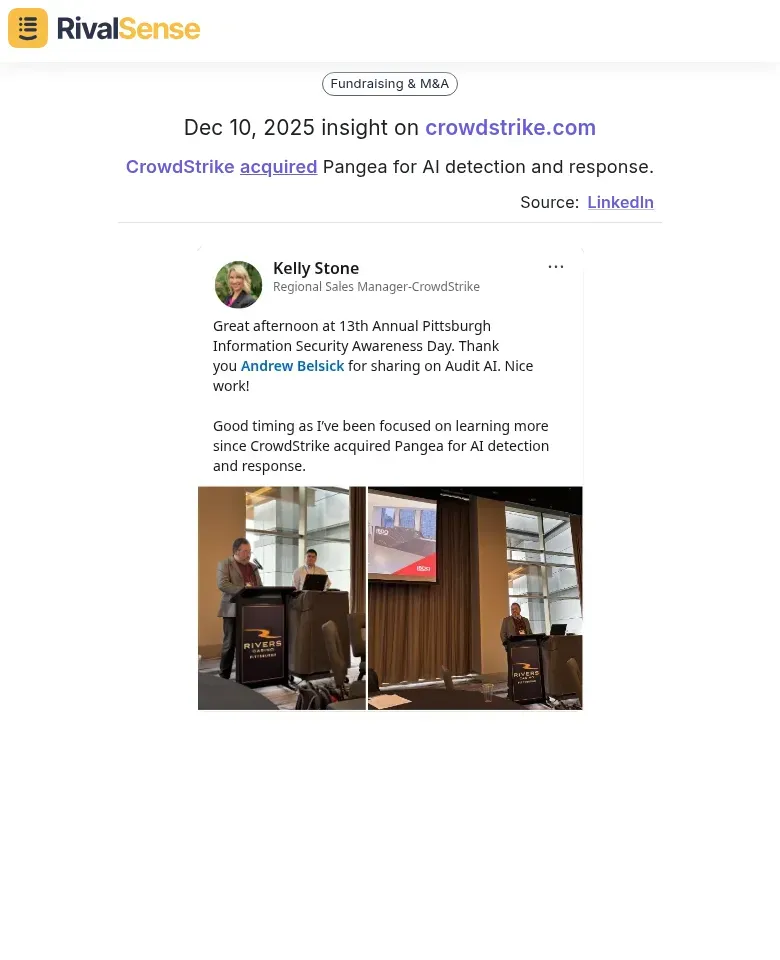
Acquisition Insight: CrowdStrike's acquisition of Pangea for AI detection and response signals a strategic push into enhanced security technologies. Tracking acquisitions allows you to predict industry consolidations and technology trends that could impact your business.
By integrating these diverse insights with podcast intelligence, you gain a holistic view of competitor strategies, enabling more informed decision-making.
Take Action with Comprehensive Competitor Tracking
To effectively monitor competitor podcasts and other critical activities, consider leveraging automated tools like RivalSense. It tracks competitor product launches, pricing updates, event participations, partnerships, regulatory aspects, management changes, and media mentions across websites, social media, and registries, delivering consolidated weekly reports.
🔗 Ready to gain a strategic edge? Try RivalSense for free at https://rivalsense.co/ to streamline your competitor intelligence efforts. Get your first competitor report today and start transforming insights into actionable strategies for your air freight business!
📚 Read more
👉 How RivalSense Alerted Competitors to CrowdStrike's AI Security Move
👉 Competitor Insights Cheat Sheet: Mastering Key Account Lifecycle Tracking for B2B Success
👉 Facility Management Competitive Intelligence Workflow: Uncover Rival Insights
👉 Uncover Competitor Financial Moves: Monitor Press Releases for M&A Insights
👉 Decoding Competitor Strategies: Insights from Russell Reynolds Associates' CFO Event