
Workflow Automation CRM Benchmarking: Key Account Tracking Insights
In 2026, key account management has evolved beyond reactive monitoring into a strategic imperative powered by workflow automation. This shift is essential for maintaining competitive advantage and driving sustainable growth. Traditional CRM systems that merely track transactions are being replaced by intelligent platforms that transform data into proactive intelligence. The shift is clear: companies leveraging automated CRM benchmarking identify 17% more upsell opportunities and achieve 20% higher retention rates than those relying on manual processes.
Practical Implementation Checklist:
✅ Audit your current account tracking workflows for manual bottlenecks
✅ Implement AI-powered conversation intelligence to detect early churn signals
✅ Set up automated health scoring with configurable risk thresholds
✅ Integrate whitespace analytics to identify expansion opportunities before competitors
✅ Establish real-time benchmarking against industry standards
Key advantage: Automated systems save account managers 20+ hours weekly while providing predictive insights that transform key account tracking from administrative burden to strategic growth engine. By 2026, integrated automation isn't optional—it's the foundation for sustainable 15-25% annual revenue growth from existing accounts.
Competitive Intelligence Insights: Learning from Market Leaders' Growth Strategies
Competitive intelligence through workforce tracking offers unprecedented visibility into market leaders' strategic priorities. By analyzing hiring patterns, partnership announcements, and leadership changes, you can decode competitors' growth strategies months in advance. Here’s how to leverage these insights effectively.
Senior Leadership Hires Reveal Market Expansion Priorities
When competitors hire C-level executives with specific geographic or industry expertise, they're signaling strategic focus areas. For example, appointing a Chief Revenue Officer with APAC experience indicates imminent Asian market expansion. Practical tip: Create alerts for executive moves at top 5 competitors to anticipate market shifts.
Engineering Talent Acquisition Patterns Uncover Product Roadmap Investments
Aggressive hiring of AI/ML engineers or cloud specialists reveals where competitors are investing R&D dollars. Track job description evolution - a shift from "CRM Developer" to "AI Workflow Automation Engineer" signals product modernization. Checklist: Monitor hiring volume in specific technical domains monthly.
Partnership Appointments Identify Emerging Geographic Opportunities
New partnership directors in specific regions often precede market entry. When workflow automation leaders appoint channel partners in Latin America, they're testing new markets. Actionable step: Map partnership announcements against geographic hiring patterns to validate expansion strategies.
Real-World Competitive Intelligence from RivalSense
Here are concrete examples of how tracking competitor movements can inform your strategy:
-
n8n's Growth Strategy Signal: On January 7, n8n's VP Sales Ben Kiziltug announced hiring senior GTM leaders for roles including VP Sales US and VP Partnerships to support aggressive growth after scaling 10x+ year-over-year.
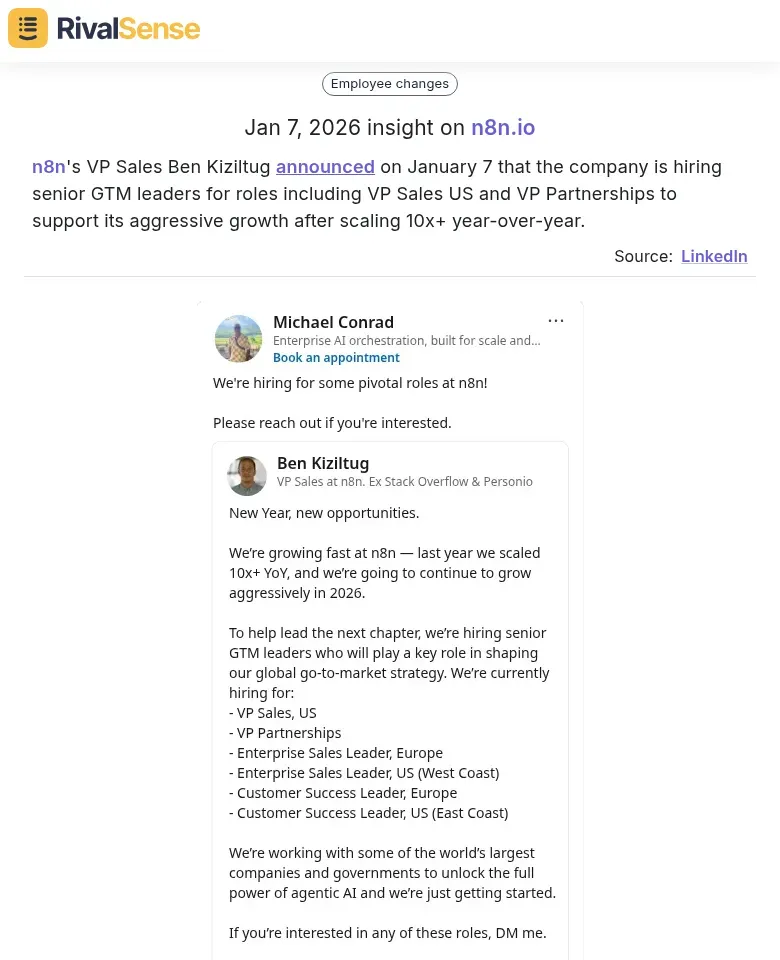
Why it matters: Senior leadership hires like these indicate a company's commitment to expanding into new markets and scaling operations. By monitoring such announcements, you can anticipate competitive threats and adjust your own GTM strategies. -
Engineering Leadership Change: Dr Claire Knight joins n8n as Director of Engineering in the United Kingdom, previously VP of Engineering at Odin.
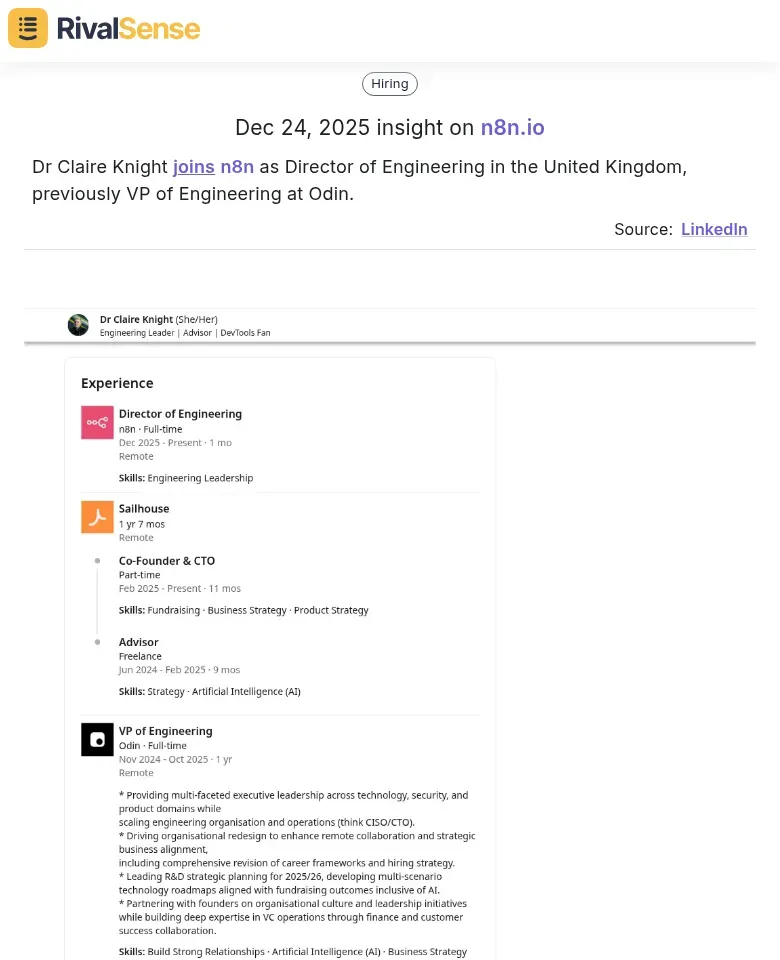
Why it matters: Key engineering appointments often signal shifts in product development priorities or investments in new technologies. Tracking these changes helps you understand competitors' innovation focus and prepare your product roadmap accordingly. -
Partnership Expansion: Recaip Kara has joined n8n as a Partner in Türkiye, previously holding a position at another company.
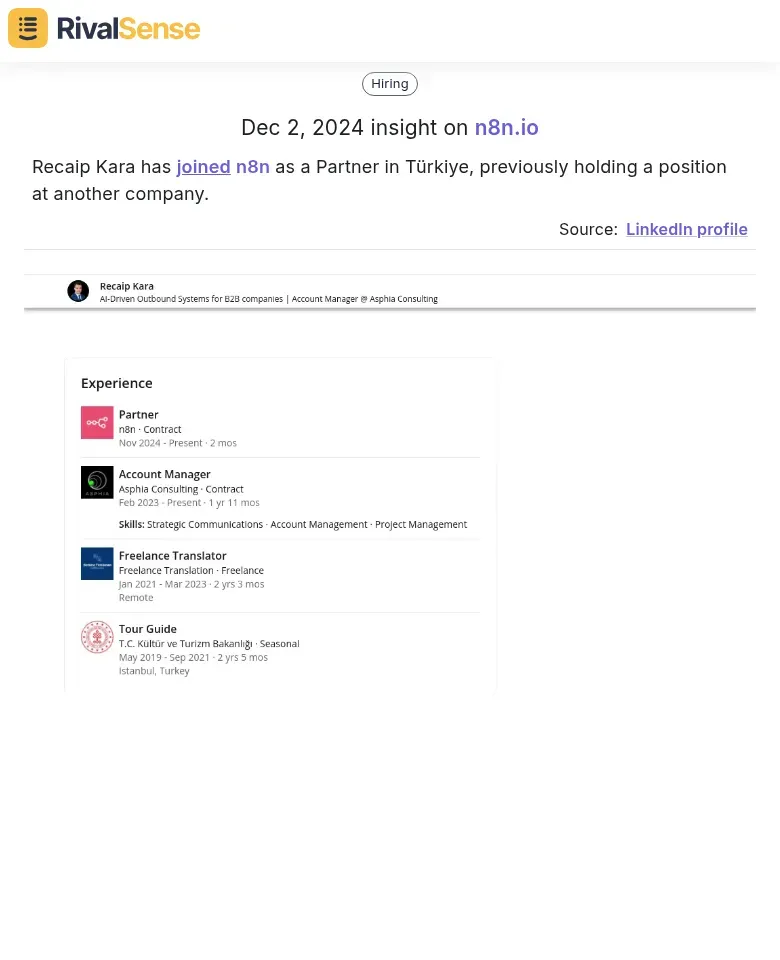
Why it matters: New partnerships in specific regions reveal geographic expansion plans and alliance strategies. This intelligence allows you to identify emerging markets and strengthen your own partnerships or entry plans.
Key Implementation Steps:
- Set up automated tracking for competitor job postings using tools like RivalSense
- Create executive movement dashboards for leadership changes
- Analyze technical skill requirements in engineering hires quarterly
- Cross-reference partnership announcements with geographic hiring data
- Benchmark your talent acquisition strategy against market leaders' patterns
By systematically analyzing these workforce signals, you can anticipate competitor moves 6-12 months before they impact your market position.
Key Account Tracking Framework: Automation-Driven Monitoring Best Practices
Implementing an automation-driven key account tracking framework requires systematic monitoring across three core areas. This approach ensures that you proactively manage account health and mitigate risks. First, automate account health metrics tracking by integrating CRM data with engagement platforms—monitor usage frequency, support ticket volume, and feature adoption rates. Set up weekly automated reports that flag accounts with 20%+ engagement drops.
Second, configure workflow triggers for proactive intervention. Create rules that automatically alert account managers when: (1) key contact job changes occur, (2) usage patterns shift toward competitor-favored features, or (3) contract renewal windows open within 90 days. Use these triggers to schedule automated check-in sequences.
Third, integrate competitive intelligence into scoring algorithms. Weight accounts based on competitor targeting signals—increase scores for accounts where competitors are hiring similar roles or launching complementary products. Implement a 5-point scoring system that combines internal health metrics (40%), engagement patterns (30%), and competitive threat levels (30%).
Practical Checklist:
✅ Map all customer touchpoints to automated tracking
✅ Define 3-5 critical behavior change triggers
✅ Set up competitor signal monitoring (job postings, product launches)
✅ Create tiered intervention workflows
✅ Schedule monthly algorithm calibration reviews
Pro tip: Use historical win/loss data to refine scoring weights quarterly, ensuring your automation adapts to market changes.
CRM Benchmarking Methodology: Measuring Performance Against Market Standards
To establish effective CRM benchmarking, start by automating key account tracking. This process involves comparing your performance against industry leaders to identify gaps and opportunities. Set up alerts for competitor pricing changes and packaging updates using tools like RivalSense. Monitor response times to customer inquiries across your industry—aim for benchmarks like 2-hour response for enterprise accounts. Track engagement frequency: how often competitors interact with key accounts through emails, calls, or demos.
Create a checklist:
- Identify 3-5 key competitors in your niche
- Set up automated tracking for their pricing pages and product updates
- Monitor their social media and content engagement with enterprise clients
- Track industry reports for workflow automation adoption rates (e.g., % of companies using automated onboarding)
Practical tip: Use a scoring system (1-10) to rate competitors on response speed, feature depth, and client retention tactics. Compare your metrics monthly to spot trends. For example, if competitors reduce response times by 20%, adjust your targets. Focus on industry-specific insights: in SaaS, track automated workflow adoption; in manufacturing, monitor IoT integration rates. This data informs account strategy—like matching competitor engagement frequency or highlighting superior automation in pitches.
Implementation Roadmap: Building Your Automated Key Account Intelligence System
Building your automated key account intelligence system requires a structured 5-step implementation roadmap. This roadmap ensures a smooth transition from manual processes to automated insights. Follow these steps to deploy an effective system.
Step 1: Audit & Define Intelligence Gaps
Start by mapping your current manual processes. Identify where competitive intelligence leaks occur—typically in tracking competitor product launches, pricing changes, or organizational shifts affecting key accounts. Create a checklist of critical signals: competitor website updates, leadership changes, funding announcements, and regulatory developments.
Step 2: Select & Integrate Intelligence Sources
Connect your CRM (Salesforce, HubSpot) with external intelligence platforms like RivalSense that monitor 80+ sources. Use API integrations or webhook connections to ensure seamless data flow. Pro tip: Start with your top 5 accounts to validate the integration before scaling.
Step 3: Configure Automated Alert Systems
Set up tiered alert thresholds: immediate notifications for competitor wins with your key accounts, daily digests for product updates, and weekly summaries for market trends. Configure alerts to trigger CRM updates, Slack notifications, and email digests based on severity.
Step 4: Establish Response Protocols
Create playbooks for common scenarios: competitor price drop → initiate value conversation; competitor leadership change → update relationship maps; competitor product launch → schedule competitive briefing. Assign clear ownership for each alert type.
Step 5: Measure & Optimize
Track key metrics: time-to-detection for competitive threats, account retention rates, and cross-sell opportunities identified. Conduct quarterly reviews to refine alert thresholds and intelligence sources based on what drives actual business impact.
Practical Checklist:
✅ Map current intelligence gaps
✅ Connect CRM with 2-3 external sources
✅ Set up tiered alert system
✅ Create response playbooks
✅ Define success metrics
Future-Proofing Your Strategy: Adapting to 2026 Market Dynamics
As we approach 2026, market dynamics demand agile key account management. Future-proofing your strategy involves embedding flexibility and continuous learning into your workflows. Here’s how to achieve this with workflow automation.
-
Scale with Automation: During aggressive growth, automate routine tasks like data entry, follow-up reminders, and report generation. Use CRM workflows to trigger personalized outreach based on account milestones, freeing your team for high-value relationship building.
-
Build Flexible Workflows: Design modular workflows that can be quickly adjusted when competitors launch new products or shift pricing. For example, set up alerts for competitor announcements and create conditional paths in your CRM to respond with tailored messaging or offers.
-
Create Intelligence Feedback Loops: Integrate competitive intelligence tools with your CRM to feed real-time insights into account strategies. Regularly review competitor moves in weekly account meetings, and update workflows to counter threats or capitalize on gaps. Use dashboards to track competitor activity alongside account health metrics.
Practical Checklist:
- Audit current CRM workflows quarterly for adaptability
- Set up automated alerts for key competitor actions
- Train teams to interpret competitive data in account contexts
- Test workflow adjustments in sandbox environments before full deployment
By embedding flexibility and intelligence into your automation, you’ll maintain competitive edge as markets evolve.
Take Action with RivalSense
The insights and strategies discussed highlight the critical role of competitive intelligence in key account management. To implement these practices effectively, consider using a tool like RivalSense. RivalSense tracks competitor product launches, pricing updates, event participations, partnerships, regulatory aspects, management changes, and media mentions across company websites, social media, and various registries, delivering all in a weekly email report.
Try out RivalSense for free at https://rivalsense.co/ to assist with the challenges described in this post. Get your first competitor report today and start transforming your key account tracking with automated intelligence.
📚 Read more
👉 Regulatory Competitor Insights: 5 Common Mistakes Key Account Managers Must Avoid
👉 Mastering Competitor Analysis: Insights from Hiring Trends
👉 The Ultimate Guide to Tracking Key Account History: Practical Strategies for Competitive Advantage
👉 Key Account Management Podcasts: Productivity Tips for Medical Equipment Distribution
👉 Twitter Competitor Insights Cheat Sheet for Key Account Tracking