
VPN Key Account Management: A Process Optimization Guide for Cybersecurity Leaders
In the VPN cybersecurity landscape, key accounts are critical assets that drive long-term success. They represent more than just revenue—they're strategic partnerships that demand specialized protection and attention. Unlike standard enterprise solutions, these high-value relationships require tailored VPN security approaches that address unique threat vectors, compliance requirements, and operational complexities. A breach in these accounts doesn't just mean data loss; it jeopardizes trust, competitive positioning, and business viability.
Practical steps for securing key accounts:
✅ Conduct dedicated threat assessments for each key client
✅ Implement multi-layered authentication beyond standard protocols
✅ Establish client-specific security SLAs with clear response times
✅ Create customized monitoring dashboards for each account
✅ Develop incident response playbooks tailored to client industries
Robust cybersecurity measures directly impact client retention and revenue growth. When key accounts feel protected, they deepen their engagement, expand service usage, and become advocates for your VPN solutions. Optimized VPN management transforms security from a cost center to a revenue driver by enabling upsell opportunities and reducing churn risk. The result? Sustainable growth built on trust and demonstrated value.
Building a Foundation: Essential Components of VPN Key Account Security Architecture
Securing key accounts in the VPN space starts with a solid architectural foundation. It requires three core components to ensure comprehensive protection and scalability. First, implement dedicated IP solutions with customized access controls. Assign exclusive IP addresses to key accounts to prevent shared infrastructure risks, and configure granular access policies based on roles, locations, and time-of-day requirements.
Checklist for deployment:
🔒 Audit current IP allocations
🔒 Deploy dedicated IPs for top-tier clients
🔒 Set up multi-factor authentication with geo-fencing rules
Second, design scalable infrastructure that adapts to evolving needs. Plan for compliance shifts (like GDPR or CCPA updates) and client growth by using modular VPN gateways and cloud-native solutions. Tip: Conduct quarterly capacity reviews and maintain documentation on compliance mappings to streamline audits.
Third, establish baseline security protocols with regular updates. Define minimum system requirements (e.g., encryption standards, patch levels) and enforce them through automated compliance scans. Schedule monthly reviews to update protocols based on threat intelligence, and create a rollback plan for seamless transitions. Practical step: Use a dashboard to track adherence across key accounts, flagging deviations for immediate remediation.
Process Optimization: Streamlining VPN Management for Key Accounts
Streamlining VPN management for key accounts requires a systematic and efficient approach. By optimizing processes, you can enhance reliability, reduce overhead, and improve client satisfaction. Start by developing automated monitoring systems with interactive dashboards that provide real-time visibility into connection status, bandwidth usage, and security metrics.
Practical tip: Create custom dashboards showing uptime percentages, latency trends, and concurrent user counts for each key account. For standardized implementation, establish documented processes for headless/server installations using automation tools like Ansible or Terraform.
Checklist for installations:
- Pre-deployment compatibility testing
- Automated configuration deployment
- Post-installation validation scripts
- Scheduled update procedures
Implement performance optimization tools including built-in speed tests and fastest location features. Practical advice: Schedule automated speed tests during off-peak hours and use the results to create optimized server selection algorithms. Enable clients to easily switch between servers based on real-time performance data, reducing support tickets and improving user experience.
Monitoring competitor product launches can provide strategic insights for your own optimization efforts. For example, RivalSense tracked ExpressVPN's release of version 5.0 for its Linux GUI app, introducing features like a built-in speed test, dedicated IP support, and a redesigned dashboard.
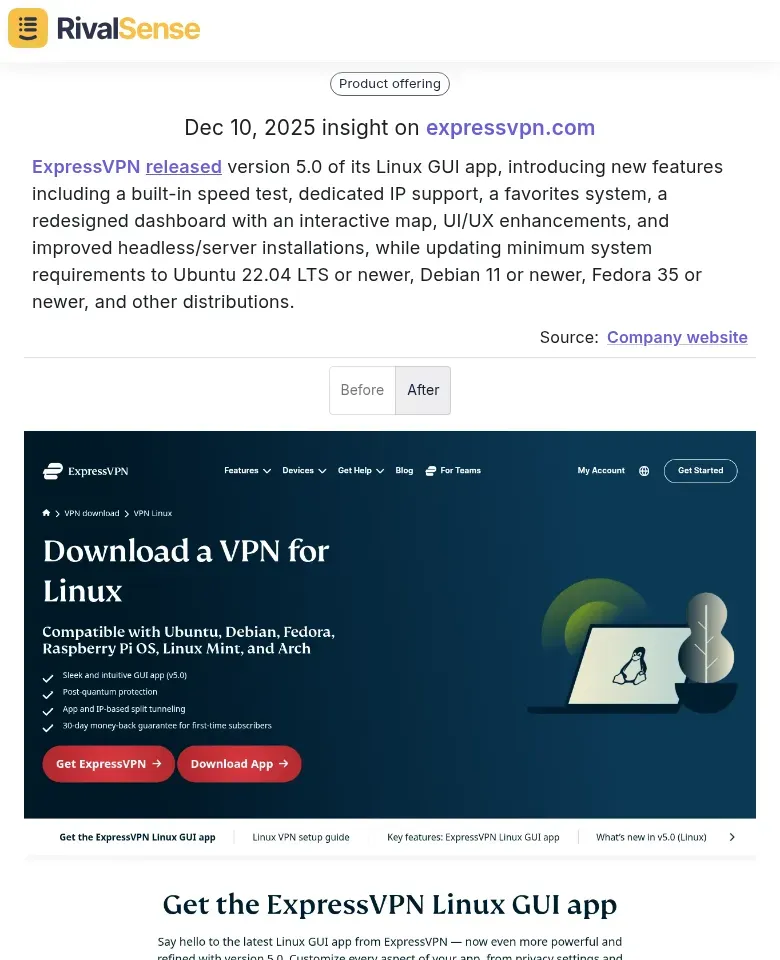
This type of insight into product updates is valuable for business strategy as it reveals competitor innovation directions, helping you benchmark your own features and identify gaps in your offerings.
User Experience and Relationship Management
Focusing on user experience transforms VPN key account management from technical support to strategic partnership. It strengthens client relationships by reducing friction and demonstrating value. Start with intuitive interfaces featuring favorites systems for quick access to frequently used VPN servers and simplified connection workflows. Implement UI/UX enhancements like one-click connections, visual server status indicators, and mobile-responsive dashboards.
Establish clear communication protocols: create dedicated secure channels (encrypted messaging, private portals) for key accounts, provide 24/7 emergency contact procedures, and implement automated status updates. Make secure connections effortless with single sign-on (SSO) integration, biometric authentication options, and pre-configured connection profiles for different user roles.
Tracking competitor feature releases can inspire your own UX improvements. RivalSense captured ExpressVPN's launch of a 'Fastest Location' feature and a native macOS app, aimed at making secure connections effortless.
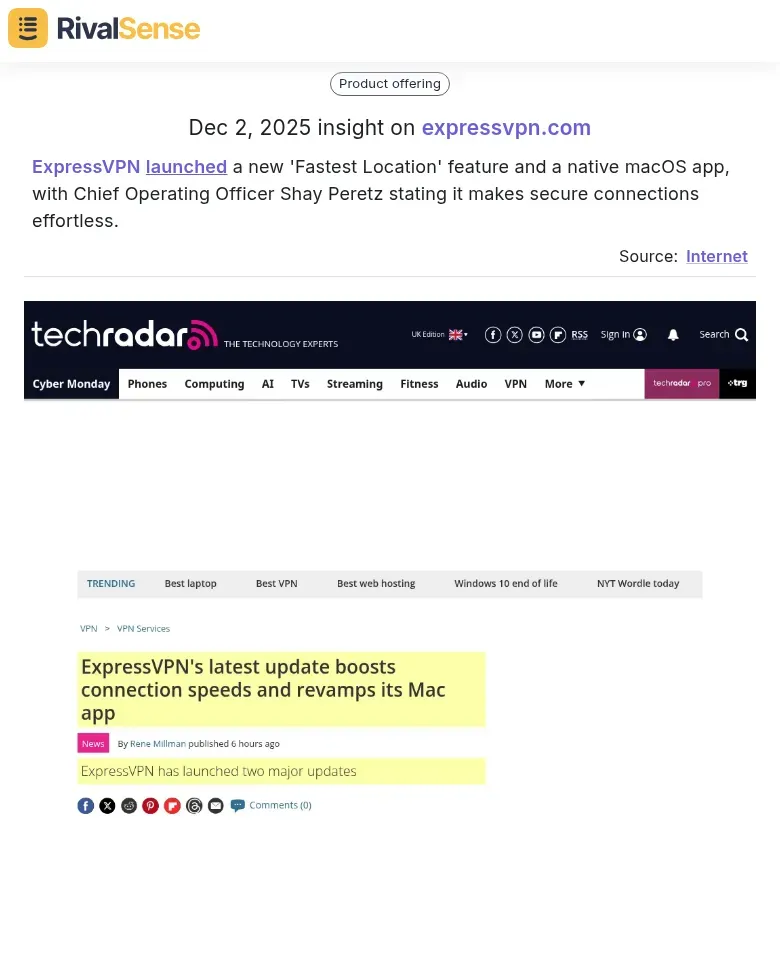
Insights into new features like these are valuable for business strategy as they help you understand market trends, benchmark user experience, and identify opportunities to enhance client satisfaction and retention.
Develop relationship strategies that go beyond troubleshooting: assign dedicated account managers, conduct quarterly strategic reviews, and provide proactive threat intelligence briefings. Partnership checklist:
🤝 Regular security audits
🤝 Customized training sessions for client teams
🤝 Joint incident response planning
🤝 Co-branded success stories
Strategic Marketing and Value Demonstration
Strategic marketing for VPN key accounts requires demonstrating tangible value beyond basic service delivery. Effective marketing shows real-world impact and aligns with client business objectives. Start by identifying complementary cybersecurity partners for co-marketing initiatives—joint webinars with threat intelligence providers or bundled solutions with identity management platforms can significantly enhance your credibility.
For sponsorships, target industry-specific events like cybersecurity conferences where your key accounts' decision-makers are present. Monitoring competitor marketing moves can offer ideas for your own campaigns. RivalSense observed ExpressVPN sponsoring The Ben Shapiro Show podcast with an offer of four months of free service.
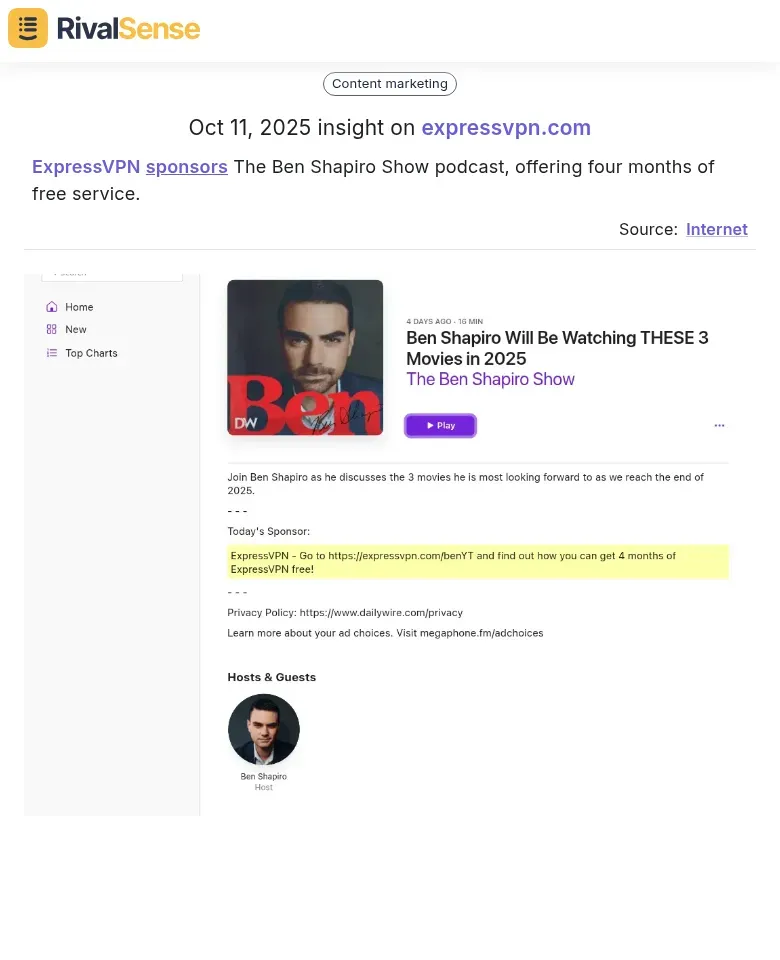
This type of insight into partnerships and sponsorships is valuable for business strategy as it reveals effective marketing tactics, allowing you to craft targeted campaigns and explore similar partnership opportunities to boost brand visibility.
Create value-added offerings that directly address key account pain points: offer extended trial periods for new security features, provide complimentary vulnerability assessments, or include quarterly security posture reviews in premium packages. Develop detailed case studies that quantify results—focus on metrics like reduced incident response time or cost savings.
Practical checklist for value demonstration:
- Map 3-5 strategic partnership opportunities aligned with key accounts' tech stacks
- Design tiered value-add packages (basic/advanced/premium)
- Interview key account contacts quarterly for case study material
- Create ROI calculators showing cost-benefit analysis
- Schedule biannual executive briefings to showcase ongoing value
Continuous Improvement and Competitive Advantage
Continuous improvement is key to staying competitive in the VPN cybersecurity market. Leveraging feedback and intelligence drives long-term success by adapting to client needs and market shifts. Transform key account management into a continuous improvement engine by implementing systematic feedback loops and competitive intelligence processes. Start with quarterly client feedback sessions specifically focused on feature requests and pain points, then prioritize these insights in your product roadmap.
Create a competitive intelligence dashboard using tools like RivalSense to track competitor feature releases, pricing changes, and regulatory adaptations in real-time. Practical steps:
📊 Establish monthly competitive intelligence reviews with product and sales teams
📊 Set up automated alerts for competitor announcements and market shifts
📊 Create a feedback-to-feature pipeline with clear ownership and timelines
📊 Monitor competitor customer reviews and support forums for unmet needs
📊 Conduct quarterly competitive gap analysis against top rivals
Pro tip: Use competitive intelligence to respond swiftly to regulations—early adopters of compliance features often capture significant market share by implementing changes before slower rivals.
Checklist for continuous improvement:
✅ Weekly competitor monitoring across websites, social media, and news
✅ Monthly client feedback synthesis and prioritization
✅ Quarterly competitive positioning analysis
✅ Bi-annual regulatory compliance review
✅ Annual market gap assessment based on competitor weaknesses
By systematically converting key account insights into product enhancements and staying ahead of market developments, you create a defensible competitive moat that drives sustainable growth.
Leverage Competitor Insights with RivalSense
To effectively track competitor moves, product launches, pricing updates, and marketing strategies—like the ExpressVPN examples highlighted—consider using a dedicated tool. RivalSense monitors competitor activities across company websites, social media, registries, and more, delivering weekly email reports with actionable insights. This helps you stay informed, identify opportunities, and make data-driven decisions to optimize your VPN key account management.
Try RivalSense for free today at https://rivalsense.co/ and get your first competitor report to gain a competitive edge in the cybersecurity landscape.
📚 Read more
👉 Competitor Product Insights: A Strategic Guide for Key Account Management
👉 Decoding Competitor Strategy: How Safran's Air Show Move Reveals Innovation Priorities
👉 How to Track Competitor Podcast Appearances: The Complete Strategic Guide
👉 How Systems Software Leaders Win with Competitor Feature Gap Analysis
👉 How Early Regulatory Alerts Enabled VPN Competitors to Capture Market Share