
Video Conferencing Competitive Intelligence: Real-World Key Account Tracking Examples
In the high-stakes world of enterprise video conferencing, competitive intelligence isn't just nice-to-have—it's your frontline defense against revenue leakage in key accounts. By systematically monitoring competitor moves, you can protect your most valuable clients and identify growth opportunities before they arise. When competitors like Zoom, Microsoft Teams, or Cisco Webex release new AI-powered features, enhanced security protocols, or enterprise integrations, your most valuable clients notice immediately. Strategic monitoring of competitor product development cycles allows you to anticipate feature gaps before they become retention risks.
Practical Checklist for Video Conferencing Competitive Intelligence:
- Track competitor beta programs and early access announcements
- Monitor patent filings for upcoming AI/ML video enhancements
- Set alerts for competitor case studies featuring your key accounts' industries
- Analyze competitor pricing changes before renewal seasons
- Watch for new enterprise integrations that could disrupt your value proposition
Real-time intelligence prevents revenue leakage by enabling proactive responses. When a competitor launches noise cancellation AI that your healthcare client needs for HIPAA compliance, you can't afford to learn about it during renewal negotiations. By tracking 80+ sources including product blogs, release notes, and industry publications, you gain the 2-3 month lead time needed to develop competitive responses or accelerate your own roadmap.
Key Account Protection Framework:
- Weekly competitor feature release monitoring
- Monthly competitive gap analysis for top 10 accounts
- Quarterly strategic review of competitor positioning in your clients' verticals
- Automated alerts when competitors mention your accounts' industries
Remember: In B2B video conferencing, customer retention directly correlates with feature parity awareness. The companies that systematically track competitor moves don't just defend accounts—they use competitive intelligence to identify expansion opportunities before their clients even recognize the need.
Decoding Product Development Patterns: What Competitor Release Cycles Reveal
Understanding competitor release cycles provides crucial market timing intelligence. Major video conferencing platforms like Microsoft Teams use staged release channels (Preview → Current → Monthly Enterprise → Semi-Annual Enterprise) that reveal their product development cadence. For instance, features appearing in Teams' Current Channel (Preview) typically reach stable release 1-2 months later, giving you advance notice of upcoming market offerings.
Platform expansion patterns signal market direction. When Google Meet integrates with Android 13 or Microsoft Teams expands to new hardware ecosystems, these moves indicate where enterprise customers are heading. Track these integrations to anticipate which platforms will dominate specific market segments.
Example from RivalSense: Tracking preview releases can give you early insights into competitor priorities. For instance, RivalSense detected that Neat released a preview software on January 16 that allows pairing three Neat Centers with a Neat Bar or Board for larger meeting spaces.
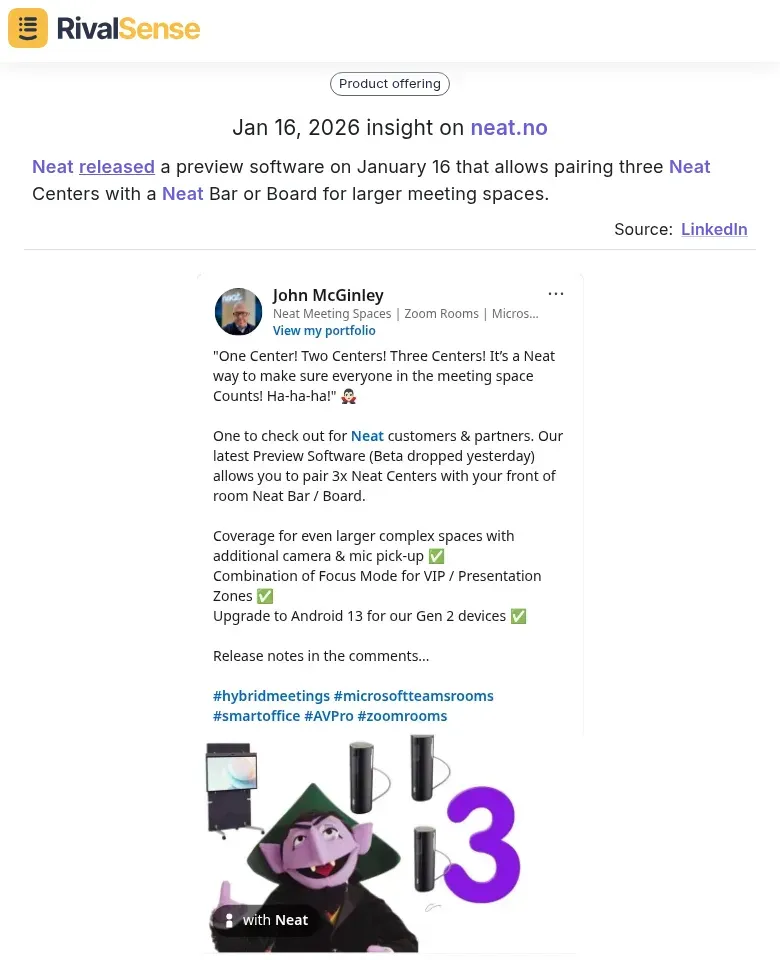
This type of insight is valuable because it shows competitor focus on scalable solutions for enterprise environments, allowing you to anticipate market demands and adjust your product roadmap accordingly.
Hardware-software synergy patterns reveal enterprise priorities. Companies like Zoom partnering with Poly or Cisco integrating Webex with their hardware show a trend toward unified ecosystems. Monitor which competitors are investing in hardware partnerships versus pure software solutions.
Practical tracking checklist:
- Subscribe to competitor beta/preview channels
- Monitor platform integration announcements (OS updates, hardware partnerships)
- Track release frequency patterns (monthly vs quarterly cycles)
- Analyze feature adoption rates across different release channels
- Document hardware compatibility expansions
Key insight: Competitors who accelerate release cycles while maintaining hardware compatibility are likely targeting enterprise market share growth. Use this intelligence to time your own product launches and partnership announcements strategically.
Enterprise Space Strategy: How Competitors Address Large Meeting Environments
In enterprise video conferencing, tracking how competitors handle large meeting environments reveals critical strategic insights. Leading platforms like Zoom, Microsoft Teams, and Cisco Webex employ distinct multi-device integration approaches for boardrooms and auditoriums. Understanding these strategies helps you position your solutions effectively and address client needs proactively.
Example from RivalSense: Monitoring software updates can uncover competitor moves into new market segments. For example, RivalSense captured that Neat released NeatOS 25.4.2 in preview on January 17, 2026, adding Android 13, Google Meet as a native platform, and support for up to three Neat Centers for better coverage in large meeting spaces.
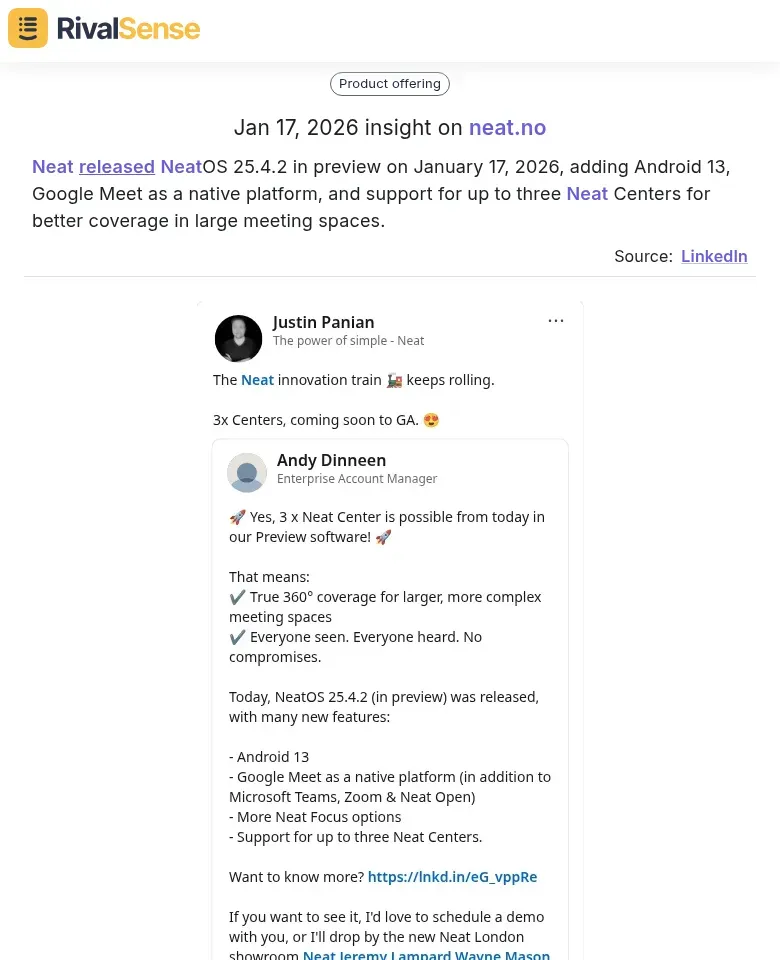
This insight is valuable for business strategy as it highlights competitor expansion into multi-platform compatibility and large-space solutions, enabling you to assess competitive threats and opportunities in enterprise deployments.
Zoom's scalable architecture supports triple-device configurations with dedicated room systems, while Microsoft Teams leverages Surface Hub integration for seamless large-space collaboration.
Practical Tracking Checklist:
- Monitor device compatibility matrices for room systems (Logitech, Poly, Cisco)
- Track API documentation updates for third-party hardware integration
- Analyze support documentation for maximum participant thresholds
- Review case studies on enterprise deployment scalability
Key Learning Points:
- Zoom's approach: Dedicated room systems with centralized management
- Microsoft's strategy: Native integration with Surface Hub ecosystem
- Cisco's solution: Webex Room Series with modular expansion
- Quality solutions: Competitors address coverage gaps through beamforming microphones, 4K camera arrays, and AI-powered audio optimization
Actionable Tip: Create a competitor matrix tracking device support tiers (single, dual, triple configurations) and note how each platform handles bandwidth optimization for 50+ participant meetings. Watch for announcements about new hardware partnerships and enterprise deployment tools that simplify large-scale rollouts.
Communication Strategy Insights: What Competitor Announcements Teach Us
Competitor communication strategies reveal critical insights for enterprise sales. When analyzing video conferencing platforms, observe how top players deploy product specialists during major announcements. This approach builds credibility and addresses technical concerns upfront, which is essential for B2B decision-makers.
Example from RivalSense: Tracking announcement styles can inform your own communication plans. RivalSense identified that Neat released Dual Neat Centers for testing in its Preview Channel on January 9, with a move to the Stable channel planned for later in the month, as announced by Briana Blohm, a Neat Product Specialist.
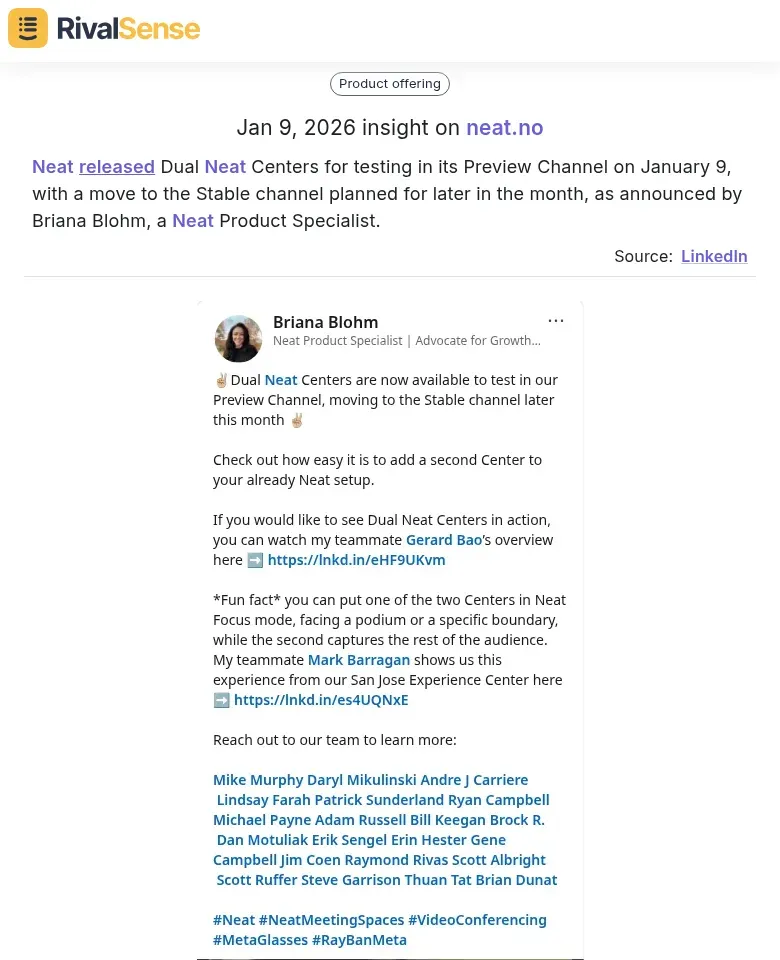
This type of insight is valuable because it shows how competitors use technical experts to validate features during preview phases, signaling confidence and targeting IT administrators early in the sales cycle.
For example, Zoom's technical experts often present alongside executives during feature launches, establishing immediate credibility with enterprise buyers.
Practical Checklist for Analyzing Competitor Communication:
- Track which technical roles participate in announcement webinars
- Document the ratio of technical vs. marketing content in launch materials
- Monitor how competitors transition features from preview to stable channels
- Analyze the technical depth of enterprise case studies
Notice how Microsoft Teams structures their communication: technical previews target IT administrators with detailed documentation, while stable releases focus on business benefits. This dual-channel approach ensures both technical validation and business adoption.
Key Insight: Enterprise buyers prioritize platforms where technical expertise is woven into the sales narrative. When competitors feature product specialists explaining complex integrations or security protocols, they're signaling confidence in their technical foundations. Track how often competitors reference specific technical certifications, compliance standards, or integration capabilities during announcements.
Actionable Tip: Create a matrix comparing competitors' communication strategies across three dimensions: technical depth, audience targeting, and channel sequencing. This reveals patterns in how they build credibility throughout the sales cycle.
Practical Implementation: Building Your Video Conferencing Competitive Intelligence System
Building an effective video conferencing competitive intelligence system requires a structured approach. Start by identifying key sources and setting up automated monitoring to ensure you don't miss critical updates. This proactive stance allows you to respond swiftly to competitor moves and protect your key accounts.
Start by monitoring competitor software release channels like Webex's RoomOS release notes, Zoom's release notes portal, and Microsoft Teams' update channels. Set up automated alerts using tools like Visualping or RivalSense to track changes in these channels. For hardware-software integration announcements, monitor manufacturer blogs (Cisco, Poly, Logitech), industry publications, and patent filings.
Create a competitive response framework with these steps:
- Categorize releases by impact level (critical, major, minor)
- Establish response timelines (24 hours for critical, 72 hours for major, 1 week for minor)
- Develop pre-planned responses for common scenarios
- Create cross-functional response teams (product, marketing, sales)
Practical tip: Use release timing intelligence to schedule your own announcements strategically. For example, if a competitor announces a major feature, consider timing your response announcement 2-3 weeks later when media attention has shifted but customer interest remains high. Maintain a competitive feature matrix that tracks release dates, adoption rates, and customer feedback to inform your product roadmap decisions.
Conclusion: Turning Competitive Intelligence into Key Account Growth
Turning competitive intelligence into tangible key account growth requires systematic integration into your quarterly business reviews (QBRs). By making competitor analysis a regular part of your client engagements, you can proactively address concerns and highlight your unique value propositions.
Start by dedicating a specific QBR section to competitor analysis, where you present 2-3 key competitor developments that directly impact each account. Use a simple framework: 1) Document competitor moves (feature launches, pricing changes, partnerships), 2) Assess vulnerability for each key account, 3) Create 30/60/90-day response plans.
To anticipate customer needs before they arise, implement a weekly monitoring checklist: track competitor product updates, pricing changes, event participations, and partnership announcements. When you spot a competitor launching a new feature targeting your account's industry, proactively schedule a value demonstration of your equivalent or superior capability before the customer even asks.
Build proactive account strategies by analyzing competitor development patterns. Create a simple matrix mapping competitor initiatives against your key accounts' pain points. For example, if competitors consistently launch integrations with specific platforms your accounts use, prioritize developing those integrations first. Establish monthly competitive intelligence briefings with your account teams to translate insights into specific upsell and retention opportunities.
Practical checklist:
- Add competitor analysis to QBR agendas
- Set up automated alerts for 3-5 key competitors
- Create account-specific vulnerability assessments
- Develop "if-then" response scenarios for common competitor moves
- Measure competitive win rates quarterly
This transforms intelligence from passive information to active growth strategy.
Ready to take action? Implementing a competitive intelligence system can be daunting, but tools like RivalSense simplify the process. RivalSense tracks competitor product launches, pricing updates, event participations, partnerships, regulatory aspects, management changes, and media mentions across company websites, social media, and various registries, delivering all in a weekly email report. Try RivalSense for free at https://rivalsense.co/ to get your first competitor report today and start protecting your key accounts with real-time insights.
📚 Read more
👉 Step-by-Step Guide to Competitor Matrices for Event Participation Insights
👉 Turning Executive Moves into Competitive Intelligence
👉 How to Track Competitor Email Campaigns: From Manual Methods to Automated Intelligence
👉 5 Actionable Hacks to Master Key Account Feedback in Cybersecurity
👉 From Monitoring to Action: How Real-Time Competitor Intelligence Drives Strategic Wins