
Twitter Intelligence: Extract Competitor Insights for Key Account Success
In the fast-paced world of B2B competition, timing is everything. While traditional market research methods can take weeks to surface competitor insights, Twitter delivers real-time intelligence 10-15x faster—making it your secret weapon for key account success. Key account decisions are heavily influenced by competitor announcements that surface first on Twitter, from product launches and pricing changes to executive hires and strategic partnerships. By monitoring these signals in real-time, you can anticipate competitor moves before they impact your key accounts.
Automated monitoring transforms reactive tracking into proactive strategic advantage for account planning. Instead of scrambling to respond to competitor news, you can integrate Twitter intelligence into your account strategy sessions. Practical steps include:
- Set up Twitter Lists for each key competitor
- Use advanced search operators to track specific keywords and hashtags
- Monitor competitor executives and key personnel for leadership changes
- Track customer conversations mentioning competitors to identify pain points
- Use social listening tools to automate alerts for critical announcements
This approach ensures you're not just collecting data but translating Twitter signals into actionable account strategies—helping you protect existing business while identifying new opportunities before your competitors do.
Three Core Types of Twitter Competitor Insights for Account Tracking
Twitter provides three essential competitor intelligence streams for key account tracking. Understanding these streams allows you to focus your monitoring efforts effectively and extract meaningful insights.
1. Event & Partnership Monitoring
Tracking competitor events and partnerships on Twitter reveals their market focus and investment priorities. These announcements often precede formal press releases, giving you an early advantage. Practical steps:
- Create Twitter Lists for competitor executives and marketing teams
- Monitor hashtags for industry events and set calendar alerts for major conferences
- Use tools like RivalSense to automate tracking of booth locations and sponsorship patterns—prime exhibition spots often indicate higher strategic investment
2. Executive Thought Leadership Analysis
Analyzing C-suite and leadership content provides early signals of strategic direction and market expansions. Executive tweets can hint at upcoming initiatives before they are widely announced. Practical tip:
- Monitor executive accounts for mentions of new markets, technologies, or partnerships
- Track engagement patterns on leadership posts—high interaction often precedes formal announcements
- Create a spreadsheet documenting recurring themes and strategic language shifts over time
3. Creative Campaign Tracking
Monitoring campaign launches helps you understand competitor customer engagement strategies and messaging differentiation. By analyzing their content, you can identify gaps in their approach. Practical checklist:
- Document content cadence patterns and note engagement metrics (likes, retweets, replies)
- Identify content gaps where competitors aren't addressing key customer concerns
- Track response patterns to customer inquiries for service positioning insights
For systematic implementation, set up daily check-ins for competitor activity review and weekly analysis sessions to identify patterns. Use Twitter's advanced search with competitor-specific keywords and enable notifications for critical accounts. Focus on actionable insights—when you spot competitor weaknesses through Twitter patterns, strengthen your own positioning accordingly.
Practical Framework: Setting Up Your Twitter Monitoring System
Building an effective Twitter monitoring system requires a structured approach. This framework will help you organize your efforts and ensure consistent intelligence gathering for key account success.
Step 1: Create Specialized Twitter Lists
- Competitors List: Include direct competitors, indirect alternatives, and adjacent market players
- Industry Influencers List: Add analysts, journalists, and thought leaders in your space
- Target Account Decision-Makers List: Follow key executives, procurement teams, and department heads from your priority accounts
Step 2: Set Up Automated Alerts with Boolean Operators
Use tools like TweetDeck or Mention with these search patterns:
- Product launches: "(competitor) AND (launch OR announce) AND (product OR feature)"
- Partnerships: "(competitor) AND (partner OR integrate) AND (company OR platform)"
- Executive insights: "from:(competitorCEO) AND (strategy OR roadmap OR vision)"
- Customer signals: "(competitor) AND (switched OR left OR disappointed)"
Step 3: Implement Sentiment Analysis
Categorize reactions to competitor announcements as:
- Positive: Market validation opportunities
- Negative: Competitor weaknesses to exploit
- Neutral: Baseline market positioning
Weekly Checklist:
✅ Review all three Twitter Lists for new accounts to add
✅ Check automated alerts and refine Boolean queries
✅ Analyze sentiment trends from competitor mentions
✅ Document insights in shared competitive intelligence dashboard
✅ Update battle cards with validated intelligence
Pro tip: Combine Twitter monitoring with CRM integration to trigger timely outreach when competitors announce relevant news to your key accounts.
Turning Twitter Insights into Actionable Account Strategies
Transforming Twitter insights into strategic advantage requires a methodical process. By analyzing competitor announcements and audience responses, you can identify opportunities to differentiate your offerings.
First, analyze competitor announcements to identify underserved segments. When competitors celebrate enterprise wins but ignore SMB pain points, you've found a gap. Create a checklist to track announcement frequency, engagement patterns, and audience responses.
Develop targeted messaging that positions your company as the specialist for these gaps. If competitors focus on large enterprises, craft messaging emphasizing SMB-friendly pricing and support. Practical tip: Use Twitter analytics to validate messaging resonance before full campaigns.
Create competitive battle cards with validated intelligence. Include: competitor feature gaps, pricing vulnerabilities, and engagement metrics showing audience dissatisfaction. Actionable 3-step validation process:
- Monitor competitor Twitter engagement for 30 days
- Test messaging in targeted Twitter polls
- Refine positioning based on response patterns
Integrate insights across teams by creating shared dashboards in tools like RivalSense or Google Sheets. Build dashboards with key metrics: follower growth, engagement rates, top-performing content, and sentiment analysis.
Quarterly Review Checklist:
- Audit dashboard data weekly
- Assign team leads for monitoring different competitor segments
- Document response protocols for major competitor announcements
- Update competitive playbooks based on new insights
Integrating Twitter Intelligence Across Marketing, Sales, and Product Teams
Maximizing Twitter intelligence across your organization ensures that insights lead to coordinated actions. Implementing shared systems and protocols can streamline this process.
1. Create Shared Competitor Dashboards
Use tools like RivalSense to build centralized dashboards that automatically track competitor Twitter activity. Include metrics like engagement rates, announcement frequency, and sentiment analysis. Set up Slack/Teams alerts for major competitor tweets so marketing, sales, and product teams receive real-time notifications. Tip: Color-code competitors for quick visual scanning.
2. Develop Response Protocols
Create templated counter-messaging for common competitor announcements (product launches, pricing changes, feature releases). Establish clear escalation paths: marketing handles brand messaging, sales addresses customer concerns, and product analyzes technical claims.
Checklist for Response Protocols:
- Define response timelines and approval workflows
- Develop channel-specific messaging templates
- Assign roles and responsibilities for each type of announcement
3. Quarterly Competitive Playbook Updates
Schedule quarterly reviews where teams analyze Twitter insights together. Identify emerging competitor strategies, customer pain points mentioned in replies, and market sentiment shifts. Update battle cards, objection handling guides, and product positioning based on fresh Twitter data.
Practical step: Create a shared document template for capturing insights and action items. Pro tip: Assign "Twitter intelligence champions" in each department to ensure consistent monitoring and knowledge sharing across teams.
Beyond Twitter: Building a Comprehensive Competitor Tracking System
While Twitter provides valuable real-time insights, true competitive advantage requires a multi-source intelligence system. Integrating data from various platforms gives you a holistic view of competitor activities and market dynamics.
Implement a three-tier tracking framework:
- Account-Level Monitoring: Track competitor interactions with your key accounts using social listening tools and CRM integration
- Sentiment Analysis: Analyze customer sentiment across platforms to identify competitor weaknesses and opportunities
- Influencer Mapping: Identify industry influencers engaging with competitors to build your own advocacy network
To measure ROI, establish clear correlation metrics:
- Track competitive intelligence alerts that preceded key account wins
- Calculate time saved in research versus manual monitoring
- Quantify revenue impact from intelligence-driven strategy adjustments
Actionable Checklist for Comprehensive Tracking:
- Set up automated alerts for competitor mentions across all platforms
- Create a centralized intelligence dashboard with weekly review cadence
- Document intelligence-to-action workflows for your sales team
- Conduct quarterly ROI analysis comparing intelligence investments to account wins
Leveraging Broad Competitor Insights: Examples from RivalSense
Twitter is just one piece of the puzzle; comprehensive competitor tracking involves monitoring multiple sources. Tools like RivalSense aggregate insights from company websites, social media, registries, and more, delivering weekly reports. Here are real-world examples of how such insights can inform business strategy:
-
Brand Strategy Insight: adidas is aligning its kit colors with reggae colors to capitalize on Jamaica's international reggae music success. This type of insight reveals how competitors are leveraging cultural trends for brand positioning, helping you anticipate marketing moves and adjust your own branding strategies.
-
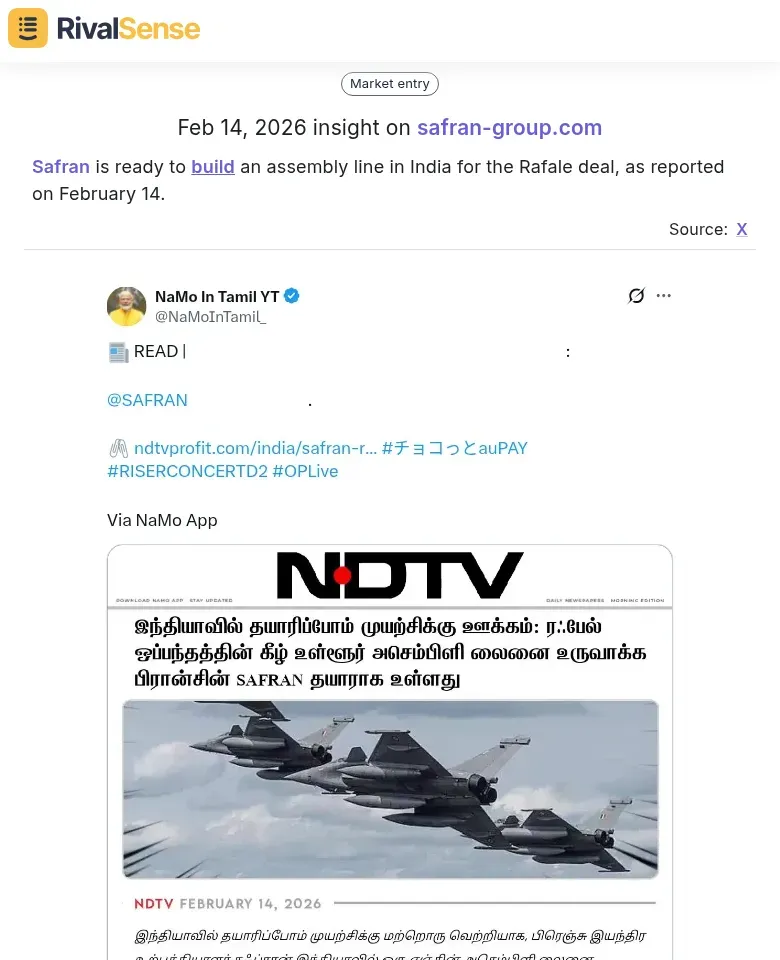
Expansion and Partnership Insight: Safran is ready to build an assembly line in India for the Rafale deal, as reported on February 14. Tracking such expansions alerts you to new market entries and partnerships, enabling you to assess competitive threats and opportunities in emerging regions.
-
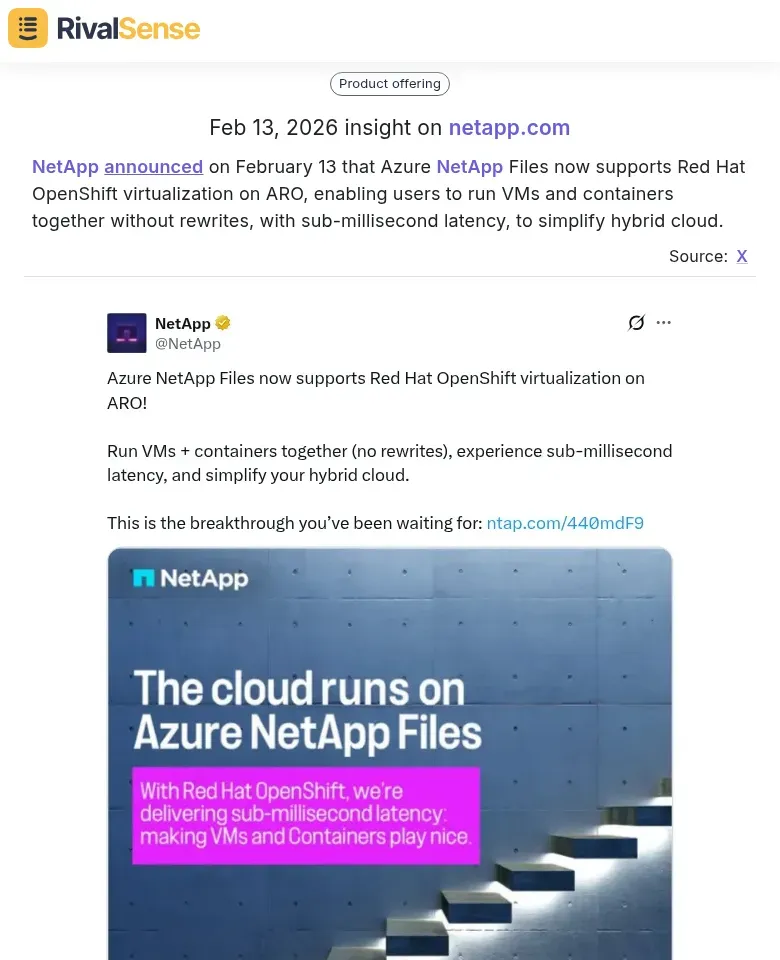
Product and Technology Insight: NetApp announced on February 13 that Azure NetApp Files now supports Red Hat OpenShift virtualization on ARO, enabling users to run VMs and containers together without rewrites, with sub-millisecond latency, to simplify hybrid cloud. Product launch insights like this help you understand competitor innovation cycles and technology integrations, allowing you to benchmark your own offerings and identify gaps.
By integrating such multi-source insights with your Twitter monitoring, you can build a holistic view of competitor activities and make data-driven strategic decisions.
Take Your Competitor Intelligence to the Next Level
To effectively track competitors across Twitter and beyond, consider using a dedicated tool like RivalSense. It automates the monitoring of product launches, pricing updates, event participations, partnerships, regulatory changes, management moves, and media mentions from various sources. All insights are delivered in a concise weekly email report, saving you time and ensuring you never miss a critical update.
Ready to enhance your key account strategy? Try RivalSense for free today and get your first competitor report to start gaining a competitive edge.
📚 Read more
👉 Actionable Competitive Intelligence for Gaming: Track Competitor Keywords to Stay Ahead
👉 Step-by-Step Guide: Uncover Competitor Event Strategies for Enterprise Key Accounts
👉 Analyzing Competitor Advertising Launches: Lessons from Uber Advertising's New Format
👉 Key Account Tracking Best Practices: The 2026 Strategic Guide for Business Leaders
👉 Mastering Key Account Management: A Practical Implementation Guide for B2B Leaders