
The Ultimate Key Account Tracking Spreadsheet Template: A Practical Guide for B2B Leaders
As a founder or business leader, managing key accounts is critical for revenue stability and growth. Spreadsheets have long been the trusted tool for tracking these valuable client relationships due to their accessibility and customizability. However, as your business scales and the number of key accounts increases, relying solely on manual spreadsheets can lead to inefficiencies and missed opportunities.
The Reality Check: Most B2B companies start with spreadsheets but quickly hit limitations when managing 10+ key accounts across multiple data sources. According to industry research, account managers typically monitor data from 8-12 different systems including CRM, financial platforms, communication tools, and performance metrics.
Your Free Key Account Tracking Spreadsheet Template
Based on best practices from successful B2B companies, here’s a comprehensive spreadsheet template structure you can implement today. This template is designed to be practical and scalable, ensuring you capture all critical aspects of key account management.
Core Template Structure Checklist: 📋
1. Account Overview Tab
- Company name, industry, location
- Key stakeholders and decision-makers
- Contract value and renewal date
- Account tier/priority level
- Account manager assignment
2. Performance Metrics Tab 📈
- Revenue tracking (monthly/quarterly)
- Usage/adoption metrics
- Client satisfaction scores (NPS/CSAT)
- Service level agreement compliance
- Growth opportunities identified
3. Relationship Management Tab 🤝
- Meeting cadence and last contact date
- Communication frequency tracking
- Stakeholder engagement scores
- Relationship health indicators
- Next planned interactions
4. Risk Assessment Tab ⚠️
- Churn risk score (1-10)
- Warning signs and red flags
- Competitor activity within account
- Contract renewal probability
- Mitigation action plan
5. Growth Opportunities Tab 🚀
- Upsell/cross-sell potential
- Referral opportunities
- Expansion areas identified
- Pipeline value and probability
- Timeline for execution
Practical Implementation Steps:
Step 1: Customize Your Template
- Download our free Excel/Google Sheets template
- Add your company’s specific KPIs
- Configure formulas for automated calculations
- Set up conditional formatting for visual alerts
Step 2: Data Collection Protocol
- Assign data entry responsibilities
- Establish update frequency (weekly/bi-weekly)
- Create data validation rules
- Set up backup procedures
Step 3: Review Cadence
- Weekly: Account manager updates
- Monthly: Team review meetings
- Quarterly: Executive strategy sessions
- Annually: Comprehensive account planning
The Limitations of Spreadsheet-Only Tracking
While spreadsheets provide a solid foundation, they have critical limitations that become apparent as you scale. Understanding these drawbacks is essential for evolving your key account management strategy.
1. Manual Data Entry Burden ⏳
- Time-consuming updates across multiple systems
- High risk of human error
- Delayed insights due to infrequent updates
2. Lack of Real-Time Insights 🔄
- Static data that quickly becomes outdated
- No proactive alerts for critical changes
- Delayed response to account issues
3. Missing Competitive Context 🏆
- No visibility into competitor activities
- Limited market intelligence
- Reactive rather than proactive positioning
Beyond Spreadsheets: The Modern Approach
Successful B2B companies have evolved beyond spreadsheets to automated dashboards that provide real-time insights and competitive context. This modern approach combines internal data with external intelligence for a holistic view.
Automated Data Integration
- Real-time updates from multiple sources
- Automated calculations and reporting
- Proactive alerts for critical changes
Competitive Intelligence Integration
This is where tools like RivalSense add crucial value to your key account strategy. While internal metrics are important, understanding your competitive landscape is essential for key account success.
Why Competitive Intelligence Matters for Key Accounts:
When you’re managing strategic client relationships, knowing what your competitors are doing can make or break your account strategy. RivalSense tracks competitor activities across 80+ sources including:
- Product launches and updates
- Pricing changes
- Event participation
- Partnership announcements
- Regulatory developments
- Management changes
- Media mentions
Real-World RivalSense Insights for Key Account Strategy 🔍
Here are actual examples from RivalSense reports, showing how different types of insights can inform your strategy:
-
Product Launch Insight: Buffer's Threads Trending Topics

Buffer launched Threads Trending Topics in its composer to help users identify popular topics for posting, as demonstrated by Michael Eckstein, a content creation genius at the company, who gained 45K views by using a quantum physics trend. Why this matters: Knowing about competitor feature launches allows you to proactively address client inquiries and highlight your own unique value propositions. For key accounts in social media or content marketing, this insight helps you stay relevant and responsive. -
Management Change Insight: Labrys's Promotions
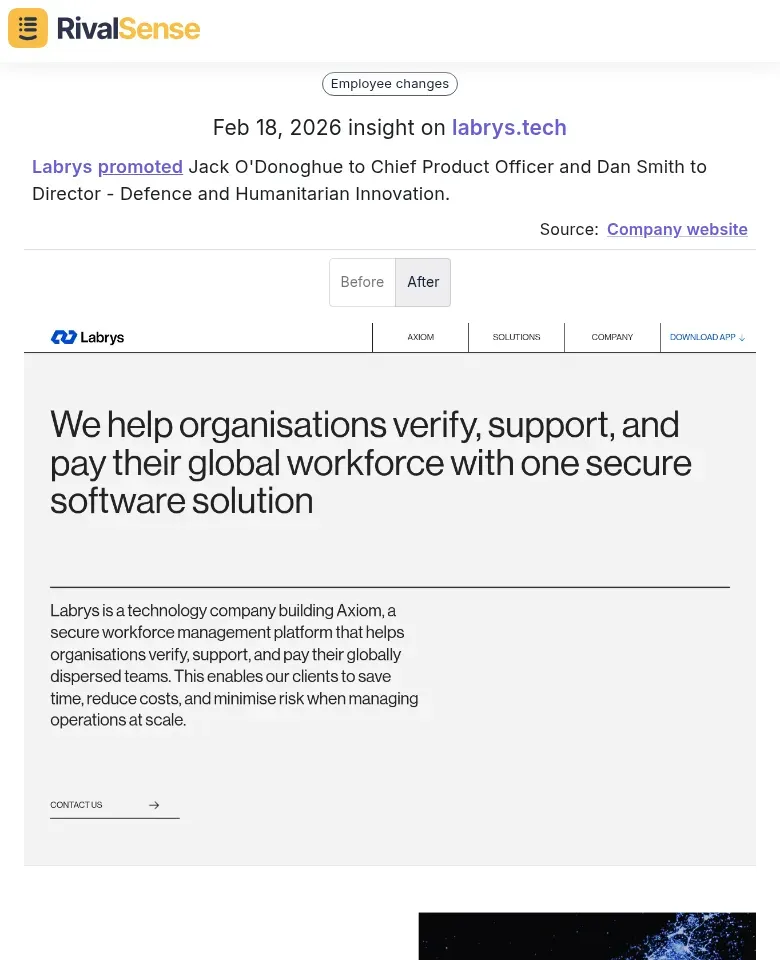
Labrys promoted Jack O'Donoghue to Chief Product Officer and Dan Smith to Director - Defence and Humanitarian Innovation. Why this matters: Management changes can indicate strategic shifts or new focus areas. For key accounts in defense or humanitarian sectors, this insight helps you tailor conversations and anticipate changes in competitor offerings or partnerships. -
New Tool Launch Insight: Later 360

Later launched Later 360 on February 18, 2026, a tool that helps enterprise brands see creator performance across content, spend, and outcomes in one place. Why this matters: Competitor tool launches reveal market trends and gaps. For key accounts seeking integrated solutions, this insight enables you to position your services as complementary or superior, based on actual competitor moves.
Practical Tips for Effective Key Account Tracking
Implementing a robust tracking system requires a balanced approach. Here are actionable tips to ensure success from the start.
1. Start Simple, Then Scale 📊
- Begin with our free spreadsheet template
- Focus on 3-5 critical accounts first
- Document what works and what doesn’t
- Gradually expand to more sophisticated tools
2. Combine Internal and External Data 🔗
- Track internal performance metrics
- Monitor competitor activities (using tools like RivalSense)
- Analyze market trends
- Correlate data for deeper insights
3. Establish Clear Processes 📝
- Define update frequencies
- Assign clear responsibilities
- Create escalation protocols
- Document best practices
4. Leverage Automation Wisely ⚙️
- Automate repetitive data collection
- Set up alerts for critical changes
- Use templates for consistent reporting
- Integrate competitive intelligence
The Evolution Path: From Spreadsheets to Strategic Management
Your key account tracking should evolve with your business. Here’s a phased approach to growth.
Phase 1: Foundation (Spreadsheets) 🏗️
- Use our free template
- Establish basic tracking
- Build consistent processes
- Train your team
Phase 2: Enhancement (Basic Automation) 🚀
- Integrate data from key systems
- Set up automated calculations
- Create simple dashboards
- Add competitive monitoring
Phase 3: Optimization (Advanced Tools) 🎯
- Implement comprehensive dashboards
- Automate competitor tracking with RivalSense
- Enable real-time alerts
- Support strategic decision-making
Key Takeaways for Business Leaders
- Spreadsheets are a great starting point but become limiting as you scale
- Automation saves time and reduces errors in account management
- Competitive intelligence is non-negotiable for key account success
- The right tools combine internal metrics with external market data
- Proactive monitoring beats reactive firefighting every time
Next Steps for Your Key Account Strategy
- Download our free spreadsheet template to get started immediately
- Implement the tracking structure with your top 3 accounts
- Schedule a monthly review to assess what’s working
- Consider adding competitive intelligence with tools like RivalSense
- Plan your evolution from spreadsheets to automated dashboards
Pro Tip: The most successful key account strategies combine solid internal tracking with comprehensive market intelligence. While spreadsheets give you control over your data, competitive intelligence tools like RivalSense give you context about the market landscape, helping you anticipate client needs and stay ahead of competitors.
Remember: Your key accounts are your most valuable assets. Tracking them effectively requires both internal discipline and external awareness. Start with our free spreadsheet template, build consistent processes, and gradually enhance your approach with automation and competitive intelligence to drive sustainable growth.
Ready to take your key account tracking to the next level? Start with our free spreadsheet template, and try RivalSense for free to get your first competitor report today. Visit https://rivalsense.co/ to see how automated competitive intelligence can protect your key accounts and drive growth.
📚 Read more
👉 Predictive Analytics for Engineering Consulting Key Account Management: Free Trial Guide
👉 How Glean's AI Assistant Evolution Revealed Competitor Growth Opportunities
👉 Optimizing Competitor Website Monitoring for Influencer Partnership Insights
👉 Nanotech SEO Hacks: Quick Competitor Strategy Wins
👉 Optimize Pricing with Competitor Insights to Boost Key Account Metrics