
The Ultimate Key Account Management Playbook for 2026: A Strategic Guide for Business Leaders
As Alex Raymond and Mark Davies discussed in Episode 68 of Account Management Secrets, "Most key account programs collapse because companies treat a strategic discipline like a standard sales motion." This fundamental misunderstanding costs businesses millions in lost revenue and missed opportunities.
In today's competitive landscape, where resources are tighter and customer attention is harder to earn, having a systematic playbook for key account management isn't just nice-to-have—it's essential for survival and growth. This comprehensive guide provides the practical framework, checklists, and strategic insights you need to transform your key account management from a reactive function into a proactive growth engine.
The Foundation: Understanding What Makes an Account "Key"
Step 1: Strategic Account Segmentation Checklist
Before you can manage key accounts effectively, you need to identify which accounts truly deserve "key" status. Use this practical framework:
Quantitative Criteria:
- Revenue contribution (top 20% of accounts)
- Profit margin (accounts with highest profitability)
- Growth potential (accounts with untapped expansion opportunities)
- Strategic importance (accounts in target industries or geographies)
Qualitative Criteria:
- Strategic alignment (accounts that fit your ideal customer profile)
- Relationship depth (executive-level connections and trust)
- Reference potential (accounts willing to advocate for you)
- Innovation partnership (accounts open to co-development)
Pro Tip: As Joel Sylvester emphasized in Episode 71, "Sustainable growth comes from clarity about what works and the willingness to protect it." Don't try to make every account a key account—focus on the 20% that drive 80% of your strategic value.
The 7-Step Key Account Management Framework
Step 2: Build Your Strategic Account Plan Blueprint
Every key account needs a customized strategic plan. Here's your template:
Account Profile Section:
- Company overview and strategic objectives
- Key stakeholders and decision-makers (with influence mapping)
- Current relationship status and history
- Competitive landscape within the account
Strategic Objectives:
- Short-term goals (next 90 days)
- Medium-term objectives (next 12 months)
- Long-term vision (3-5 year partnership)
Action Plan:
- Quarterly business review (QBR) schedule and agenda
- Executive engagement plan
- Value delivery roadmap
- Risk mitigation strategies
Step 3: Establish Your Review Cadence
As Joel Sylvester highlighted, "Value stays visible through a steady cadence of weekly, monthly, quarterly, and annual reviews." Here's your practical schedule:
Weekly (Account Manager Level):
- Check-in on action items and deliverables
- Monitor account health indicators
- Update stakeholder engagement log
Monthly (Cross-functional Team):
- Review progress against strategic objectives
- Identify emerging opportunities or risks
- Coordinate internal resources
Quarterly (Executive Level - The "Flip the QBR" Approach):
As Alex Raymond emphasized in Episode 70, "Strong QBRs create forward momentum, invite real dialogue, and position the account manager as a leader in the room."
- Strategic business review with customer executives
- Value demonstration and ROI analysis
- Joint planning for next quarter
Annually (Strategic Partnership Review):
- Long-term partnership assessment
- Contract renewal and expansion planning
- Strategic roadmap alignment
Step 4: Implement Your Value Delivery System
Mark Davies pointed out the critical issue of "value leakage"—where customers don't realize the full value of your solution. To prevent this:
Value Tracking Framework:
- Baseline measurement (establish starting metrics)
- Regular value reporting (quantitative and qualitative)
- Success story documentation
- ROI calculation and presentation
Pro Tip: Use a balanced scorecard approach that includes:
- Business outcomes (revenue growth, cost savings)
- Operational improvements (efficiency gains)
- Strategic benefits (competitive advantage)
- Relationship metrics (satisfaction, advocacy)
Step 5: Develop Your Risk Management Protocol
As Liz Jones discussed in Episode 69 regarding nonprofit account management, "Renewal health, risk awareness, and the discipline required to surface hard truths early" are essential. Your risk management checklist:
Early Warning Signs:
- Declining engagement metrics
- Changes in key stakeholders
- Budget constraints or shifts
- Competitive threats
- Organizational changes at the account
Risk Mitigation Actions:
- Proactive communication plan
- Executive sponsorship activation
- Value reinforcement strategy
- Contingency planning
Step 6: Create Your Expansion Playbook
Growth within key accounts should be systematic, not opportunistic. Your expansion framework:
Expansion Triggers:
- Successful value delivery
- Organizational changes at the account
- New business initiatives
- Competitive threats
- Technology upgrades
Expansion Pathways:
- Additional products or services
- New departments or divisions
- Geographic expansion
- Deeper integration
- Strategic partnership development
Step 7: Build Your Internal Alignment System
As Ellie Wu discussed in Episode 72, "Teams have tools, data, and ideas, but leadership struggles to choose a direction and commit to it." To overcome this:
Internal Communication Cadence:
- Weekly account team syncs
- Monthly executive briefings
- Quarterly strategic reviews
- Annual planning sessions
Cross-functional Collaboration Tools:
- Shared account dashboards
- Centralized documentation
- Regular stakeholder updates
- Success metric tracking
The Competitive Intelligence Advantage
Integrating Market Intelligence into Your KAM Strategy
In today's dynamic business environment, understanding your competitors is just as important as understanding your customers. As highlighted in recent competitive intelligence research, "Modern key account management requires understanding not just your customers but also your competitors." This insight helps you anticipate market shifts and protect your key accounts from competitive threats.
Competitive Monitoring Checklist:
-
Product Intelligence:
- Track competitor product launches and updates
- Example: LinkedIn announced new AI-powered people search experience, events scaling updates, and a 100 million verified members milestone. Monitoring such innovations helps you benchmark your offerings and identify gaps.

- Example: LinkedIn announced new AI-powered people search experience, events scaling updates, and a 100 million verified members milestone. Monitoring such innovations helps you benchmark your offerings and identify gaps.
- Monitor feature comparisons and differentiators
- Analyze pricing changes and packaging
- Track competitor product launches and updates
-
Market Intelligence:
- Follow competitor event participations
- Monitor partnership announcements
- Track regulatory changes affecting competitors
- Example: McDonald's plans to expand stores and drive-thrus, emphasize card payments, upgrade menus, and deploy AI assistance in 2026. This strategic move highlights market expansion and customer experience trends, valuable for anticipating competitive pressures.
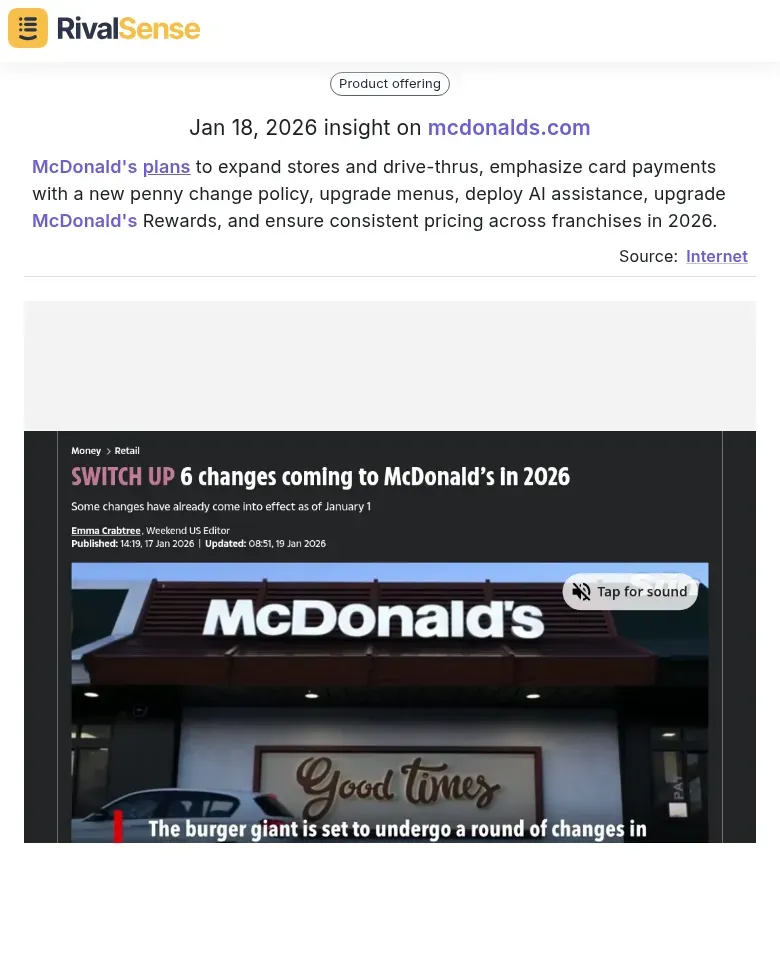
- Example: McDonald's plans to expand stores and drive-thrus, emphasize card payments, upgrade menus, and deploy AI assistance in 2026. This strategic move highlights market expansion and customer experience trends, valuable for anticipating competitive pressures.
-
Organizational Intelligence:
- Watch for management changes
- Example: Viktorija Jokantaitė-Kutkė left Kilo Health as CEO of WM Accelerator in Lithuania to become CEO at Iteractive. Such executive movements can signal strategic shifts or new leadership directions at competitors, helping you adjust your engagement strategies.
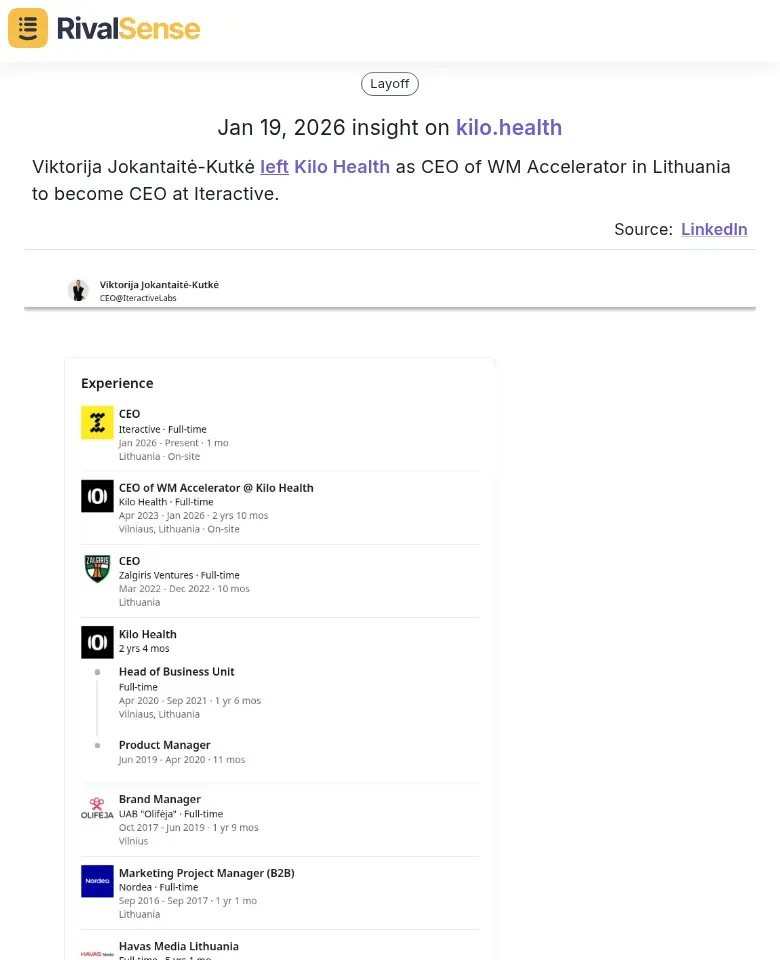
- Example: Viktorija Jokantaitė-Kutkė left Kilo Health as CEO of WM Accelerator in Lithuania to become CEO at Iteractive. Such executive movements can signal strategic shifts or new leadership directions at competitors, helping you adjust your engagement strategies.
- Monitor hiring trends and talent moves
- Track funding rounds and financial health
- Watch for management changes
-
Strategic Intelligence:
- Analyze competitor positioning and messaging
- Monitor media mentions and PR activities
- Track customer success stories and case studies
Practical Implementation: Consider supplementing your key account management platform with specialized competitive intelligence tools. For instance, RivalSense tracks competitor product launches, pricing updates, event participations, partnerships, regulatory aspects, management changes, and media mentions across 80+ sources, delivering all this intelligence in a weekly email report. This kind of comprehensive monitoring can provide crucial context for your key account strategy, helping you anticipate competitive threats and identify expansion opportunities.
The Technology Stack: Essential Tools for Modern KAM
Your Key Account Management Technology Checklist
Core Platform Requirements:
- Strategic account planning capabilities
- Stakeholder mapping and relationship tracking
- Value measurement and ROI calculation
- Cross-functional collaboration features
- Integration with competitive intelligence sources
Essential Integrations:
- CRM system connection
- Communication tools (email, video conferencing)
- Project management platforms
- Analytics and reporting tools
- Competitive monitoring systems
Pro Tip: When evaluating platforms, prioritize flexibility and ease of adoption. As recent analysis shows, "The ideal system must be flexible and easy to adopt, integrating seamlessly with existing tools and adapting to your team's unique process rather than forcing cumbersome workflow changes."
The Human Element: Developing Your Account Management Team
Building Executive Presence and Overcoming Imposter Syndrome
As Dr. Tara Halliday discussed in Episode 67, "High performers don't grow out of imposter syndrome. They just learn how to hide it better." Your team development checklist:
Skill Development Areas:
- Strategic thinking and business acumen
- Executive communication and presentation
- Negotiation and influence
- Problem-solving and creativity
- Emotional intelligence and relationship building
Professional Growth Framework:
- Regular coaching and mentoring
- Skill-based training programs
- Cross-functional exposure
- Leadership development opportunities
- Success measurement and feedback
The Metrics That Matter: Measuring KAM Success
Your Key Performance Indicator Dashboard
Leading Indicators (Predictive):
- Account health score
- Stakeholder engagement metrics
- Value delivery tracking
- Strategic initiative progress
Lagging Indicators (Results):
- Revenue growth from key accounts
- Profit margin by account
- Retention and renewal rates
- Expansion and upsell success
- Customer satisfaction and advocacy
Pro Tip: As Ellie Wu emphasized, look beyond traditional dashboards and ask practical questions: "Do you understand the level of effort required to deliver value? Where is time going, and does that work actually help customers?"
Implementation Roadmap: Your 90-Day Action Plan
Phase 1: Foundation Building (Days 1-30)
Week 1-2:
- Conduct account segmentation exercise
- Identify top 10 key accounts
- Assign account managers and teams
Week 3-4:
- Develop strategic account plans for top 5 accounts
- Establish review cadence and communication protocols
- Set up initial metrics and tracking systems
Phase 2: Execution and Optimization (Days 31-60)
Week 5-8:
- Implement regular review meetings
- Begin value tracking and reporting
- Establish competitive monitoring
- Conduct initial risk assessments
Phase 3: Scaling and Refinement (Days 61-90)
Week 9-12:
- Expand to remaining key accounts
- Refine processes based on learnings
- Develop expansion playbooks
- Establish continuous improvement cycle
Conclusion: Transforming Key Accounts into Strategic Assets
Effective key account management isn't about managing transactions—it's about building strategic partnerships that drive mutual growth. As Mark Davies emphasized, "KAM only succeeds when the company recognizes it as a different business model with a longer horizon and deeper expectations."
By implementing this playbook, you'll transform your key account management from a cost center into a growth engine. Remember the wisdom from Account Management Secrets: "Clear priorities change how work feels day to day. Teams stop spinning, effort gets focused, and progress becomes easier to see."
Your Next Steps:
- Start with account segmentation—identify your true key accounts
- Develop strategic account plans for your top 3-5 accounts
- Establish your review cadence and communication protocols
- Implement competitive monitoring to protect and grow your accounts
- Measure, refine, and scale your approach
In today's competitive environment, the companies that master key account management will be the ones that thrive. By combining strategic relationship building with competitive intelligence and systematic processes, you can transform your most important customer relationships into your most valuable strategic assets.
Ready to enhance your competitive edge? Try out RivalSense for free at https://rivalsense.co/ to assist with the challenges described in this post, and get your first competitor report today!
📚 Read more
👉 Advanced Tactics: Monitor Key Account Growth for Commercial Insurance Brokers
👉 How Salesforce's Hoa Sen Partnership Enabled Competitors to Target CRM Gaps
👉 Best Practices: Extract Competitor Insights from Website Changes for Key Account Success
👉 Competitive Edge in Professional Services: A Practical Guide to Monitoring Regulatory Filings
👉 Boost Key Account Win Rates with Competitor Product Intelligence