
The Ultimate Guide to Tracking Key Account History: Practical Strategies for Competitive Advantage
Key account history tracking isn't just about remembering past conversations—it's about building a strategic advantage that keeps you ahead of competitors. When you systematically track every interaction, purchase, support ticket, and opportunity with your most valuable clients, you create a living database that reveals patterns, predicts behavior, and uncovers opportunities your competitors miss.
Think of it this way: Your key accounts are your most valuable assets. Their history tells a story—one that reveals what works, what doesn't, and where the next opportunity lies. But here's the reality most businesses face: internal tracking only gives you half the picture. To truly understand your key accounts, you need to see the complete competitive landscape.
The Three Critical Gaps in Traditional Account Management
Most account management software focuses on internal data—what your team knows about the account. But this creates three dangerous blind spots:
- Competitor Activity Blind Spot: You can't see when competitors are courting your key accounts
- Market Context Blind Spot: You miss industry shifts that affect account priorities
- Strategic Intelligence Blind Spot: You lack external signals that predict account behavior
Practical Framework: The 5-Step Key Account History Tracking System
Step 1: Map the Complete Account Lifecycle
Every key account follows a predictable lifecycle, but most companies only track the parts they control. To get the full picture, you need to track:
Practical Checklist for Lifecycle Mapping:
- ✅ Prospecting Stage: Track competitor mentions in target accounts' press releases
- ✅ Onboarding Stage: Monitor when competitors announce similar implementations
- ✅ Growth Stage: Watch for expansion signals in industry publications
- ✅ Maturity Stage: Track account mentions in competitor case studies
- ✅ Renewal/Expansion Stage: Monitor competitor pricing changes and contract announcements
Example: When a major rideshare partner shows declining API usage, proactive intervention can prevent defection to rivals. But you need to know if competitors are offering better terms or new features that might be tempting your client.
Step 2: Track Leadership Changes for Strategic Insights
When new executives join your key accounts, they bring fresh perspectives and often signal strategic pivots. Tracking these changes provides invaluable intelligence for anticipating account needs.
Practical Steps for Leadership Tracking:
- Set up alerts for C-suite changes at your top 10 accounts
- Map new executives' past roles to infer strategic direction
- Correlate leadership data with product launches to validate predictions
Real-World Example: RivalSense detected that Luis O. joined Uber as Chief Information Security Officer | Uber Payments Mexico. This insight reveals Uber's enhanced focus on security and payments, allowing you to anticipate new compliance requirements or payment innovations that could affect your accounts.
Step 3: Monitor Product Expansions and Seasonal Patterns
Key accounts don't operate in a vacuum—they respond to market dynamics and competitor moves. Tracking product expansions and seasonal offerings helps you anticipate account needs before they're expressed.
Practical Checklist for Product Tracking:
- ✅ Set up alerts for competitor product announcements
- ✅ Map seasonal patterns using historical launch data
- ✅ Evaluate partnership ROI through customer acquisition metrics
- ✅ Test competitor integrations to identify UX improvements
- ✅ Benchmark your integration performance against industry leaders
Example: RivalSense reported that Autodesk launched Autodesk AI Assistant, an intelligent conversational AI built into Autodesk Construction Cloud that helps teams find, validate, summarize, and act on project data instantly. 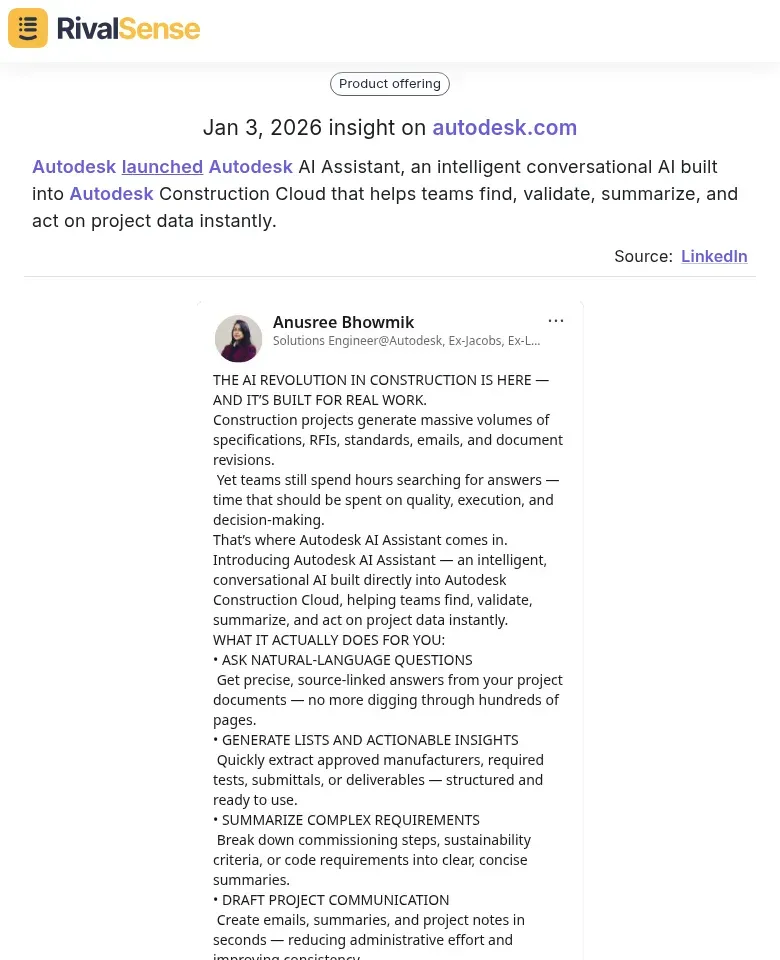 This type of product launch insight is valuable because it alerts you to new features competitors are offering, which could tempt your key accounts to switch or demand similar capabilities, allowing you to proactively address their needs.
Step 4: Analyze Geographic and Investment Moves
Understanding where competitors are investing reveals market priorities and potential threats to your key accounts.
Practical Steps for Geographic Intelligence:
- Create a checklist of top 10 global tech hubs and update it quarterly
- Subscribe to investment newsletters for real-time alerts
- Map competitor locations against your own to identify overlap risks
Real-World Insight: RivalSense captured that Motive launches a new service for commercial vehicle operators in Mexico.  This geographic and service expansion insight helps you understand where competitors are targeting new markets, enabling you to assess threats to your key accounts in those regions and adjust your strategy accordingly.
Step 5: Integrate Competitive Intelligence into Account Strategy
This is where most companies fail—they collect data but don't turn it into action. Here's how to bridge that gap:
Actionable Integration Framework:
- Weekly Intelligence Review: Dedicate 30 minutes each week to review competitor moves affecting your key accounts
- Account-Specific Alerts: Set up customized alerts for each key account based on their industry and competitive landscape
- Proactive Strategy Sessions: Monthly meetings where sales, customer success, and product teams discuss competitive intelligence and adjust account strategies
The Competitive Intelligence Advantage: Beyond Internal Tracking
While internal account management tools track what's happening inside your organization, competitive intelligence tools like RivalSense track what's happening in the broader market. This external perspective is what transforms reactive account management into proactive strategy.
What RivalSense Adds to Your Account Management:
- Competitor Product Launches/Updates: Know when competitors release features that might tempt your accounts
- Pricing Updates: Track competitor pricing changes that could affect renewal negotiations
- Event Participations: Monitor which conferences your key accounts attend with competitors
- Partnerships: Watch for competitor alliances that could create new value propositions. For instance, RivalSense tracked that Chaumet collaborates with Qatar Museums on a project featuring Patrick Sawaya.
 This partnership insight is valuable for understanding how competitors are building strategic relationships that could affect your key accounts' loyalty.
 - Regulatory Aspects: Stay ahead of compliance changes that affect account requirements
- Management Changes: Track executive movements that signal strategic shifts
- Media Mentions: Monitor how competitors are positioning themselves to your accounts
Practical Implementation: Your 30-Day Key Account Tracking Transformation
Week 1: Foundation Setup
- Identify your 10 most critical accounts
- Set up basic tracking for each account's public information
- Create a centralized dashboard for account intelligence
Week 2: Competitive Layer Addition
- Implement RivalSense or similar competitive intelligence tool
- Configure alerts for competitor activity affecting your key accounts
- Train your account team on interpreting competitive signals
Week 3: Integration and Workflow
- Integrate competitive intelligence into weekly account reviews
- Create response protocols for different types of competitor moves
- Establish KPIs for competitive intelligence effectiveness
Week 4: Optimization and Scaling
- Review what's working and adjust your tracking system
- Expand tracking to additional accounts
- Document best practices and create training materials
Real-World Success Story: How Competitive Intelligence Saved a Key Account
A cybersecurity company using RivalSense noticed that one of their key financial services clients was being heavily courted by a competitor. The competitor had recently:
- Hired a former executive from the client company
- Launched a new feature specifically for financial compliance
- Announced a partnership with a major cloud provider the client used
- Secured speaking slots at three industry conferences the client attended
Armed with this intelligence, the cybersecurity company:
- Proactively scheduled a strategic review with the client
- Accelerated development of a competing compliance feature
- Strengthened their own cloud integration messaging
- Secured speaking opportunities at the same conferences
Result: They not only retained the account but expanded the contract by 40% when the client saw their proactive approach and competitive awareness.
Key Metrics to Track: Measuring Your Competitive Advantage
Don't just track activity—track impact. Here are the metrics that matter:
Account Retention Metrics:
- Competitive threat detection rate
- Time from competitor move to your response
- Account expansion rate in competitive situations
Business Impact Metrics:
- Win/loss rates against monitored competitors
- Average deal size in competitive scenarios
- Customer lifetime value of intelligence-informed accounts
Operational Efficiency Metrics:
- Time saved on manual competitor research
- Intelligence-to-action conversion rate
- Cross-team alignment on account strategy
Common Pitfalls to Avoid
- Information Overload: Don't track everything—focus on signals that matter to your key accounts
- Siloed Intelligence: Competitive intelligence must be shared across sales, customer success, and product teams
- Reactive Mindset: Use intelligence to anticipate, not just respond
- Tool Dependency: Technology enables strategy but doesn't replace human judgment
The Future of Key Account Tracking: AI and Automation
As account management evolves, the winners will be those who combine internal data with external intelligence. Tools that automate competitor tracking across 80+ sources—like RivalSense—are becoming essential for staying competitive.
What to Look for in Modern Tracking Solutions:
- Automated monitoring across websites, social media, registries, and publications
- AI-powered analysis that surfaces relevant insights
- Customizable alerts based on your specific accounts and competitors
- Integration with existing CRM and account management systems
- Weekly digest reports that save research time
Your Next Step: From Theory to Action
Tracking key account history is no longer optional—it's a competitive necessity. But the real advantage comes from combining your internal knowledge with external competitive intelligence.
Practical Action Items for This Week:
- Pick one key account and research their last three public announcements
- Identify the top two competitors for that account
- Set up Google Alerts for those competitors plus the account name
- Schedule a 15-minute review of what you find with your account team
- Consider testing a competitive intelligence tool like RivalSense to automate this process
Remember: Your key accounts are being courted right now. The question isn't whether competitors are targeting them—it's whether you'll see it coming in time to respond. Systematic key account history tracking gives you that visibility, turning potential threats into strategic opportunities.
Ready to transform your key account management with competitive intelligence? RivalSense tracks competitor product launches, pricing updates, event participations, partnerships, regulatory changes, management moves, and media mentions across 80+ sources, delivering actionable insights in a weekly email report. Try it free today and get your first competitor report today to see what your competitors don't want you to know about your key accounts.
📚 Read more
👉 Key Account Management Podcasts: Productivity Tips for Medical Equipment Distribution
👉 How Sensor Integration Exposed Competitors' Verification Gaps in Carbon Markets
👉 Twitter Competitor Insights Cheat Sheet for Key Account Tracking
👉 Advanced Semiconductor Competitor Pricing Intelligence Tactics for Strategic Edge
👉 5 Quick Hacks to Track Competitor Media Mentions for Smarter SWOT Analysis