
The Ultimate Guide to Key Account Tracking APIs: Automate Competitive Intelligence in 2026
In today's hyper-competitive B2B landscape, tracking your most important competitors—your key accounts—has evolved from a nice-to-have to a strategic necessity. Founders, CEOs, and business leaders face a critical challenge: how to stay ahead of competitors without spending countless hours on manual research. The solution? Key account tracking APIs that automate competitive intelligence and deliver actionable insights directly into your workflows.
What is a Key Account Tracking API?
In the context of competitive intelligence, a key account tracking API serves as the backbone for automated monitoring systems. A key account tracking API is a programmatic interface that connects competitive intelligence platforms with your business systems to provide real-time updates about competitor movements. Unlike traditional monitoring tools that require manual checking, these APIs create automated pipelines that:
- Monitor 80+ data sources including company websites, social media platforms, regulatory databases, news outlets, and patent registries
- Track critical competitor activities like product launches, pricing changes, partnerships, executive moves, and media mentions
- Deliver intelligence through API endpoints, webhooks, or integrated dashboards
- Transform raw data into structured insights that inform strategic decisions
The 5-Step Framework for Implementing Key Account Tracking APIs
Step 1: Identify Your Strategic Competitors
Start by defining which competitors matter most to your business strategy. These are typically 3-5 companies that directly compete for your target customers or have similar offerings.
Practical Checklist:
- ✅ Create a competitor matrix ranking companies by strategic importance
- ✅ Document why each competitor is critical to track
- ✅ Identify adjacent players who could become future competitors
- ✅ Map competitor strengths and weaknesses relative to your offerings
Step 2: Define Your Intelligence Priorities
Determine what types of intelligence are most valuable for your strategic goals. Different intelligence categories serve different purposes, and aligning them with objectives ensures focused tracking.
Essential Intelligence Categories:
- Product/Feature Launches 🚀 - New offerings that could impact your market position
- Pricing and Packaging Changes 💰 - Competitive pricing strategies and value propositions
- Partnership Announcements 🤝 - Strategic alliances that expand competitor capabilities
- Executive Team Changes 👔 - Leadership shifts signaling strategic direction changes
- Regulatory Compliance Updates ⚖️ - Certifications opening new markets
- Media Coverage and Sentiment 📰 - Public perception and brand positioning
- Event Participations 🎯 - Conference appearances and speaking engagements
Pro Tip: Align each intelligence category with specific business objectives. For example, if market expansion is a priority, focus on tracking competitor geographic expansions and partnership announcements.
Step 3: Select and Configure Your Tracking Solution
Choosing the right competitive intelligence platform with robust API capabilities is critical for seamless integration. Look for solutions that offer comprehensive coverage and flexible delivery options to fit your tech stack.
Evaluation Criteria:
- Source Coverage: 80+ sources for comprehensive tracking (company websites, social media, regulatory databases, etc.)
- Data Freshness: Real-time vs. delayed updates
- API Documentation: Clear, well-documented endpoints and authentication methods
- Delivery Formats: API access, email reports, dashboard integrations
- Integration Capabilities: Webhooks, scheduled data pulls, CRM connections
Hint: Look for platforms that offer both API access for automation and summarized reports for executive consumption. For instance, solutions like RivalSense deliver competitor movements across all monitored channels in weekly email reports while providing API access for system integration.
Step 4: Integrate the API with Your Systems
Configure the API integration to create your automated intelligence pipeline, ensuring data flows smoothly into your decision-making processes. Start with simple setups to validate data before scaling up to avoid complexity.
Implementation Steps:
- Generate API Keys: Create authentication tokens from your tracking platform
- Set Up Endpoints: Configure webhooks or scheduled data pulls
- Map Data Fields: Connect intelligence data to your internal systems (CRM, BI tools, etc.)
- Test Data Flow: Validate format, accuracy, and timeliness
- Configure Alerts: Set thresholds for urgent developments
Practical Advice: Begin with a simple integration—perhaps pulling data into a spreadsheet or dedicated dashboard—before building complex automated workflows. This allows you to validate data quality and relevance before scaling.
Step 5: Establish Review and Action Processes
Create processes to ensure intelligence turns into action, as insights without follow-up lose their value. Without structured reviews, insights can get lost in data overload, so establish regular cadences.
Actionable Framework:
- Weekly Review Meetings: Schedule recurring 30-minute sessions to discuss competitor movements
- Alert Thresholds: Define what constitutes "urgent" (e.g., major price cuts, key executive departures)
- Integration with Planning: Connect intelligence review with strategic planning sessions
- Designated Ownership: Assign team members responsible for monitoring specific competitors
- Response Protocols: Create decision frameworks for different types of competitor moves
Key Account Insights in Action: Real Examples from RivalSense
Seeing real-world examples helps illustrate how key account tracking APIs deliver actionable intelligence. These insights from RivalSense demonstrate how different competitor movements can directly inform your business strategy and prompt timely responses.
-
Product Update Insight: IPVanish VPN Enhances Plans with New Feature
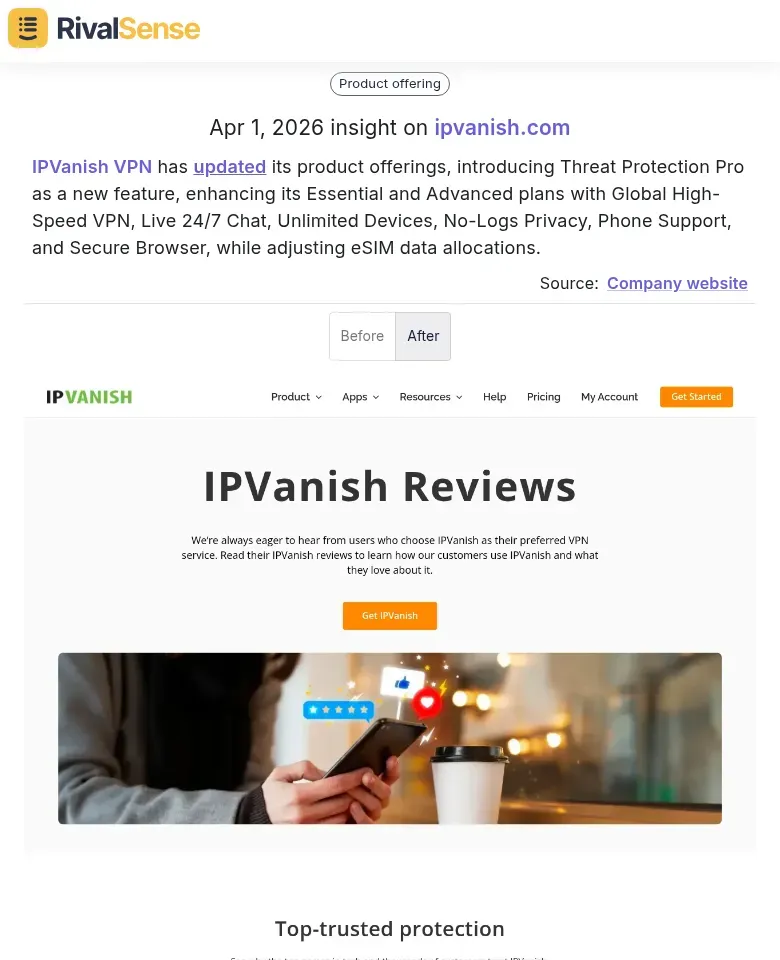
RivalSense detected that IPVanish VPN has updated its product offerings, introducing Threat Protection Pro as a new feature, enhancing its Essential and Advanced plans with Global High-Speed VPN, Live 24/7 Chat, Unlimited Devices, No-Logs Privacy, Phone Support, and Secure Browser, while adjusting eSIM data allocations. This type of insight is valuable for product strategy because it alerts you to feature additions that could shift competitive positioning, prompting you to evaluate your own roadmap for enhancements or differentiation. -
AI-Powered Tool Launch: Norton Revamp for Social Media Creation
Norton launched Norton Revamp, an AI-powered tool that helps users turn ideas into social media posts with control over publishing on LinkedIn and X. Tracking such product launches is crucial for innovation strategy, as it reveals how competitors are leveraging AI to enter new market segments or enhance user engagement, allowing you to assess potential threats or opportunities in your own offerings. -
Promotional Partnership: Airalo's Flight Offer with eSIM Purchase

Airalo introduces Airalo Air, offering a return flight with every eSIM purchase starting today. This insight into partnerships and promotional offers helps you understand competitor marketing tactics and customer acquisition strategies, enabling you to craft more effective counter-campaigns or explore similar collaborative opportunities to boost sales.
By monitoring such movements through a key account tracking API, you can automatically receive these insights and integrate them into your strategic planning, ensuring you're always one step ahead.
Practical Integration Checklist
Pre-Implementation Checklist:
- Identify 3-5 key competitors to track
- Define intelligence priorities aligned with strategic goals
- Document existing systems that need integration (CRM, BI, dashboards)
- Establish success metrics for the integration
- Assign team members responsible for implementation
Technical Setup Checklist:
- Select tracking platform with comprehensive API access
- Generate API keys and configure endpoints
- Map data fields to internal systems
- Test data flow and validate accuracy
- Set up alert thresholds and notification rules
Operational Checklist:
- Schedule weekly intelligence review meetings
- Create response protocols for different competitor moves
- Train team members on accessing and using intelligence
- Establish quarterly review of tracking priorities
- Document insights and decisions for future reference
How Key Account Tracking APIs Complement Your Existing Tools
While traditional key account management tools focus on customer relationships, key account tracking APIs provide external competitive context. This synergy enhances strategic decision-making by combining internal data with market intelligence for a holistic view.
Synergy in Action:
- CRM + Competitive Intelligence: While your CRM organizes customer relationships, competitive intelligence identifies external threats that could impact those relationships
- BI Tools + Competitor Tracking: Your business intelligence platform analyzes internal data, while competitor tracking provides market context
- Communication Platforms + Real-Time Alerts: Integrate competitor alerts into Slack, Teams, or email for immediate awareness
Emerging Trends in Key Account Tracking APIs
Artificial intelligence and broader data sources are shaping the future of competitive intelligence. Staying updated on these trends ensures your tracking strategy remains effective and adaptive to technological advancements.
AI-Powered Competitive Intelligence
Artificial intelligence is transforming competitive intelligence by automating analysis and providing predictive insights. AI can identify patterns across multiple data sources and predict competitor moves based on historical behavior, giving you a proactive edge.
Real-Time Integration with Business Systems
Modern tracking solutions offer seamless integration with popular business systems. Real-time updates ensure that intelligence is immediately available in tools like CRM, BI platforms, and communication apps, speeding up decision cycles.
Comprehensive Source Coverage
Leading platforms now monitor 80+ sources including company websites, social media, regulatory databases, and news outlets. Broad coverage minimizes blind spots and provides a complete picture of competitor activities, as exemplified by insights like those from RivalSense.
How RivalSense Enhances Your Key Account Tracking Strategy
RivalSense provides a comprehensive approach to key account tracking by combining automated monitoring with actionable delivery formats. The platform tracks competitor movements across 80+ sources—including product launches, pricing updates, event participations, partnerships, regulatory changes, management moves, and media mentions—and delivers this intelligence through:
- Weekly Email Reports: Curated summaries of competitor movements delivered directly to your inbox
- API Access: Programmatic access to raw intelligence data for integration with your systems
- Customizable Dashboards: Visual representations of competitive landscape changes
- Alert Systems: Real-time notifications for urgent developments
This combination ensures that both technical teams (through API integration) and business leaders (through summarized reports) receive the intelligence they need in the format that works best for them, turning data into strategic advantage.
Getting Started with Key Account Tracking APIs
Immediate Action Steps:
- Conduct a competitor audit - Identify your 3-5 most important competitors
- Define intelligence priorities - Determine what types of moves matter most for your strategy
- Evaluate integration options - Assess how competitor intelligence could flow into your existing systems
- Start with a pilot - Choose one competitor and one intelligence category to test integration
- Establish review processes - Create regular cadence for discussing and acting on intelligence
Long-Term Success Factors:
- Consistency: Regular review and action on intelligence
- Integration: Seamless connection with existing workflows
- Adaptation: Willingness to adjust tracking priorities as market conditions change
- Action Orientation: Focus on turning intelligence into strategic decisions
Conclusion: Transforming Intelligence into Competitive Advantage
Key account tracking APIs represent a fundamental shift from reactive competitor monitoring to proactive competitive intelligence. By automating data collection and integrating insights directly into your business systems, you transform scattered information into strategic advantage. The most successful B2B companies in 2026 won't just track competitors—they'll have systematic processes for turning that intelligence into action.
Remember: The goal isn't just to know what your competitors are doing—it's to use that knowledge to make better decisions faster. With the right API integration framework, you can transform competitive intelligence from a time-consuming chore into a strategic asset that drives growth and market leadership.
Ready to automate your competitive intelligence? Try RivalSense for free at https://rivalsense.co/ and get your first competitor report today to start turning insights into action and stay ahead of the competition.
📚 Read more
👉 Mastering Competitor Tracking in Pharma Logistics: A Strategic Guide to Promotional Offers
👉 How Real-Time Competitive Intelligence Enabled a Swift Response to Airalo's Flight Promotion
👉 Step-by-Step Guide: Extract Competitor Insights from Instagram for Strategic Advantage
👉 Auto Lending Competitors: Strategic Marketing Analysis for Financial Services
👉 Quick Tips: Uncover Competitor Partnerships to Win Key Accounts