
The Ultimate Guide to Key Account Management Newsletters in 2026: Practical Strategies for Business Leaders
In today's hyper-competitive B2B landscape, key accounts aren't just customers—they're strategic assets that can make or break your company's success. With 80% of revenue typically coming from just 20% of customers (the Pareto principle in action), your key account newsletter has evolved from a simple communication tool to a strategic weapon for relationship building and competitive defense.
Yet most companies still rely on generic newsletters that fail to deliver real value. In 2026, the most successful account managers leverage newsletters that combine relationship insights, strategic value, and competitive intelligence to transform account management from reactive support to proactive strategic partnership.
The 2026 Evolution: From Generic Updates to Strategic Intelligence
Traditional key account newsletters focused on basic company updates and product announcements. Today's landscape demands a more holistic approach that incorporates competitive intelligence and real-time market dynamics. By delivering content that goes beyond the obvious, you can anticipate shifts and protect your most valuable relationships from competitors.
The 4-Pillar Framework for Strategic Key Account Newsletters
To create newsletters that deliver strategic value, adopt a comprehensive framework. This approach ensures that your communication addresses multiple facets of account management and strengthens your position as a trusted advisor.
1. COMPETITIVE INTELLIGENCE INTEGRATION
Your newsletter should provide insights that help key accounts understand their competitive landscape better. This positions you as a strategic partner rather than just a vendor, enabling them to make informed decisions.
Practical Implementation Checklist:
✅ Include competitor product launch analysis relevant to your accounts' industries
✅ Share pricing change insights that affect their purchasing decisions
✅ Highlight regulatory developments impacting their business sectors
✅ Provide event participation intelligence showing market trends
✅ Track partnership announcements revealing strategic shifts
2. RELATIONSHIP HEALTH INSIGHTS
Go beyond satisfaction scores to provide actionable insights about relationship depth and engagement quality. Demonstrating that you understand and care about their success fosters deeper loyalty.
Best Practices:
- Use engagement metrics to tailor content relevance
- Include case studies showing how you've solved similar challenges
- Provide industry benchmarks for comparison
- Share success stories from other key accounts (with permission)
3. STRATEGIC VALUE PROPOSITION
Every newsletter should reinforce why you're the strategic partner of choice, not just another vendor. Consistently articulating your unique value helps justify premium pricing and long-term commitments.
Content Strategy Tips:
- Focus on business outcomes, not just product features
- Include ROI calculations and value metrics
- Share thought leadership content addressing industry challenges
- Provide exclusive insights unavailable elsewhere
4. OPERATIONAL EXCELLENCE UPDATES
Demonstrate your commitment to continuous improvement and service excellence. Showing that you're constantly evolving reassures accounts that they're in good hands.
What to Include:
- Service improvement announcements
- Team expertise highlights
- Process optimization updates
- Customer success metrics
Practical Newsletter Creation Checklist
✅ WEEKLY CONTENT PLANNING
-
Competitor Monitoring Integration: Use tools like RivalSense to track competitor product launches, pricing updates, event participations, partnerships, regulatory aspects, management changes, and media mentions across 80+ sources. This provides fresh, relevant content for your newsletter.
-
Account-Specific Customization: Segment your newsletter content based on account industry, size, and strategic importance.
-
Value-Driven Content Selection: Choose content that helps accounts solve real business problems or gain competitive advantages.
-
Timing Optimization: Schedule delivery when key decision-makers are most likely to engage.
✅ MONTHLY STRATEGIC ELEMENTS
- Industry Analysis: Provide insights into market trends affecting your accounts
- Competitive Positioning: Show how you compare to alternatives
- Success Metrics: Share relevant KPIs and performance data
- Strategic Recommendations: Offer actionable advice for account growth
✅ QUARTERLY DEEP DIVES
- Comprehensive Market Review: Analyze broader industry shifts
- Competitive Landscape Analysis: Detailed competitor positioning
- Strategic Partnership Opportunities: Identify collaboration potential
- Risk Assessment: Highlight potential threats and mitigation strategies
Modern Tools for Newsletter Excellence
While traditional email platforms handle basic distribution, 2026 demands more sophisticated solutions. Modern platforms integrate real-time data, automation, and competitive intelligence to provide content that truly differentiates and saves valuable time.
ESSENTIAL FEATURES CHECKLIST
✅ Real-time competitor monitoring across multiple sources
✅ Automated content curation based on account relevance
✅ Cross-platform integration with CRM and marketing automation
✅ Personalization capabilities for different account segments
✅ Analytics and engagement tracking for continuous improvement
The RivalSense Advantage for Newsletter Content
Unlike basic monitoring tools, RivalSense provides comprehensive competitor intelligence across 80+ sources including company websites, social media, regulatory filings, industry registries, and media mentions. All delivered in a consolidated weekly report, saving account managers hours of manual research while providing actionable insights into:
- Competitor product launches/updates: Stay ahead of feature comparisons
- Pricing changes: Adjust your value proposition accordingly
- Event participations: Identify networking opportunities
- Partnership announcements: Understand strategic shifts
- Regulatory developments: Anticipate compliance impacts
- Management changes: Track relationship continuity
- Media mentions: Gauge market perception
Tactical Strategies for Newsletter Success
🛡️ PROACTIVE ACCOUNT DEFENSE STRATEGIES
- Competitor Alert Integration: Include early warnings about competitor activities targeting your accounts
- Regulatory Update Summaries: Help accounts navigate compliance challenges
- Market Threat Analysis: Identify emerging competitive threats
- Value Reinforcement: Regularly demonstrate your unique advantages
📈 GROWTH OPPORTUNITY IDENTIFICATION
- White Space Analysis: Highlight areas where competitors are weak
- Partnership Intelligence: Share collaboration opportunities
- Industry Trend Insights: Help accounts capitalize on market shifts
- Expansion Signals: Track competitor growth patterns for opportunities
⚠️ RISK MITIGATION FRAMEWORK
- Regular Competitive Assessments: Quarterly reviews of competitor positioning
- Contingency Planning Content: Help accounts prepare for various scenarios
- Cross-Functional Insights: Involve different perspectives in your content
- Continuous Improvement Updates: Show your commitment to excellence
Real-World Newsletter Content Examples
Incorporating concrete competitive insights makes your newsletter directly relevant and actionable. Here are examples of how different types of intelligence can be leveraged, sourced from tools like RivalSense.
👥 Management Changes Signal Strategic Direction
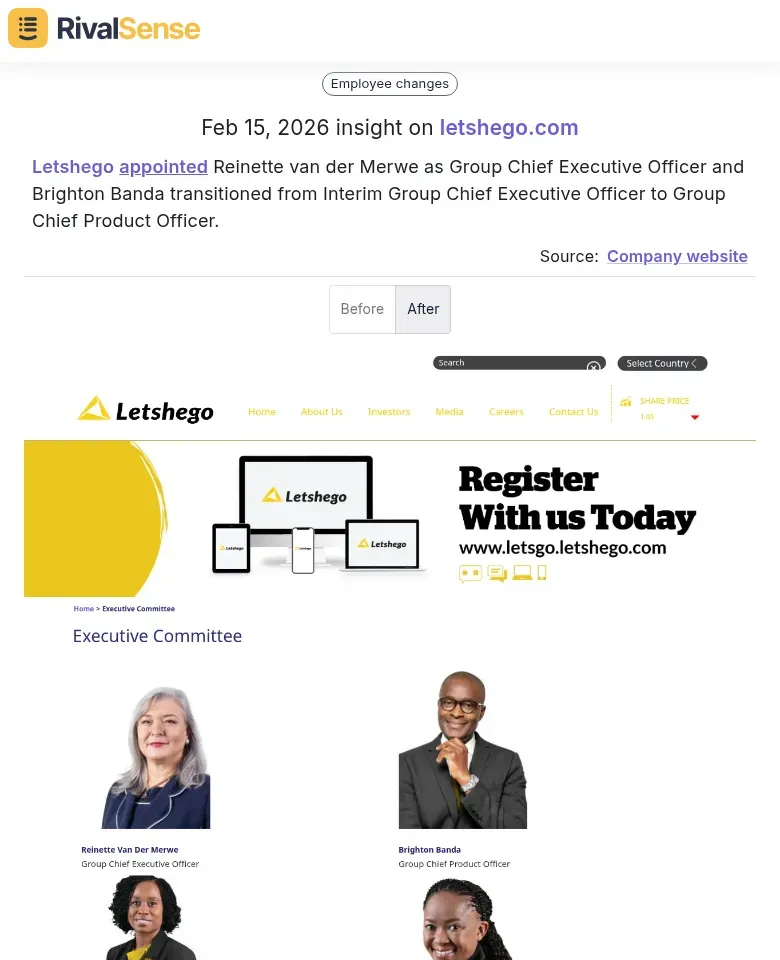
Leadership transitions can profoundly impact company strategy and relationship dynamics. Tracking these changes helps accounts anticipate shifts in vendor priorities or partnership approaches. For instance, RivalSense tracked that Letshego appointed Reinette van der Merwe as Group Chief Executive Officer and Brighton Banda transitioned from Interim Group Chief Executive Officer to Group Chief Product Officer. This insight is valuable for financial services accounts to understand new leadership focuses and potential strategic pivots.
✈️ Product Launches Indicate Market Expansion
New product launches reveal competitor innovation and market targeting efforts. Sharing such insights helps accounts in related industries stay informed about operational changes and competitive offerings. For example, RivalSense detected that Thai Airways launched a Boeing 777-3AL (ER) aircraft in Star Alliance livery for its first commercial flight to Taipei. This type of insight is valuable for travel, logistics, and hospitality accounts to track fleet upgrades and route expansions that could affect their operations.

🔧 Strategic Proposals Reveal Competitive Intent
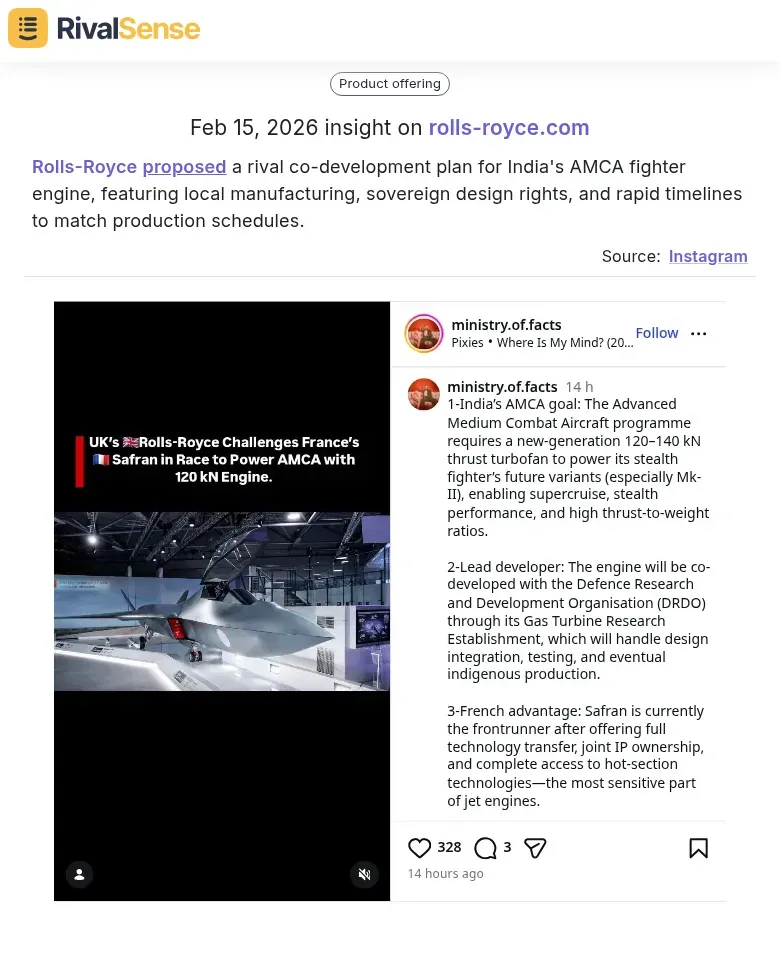
Strategic moves like co-development plans show how competitors are positioning for future opportunities and government contracts. Monitoring these proposals helps accounts anticipate competitive bids and partnership landscapes. RivalSense monitored that Rolls-Royce proposed a rival co-development plan for India's AMCA fighter engine, featuring local manufacturing, sovereign design rights, and rapid timelines to match production schedules. This insight is valuable for aerospace and defense accounts to gauge competitive intensity and technological advancements.
Best Practices for Sustainable Newsletter Success
-
FOCUS ON QUALITY OVER QUANTITY
Deliver the vital few insights that truly provide strategic value. A good rule of thumb is to have 3-5 primary content categories with each newsletter focusing on the most relevant 1-2 topics. -
ENSURE CONTENT RELEVANCE AND TIMELINESS
Your newsletter is worthless if the content isn't immediately useful. Use automated monitoring tools to ensure you're sharing the most current and relevant information. -
CONTEXTUALIZE YOUR INSIGHTS FOR DEEPER VALUE
Don't just report facts—provide context. Always analyze information in the context of your accounts' goals, challenges, and competitive landscape. -
FOSTER TWO-WAY COMMUNICATION
Use your newsletter as a conversation starter, not just a broadcast. Include calls to action that encourage feedback and dialogue. -
BE FLEXIBLE AND ADAPT AS NEEDS EVOLVE
Conduct regular reviews of your newsletter content strategy. Ask critical questions: Is this content still relevant? Does it still align with our accounts' current objectives?
Common Pitfalls and How to Avoid Them
❌ AVOIDING GENERIC CONTENT
For every newsletter item, ask the "So what?" question. If this information doesn't help your account make better decisions or gain competitive advantage, reconsider including it.
❌ SETTING UNREALISTIC FREQUENCY EXPECTATIONS
Quality trumps quantity. It's better to send one highly valuable newsletter per month than four generic ones.
❌ OVERLOOKING PERSONALIZATION
Create content segments based on account characteristics. What's valuable to a manufacturing account may not be relevant to a financial services account.
❌ TRACKING IN SILOS
Integrate your newsletter analytics with your CRM and account management systems to measure impact on relationship health and revenue.
❌ FORGETTING THE STRATEGIC NARRATIVE
Regularly communicate how your newsletter content supports your accounts' strategic objectives. Constantly reinforce your role as a strategic partner.
Advanced Strategies for Competitive Edge
PREDICTIVE CONTENT CURATION
Instead of just reporting past events, use historical data and market intelligence to anticipate future trends and challenges your accounts will face. This proactive approach positions you as a forward-thinking partner.
AI-POWERED COMPETITIVE INTELLIGENCE
Artificial Intelligence can analyze vast datasets far more quickly and effectively than manual research. AI-powered tools can automatically detect relevant competitive developments and suggest content angles, saving time and improving accuracy.
AUTOMATED COMPETITOR MONITORING INTEGRATION
Using tools like RivalSense, you can schedule automated competitor intelligence gathering across 80+ sources, ensuring your newsletter always contains fresh, relevant competitive insights delivered in a consolidated weekly report.
Frequently Asked Questions
HOW OFTEN SHOULD WE SEND KEY ACCOUNT NEWSLETTERS?
- Weekly: For high-touch strategic accounts with rapidly changing environments
- Bi-weekly: For most key accounts balancing value with attention span
- Monthly: For established accounts with stable relationships
- Quarterly: Comprehensive strategic reviews with deep analysis
CAN AUTOMATION IMPROVE NEWSLETTER RELEVANCE?
Absolutely. Modern tools provide:
- Real-time competitor monitoring
- Automated content curation based on account relevance
- Personalized distribution based on engagement patterns
- Integrated analytics for continuous improvement
HOW DOES COMPETITIVE INTELLIGENCE ENHANCE NEWSLETTER VALUE?
Competitive tracking allows you to:
- Anticipate competitor moves before they impact your accounts
- Position your solutions more effectively against alternatives
- Identify white space opportunities for account growth
- Develop more compelling value propositions
WHAT'S THE ROI OF STRATEGIC KEY ACCOUNT NEWSLETTERS?
Companies that implement strategic newsletters typically see:
- 15-25% improvement in account engagement
- 20-30% faster identification of growth opportunities
- 40-50% reduction in competitive surprise incidents
- Significant time savings on manual research and content creation
Conclusion: Transforming Account Communication in 2026
In 2026, key account management success isn't just about what you communicate—it's about the strategic value of that communication. The most successful account managers leverage newsletters that combine relationship insights, competitive intelligence, and strategic guidance to transform account relationships from transactional to transformational.
By implementing the framework outlined above and leveraging modern tools like RivalSense, you can transform your key account newsletter from a generic update to a strategic intelligence delivery system. Start by implementing one new practice from this guide each month, and see how strategic communication can give you the edge in today's competitive landscape.
Ready to transform your key account newsletter strategy? Consider how comprehensive competitor intelligence from RivalSense could provide the fresh, relevant content that makes your newsletter indispensable to your most valuable accounts. Start by auditing your current newsletter content against the checklists in this guide, and identify one area for immediate improvement. To get started with competitive intelligence, try RivalSense for free at https://rivalsense.co/ and receive your first competitor report today.
📚 Read more
👉 SEO Agency Benchmarking: Track Key Account Interactions for Growth
👉 How Tet's HBO Removal Enabled Competitors to Capture Premium Content Market
👉 Twitter Intelligence: Extract Competitor Insights for Key Account Success
👉 Actionable Competitive Intelligence for Gaming: Track Competitor Keywords to Stay Ahead
👉 Step-by-Step Guide: Uncover Competitor Event Strategies for Enterprise Key Accounts