
The Ultimate Guide to Key Account Health Dashboards in 2026: Practical Strategies for B2B Success
Posted January 22, 2026
By RivalSense Competitive Intelligence Team
Introduction: Why Key Account Health Dashboards Are Non-Negotiable in 2026
In today's hyper-competitive B2B landscape, your key accounts aren't just revenue sources—they're strategic assets that require proactive, data-driven management. As we move deeper into 2026, organizations leveraging intelligent key account health dashboards are achieving 35-45% higher retention rates and identifying 40% more upsell opportunities than those relying on manual tracking systems.
Traditional approaches to account management—spreadsheets, periodic check-ins, and reactive problem-solving—are failing modern businesses. Research shows that 68% of B2B companies lose key accounts due to preventable issues that could have been identified weeks or months earlier with proper monitoring systems.
This comprehensive guide will walk you through everything you need to know about building and implementing effective key account health dashboards, complete with practical checklists, implementation steps, and real-world examples that go beyond the obvious.
What Exactly Is a Key Account Health Dashboard?
A key account health dashboard is a centralized, real-time monitoring system that aggregates critical performance data from multiple sources to provide a comprehensive view of your most important client relationships. Unlike basic CRM reports or sales dashboards, these specialized tools focus specifically on relationship health, retention risk, and growth potential.
Core Components of an Effective Dashboard:
- Real-time Data Integration: Pulls data from CRM systems, usage analytics, support tickets, financial systems, and customer feedback platforms
- Predictive Analytics: Uses AI to forecast churn risk, renewal likelihood, and expansion opportunities
- Visual Risk Indicators: Color-coded alerts (red/yellow/green) that immediately highlight accounts needing attention
- Actionable Insights: Specific recommendations for account managers based on health scores
💡 Practical Tip: Start by identifying your top 20% revenue-generating accounts—these should be your dashboard's primary focus, as monitoring them yields the highest ROI.
Why Key Account Health Dashboards Are Essential for 2026 Success
1. Proactive Risk Mitigation
Traditional account management is reactive—you discover problems when clients complain or, worse, when they leave. A health dashboard transforms this approach by identifying risks 30-60 days before they become critical issues. For example, declining usage patterns, reduced engagement, or increased support tickets can signal dissatisfaction long before a formal complaint.
✅ Actionable Checklist for Risk Identification:
- Monitor usage drops exceeding 15% month-over-month
- Track support ticket frequency and resolution times
- Watch for changes in stakeholder engagement patterns
- Set automated alerts for contract renewal windows (90, 60, 30 days out)
2. Data-Driven Relationship Management
Without centralized health data, account managers rely on memory, intuition, and scattered notes. This leads to inconsistent service and missed opportunities. A dashboard provides objective metrics that ensure every account receives appropriate attention based on actual needs rather than perceived importance.
3. Strategic Growth Identification
Health dashboards don't just prevent churn—they identify growth opportunities. By analyzing usage patterns, feature adoption rates, and engagement metrics, you can spot accounts ready for expansion or premium upgrades.
📊 Real-World Example: An influencer platform using health dashboards identified that accounts consistently hitting content limits were prime candidates for tier upgrades, resulting in $280K in additional annual recurring revenue within six months.
4. Competitive Intelligence Integration
Your account health data becomes exponentially more valuable when benchmarked against industry standards and competitor performance. This is where tools like RivalSense provide critical context—tracking competitor product launches, pricing changes, and strategic moves that could impact your account relationships.
Essential Metrics for Your 2026 Key Account Health Dashboard
Tier 1: Financial Health Metrics
- Revenue Stability: Month-over-month revenue consistency
- Payment History: On-time payment percentage and aging receivables
- Contract Value: Current vs. potential value
- Profitability: Account-level margin analysis
Tier 2: Engagement & Usage Metrics
- Product Adoption: Feature usage rates and depth of implementation
- User Activity: Daily/monthly active users
- Support Interactions: Ticket frequency, resolution times, satisfaction scores
- Executive Engagement: C-level meeting frequency and participation
Tier 3: Relationship Health Metrics
- Stakeholder Mapping: Complete vs. incomplete stakeholder coverage
- Communication Frequency: Regular touchpoints across departments
- Strategic Alignment: Shared goals and collaborative projects
- Sentiment Analysis: Email and call sentiment scoring
Tier 4: Risk & Retention Metrics
- Churn Probability: AI-predicted likelihood of non-renewal
- Competitive Exposure: Identified competitor interactions
- Contract Timeline: Days until renewal
- Success Plan Compliance: Adherence to agreed success metrics
🔧 Practical Implementation Tip: Don't try to track everything at once. Start with 5-7 core metrics that directly impact your business objectives, then expand based on what you learn.
Step-by-Step Implementation Guide
Phase 1: Foundation (Weeks 1-2)
- Define Your Objectives: What specific business problems are you solving? (e.g., reduce churn by 15%, increase upsell conversions by 25%)
- Identify Data Sources: Map all systems containing account data (CRM, billing, support, usage analytics)
- Select Your Technology Stack: Choose between:
- Custom-built solutions (Power BI, Tableau)
- Specialized account health platforms
- CRM extensions
Phase 2: Build & Test (Weeks 3-6)
- Create Minimum Viable Dashboard: Focus on 3-5 critical metrics for your top 10 accounts
- Establish Health Scoring: Develop weighted scoring model (e.g., Financial × 40% + Engagement × 30% + Relationship × 30%)
- Set Thresholds & Alerts: Define what triggers warnings (yellow) vs. critical alerts (red)
- Pilot with Small Team: Test with 2-3 account managers and gather feedback
Phase 3: Scale & Optimize (Weeks 7-12)
- Expand Account Coverage: Gradually add remaining key accounts
- Refine Metrics: Adjust weights and thresholds based on real-world performance
- Integrate Workflows: Connect dashboard alerts to existing processes (CRM tasks, meeting agendas)
- Train Your Team: Conduct hands-on workshops with role-playing scenarios
✅ Implementation Checklist:
- [ ] Define 3-5 success metrics aligned with business goals
- [ ] Map all data sources and integration points
- [ ] Create initial health scoring model
- [ ] Set up automated alert system
- [ ] Develop response protocols for different alert levels
- [ ] Schedule weekly review cadence
- [ ] Establish quarterly optimization process
Advanced Tactics: Beyond Basic Monitoring
1. Predictive Analytics Integration
Modern dashboards should incorporate AI-powered predictions that go beyond current state analysis. For example:
- Churn Prediction: Identify accounts likely to leave 45-60 days before renewal
- Expansion Forecasting: Spot accounts ready for upsell based on usage patterns
- Relationship Decay Detection: Notice declining engagement before it becomes critical
2. Competitive Context Integration
Your account health doesn't exist in a vacuum. Integrating competitive intelligence provides crucial context:
- Benchmarking: Compare your retention rates against industry averages
- Competitor Moves: Track when competitors launch features your accounts might want
- Market Shifts: Monitor industry trends that could impact account priorities
🎯 RivalSense Insight Example: Socure has rebranded its Email RiskScore product to Email RiskScores, expanding its capabilities to assess email risk and ownership strength across onboarding, authentication, and payments, and introducing new features like adaptive risk decisioning and consortium intelligence. 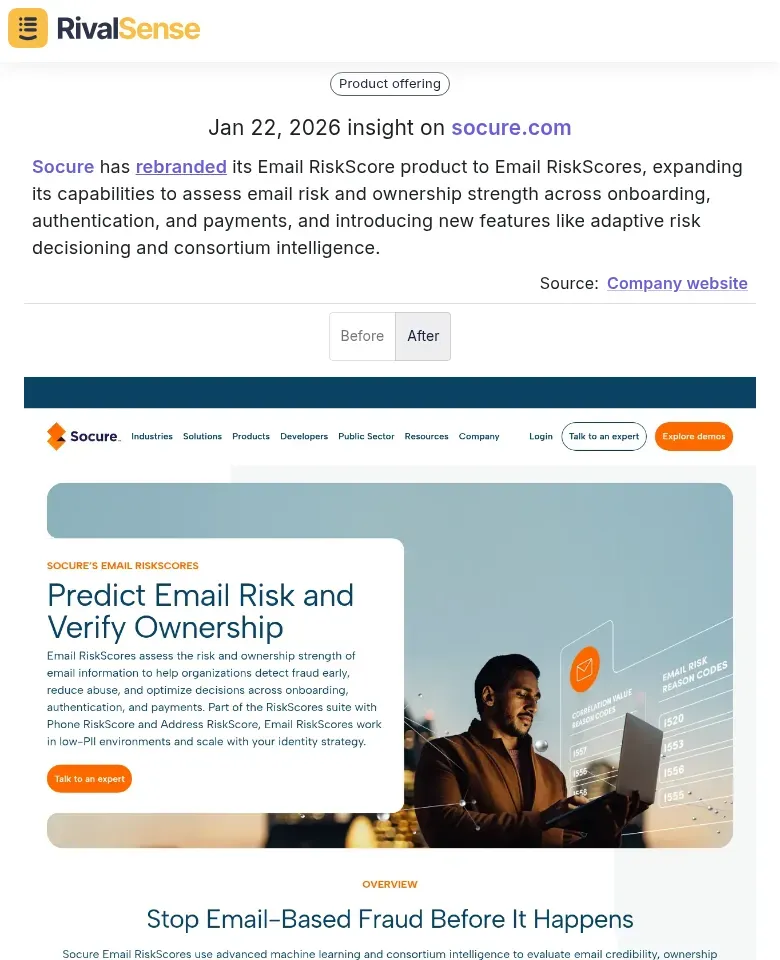
Why this matters for your strategy: Tracking such product evolutions helps you anticipate competitor enhancements that your key accounts might desire, allowing you to proactively address feature gaps or highlight your own differentiators before accounts consider switching.
3. Automated Intervention Workflows
Transform insights into action with automated workflows:
- Level 1 Alerts: Automated email to account manager with suggested talking points
- Level 2 Alerts: Scheduled check-in meeting with predefined agenda
- Level 3 Alerts: Executive escalation with prescribed action plan
Common Pitfalls to Avoid
1. Data Overload
Too many metrics create noise, not insight. Focus on what matters most.
2. Lack of Action Integration
Dashboards that don't connect to workflows become "shelfware." Ensure every alert has a corresponding action.
3. Ignoring Competitive Context
Your accounts are being courted by competitors. Without competitive intelligence, you're flying blind.
4. One-Size-Fits-All Approach
Different account tiers need different metrics. Enterprise accounts might prioritize strategic alignment, while SMBs focus on ROI and ease of use.
Measuring Success: Quantifiable ROI Metrics
Track these KPIs to demonstrate dashboard effectiveness:
- Churn Reduction: Percentage decrease in key account attrition
- Retention Rate Improvement: Increase in renewal rates
- Expansion Revenue: Additional revenue from existing accounts
- Time Savings: Reduction in manual monitoring hours
- Customer Satisfaction: Improvement in NPS or CSAT scores
📈 Real Results: Companies implementing comprehensive health dashboards typically see:
- 25-35% reduction in key account churn
- 30-40% increase in identified upsell opportunities
- 15-20 hours saved monthly per account manager
- 20-25% improvement in customer satisfaction scores
Competitive Intelligence: The Missing Piece
While internal health metrics are crucial, they only tell half the story. Your competitors are actively targeting your key accounts, and without external intelligence, you're vulnerable to surprise attacks.
How RivalSense Enhances Your Account Health Strategy:
RivalSense tracks 80+ sources including competitor websites, social media, regulatory filings, and industry publications to deliver weekly intelligence on:
- Product Launches & Updates: Know when competitors release features your accounts might want
- Pricing Changes: Monitor competitor pricing strategies that could impact your value proposition
- Management Moves: Track personnel changes that signal strategic shifts
- Partnership Announcements: Identify new alliances that could threaten your position
- Event Participation: See where competitors are investing their marketing efforts
📈 Real RivalSense Insight Example: Autotransporta direkcija confirms new increased ticket prices for regional public transport in Latvia starting January 15, 2026, while keeping social discounts and subscription benefits unchanged. 
Strategic value: Monitoring such pricing changes enables you to adjust your value proposition and pricing strategies to remain competitive, especially when negotiating with cost-sensitive accounts or defending against competitor offers.
🚀 Another RivalSense Insight Example: Helsing stated on January 19 that its HX-2 drone has been approved for frontline use in Ukraine after successful testing, with the Ukrainian army requesting over 1,000 units and the company delivering several hundred per month. 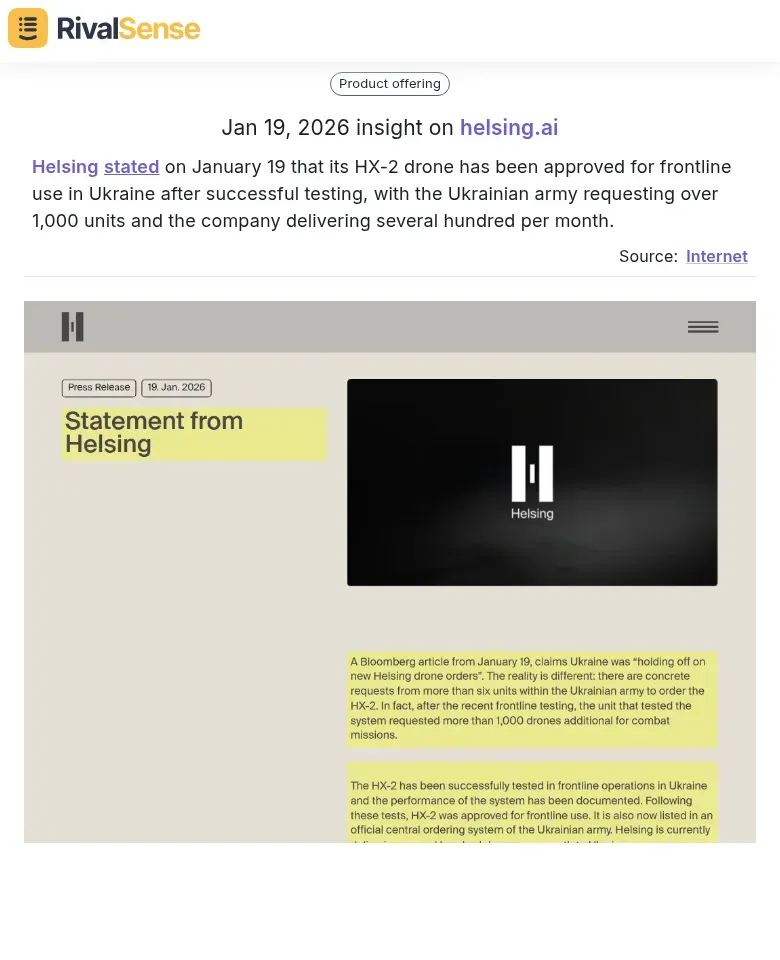
Why this insight is crucial: Such announcements signal competitor growth, market validation, and potential shifts in resource allocation, helping you assess competitive threats and opportunities in your accounts' industries, allowing for more informed strategic discussions.
🔍 Practical Application: When RivalSense alerted a client that their main competitor had hired a new VP of Enterprise Sales with experience in their key vertical, they immediately implemented a proactive outreach campaign to reinforce relationships with at-risk accounts, resulting in zero defections despite aggressive competitor targeting.
Getting Started: Your 30-Day Action Plan
Week 1: Foundation
- Identify your top 10 key accounts
- Define 3-5 critical health metrics
- Map existing data sources
Week 2: Build
- Create simple spreadsheet prototype
- Test health scoring model
- Gather initial feedback from account managers
Week 3: Implement
- Set up basic dashboard (Power BI/Tableau)
- Establish alert thresholds
- Create response protocols
Week 4: Optimize & Expand
- Review initial results
- Refine metrics and thresholds
- Plan expansion to next 20 accounts
- Bonus: Sign up for RivalSense free trial to add competitive context
Conclusion: The Future of Account Management
Key account health dashboards are no longer optional—they're essential tools for modern B2B success. As we move through 2026, the most successful organizations will be those that combine internal health monitoring with external competitive intelligence to create truly comprehensive account management strategies.
Remember: Your dashboard is only as valuable as the actions it inspires. Build it, use it, and continuously refine it based on real-world results.
🚀 Ready to Transform Your Account Management?
Start building your key account health dashboard today, and consider enhancing it with competitive intelligence from RivalSense. Track competitor product launches, pricing updates, management changes, and strategic moves across 80+ sources—all delivered in a convenient weekly email report.
👉 Try RivalSense for free today and get your first competitor intelligence report to start making more informed account management decisions.
About RivalSense: RivalSense helps B2B companies track competitor product launches, pricing updates, event participations, partnerships, regulatory aspects, management changes, and media mentions across company websites, social media, and various registries (80+ sources), delivering all in a weekly email report.
Related Resources
- [Competitor Benchmarking Mastery: Track Funding Signals for Strategic Insights]
- [Automating Key Account Intelligence: A Strategic Guide for HR Tech Leaders]
- [2026 Competitor Website Trends: Decode Strategy Shifts Before They Happen]
- [Performance Marketing Competitor Analysis: A Beginner's Guide to Boosting ROI]
📚 Read more
👉 A Practical Guide to Building a Key Account Management Framework for Software Development
👉 How Revolut's Virtual Card Designs Sparked Competitor Loyalty Program Innovation
👉 The Beginner's Guide to Tracking Competitor Website Changes for Key Account Success
👉 How Fleet Management Leaders Monitor Competitor Regulatory Filings for Strategic Advantage
👉 Predictive Analysis: Forecast Competitor Event Participation for B2B Success