
The Strategic Benefits of Tracking Emerging Competitors: Your Early Warning System
19 March 2026
Competitor monitoring often focuses on established players—the usual suspects you see in every industry report. But the most significant threats and opportunities frequently come from businesses you haven't noticed yet. Emerging competitors—startups with fresh funding, established companies pivoting into your space, or innovative solutions from adjacent markets—represent both potential disruption and valuable market intelligence.
Tracking these emerging players isn't just about watching for threats; it's about building an early warning system that gives you time to understand, adapt, and potentially collaborate before market dynamics shift irreversibly.
Why Emerging Competitors Deserve Your Attention
1. Early Market Signal Detection
Emerging competitors often signal where markets are heading before mainstream players recognize the trend. When a startup secures significant funding for a novel approach or an established company announces a strategic pivot, they're essentially placing bets on future market directions. Tracking these moves provides you with:
- Validation of market opportunities: If multiple players are entering a space, it suggests growing market demand
- Insight into investor confidence: Funding rounds reveal what sophisticated investors believe will succeed
- Early technology adoption signals: New entrants often adopt emerging technologies before incumbents
Real-world example: When Metaview launched Application Review, a tool that reviews every applicant in real time, it highlighted the growing demand for AI-driven recruitment solutions. This type of product launch insight can validate market opportunities and inspire your own innovation.
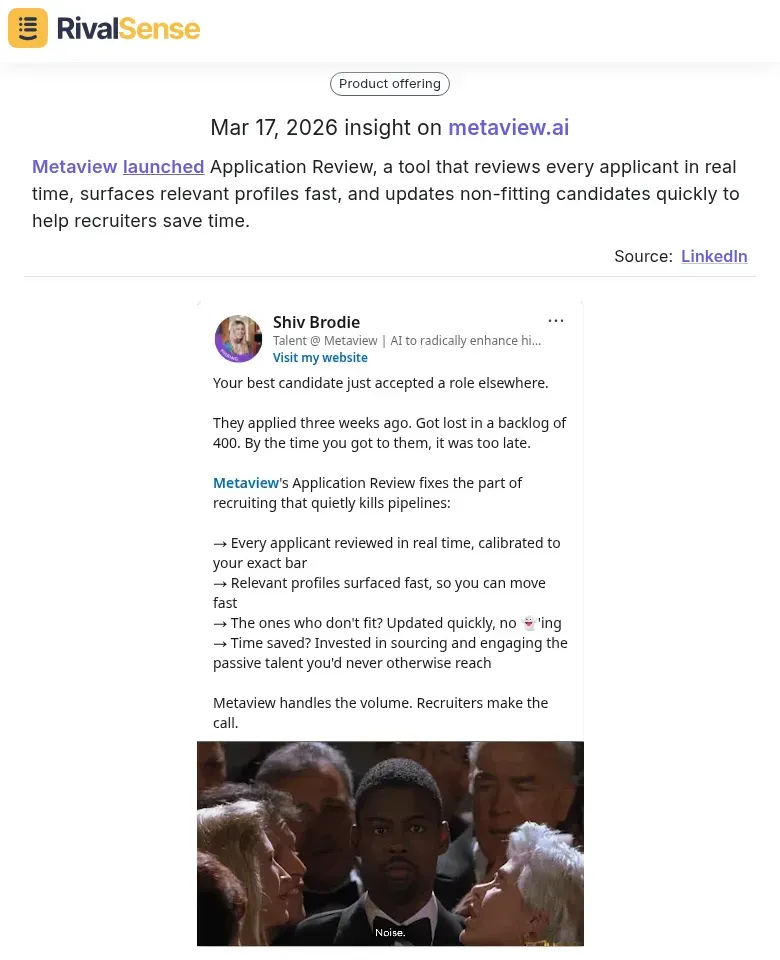
Why it matters: Tracking product launches helps you spot emerging trends early, allowing you to adapt your strategy before competitors gain market share.
2. Strategic Preparation Time
The biggest advantage of tracking emerging competitors early is the gift of time. When you spot a potential competitor in their formative stages, you gain months—sometimes years—to:
- Analyze their approach without competitive pressure
- Develop counter-strategies before they gain significant market share
- Consider partnership opportunities when they're most open to collaboration
- Adjust your own roadmap based on validated market directions
Real-world example: Regulatory insights can provide crucial preparation time. For instance, ANPC issued fines totaling over 1.49 million lei to gas stations for unfair pricing practices. Monitoring such regulatory actions helps you anticipate industry scrutiny and adjust your compliance strategies.

Why it matters: Regulatory insights serve as an early warning for potential risks, enabling proactive measures to avoid penalties and maintain reputation.
3. Innovation Inspiration
Emerging competitors often approach problems with fresh perspectives unburdened by legacy thinking or existing customer expectations. Their solutions can provide:
- New feature ideas you might not have considered
- Alternative business models worth evaluating
- Customer experience innovations that raise market expectations
- Technology applications that could enhance your own offerings
Real-world example: When Aurascape unveils a new zero-bypass MCP gateway and expands its AI security platform, it showcases advanced technology adoption in enterprise security. Such announcements can reveal new applications for AI and inspire your product development.
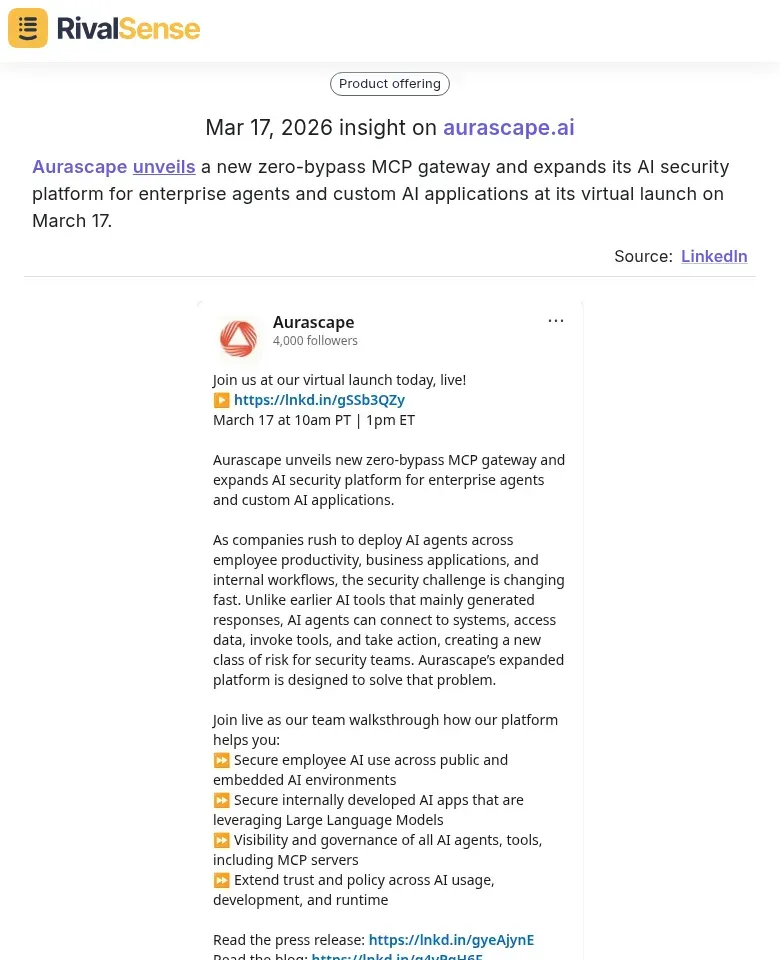
Why it matters: Tracking technology launches gives you inspiration for innovation, helping you stay competitive and explore new market opportunities.
Practical Framework: How to Identify and Track Emerging Competitors
Identifying and tracking emerging competitors requires a structured approach. Without a systematic method, you might miss critical signals or waste resources on irrelevant data. Here's a practical framework to establish your early warning system.
Step 1: Establish Your Monitoring Funnels
Create systematic channels for discovering new market entrants:
Primary Discovery Channels:
- Funding databases: Crunchbase, PitchBook, AngelList
- Product launch platforms: Product Hunt, BetaList, Launching Next
- Industry publications and newsletters
- Regulatory filings for new business registrations
- Patent and trademark databases
Secondary Signal Channels:
- Social media monitoring for announcement patterns
- Job board analysis for hiring spikes in specific roles
- Conference and event participation tracking
- Partnership announcement monitoring
Step 2: Develop Your Early Warning Signal Checklist
Monitor these specific indicators that often precede significant competitive moves:
Funding Signals:
- [ ] Series A or larger funding rounds ($5M+)
- [ ] Strategic corporate investment
- [ ] Multiple funding rounds in quick succession
- [ ] Participation from tier-1 venture firms
Hiring Patterns:
- [ ] Sudden engineering team expansion
- [ ] Key executive hires from established players
- [ ] Specialized role creation (e.g., "Head of AI")
- [ ] Geographic expansion hiring
Product Development Indicators:
- [ ] Beta program announcements
- [ ] Patent filings in your core areas
- [ ] Technology partnership announcements
- [ ] Regulatory approval applications
Market Positioning Signals:
- [ ] Messaging shifts toward your core market
- [ ] Pricing experiments in your segments
- [ ] Customer case studies in your industries
- [ ] Channel partnership development
Step 3: Implement Your Tracking System
Manual Tracking Approach:
- Weekly review cadence: Set aside 30 minutes each week to check your discovery channels
- Competitor profile creation: Document basic information for each new entrant
- Signal categorization: Tag each observation by type (funding, hiring, product, etc.)
- Impact assessment: Rate potential threat/opportunity level (low/medium/high)
Automated Tracking Solution:
For comprehensive coverage without manual effort, consider specialized tools like RivalSense, which monitors 80+ sources including company websites, social media, regulatory registries, and industry databases. These platforms deliver consolidated weekly reports covering:
- Product launches and updates
- Pricing changes
- Event participation
- Partnership announcements
- Regulatory developments
- Management changes
- Media mentions
This automated approach ensures you never miss critical signals while freeing your team to focus on analysis and strategy rather than data collection.
Actionable Insights: Turning Signals into Strategy
When You Spot an Emerging Competitor
Immediate Actions (First 48 Hours):
- Create a competitor profile with available information
- Assess funding and backing to gauge their runway and credibility
- Analyze founding team background for experience patterns
- Review initial product/market fit based on early messaging
Strategic Assessment (First Week):
- Map their approach against your current offerings
- Identify potential differentiation points
- Assess threat timeline (immediate vs. long-term)
- Determine monitoring frequency based on threat level
Response Framework Based on Threat Level
Low Threat / High Opportunity:
- Add to regular monitoring list
- Consider partnership exploration
- Extract innovation insights for your roadmap
- Monitor for pivot points
Medium Threat / Watch Closely:
- Increase monitoring frequency
- Develop contingency plans
- Consider preemptive positioning moves
- Engage in competitive analysis exercises
High Threat / Immediate Action Required:
- Activate response team
- Accelerate relevant roadmap items
- Consider strategic counter-moves
- Prepare customer communication plans
Common Mistakes to Avoid
1. Overlooking Indirect Competitors
Many businesses focus only on direct competitors while missing companies solving the same customer problems through different approaches. Remember that:
- Spreadsheet templates compete with dedicated software
- Manual services compete with automation platforms
- Free tools compete with premium solutions
2. Ignoring Geographic Expansion Patterns
Emerging competitors often test markets geographically before broader launches. Track:
- Localized hiring in new regions
- Language-specific website versions
- Regional partnership announcements
- Country-specific regulatory approvals
3. Underestimating Pivot Potential
Established companies in adjacent markets often have resources to pivot quickly. Monitor:
- Corporate venture investment patterns
- Strategic acquisition activity
- Executive team changes signaling new directions
- R&D spending shifts
Building Your Early Warning System
Weekly Monitoring Checklist
- [ ] Review funding databases for new rounds in your space
- [ ] Check product launch platforms for new solutions
- [ ] Scan regulatory filings for new business registrations
- [ ] Monitor hiring boards for pattern changes
- [ ] Review partnership announcements
- [ ] Update competitor profiles with new information
- [ ] Assess signal patterns for trend identification
Monthly Strategic Review
- [ ] Update competitive landscape map
- [ ] Reassess threat/opportunity ratings
- [ ] Review response protocol effectiveness
- [ ] Share insights with relevant teams
- [ ] Adjust monitoring priorities based on findings
The RivalSense Advantage: Automated Emerging Competitor Tracking
While manual tracking provides basic coverage, comprehensive emerging competitor monitoring requires systematic attention to dozens of signal sources. RivalSense addresses this challenge by:
Comprehensive Source Coverage:
- Monitoring 80+ data sources including websites, social media, regulatory databases, and industry publications
- Tracking product launches, pricing changes, and feature updates
- Capturing partnership announcements and event participation
- Following management changes and hiring patterns
Structured Intelligence Delivery:
- Weekly consolidated email reports
- Categorized insights by competitor and signal type
- Prioritized alerts based on potential impact
- Historical tracking for pattern analysis
Strategic Time Savings:
- Eliminating manual data collection effort
- Reducing signal-to-noise ratio through intelligent filtering
- Providing consistent monitoring regardless of team bandwidth
- Enabling focus on analysis rather than data gathering
Key Takeaways for Business Leaders
- Emerging competitors represent your most valuable intelligence source for future market directions
- Early detection provides strategic preparation time that established competitors don't offer
- Systematic tracking requires both broad discovery and focused monitoring
- Automated tools like RivalSense transform signal collection from a chore into a strategic advantage
- The real value comes from translating signals into actionable strategy, not just collecting information
Next Steps for Your Organization
- Conduct an emerging competitor audit using the framework above
- Establish your monitoring system (manual or automated)
- Develop response protocols for different threat levels
- Integrate emerging competitor insights into your strategic planning cycles
- Consider specialized tools if manual tracking becomes unsustainable
Tracking emerging competitors isn't about paranoia—it's about strategic foresight. In today's rapidly evolving markets, the businesses that succeed aren't necessarily the ones with the best current products, but those that can see where the market is heading and position themselves accordingly. Your emerging competitor tracking system is your lens into that future.
Ready to automate your competitor tracking? Try RivalSense for free at https://rivalsense.co/ and get your first competitor report today to start building your early warning system.
About RivalSense: RivalSense provides automated competitor tracking across 80+ sources, delivering consolidated weekly reports on product launches, pricing updates, event participation, partnerships, regulatory changes, management updates, and media mentions. Designed for founders and business leaders who need comprehensive competitive intelligence without manual effort.
Adam Hausman has worked with competitive intelligence platforms since 2018 and is passionate about helping businesses transform market signals into strategic advantage. He holds degrees from Indiana University and the University of Illinois-Chicago and lives in Maine with his family.
📚 Read more
👉 How to Conduct Fleet Management Competitor Analysis for Strategic Advantage
👉 How RivalSense Alerted Competitors to BoursoBank’s Rate Hike for Strategic Response
👉 Competitor Website Changes Cheat Sheet for Key Account Managers
👉 Step-by-Step Guide to Tracking Competitor Partnerships in Public Transportation
👉 How to Conduct a Regulatory Competitor SWOT Analysis for Strategic Insights