
The Strategic Advantage: 7 Key Benefits of a Dedicated Key Account Manager
In today's competitive B2B landscape, where customer acquisition costs continue to rise and retention becomes increasingly critical, the role of a dedicated Key Account Manager (KAM) has evolved from a luxury to a strategic necessity. As we examine successful organizations like Danone's Nutricia division—which recently sought a dedicated KAM for their healthcare nutrition team in Queensland—we uncover compelling evidence that specialized account management delivers measurable business outcomes.
Why Dedicated Key Account Management Matters More Than Ever
Research from RAIN Group reveals that companies with effective key account management programs are:
- 3.1X more likely to grow revenue by 20% or more in their key accounts
- 3.4X more likely to grow profit by 20% or more
- 4.5X more likely to experience year-over-year client satisfaction improvement
But what specifically makes a dedicated Key Account Manager different from general account management? Let's explore the seven strategic benefits that justify this specialized investment. Understanding these benefits helps founders and CEOs allocate resources effectively to protect and grow their most valuable client relationships.
Benefit 1: Deep Relationship Building and Trust Development
A dedicated KAM serves as the single point of contact for your most valuable clients, allowing for relationship depth that general sales teams simply cannot achieve. This focused approach enables consistent communication and a deep understanding of client needs over time. By having one person deeply embedded in the account, trust is built through reliability and personalized attention, which is essential for long-term partnerships.
Practical Checklist for Relationship Building:
- Monthly strategic reviews with key stakeholders
- Quarterly business reviews focusing on mutual value creation
- Annual relationship mapping to identify new connections and influencers
- Regular value documentation to demonstrate ROI and build trust
Example: The Danone KAM role specifically mentions "building robust connections with healthcare professionals" and "understanding the unique needs of oncology patients"—relationships that require specialized, dedicated attention.
Benefit 2: Strategic Account Growth and Expansion
Unlike general sales roles focused on new customer acquisition, dedicated KAMs concentrate on penetrating existing accounts more deeply. This strategic focus allows for identifying untapped opportunities within current clients. Research shows that new business from key accounts is 60-70% more likely to close compared to the 5-20% likelihood with new clients.
5-Step Account Growth Framework:
- Account Assessment: Evaluate current revenue, growth potential, and relationship strength
- Stakeholder Mapping: Identify all decision-makers and influencers
- Value Gap Analysis: Uncover unmet needs and expansion opportunities
- Growth Strategy Development: Create tailored expansion plans
- Execution and Review: Implement and measure growth initiatives
Benefit 3: Competitive Defense and Market Intelligence
A dedicated KAM serves as your frontline intelligence officer, monitoring competitive threats and protecting your most valuable accounts. This proactive stance helps in anticipating moves that could jeopardize your position. For instance, tracking competitor product launches can alert you to new threats. Tools like RivalSense become invaluable here—while your KAM builds relationships, RivalSense tracks competitor movements across 80+ sources, delivering weekly reports on product launches, pricing changes, partnerships, and management shifts.
Example: RivalSense detected that Apple has updated its product lineup by replacing AirPods Max with AirPods Max 2. 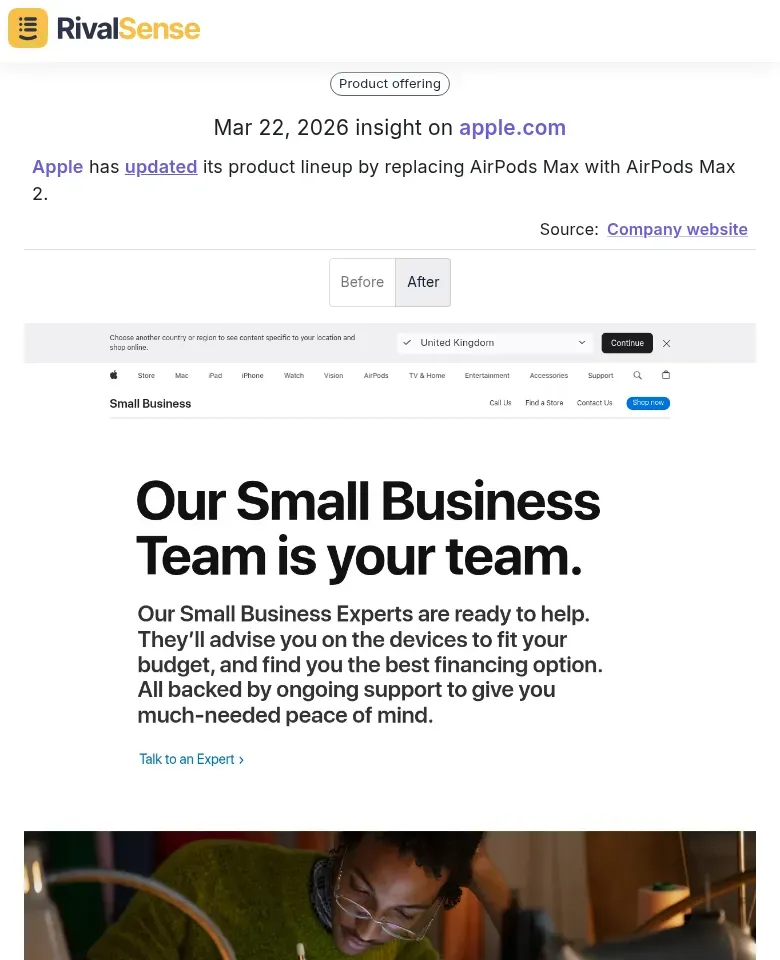 This type of insight is valuable because it helps you anticipate competitive moves and prepare your response to protect key accounts, ensuring your offerings remain relevant.
Competitive Intelligence Checklist:
- Monitor competitor product launches that could threaten your position
- Track pricing changes that could trigger client negotiations
- Watch for competitor partnerships that could create new threats
- Stay informed about management changes that could affect relationships
Benefit 4: Customized Value Delivery and Solution Development
Dedicated KAMs have the bandwidth to develop truly customized solutions rather than pushing standard offerings. This tailored approach ensures that solutions align precisely with client objectives. The Danone example highlights this with their focus on "optimizing patient and organizational outcomes" through tailored medical nutrition solutions.
Value Creation Framework:
- Understand client business objectives beyond immediate needs
- Map your capabilities to their strategic goals
- Co-create solutions rather than just selling products
- Measure and communicate value regularly
Benefit 5: Improved Customer Retention and Reduced Churn
Statistics show that a 5% increase in customer retention can increase profits by up to 95%. Dedicated KAMs dramatically improve retention through proactive relationship management and early problem detection. By having a dedicated point of contact, issues are resolved quickly, and clients feel valued, reducing the likelihood of churn.
Retention Strategy Checklist:
- Quarterly satisfaction assessments to identify issues early
- Proactive renewal planning starting 6 months before contract end
- Value reinforcement throughout the relationship lifecycle
- Executive sponsorship development at multiple levels
Benefit 6: Enhanced Cross-Selling and Upselling Opportunities
With deep account knowledge, dedicated KAMs can identify cross-selling opportunities that general sales teams might miss. This deep understanding comes from continuous engagement and strategic account planning. The Danone role specifically mentions "collaborating with the wider team and other internal functions" to deliver comprehensive solutions.
Cross-Sell Optimization Tips:
- Create account maps showing all potential solution touchpoints
- Develop internal collaboration processes between departments
- Track usage patterns to identify natural expansion opportunities
- Align compensation structures to reward cross-selling success
Benefit 7: Strategic Partnership Development
Dedicated KAMs transform vendor-client relationships into strategic partnerships. This evolution involves moving beyond transactional interactions to shared goals and mutual investment. As the Danone job description notes, they seek someone who can "navigate healthcare organisations and interact with various stakeholders to uncover needs and drive large-scale value."
Example: Monitoring industry partnerships can reveal new opportunities or threats. RivalSense tracked Le Bon Marché's gourmet food hall La Grande Épicerie partnering with Hyundai Department Store for its first Asian collaboration, launching joint marketing and selling over 400 French food items online and in stores.  This insight is valuable for understanding how competitors are expanding globally and forming alliances, which can inform your own partnership strategies and competitive positioning.
Partnership Development Framework:
- Transactional Relationship: Basic vendor-client interaction
- Cooperative Relationship: Some collaboration on shared goals
- Integrated Relationship: Deep collaboration and shared processes
- Strategic Partnership: Joint business planning and mutual investment
Implementing a Successful Dedicated KAM Program: Practical Steps
Based on the Danone example and industry best practices, here's your implementation roadmap. Following these steps ensures a structured approach to deploying dedicated KAMs effectively.
Step 1: Account Selection Criteria
- Current revenue and growth potential
- Strategic importance to your business
- Relationship depth and expansion opportunities
- Competitive vulnerability and protection needs
Step 2: KAM Role Definition
- Clear responsibilities beyond basic sales
- Authority levels and decision-making boundaries
- Performance metrics focused on long-term value
- Collaboration requirements with other departments
Step 3: Support Systems Implementation
- Competitive intelligence tools like RivalSense to track market movements
- CRM systems with dedicated account planning modules
- Internal collaboration platforms for cross-functional teamwork
- Analytics tools for measuring account health and growth
Step 4: Measurement and Optimization
- Track account growth rates and profitability
- Measure customer satisfaction and NPS scores
- Monitor competitive displacement and protection
- Evaluate cross-sell and upsell success rates
The Competitive Intelligence Advantage
While your dedicated KAM focuses on building relationships and delivering value, maintaining competitive awareness is crucial. Automated solutions like RivalSense provide strategic advantage by tracking competitor activities in real-time. For example, RivalSense detected that Huel is joining Danone, as announced by Brian Hopkins-Parkinson, Global Retail Director at Huel.  This type of insight into management announcements and strategic collaborations is valuable because it helps you anticipate shifts in competitor strategies and align your key account management approach accordingly.
RivalSense delivers weekly reports on product launches, pricing updates, event participations, partnerships, regulatory aspects, management changes, and media mentions across company websites, social media, and various registries. This comprehensive monitoring ensures your KAMs are always informed without manual research.
Conclusion: The ROI of Dedicated Key Account Management
Investing in dedicated Key Account Managers isn't an expense—it's a strategic investment with measurable returns. Companies that excel at key account management see dramatically better growth, profitability, and customer satisfaction. By combining dedicated human expertise with competitive intelligence tools like RivalSense, you create a powerful ecosystem for protecting and growing your most valuable assets: your key accounts.
Final Checklist for Success:
- [ ] Select accounts based on strategic value, not just revenue
- [ ] Define clear KAM roles and responsibilities
- [ ] Implement support systems and competitive intelligence tools
- [ ] Establish measurement frameworks for long-term success
- [ ] Foster internal collaboration and executive support
- [ ] Continuously monitor competitive landscape and adjust strategies
In an increasingly competitive market, the combination of dedicated human relationship building and automated competitive intelligence creates an unbeatable advantage for protecting and growing your most valuable business relationships.
Ready to enhance your key account management strategy? Try out RivalSense for free at https://rivalsense.co/ to get automated competitor insights that support your KAMs. Get your first competitor report today and stay ahead of the competition!
📚 Read more
👉 Beginner's Guide: Competitive Intelligence Software Benefits for IT Asset Management
👉 How Intel Countered NVIDIA's Visteon Deal with Edge AI Partnerships
👉 Best Practices: Analyzing Competitor Brand Perception on Facebook
👉 Advanced Tactics: Tracking Video Conferencing Leaders for Strategic Edge
👉 How Competitor Insights Solve Market Entry Challenges for Key Account Success