
Strategic Account Tracking Tools: IT Consulting's Competitive Edge Analysis
Introduction: The Strategic Imperative of Account Tracking in IT Consulting
In today's hyper-competitive IT consulting landscape, strategic account tracking has evolved from a nice-to-have to a business-critical imperative. The difference between reactive monitoring and proactive competitive advantage lies in how you leverage account intelligence. Top-performing consulting firms now use specialized tools to transform raw data into actionable insights.
Practical Implementation Checklist:
✅ Identify Key Accounts: Prioritize your top 20% of clients generating 80% of revenue
✅ Monitor Competitor Activity: Track competitor hiring, client wins, and service expansions
✅ Analyze Client Signals: Watch for budget changes, organizational restructuring, and technology stack updates
✅ Set Automated Alerts: Configure real-time notifications for critical account developments
Business Impact Framework:
- Revenue Protection: Early detection of competitor encroachment allows proactive defense strategies
- Client Retention: Anticipate client needs before they become pain points
- Market Expansion: Identify cross-selling opportunities through account intelligence
Pro Tip: Implement a weekly account intelligence review meeting where your leadership team analyzes tracked data and makes strategic decisions. This transforms intelligence from information gathering to competitive advantage creation.
Core Capabilities of Strategic Account Tracking Tools
Strategic account tracking tools provide three core capabilities that transform how IT consulting firms monitor competitive landscapes. First, real-time competitor monitoring tracks digital channels and market activities. For instance, tracking job postings can reveal a competitor's strategic focus areas.
Why it matters: Monitoring hiring patterns, like Rula's search for a Director of Revenue Strategy & Planning, signals expansion into B2B revenue strategy and can alert you to new competitive threats in your key accounts.
Second, account intelligence aggregation consolidates data from multiple sources. Create a centralized dashboard showing each competitor's relationship strength, recent engagements, and decision-maker access across your key accounts.
Third, predictive analytics identifies client vulnerability and expansion opportunities by analyzing patterns. Actionable step: Use scoring models to flag accounts where competitors are 40%+ likely to win business in the next quarter, then develop targeted retention strategies.
Implementation checklist:
- Map your top 50 accounts and their current competitors
- Define key monitoring metrics (win/loss rates, client satisfaction scores)
- Establish weekly review cadences for predictive insights
- Train account teams on interpreting vulnerability scores
- Integrate tracking data into quarterly business reviews for proactive strategy adjustments
Key Features Differentiating Top Account Tracking Solutions
When evaluating strategic account tracking solutions, focus on three critical differentiators. First, automated competitive intelligence gathering with AI-powered alert systems is non-negotiable. These systems monitor management changes that can indicate strategic shifts.
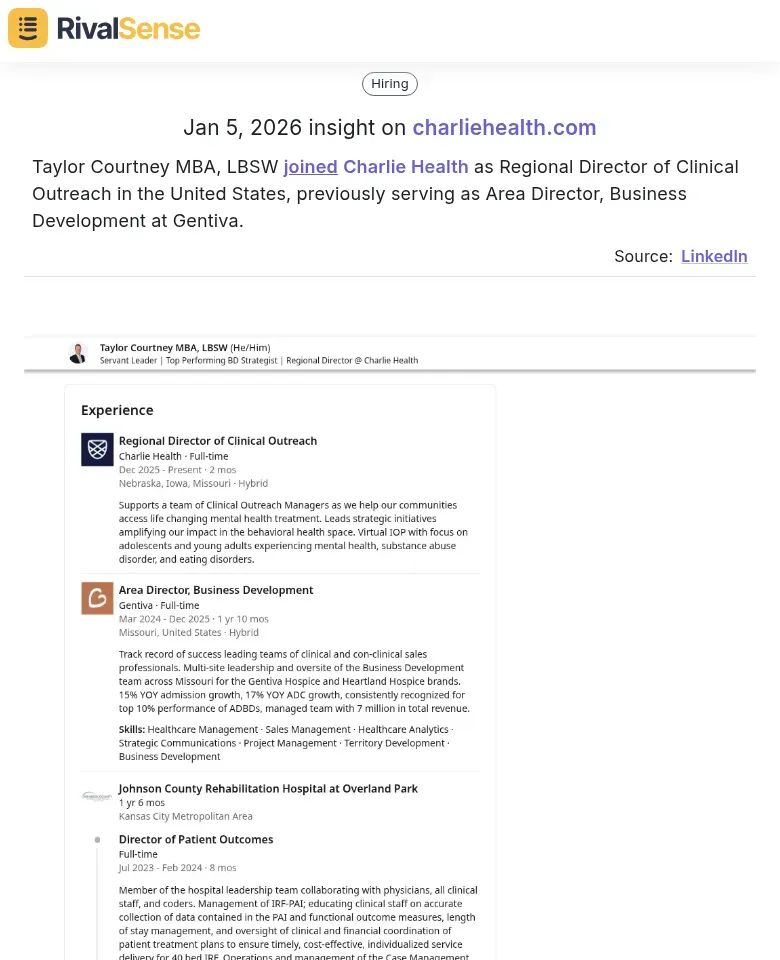
Why it matters: Tracking executive moves, like Taylor Courtney joining Charlie Health as Regional Director of Clinical Outreach, helps you anticipate new market initiatives or partnership opportunities from competitors.
Second, seamless integration capabilities with CRM systems and existing consulting workflows determine adoption success. Look for platforms offering two-way Salesforce/HubSpot integration.
Third, customizable dashboards and reporting must serve different stakeholder needs. Partners need executive summaries, while delivery teams require detailed feature comparisons.
Checklist for tool selection:
- Ensure real-time alerts for competitor activities
- Verify CRM integration capabilities
- Create role-based dashboards for sales, leadership, and consultants
Implementation Framework for IT Consulting Firms
Assessment Phase: Start by identifying your most critical accounts using a weighted scoring framework. Evaluate accounts across revenue potential, strategic fit, growth potential, and partnership value.
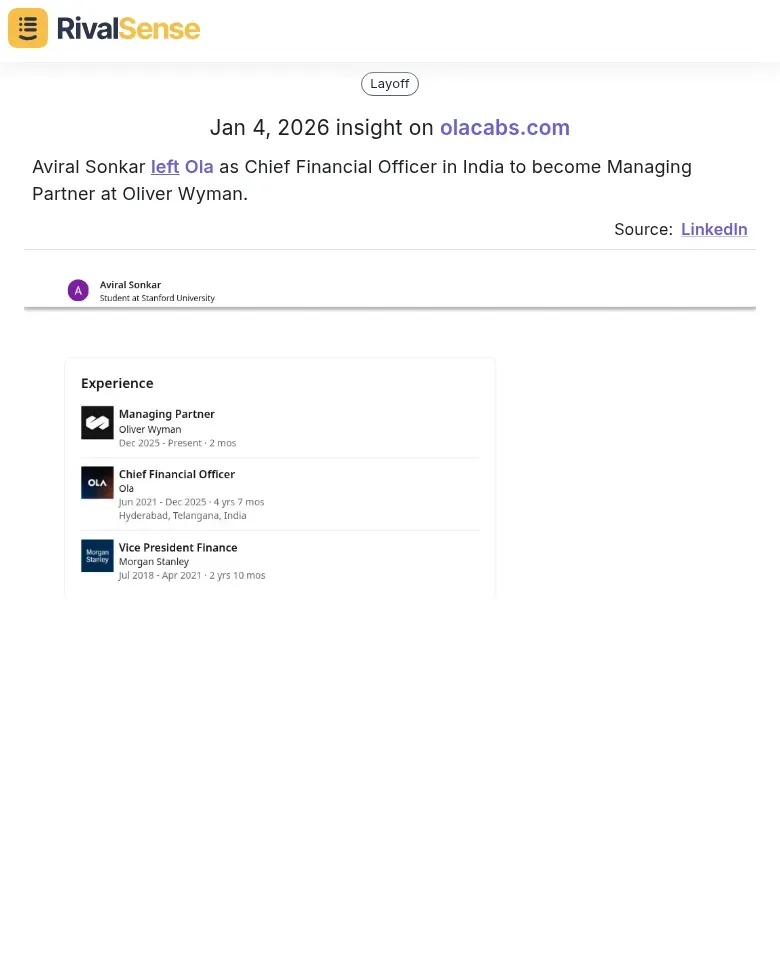
Why it matters: Monitoring executive departures, like Aviral Sonkar leaving Ola as CFO, can signal internal restructuring or new strategic directions, helping you assess competitive threats in your accounts.
Tool Selection Criteria: Choose tools that scale with your consulting growth. Prioritize platforms with API integration to connect with your CRM, project management, and billing systems.
Change Management: Implement a phased rollout starting with your top 5 accounts. Create role-specific training modules and embed tools into existing processes.
Practical step: Assign "tool champions" in each practice area to drive adoption and gather feedback for continuous improvement.
Measuring Success and ROI of Account Tracking Initiatives
Measuring the success of account tracking initiatives requires a data-driven approach. First, track key performance indicators like client retention rates and competitive win rates. Second, quantify business impact through revenue protection and expansion metrics. Third, implement continuous improvement by analyzing insights quarterly.
Practical steps:
- Establish baseline metrics before implementation
- Track monthly performance dashboards
- Conduct win/loss analysis on competitive deals
- Adjust service offerings based on competitor weaknesses
- Share insights across delivery teams to refine client engagement
Future Trends: AI and Advanced Analytics in Account Intelligence
The future of strategic account tracking is evolving from passive monitoring to AI-powered predictive intelligence. Artificial intelligence now enables IT consulting firms to forecast competitor moves before they happen. These systems analyze historical data combined with real-time monitoring to identify vulnerabilities.
Practical implementation checklist:
✅ Deploy multimodal sentiment analysis platforms
✅ Implement AI-powered supply chain intelligence networks
✅ Use predictive analytics to forecast market movements 3-6 months ahead
✅ Integrate automated competitive response systems
✅ Establish cross-functional intelligence teams
By 2027, 95% of sellers' research workflows will begin with AI, making early adoption a critical competitive advantage.
Ready to Elevate Your Competitive Strategy?
Leveraging account tracking tools can transform how you protect and grow your IT consulting business. To get started with actionable competitor insights, try RivalSense for free. RivalSense tracks competitor product launches, pricing updates, event participations, partnerships, regulatory aspects, management changes, and media mentions across various sources, delivering a comprehensive weekly email report.
👉 Get your first competitor report today at https://rivalsense.co/
📚 Read more
👉 How Hubstaff's SCIM Move Prompted Competitors to Accelerate Enterprise Security
👉 Actionable Internet Hacks for Competitive Positioning Insights
👉 Airline Competitive Intelligence Checklist: Track Rivals Like AirAsia 🛫
👉 How to Analyze Competitor Partnerships and Client Relationships for Strategic Insights
👉 Decoding Competitor Moves: A Real-World Analysis of Better Stack's Updates