
Regulatory Competitor Insights: A Checklist for Key Account Growth
For B2B leaders, regulatory compliance is often viewed as a defensive cost center—a necessary evil that drains resources. But what if you could transform compliance tracking into your most powerful competitive differentiator? Regulatory competitor insights provide exactly that opportunity, turning what was once a burden into your key account growth engine.
By systematically monitoring competitors' regulatory filings, compliance updates, and market adaptations, you gain a 3-6 month advantage in understanding market shifts before they become mainstream. This intelligence isn't just about avoiding penalties—it's about identifying emerging opportunities that competitors haven't yet capitalized on.
Practical steps to get started:
- Create a regulatory tracking dashboard for your top 5 competitors
- Monitor their FDA, SEC, or industry-specific filings weekly
- Analyze how they're adapting to new regulations 3-6 months before market-wide adoption
- Use these insights to initiate strategic conversations with key accounts about upcoming compliance needs
When you spot a competitor struggling with a new regulation or slowly adapting to compliance changes, you can proactively approach key accounts with solutions before they even realize they have a problem. This transforms regulatory intelligence from a defensive cost into offensive growth opportunities, positioning your company as the forward-thinking partner who sees around corners.
Certification and Compliance Milestones: Building Trust and Market Positioning
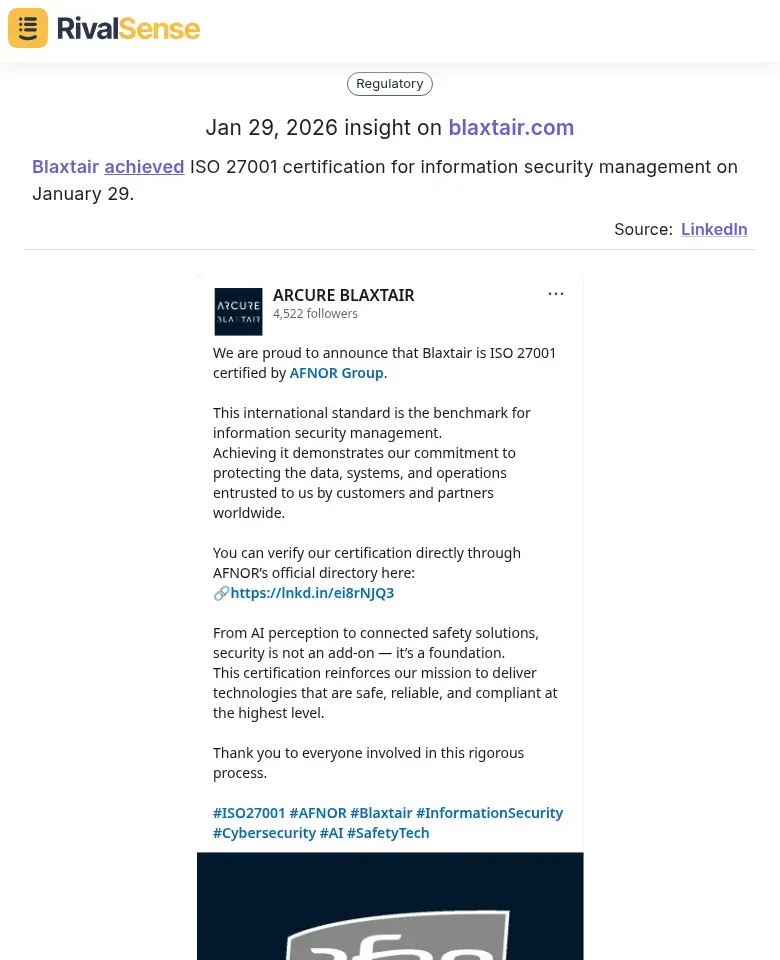
Certification and compliance milestones represent critical trust signals in regulated industries. Tracking these milestones can reveal strategic shifts in market positioning and competitive advantages. For instance, when Blaxtair achieved ISO 27001 certification for information security management on January 29, it signaled their commitment to data protection, which is invaluable for targeting security-conscious clients. This type of insight helps you benchmark your compliance maturity and identify gaps where you can position your solutions as more secure alternatives to key accounts.
Practical steps:
- Set up automated alerts for competitor certification announcements and compliance updates
- Monitor certification bodies' public databases and industry regulatory portals
- Track compliance investment patterns through job postings, R&D announcements, and partnership disclosures
- Analyze certification timelines to anticipate market shifts and regulatory expectations
When competitors lack key certifications, use this intelligence to target their vulnerable accounts with messaging emphasizing your superior compliance posture. Monitor when competitors' certifications expire or face challenges—these create immediate opportunities for account acquisition. Compliance tracking isn't just about meeting requirements; it's about identifying competitive weaknesses and positioning your solutions as the safer, more reliable choice for risk-averse enterprise clients.
Legal and Regulatory Investigations: Early Warning Signals for Risk Mitigation
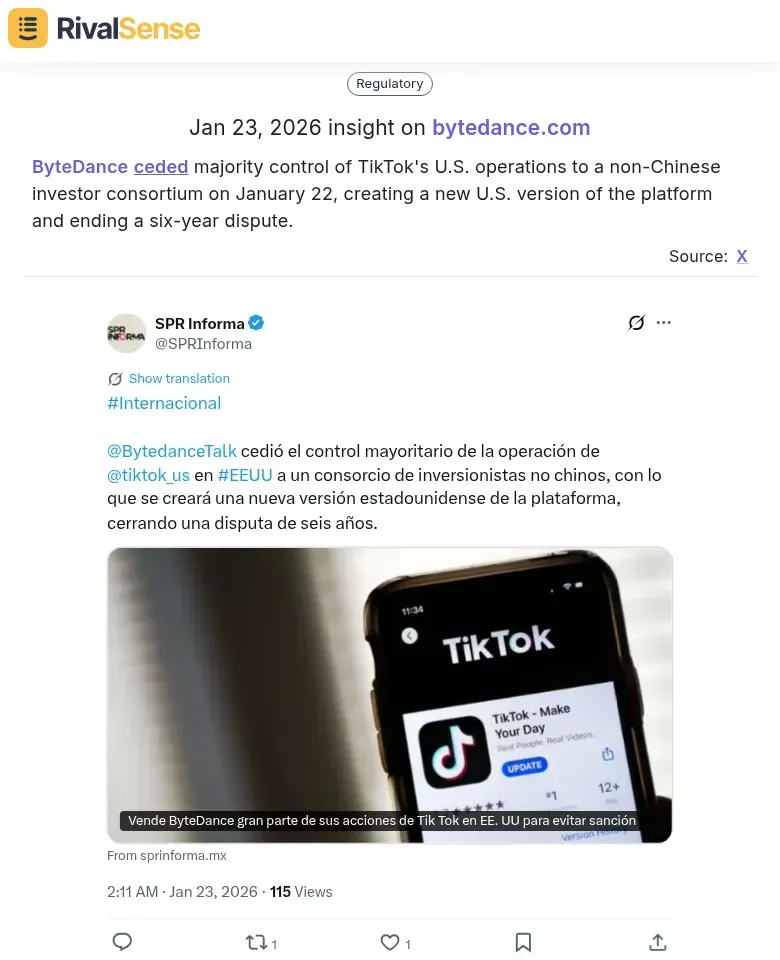
When competitors face regulatory scrutiny, it serves as an early warning signal for potential industry-wide compliance tightening. Monitoring these investigations helps you anticipate changes and mitigate risks proactively. For example, ByteDance ceding majority control of TikTok's U.S. operations to a non-Chinese investor consortium on January 22 ended a six-year regulatory dispute, highlighting how regulatory pressures can force major business restructuring. Insights like these are valuable for understanding geopolitical risks and adapting your strategy accordingly.
Benchmarking Checklist:
✅ Compare incident response times (aim for 20% faster than industry average)
✅ Audit training program comprehensiveness quarterly
✅ Measure regulatory approval speed against top performers
✅ Track compliance investment as percentage of revenue
Proactive Risk Mitigation Steps:
- Implement automated monitoring of regulatory filings using tools like RivalSense
- Create threshold alerts for enforcement actions and compliance changes
- Conduct quarterly competitor compliance audits
- When competitors face penalties (e.g., data privacy violations), immediately review and strengthen your own protocols
This approach demonstrates to key accounts that you're not just compliant—you're ahead of the curve, building trust through visible risk mitigation leadership that directly enhances retention and positions your solutions as compliance-ready alternatives.
Competition Law Violations: Identifying Market Gaps and Pricing Opportunities
When competitors face competition law violations, these regulatory failures reveal strategic market gaps you can exploit. These violations often stem from pricing or market practices that can be leveraged to your advantage. Analyze competitor pricing patterns that led to legal breaches—like Robinson-Patman Act violations where sellers charge different prices to competing buyers—to identify underserved customer segments. These violations often expose customer groups receiving unfavorable treatment, creating opportunities for fair, transparent pricing.
Map competitor restricted activities to market opportunities for compliant market entry. For example, if a competitor faced FTC action for discriminatory promotional allowances, develop a transparent, equitable promotional program available to all customers proportionately. This creates a competitive advantage while ensuring compliance.
Leverage competitor compliance failures in marketing to emphasize reliability and ethical practices. In your messaging, highlight your transparent pricing policies, equal treatment of all customers, and commitment to fair competition.
Practical checklist:
- Monitor competitor regulatory actions and settlements
- Identify customer segments affected by discriminatory practices
- Develop compliant alternatives to restricted activities
- Create marketing content contrasting your ethical approach with competitor violations
- Train sales teams on explaining your compliance advantages to prospects concerned about fair treatment
Class Action Lawsuits: Customer Trust Insights and Product Validation Requirements
Class action lawsuits against competitors reveal critical customer trust insights and product validation requirements. They provide a window into systemic issues that affect customer satisfaction and compliance. For instance, a tribunal ruled on January 27, 2026, that Valve must defend itself against a $900 million class action lawsuit regarding its pricing and commission practices. This insight is valuable for refining your own pricing transparency and avoiding similar legal pitfalls, while also identifying customer pain points you can address.
Analyze competitor litigation to identify recurring dissatisfaction patterns—track complaint themes across multiple cases to pinpoint systemic service gaps. Extract validation requirements from court rulings: document what evidence judges required to substantiate product claims, then implement those standards in your own substantiation processes.
Practical checklist:
- Monitor competitor class actions monthly using legal databases
- Categorize complaints by type (billing, data handling, performance claims)
- Document court-required validation standards for each product category
- Audit your claims against competitor litigation outcomes
- Implement enhanced transparency measures where competitors failed
For data handling vulnerabilities, analyze privacy-related lawsuits to identify where competitors lacked transparency or proper consent mechanisms. Build superior customer protection by addressing these gaps—implement clearer data usage explanations, simplified opt-out processes, and regular compliance audits. Use litigation outcomes as validation benchmarks for your own product claims, ensuring you meet or exceed court-established standards.
Implementation Framework: Turning Regulatory Insights into Account Growth
To operationalize regulatory competitor intelligence, implement this three-step framework. This systematic approach ensures that insights are translated into actionable strategies that drive revenue.
1. Automated Monitoring Infrastructure
- Deploy AI-powered tools to monitor 80+ regulatory sources including SEC filings, FDA announcements, state-level legislation, and industry-specific compliance portals
- Set up real-time alerts for competitor regulatory submissions, approvals, and compliance changes
- Create a centralized dashboard with competitor regulatory timelines and compliance status
2. Cross-Functional Translation Process
- Establish weekly regulatory review meetings with Sales, Marketing, and Product teams
- Develop a standardized template to convert regulatory changes into specific account opportunities
- Assign regulatory intelligence champions in each department to ensure timely action
- Create playbooks for common regulatory scenarios (e.g., new compliance requirements, competitor product approvals)
3. Impact Measurement System
- Track revenue growth from existing accounts exposed to regulatory changes
- Measure regulatory-driven deal velocity (time from regulatory alert to closed deal)
- Monitor win rates against competitors in regulated segments
- Calculate ROI of regulatory intelligence by comparing deal sizes with vs. without regulatory insights
Practical Checklist:
- [ ] Map all relevant regulatory bodies for your industry
- [ ] Configure automated alerts for top 5 competitors
- [ ] Create regulatory opportunity scoring matrix
- [ ] Establish quarterly regulatory impact reviews
- [ ] Train sales teams on regulatory talking points
By implementing this framework, you'll transform regulatory monitoring from passive observation into active account growth strategy, creating sustainable competitive advantage in regulated markets.
To effectively track these regulatory insights and turn them into growth opportunities, consider using a tool like RivalSense. RivalSense monitors competitor product launches, pricing updates, event participations, partnerships, regulatory aspects, management changes, and media mentions across company websites, social media, and various registries, delivering all in a weekly email report. Try RivalSense for free at https://rivalsense.co/ and get your first competitor report today to start leveraging regulatory intelligence for your key account growth.
📚 Read more
👉 Leveraging Personnel Changes for Competitor Analysis: A Real-World Example
👉 Competitor SWOT Analysis: Your Actionable Guide to Strategic Advantage
👉 2026 Trend Analysis: Why Competitor Analysis Drives Digital Marketing Agency Success
👉 How Adidas' CLOT Partnership Served as a Competitive Intelligence Wake-Up Call
👉 Step-by-Step Guide to Facebook Competitor Insights for Key Account Management